Dario De Marinis is an Assistant Professor at the Department of Mechanics, Mathematics & Management, Politecnico di Bari, Italy. His research focuses on fluid dynamics with applications in biomedical engineering, aerospace, and computational physics. Research Interests Fluid-structure interaction modeling Microfluidics and particle transport Biomedical applications (blood flow, valve mechanics) Aerospace engineering (hypersonic flows, turbulence) Numerical methods (Lattice Boltzmann, immersed boundary) Publications Trend Dario's recent work (2015–2025) spans computational fluid dynamics, with emphasis on multiphase flows, viscoelastic material behavior, and biomedical microfluidic devices. He has contributed to aerospace applications and turbulent thermal flows.
Andrea Gasparella is a Tenured Full Professor and Dean of the Faculty of Engineering at the Free University of Bozen-Bolzano, located at NOI Techpark in Bozen-Bolzano, Italy. His research focuses on building physics, energy systems, and inclusive design, with a particular emphasis on indoor environmental quality for neurodivergent individuals and sustainable urban development. He leads projects like the Flexibots initiative (biodegradable medical microrobots) and BeSENSHome (autonomy support for neurodivergent people). His work integrates advanced modeling (e.g., CFD, machine learning) with real-world applications in energy efficiency, climate adaptation, and human-centered design. Key research areas include thermal and acoustic comfort, renewable energy integration, and smart building technologies. He collaborates with industry partners like Galileo High School and regional institutions to advance automation and robotics. Notable contributions include studies on urban heat islands, energy retrofit strategies for historic buildings, and the impact of ventilation on contagion risks in educational settings. As Dean, he promotes innovation through interdisciplinary initiatives at NOI Techpark, including new engineering programs and infrastructure like the university canteen. His publications span over 50 peer-reviewed articles in journals and conferences like Building Simulation Applications (BSA), addressing topics ranging from solar irradiance prediction in mountain regions to the psychophysical needs of neurodivergent populations. He actively contributes to policy discussions on decarbonization and energy equity in Alpine contexts. Professional activities include organizing events such as the 'nextFSE' fire safety conference and engaging with local organizations like Rotary Clubs to foster community ties. His work bridges academic research with practical solutions for climate resilience, accessibility, and technological advancement.
Hugo Georges Victor Lavenant serves as Assistant Professor in the Department of Decision Sciences at Bocconi University, Milan, where he has held a faculty position since 2020. Previously, he completed a postdoctoral fellowship at the University of British Columbia (2019-2020) under the Pacific Institute of Mathematical Sciences and earned his PhD in Mathematics from Université Paris-Sud (2016-2019) under Filippo Santambrogio's supervision. His academic foundation includes: PhD in Mathematics, Université Paris-Sud (2016-2019) Studies at École Normale Supérieure (2012-2016) covering mathematics, physics, history, and philosophy of science Classes préparatoires in mathematics and physics (2010-2012) Lavenant's research centers on optimal transport theory and its applications across mathematical disciplines. He investigates geometric structures in Wasserstein spaces, develops numerical methods for dynamical optimal transport, and bridges theoretical advances with Bayesian statistics. His work demonstrates particular innovation in trajectory inference for biological data and dependence measures for random measures, connecting pure mathematics with computational statistics. Recent publications reveal accelerating interdisciplinary impact, with 2024-2025 works extending optimal transport to machine learning (kernel methods, variational inference) and data science (opinion dynamics, single-cell analysis). This trajectory shows increasing methodological sophistication in handling measure-valued mappings and non-smooth geometries while maintaining computational tractability. Award recognition includes: Pacific Institute of Mathematical Sciences Postdoctoral Fellowship Lavenant actively mentors early-career researchers through formal advising relationships and collaborative projects. He currently supervises two PhD candidates (George Kanchaveli and Francesco Mascari, co-advised with Marta Catalano) and has guided Master's students including Mathis Hardion and Niccolò Bargellini. His teaching portfolio spans advanced analysis, optimization, and real analysis courses at Bocconi, reflecting his commitment to mathematical rigor in education. He operates within Bocconi's Decision Sciences ecosystem while maintaining international collaborations with researchers at UBC, Université Paris-Sud, and statistical groups worldwide. Current projects focus on entropy-based transport methods and geometric approaches to nonparametric statistics, positioning his work at the intersection of theoretical mathematics and data-driven applications.
Francesco Galuppi is an Assistant Professor at the University of Warsaw, within the Faculty of Mathematics, Informatics and Mechanics. His research focuses on complex algebraic geometry, tensor decompositions, and their applications to signature tensors of paths, bridging theoretical mathematics with applied sciences like data analysis and machine learning. He leads the Sonata grant 'Tensor rank and its applications to signature tensors of paths' funded by the National Science Center, Poland. His work explores geometric approaches to tensor structure, emphasizing interactions across disciplines. Key topics include secant varieties, tensor rank, and symmetry analysis of signature tensors. Galuppi has organized workshops such as 'Apolarity in Varsavia' and co-organized conferences like the SIAM minisymposium 'Tensors in Applications.' His recent activities include talks on path signatures, eigenpoint schemes, and defectivity of Segre-Veronese varieties, reflecting his commitment to advancing algebraic geometry’s practical applications. He actively engages in academic communities, delivering seminars and collaborating internationally. His research narrative includes grants, interdisciplinary collaborations, and contributions to thematic semesters like AGATES, focusing on tensors in diverse fields from quantum physics to optimization.
Stefano Scialo' is an Associate Professor in the Department of Mathematical Sciences "G.L. Lagrange" (DISMA) at the Polytechnic University of Turin. He is also a member of the Interdepartmental Center Ec-L - Energy Center Lab and serves as the contact person for the Bachelor's Degree Program in Mathematics for Engineering (L3). His academic journey began with a Master’s in Aerospace Engineering (2007), followed by a PhD in Mathematics for Engineering (2014), both from the same institution. After his PhD, he held postdoctoral and Assistant Professor positions at DISMA before being promoted to Associate Professor. Education: PhD in Mathematics for Engineering, Politecnico di Torino, 2014 Master in Aerospace Engineering, Politecnico di Torino, 2007 His research focuses on advanced numerical methods for partial differential equations, particularly in the context of complex multiscale and multiphysics systems. Key areas include the Virtual Element Method (VEM), domain decomposition techniques based on PDE-constrained optimization, and the simulation of flows in fractured porous media. He has made significant contributions to 3D-1D coupled problems, with applications in geosciences and biomedical modeling such as tumor-induced angiogenesis. His methodological work emphasizes robustness, scalability, and applicability to non-conforming and polygonal meshes, enabling high-performance computing solutions. The trend in his recent publications reveals a strong emphasis on developing and analyzing mixed virtual element methods, optimization-based coupling strategies, and their applications to engineering and biological systems. His work bridges theoretical numerical analysis with practical implementations in fluid dynamics and subsurface flow. Scientific Contributions: Principal Investigator of the FREYA project (2023–2026) on hybrid numerical approaches for fault reactivation. Coordinator of the INdAM-GNCS research project (2018–2019). Member of the research group "Numerical Analysis and Scientific Computing" at DISMA. Stefano Scialo' actively supervises doctoral students, including Matteo Trombini in the PhD program in Mathematical Sciences. He teaches a range of courses such as Advanced Scientific Programming in MATLAB, Numerical Methods and Scientific Computing, and specialized topics on Virtual Element Methods. He also contributes to curriculum development and academic governance through roles in doctoral colleges and degree program committees, including those for Mathematical, Mechanical, Aerospace, and Automotive Engineering. Laboratories and Research Groups: Member, Interdepartmental Center Ec-L - Energy Center Lab Research Group: Numerical Analysis and Scientific Computing (DISMA)
Violetta Lonati is an Assistant Professor at the University of Milan 's Department of Computer Science since 2005. Her research spans Formal Languages and Automata (operator precedence languages, Wang automata, tiling systems) and Computer Science Education . She co-authored over 15 publications in theoretical computer science and education, focusing on 2D language recognition, logic characterization of automata, and pattern statistics in stochastic models. Education : PhD in Computer Science (2005) and Laurea in Mathematics (2001) from University of Milan Research Groups : ALaDDIn Lab for Didactics and Dissemination of Informatics, Bebras International Initiative Her work on Wang automata established their equivalence to tiling systems while introducing deterministic variants. In education, she designed workshops for schools and contributed to Italy's national computing curriculum proposal (2019). She held leadership roles at ACM ITiCSE (WG5 leader 2022), served as Associate Program Chair (2019-2022), and reviewed for top venues like ICER and SIGCSE TS. She received Google CS[4]HS and Informatics Europe awards for her educational contributions. Key Publications (2017-2001): Input-driven locally parsable languages (TCS 2017) Operator precedence logic characterization (SICOMP 2015) Snake-deterministic tiling systems (MFCS 2009) Graph fibrations and PageRank (RAIRO 2006) Pattern statistics in rational models (STACS 2005) Scientific awards include Google CS[4]HS (2011, 2017, 2019) and the Informatics Europe Best Practices in Education (2016). As part of ALaDDIn, she developed teacher training programs and graduate courses on computing education. Her teaching experience covers Algorithms & Data Structures (2013-2023), Computer Science Teaching (2014-2023), and courses for Biotechnology and Geological Sciences programs (2005-2007).
Emilio Musso is a Full Professor in the Department of Mathematical Sciences "GL Lagrange" (DISMA) at Politecnico di Torino, Italy. His research spans differential geometry, exterior differential systems, integrable systems, and submanifold theory, with strong applications in geometric analysis and mathematical physics. Research Interests: Differential Geometry, Conformal Geometry, Lorentzian and CR Geometry, Integrable Systems, Elasticae, Variational Problems on Curves and Surfaces. Academic Leadership: Scientific Director of the PRIN projects (2013–2016, 2019–2022) and ReCoMa (2023–2025); Scientific Manager of the Erasmus+ ECCUM project (2015–2018). External Appointments: Full Professor at Turin Polytechnic University in Tashkent (2011–2021). His research focuses on the geometric properties of curves and surfaces under conformal and pseudohermitian structures, including null curves in anti-de Sitter space, elasticae in the hyperbolic plane and 2-sphere, and Legendrian curves in the 3-sphere. He frequently employs integrable systems techniques and exterior differential systems to analyze geometric evolution equations and variational problems. The recent publications reveal a consistent focus on conformal invariants, geometric flows, CR geometry, and the interplay between differential geometry and soliton theory. His work often involves collaboration with Lorenzo Nicolodi, Álvaro Pámpano, and Gary R. Jensen. Scientific Awards: IOP Select (2015) ANASSILAOS Award (2015) Professional Service: Member of the Italian Mathematical Union (2015–2021), Interuniversity Consortium for Higher Education in Mathematics (2021), and the F. Severi Institute of Higher Mathematics (1986–2021). Former editor-in-chief (2018–2021) and editorial board member (2015–2018) of Mathematical Seminar Reports . Active participant in scientific committees of international conferences in differential geometry. Teaching and Mentorship: Longstanding involvement in doctoral programs at the University of Turin, Politecnico di Torino, and the University of L’Aquila. He has taught courses such as Linear Algebra and Geometry and Differential and Computational Geometry, and served as a collaborator in the PhD course Fundamentals of Differential Geometry . Research Groups: Functional Analysis and Differential Geometry (DISMA), with active projects in harmonic analysis, discrete differential geometry, and submanifolds in Lorentzian conformal and Cauchy-Riemann geometries.
Maria Chiara Brambilla is an Associate Professor in the Department of Industrial Engineering and Mathematical Sciences (DIISM) at Università Politecnica delle Marche, Faculty of Engineering. Her research specializes in algebraic geometry, with emphasis on moduli spaces, vector bundles, and secant varieties. She investigates fundamental structures in birational geometry and interpolation theory, contributing to advancements in the classification of geometric objects and their deformations. Research Focus: Her work explores: Birational properties of Mori dream spaces and blowups Defectivity and non-defectivity in Segre-Veronese varieties Terracini loci and their minimality conditions Geometric invariants of flag manifolds and hypersurfaces Algebraic boundaries in tensor rank theory Publication Trends: Recent articles (2021-2025) demonstrate deepening work on Terracini loci, twistor geometry, and movable divisors, frequently employing combinatorial and deformation-theoretic methods to resolve problems in higher-dimensional algebraic geometry.
Giovanni Camanni is an Associate Professor at the Department of Chemical and Geological Sciences, University of Modena and Reggio Emilia. His work focuses on structural geology, fault mechanics, and seismic hazard assessment, with extensive research in fault segmentation, reactivation processes, and 3D geological modeling. Research Interests: Structural geology, tectonic inheritance, fault kinematics, petrophysical reservoir characterization, and volcano-tectonic processes. Teaching: Courses on Seismic Sources and Microzonation , Structural Geology and Tectonics , and Geological Survey , covering advanced fault mapping, displacement analysis, and field methodologies. Techniques: Utilizes 3D seismic reflection data, photogrammetry, unsupervised learning algorithms (DBSCAN/OPTICS), and U-Pb dating for fault and reservoir studies. Applications: Findings contribute to seismic risk mitigation, fluid flow prediction in fractured reservoirs, and urban subsidence management, particularly in southern Italy and Taiwan. Recent Publications (2020-2025): Advanced understanding of fault zone architecture in dolostones, displacement transfer mechanisms in relay zones, Wilson cycle fault reactivation, and multidisciplinary approaches to ground deformation studies.
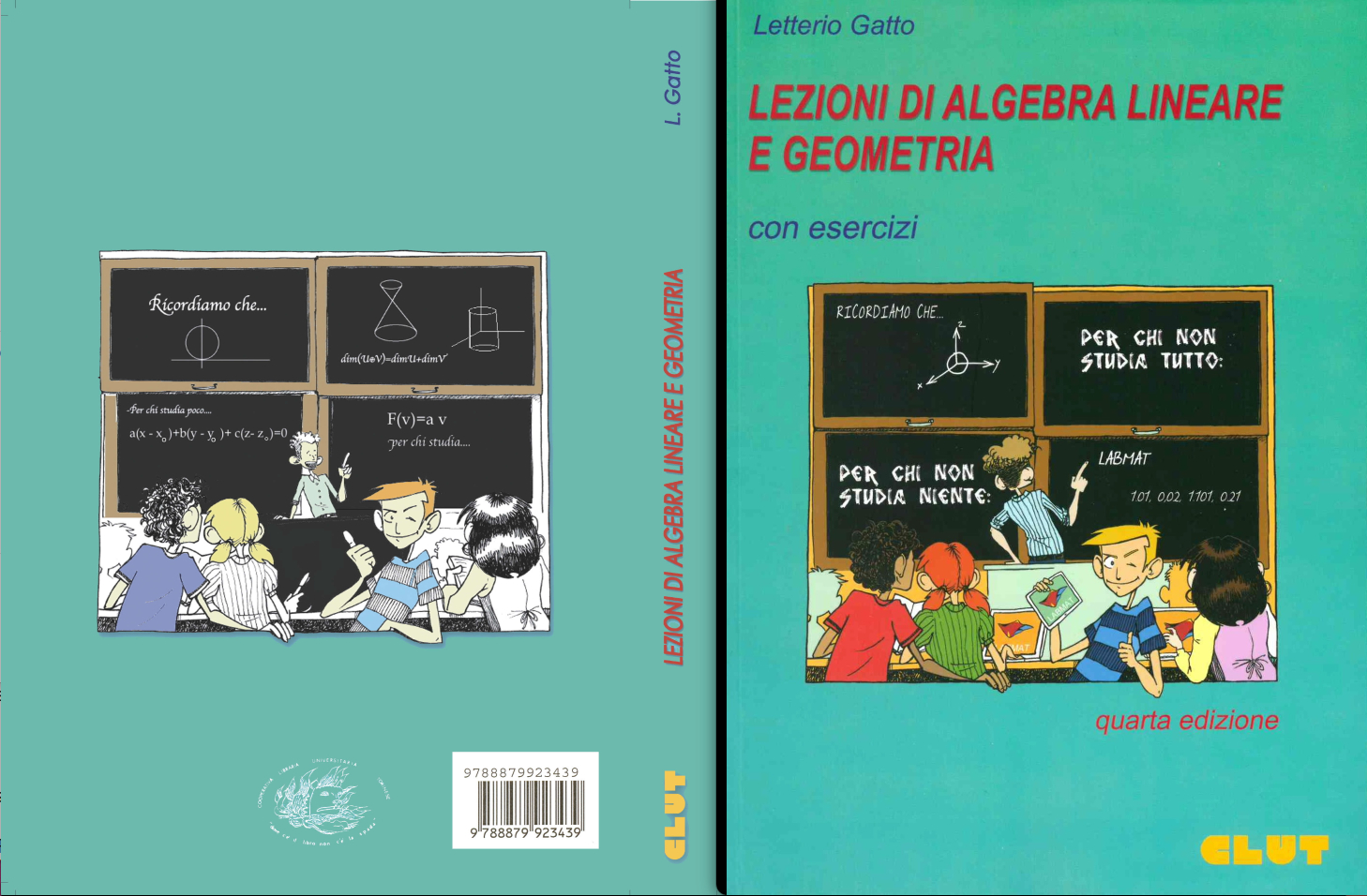
Letterio Gatto is a Tenured Associate Professor in the Department of Mathematical Sciences (DISMA) at Politecnico di Torino, Italy. His research focuses on algebraic geometry, commutative algebra, and their connections to mathematical physics. He has held visiting positions at Brazilian institutions including Fundação de Amparo à Pesquisa do Estado de São Paulo (FAPESP) and Conselho Nacional de Desenvolvimento Científico e Tecnológico. Gatto has been actively involved in international collaborations, particularly between Italy and Brazil, and has received several research awards including the Collectanea Mathematica's Distinguished Paper Award. His educational background includes a Laurea in Matematica from Università di Torino (1987, 110/110 e Lode), a Dottorato di Ricerca in Matematica from Consorzio Universitario Torino-Genova (1988-1992), a Visiting Ph.D. student position at Boston University (January-June 1990), and a Postdoc at Rijkuniversiteit te Utrecht (1994-1995) with a NATO fellowship. Gatto's research spans several interconnected areas in mathematics. His primary focus is on the application of Hasse-Schmidt derivations on exterior algebras to symmetric polynomials and Schubert calculus. He investigates vertex operators in Heisenberg's vertex algebra and their connections to bosonic and fermionic representations of infinite-dimensional Lie algebras. His work also extends to Wronskians and ordinary differential equations with indeterminate coefficients, as well as families of special Weierstrass points on complex algebraic curves. These research threads converge in his development of the theory of Hasse-Schmidt Derivations on Exterior Algebras (HiDEAs). Gatto's recent publications demonstrate a consistent focus on algebraic structures related to exterior algebras and their applications. His work bridges commutative algebra, representation theory, and algebraic geometry. A notable trend is the exploration of connections between Grassmann algebras, Clifford algebras, and Lie algebra representations. His research has increasingly incorporated vertex operator techniques and their applications to Schubert calculus. The collaborative nature of his work is evident through partnerships with mathematicians across Europe and the Americas. His major awards include: Collectanea Mathematica's Distinguished Paper Award (2022) MARM AWARD (Mentoring African Research in Mathematics) by London Mathematical Society Cientista Visitante fellowship from FAPESP (multiple periods) Gatto has served on PhD committees at Università degli Studi di Torino for multiple cycles (32nd-34th). He has been a scientific responsible for the MARM Partnership project (2024-2025) between Politecnico di Torino and University of Lubumbashi. His grant activities include the MARM program (2020-2022) mentoring mathematics research at the University of Namibia. He has organized several international meetings including 'Mathematics Building Partnership with Africa' (2023) and 'A Fall Meeting in Algebraic Geometry and Related Topics' (2017). Gatto is part of the 'Algebraic, Computational and Differential Geometry' research group at DISMA and has been an active peer reviewer for numerous mathematical journals.
Giovanni Stagliano' is an Associate Professor of Geometry at the Department of Mathematics and Computer Science, University of Catania. He specializes in algebraic geometry with computational aspects, focusing on classification problems related to Cremona transformations and rationality questions of smooth projective varieties, including cubic fourfolds, Gushel-Mukai fourfolds, and complete intersections of three quadrics in P^7. His work also addresses tensor rank in real algebraic geometry and algorithmic implementations for resultants, discriminants, and hyperdeterminants. Research interests include complex algebraic geometry, computational algebra, and tensor analysis. He leads the PRIN 2022 project "Unirationality, Hilbert schemes, and singularities" (funded by MUR with ~€165,000). Teaches in Mathematics Master's and Computer Engineering Bachelor's programs; member of the CT-ME-PA Mathematics PhD board.
Annamaria Montanari is a Full Professor at the Department of Mathematics, University of Bologna, where she has worked since 2016. Her research focuses on Mathematical Analysis, particularly degenerate elliptic partial differential equations and Sub-Riemannian geometric structures. University of Bologna (1998-present) Ph.D. in Mathematics (University of Bologna, 1998) Visiting positions at Temple University, MSRI Berkeley, Pittsburgh University, ETH Zurich Her research explores: Regularity theory for Levi curvature equations Viscosity solutions in complex geometry Sub-Riemannian metrics and cut loci Optimal transport with non-quadratic costs Recent publications demonstrate expertise in: Geometric PDEs Convexity on Carnot groups Harnack inequalities in quasi-metric spaces Transport equations and conservation laws She supervises doctoral students and collaborates on international projects, serving as Editor-in-Chief of the Bruno Pini Mathematical Analysis Seminar journal.
Alberto Raffero is an Associate Professor at the University of Turin, specializing in Differential Geometry and related fields. His research focuses on geometric structures such as G2-manifolds, SU(3)-structures, and calibrated geometries, with applications to mathematical physics and supersymmetry. He has published on topics including gradient maps on probability measures, conformal calibrated G2-manifolds, and coupled SU(3)-structures. He has actively participated in academic events, organizing workshops like the Informal Geometry Workshop in 'Paradiso' (2018) and speaking at conferences such as Geometry Meets Strings (2024) and the MGT²: Milano-Grenoble-Torino Meeting in Geometry and Topology (2023). His seminars cover advanced topics like closed G₂-structures, Laplacian solitons, and potential theory in calibrated geometry. No scientific awards are listed in the provided materials. His work integrates pure geometric analysis with interdisciplinary connections to theoretical physics, particularly in supersymmetric frameworks.
Mima Stanojkovski is an Assistant Professor at the Department of Mathematics, University of Trento. Her research focuses on group theory, algebra, and their applications in coding theory and cryptography. She teaches courses such as Algebra B, Statistics for Data Science, and Teoria dei Gruppi, emphasizing foundational concepts in abstract algebra and their practical implications. Teaching Responsibilities: Algebra B (Department of Mathematics) Statistics for Data Science (Department of Sociology and Social Research) Teoria dei Gruppi (Department of Mathematics) Research Interests: Mima's work centers on geometric and combinatorial aspects of finite groups, modular group algebras, and cryptographic applications of algebraic structures. She explores topics such as independence complexes, rank-metric codes, and pro-p group constructions. Her recent publications address conjectures in coding theory and security analyses of homomorphic encryption schemes. Grants & Collaborations: No grants or collaborative projects explicitly listed in the provided text. Labs/Teams: No specific lab affiliations or research teams mentioned.
Marco Andreatta is a Full Professor of Geometry at the University of Trento's Department of Mathematics, Faculty of Science. He earned his Ph.D. in Mathematics from the University of Trento in 1981 with highest honors. His academic career includes positions as Researcher (1983-1987), Associate Professor (1987-2000), and Full Professor (since 2000). He has held visiting professorships globally, including at the University of Notre Dame, Max-Planck Institute, and MSRI Berkeley. Research Interests: Andreatta specializes in algebraic geometry, focusing on classification of projective varieties, minimal models, Mori theory, and adjunction theory. His work extends to complex differential geometry, topology, and the philosophy of space. Since the 2000s, he has actively researched science communication, exploring mathematics' societal role through books and public engagement. Publications & Research: His 60+ publications emphasize birational geometry and higher-dimensional varieties. Recent works analyze Fano varieties, geometric contractions, and historical/theoretical intersections in mathematics. He frequently contributes to interdisciplinary topics linking geometry with art, history, and education. Awards & Leadership: Corresponding Member, Accademia delle Scienze di Torino (2014) Ordinary Member, Accademia Roveretana degli Agiati (2014) Finalist, Premio Nazionale di Divulgazione Scientifica (2022) Andreatta directs the Centro Internazionale di Ricerche Matematiche (CIRM) and has led the Department of Mathematics (2018-2021), the Faculty of Science (2004-2008), and the Trento Science Museum. He coordinates national research projects (PRIN) and advises doctoral students. Outreach: He authors popular science books (e.g., La Forma delle Cose , Archimede, l’arte della misura ) and lectures at festivals globally on mathematics' cultural and practical impact.