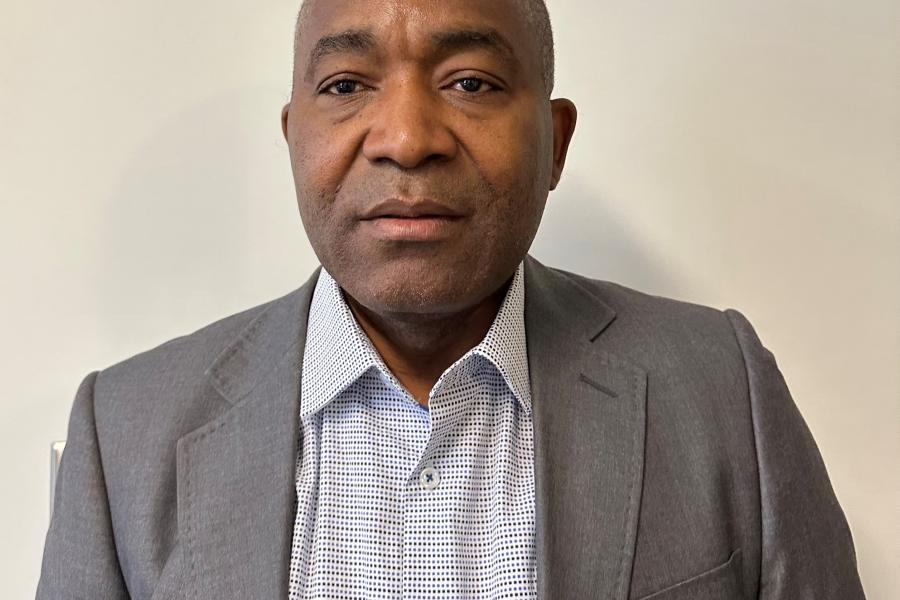
Dr. Mark Tachie is a Full Professor in the Department of Mechanical Engineering at the University of Manitoba's Price Faculty of Engineering. He holds a B.Sc. from Kwame Nkrumah University of Science and Technology (1993), M.Sc. (1998), and Ph.D. (2001) from the University of Saskatchewan. His research focuses on experimental fluid dynamics, particularly turbulent shear flows, boundary layers, and bluff body hydrodynamics. He operates a state-of-the-art lab with stereoscopic PIV and tomographic PIV systems. Notable awards include the 2010 Rh Award and Governor General's Gold Medal for academic excellence. Research interests include turbulent boundary layers, free surface flows, and flow separation phenomena. His work addresses industrial and environmental challenges like fish migration hydraulics and ice-jam dynamics. He has over 300 peer-reviewed publications and served as Associate Editor of the ASME Journal of Fluid Engineering (2010–2017) and Associate Head of the Mechanical Engineering Department (2011–2019). Key contributions include studies on wake dynamics of submerged cylinders, twin jets, and flow interactions with complex geometries. His lab's advanced PIV systems enable detailed turbulence visualization and analysis. Current projects explore turbulence modification in spillways and ice-covered flows, aiming to improve fish passage and environmental flow management.
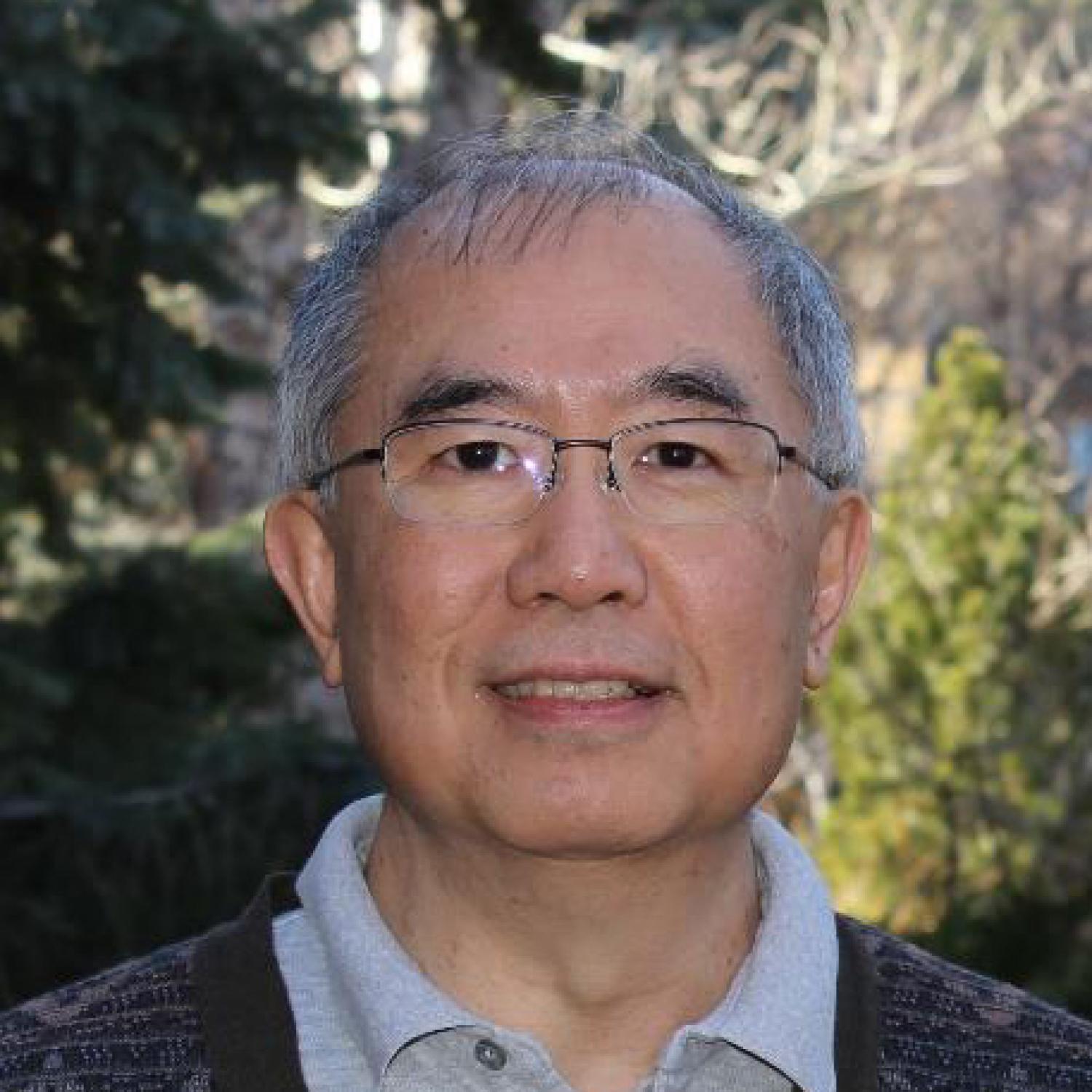
Ronald Y. S. Pak is a Professor in the Department of Geotechnical Engineering & Geomechanics at the University of Colorado. He holds the position of Professor in the School of Civil, Environmental and Architectural Engineering. His research focuses on geotechnical earthquake engineering, dynamic soil-structure interaction, wave propagation, and constitutive modeling in porous media. Education: Ph.D., California Institute of Technology, Pasadena (1985) M.S., California Institute of Technology, Pasadena (1980) B.E., McMaster University, Canada (1979) Research Interests: Dynamic soil-structure interaction and wave propagation in geotechnical systems Rock mechanics under dynamic and cyclic loading conditions Poroelasticity and boundary element methods for multi-layered media Seismic response of structures and canyons to oblique ground motion Experimental and analytical modeling of geotechnical systems Key Contributions: Development of advanced computational frameworks for soil-structure interaction Studies on water weakening mechanisms in saturated rocks Analysis of seismic amplification effects in complex topographies Awards & Affiliations: NSF Presidential Young Investigator (1985) Association of Professional Engineers Gold Medal, Ontario, Canada Editorial Board Member, ASCE Journal of Engineering Mechanics Member, American Society of Civil Engineers Facilities & Location: Office: ECOT 423, University of Colorado Contact: 303-492-8613 | pak@colorado.edu
Dr. Christopher Green is an Assistant Professor of Applied Mathematics at Wichita State University's Fairmount College of Liberal Arts and Sciences, Department of Mathematics, Statistics & Physics. He holds a PhD from Imperial College London (supervised by Prof. Darren Crowdy) and has held postdoctoral positions at the University of California San Diego and Queensland University of Technology. Previously, he served as a Lecturer in Applied Mathematics and ARC DECRA Fellow at Macquarie University in Sydney, Australia. His research focuses on computational and applied complex analysis, particularly in multiply connected domains. Key interests include the Schottky-Klein prime function, ideal fluid mechanics, and free boundary problems. His work bridges classical function theory with modern computational methods. Recent publications emphasize fluid dynamics applications such as Hele-Shaw bubble dynamics, harmonic measure computations, and airfoil potential flow. His research has been published in high-impact journals across applied mathematics and fluid mechanics. Christopher Green has received the ARC DECRA Fellowship, a prestigious early-career award. His advising and grants include contributions to computational methods in complex analysis and fluid dynamics. He maintains active collaborations internationally, leveraging both theoretical and numerical approaches to geometrically complex problems.
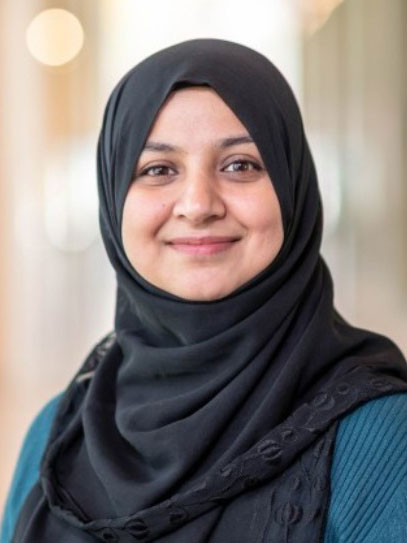
Qurat-ul-Ain Azim is an Assistant Teaching Professor in the Department of Mechanical and Industrial Engineering at Northeastern University. She holds a PhD in Mathematics from Imperial College London (2016). Her research focuses on fluid dynamics, mathematical modeling in biomedical contexts, porous media applications, and heat transfer in complex fluid systems. Dr. Azim's work spans theoretical and applied studies, including computational models for biomedical systems like breast cancer epidemiology and renal tubule dynamics. She also investigates non-Newtonian fluid flows (e.g., Jeffery, PTT, and Oldroyd fluids) in engineering and biological settings. Her contributions address challenges in porous medium analysis, thin film coatings, and peristaltic pumping mechanisms. Her publications highlight interdisciplinary applications of fluid mechanics, with recent work emphasizing disease modeling and porous media interactions. Collaborative projects involve biomedical engineering, polymer rheology, and thermal analysis of fluid systems. While no specific awards or grants are listed, her extensive publication record reflects continuous engagement with cutting-edge research in applied mathematics and mechanical engineering.
Olga Turanova is an Assistant Professor in the Department of Mathematics at Michigan State University (MSU). Her research focuses on nonlinear partial differential equations (PDEs), reaction-diffusion systems, free boundary problems, optimal transport, and numerical analysis. She is currently supported by the NSF grant DMS-2204722. Her work bridges theoretical mathematics with applications in biology and engineering. Key areas of investigation include tumor growth models, chemotaxis dynamics, and robotic swarm coverage optimization. She actively contributes to the analysis of incompressible limits, nonlocal equations, and multi-agent control systems. Research outputs span topics from mathematical biology to fluid dynamics, with recent emphasis on nonlocal diffusion phenomena and inhomogeneous tissue growth models. Turanova maintains an active presence in the academic community through her arXiv preprints and Google Scholar profile. Her grants and collaborations reflect interdisciplinary interests, integrating analytical rigor with computational methods to address complex systems in natural and engineered environments.
Michal Kalkowski is an Associate Professor at the University of Southampton's Institute of Sound and Vibration Research (ISVR). His research focuses on structural wave and vibration analysis for non-destructive testing, material characterization, and infrastructure monitoring. He develops advanced modeling tools and signal processing techniques for applications in nuclear energy, aerospace, and water industries. Current projects include weld inspection through ultrasound-based 'weld map tomography' and leak detection in buried pipes using distributed acoustic sensing. He is Editor of the Journal of Sound and Vibration and Co-chair of the UK Acoustics Network UKAN+. Education: MEng in Control Engineering & Robotics (AGH University, Krakow), PhD in Structural Wave Applications (ISVR, 2010). Postdoctoral work included EPSRC projects on active vibration control and underground structure interrogation. Served as H2020 ADVISE project researcher at Imperial College London before returning to Southampton in 2021 as Lecturer in Dynamics. Teaching responsibilities include coordinating the Mechanics, Machines & Vibration module (joint with Harbin Engineering University), and teaching Statics/Dynamics (FEEG1002) and Fundamentals of Vibration (ISVR6141). Actively supervises four PhD students in engineering disciplines. Research highlights include: Developing numerical models for wave propagation in complex materials Pioneering weld map tomography for grain orientation analysis Advancing distributed acoustic sensing for infrastructure monitoring AI integration for coarse-grained metal characterization Current active projects: Horizon Europe iWeld intelligent Weld inspection and EPSRC Core Equipment grants.
Jay Walton is a Professor in the Department of Mathematics at Texas A&M University. His research focuses on applied mathematics with applications in biomechanics, fracture mechanics, and computational modeling. He received the 2010 Association of Former Students Teaching Award for his educational contributions. His current research explores mathematical modeling of biological systems, including biochemical reaction networks, cellular iron trafficking, and fluid dynamics. Work integrates advanced computational methods to address complex biological questions with sparse data constraints.
Jörg G. Werner is Assistant Professor of Mechanical Engineering and Materials Science & Engineering at Boston University, where he directs the Mesostructured Materials and Devices (MeMaD) Laboratory. His research develops novel fabrication methods for functional nanostructured materials with applications in energy storage, coatings, and sustainability technologies. Education includes: Ph.D. from Cornell University (2015) Research focuses on: Bottom-up assembly of nano/micro-structured materials Block copolymer self-assembly for ordered mesostructures Electrodeposition of functional polymer coatings Phase separation strategies for architected electrodes Design of mesostructured energy storage systems Recent work emphasizes electrodeposited conformal coatings, nanostructured organogels, and block copolymer-derived functional materials. Key trends include innovation in energy storage architectures and sustainable material design. Awards and honors: DARPA Young Faculty Award (2023) emc2 Young Investigator Award (2013) Howard Neal Wachter Memorial Prize (2014) Leads the MeMaD Lab with focus on interdisciplinary approaches to materials design through controlled self-assembly processes.
Nicholas Ouellette is a Professor of Civil and Environmental Engineering at Stanford University, specializing in complex systems far from equilibrium. His research emphasizes dynamical self-organization across disciplines like fluid dynamics, granular media, and collective animal behavior. He holds a Ph.D. in Physics from Cornell University (2006), an M.S. in Physics (2005), and a B.A. in Physics and Computer Science from Swarthmore College (2002). Prior to Stanford, he was on the faculty at Yale University’s Mechanical Engineering and Materials Science department from 2008-2015. He has received teaching awards at both institutions. His work spans experimental and theoretical studies of turbulence, granular erosion, insect swarms, and urban dynamics. Current research includes sediment transport in turbulent flows, collective behavior in bird flocks, and urban street network analysis. He leads the Environmental Complexity Lab and collaborates on projects involving ocean mixing instrumentation and computational modeling of complex systems. Research interests include turbulent flows in fluids, particle transport dynamics, granular bed erosion mechanics, and quantitative analysis of animal collective motion. Techniques employed range from particle tracking velocimetry to machine learning for free-surface reconstruction. Ouellette’s recent work explores interdisciplinary connections between physics and urban systems, such as pedestrian access optimization in suburban layouts and the interplay of multiple environmental stressors in policy modeling. Notable contributions include studies on midge swarm mechanics, jackdaw flock kinematics, and the application of spectral analysis to energy transfer in turbulence. His lab develops advanced measurement systems for oceanographic studies and applies network theory to environmental and urban systems analysis. Ouellette maintains active collaborations across engineering, biology, and policy domains.
Prof. Jörg Seume is the Executive Director of the Institute of Turbomachinery and Fluid Dynamics at Leibniz University Hannover (Faculty of Mechanical Engineering). He also serves as Spokesperson of the Collaborative Research Centre (CRC) 871 'Regeneration of Complex Capital Goods' and holds roles in the Leibniz Research Centre Energy 2050. His research focuses on turbomachinery, fluid dynamics, gas turbine technology, and aerodynamics. Education details are not explicitly provided, but his academic and professional trajectory indicates expertise in mechanical engineering and fluid dynamics. Research interests include compressor and turbine design, aeroelasticity, aeroacoustics, and energy systems (e.g., PEM fuel cells, organic Rankine cycles). Recent publications (2023-2024) emphasize numerical simulations of turbine and compressor performance, aeroacoustic scaling, labyrinth seal dynamics, and innovations in hydrogen and fuel cell systems. He leads experimental and computational projects, including wind tunnel tests and fluid dynamics modeling. Notable projects include the WiValdi wind farm research initiative and the development of electric turbochargers for automotive applications. His work bridges academic research with industrial applications in energy and propulsion systems.
Stéphane BORDAS is a Full Professor in Computational Mechanics at the University of Luxembourg's Faculty of Science, Technology and Medicine (FSTM), leading the Computational Mechanics (Legato) research group. His work focuses on free boundary problems, method development for complex geometries, and applications in fracture mechanics, biomechanics, and computational engineering. He previously held roles at Cardiff University and the Swiss Federal Institute of Technology in Lausanne (EPFL). His research integrates computational methods like XFEM, isogeometric analysis, and meshfree techniques to address challenges in engineering and medicine. Education: Ph.D. in Theoretical and Applied Mechanics, Northwestern University (2003) M.Sc. in Civil Engineering, École Spéciale des Travaux Publics and Northwestern University (1999) Research Interests: Computational Mechanics, Biomechanics, Finite Element Methods, Fracture Mechanics, High-Performance Computing, Isogeometric Analysis. Grants & Projects: ERC Starting Grant (RealTCut) for surgical simulation and material cutting FP7 ITN INSIST for meshless methods Labs/Teams: Computational Mechanics (Legato) Group at the University of Luxembourg. His work bridges academia and industry, with applications in aerospace, biomedical engineering, and materials science. He is active in open-source software development, including codes for XFEM, isogeometric analysis, and meshfree methods.
Professor Katherine Dobson is a Reader in Geomaterials and Imaging at the University of Strathclyde, jointly appointed in Civil & Environmental Engineering and Chemical & Process Engineering. She joined Strathclyde in 2019 as a Chancellor’s Fellow and has since held various academic roles. Her research focuses on the behavior and evolution of natural and man-made materials using advanced imaging techniques like X-ray computed tomography (CT) and real-time 4D imaging. These methods enable non-destructive analysis of material microstructures under dynamic conditions, such as thermal, mechanical, or chemical changes. Education: Doctor of Philosophy (2007): Specializing in thermochronometry of igneous provinces Bachelor of Science (2001): Natural Sciences (Earth Science & Physics) Research Interests: Multi-phase flows and rheology in complex fluids Pore-scale controls on slope stability for infrastructure resilience Diffusion and bubble growth in silicate melts In situ deformation of composite materials Sustainable resource management and environmental remediation Grants & Projects: EPSRC-funded IM3AGES Facility (2024–2027): Multi-scale imaging for engineering and environmental sustainability NERC Training Courses in 3D/4D X-ray CT imaging (2023–present) Studies on enzyme-induced carbonate precipitation for subsurface CO 2 storage Labs & Equipment: Leverages state-of-the-art facilities including synchrotron-based XCT systems and high-pressure/temperature experimental setups. Collaborates on projects involving soil health, geothermal energy, and bio-cementation technologies.
Sara Grundel is a leading researcher at the Max Planck Institute for Dynamics of Complex Technical Systems in Magdeburg, Germany. Her work focuses on computational methods in systems and control theory, particularly in model order reduction, gas network simulation, and optimization of energy systems. Education: Diplom in Mathematics, ETH Zurich (2005) PhD in Mathematics, Courant Institute of Mathematical Sciences, New York University (2011) Research Interests: Sara’s research encompasses mathematical control theory, stability analysis, and numerical methods for differential-algebraic equations. She applies these techniques to gas and energy networks, epidemic modeling, and multi-agent systems. Her interdisciplinary work bridges computational mathematics with real-world engineering and public health challenges. Recent Publications: Her 15 most recent articles (2024–2012) demonstrate expertise in parametrized PDEs, model reduction for coupled systems, and control strategies for SARS-CoV-2 containment. Key subtopics include adaptive meshing, stability-preserving algorithms, and optimization of nonlinear network dynamics. Scientific Contributions: Developed clustering-based model reduction techniques for networked systems Investigated hyperbolic discretization methods using Riemann invariants Advanced polynomial root radius optimization with affine constraints Collaborations: Sara frequently collaborates with researchers like Peter Benner and Martin Gersen on energy grid simulations and control theory. She participates in international conferences (GAMM, IEEE CDC, MTNS) and contributes to edited volumes in applied mathematics.
Patrick Le Tallec is a Professor of Mechanics at École Polytechnique in France, where he currently serves as Dean of the Bachelor Program and is a member of the M3DISIM project. His distinguished academic career spans multiple institutions including Université Paris Dauphine, INRIA (French National Institute for Research in Digital Science and Technology), and international universities such as Stanford University, University of Wisconsin, and Shanghai Jiao Tong University. He has held leadership positions including Vice President for Education and Head of the Laboratory of Solid Mechanics at École Polytechnique. His educational background includes: Graduate from École Polytechnique Ph.D. in Engineering Mechanics from The University of Texas at Austin (1980) Thèse d'Etat in Applied Mathematics from Université Pierre et Marie Curie in Paris (1981) Professor Le Tallec's research focuses on computational mechanics and applied mathematics with expertise in nonlinear mechanics, domain decomposition methods, and multiscale modeling. His work bridges theoretical mathematics with practical engineering applications, particularly in material science and fluid-structure interactions. He has developed advanced numerical methods for elasticity, viscoelasticity, and fluid dynamics with applications in industrial manufacturing and biomedical engineering. His recent publications demonstrate progression from foundational numerical methods to sophisticated multiscale approaches addressing complex engineering challenges in material science. The research shows particular emphasis on rubber mechanics, fatigue analysis, and computational methods for nonlinear structures, reflecting his ongoing commitment to solving real-world engineering problems through mathematical innovation. His scientific honors include: CISI award in Scientific Computing Prize Blaise Pascal of the French Academy of Sciences Chevalier des Palmes Académiques Chevalier de la Légion d'Honneur Officier de l'Ordre National du Mérite Professor Le Tallec has directed over 40 Ph.D. students from 10 different nationalities, demonstrating significant impact in academic mentoring. His research has been supported through extensive collaborations with industrial partners including Michelin, PSA Group, and Dassault Aviation, as well as scientific advisory roles at the French Alternative Energies and Atomic Energy Commission. He has served as president of the French Society of Applied and Industrial Mathematics and held editorial positions with leading journals in his field. His laboratory work centers around computational mechanics research, particularly through the M3DISIM project at École Polytechnique. His research team brings together mathematicians, engineers, and computer scientists to develop innovative solutions for complex problems in material science and structural mechanics, with applications ranging from industrial tire manufacturing to biomedical engineering.
Harald Köstler is an Associate Professor and Head of Research at the Erlangen National High Performance Computing Center (NHR@FAU) within the Department of Computer Science at Friedrich-Alexander-Universität Erlangen-Nürnberg (FAU). He leads the research group on HPC Software Design at the Chair of Computer Science 10 (System Simulation), focusing on software engineering for high-performance computing and data analytics. His research interests include: Software Engineering for HPC Code Generation for Numerical Solvers Performance Engineering on Hybrid Architectures Discontinuous Galerkin and Lattice Boltzmann Methods Multigrid Solvers and Parallel Algorithms Performance Portability across CPUs, GPUs, and FPGAs The recent publications highlight a strong trend in developing efficient, scalable, and portable simulation frameworks for complex physical systems. His work emphasizes code generation, performance optimization, and the integration of classical model-driven and data-driven approaches. Key application areas include computational fluid dynamics, geotechnical engineering, and climate modeling, often leveraging the waLBerla and ExaStencils frameworks. Harald Köstler has no listed scientific awards in the provided text. He advises students in the areas of high-performance computing, numerical methods, and software engineering for scientific applications. His research is supported by collaborations within the FAU HPC ecosystem and likely involves grants related to national high-performance computing initiatives. He is a key contributor to the waLBerla framework, a block-structured, high-performance software for multiphysics simulations, and is involved with the ExaStencils project, which focuses on advanced multigrid solver generation. These frameworks form the core of his research team's efforts in scalable scientific computing.