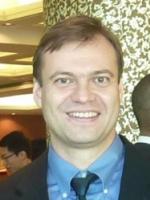
Roman Rafikov is Professor of Astrophysics at the Department of Applied Mathematics and Theoretical Physics (DAMTP) within the Faculty of Mathematics at the University of Cambridge. He has held this position since 2021, after serving as Reader in Astrophysics (2018-2021) and University Lecturer in Astrophysics (2016-2018) at DAMTP. Prior to his Cambridge appointments, he was Assistant Professor at Princeton University (2007-2015) and the Canadian Institute for Theoretical Astrophysics at the University of Toronto (2005-2007). He was also a Visiting Faculty Member at the Institute for Advanced Study in Princeton (2015-2016). Rafikov's research focuses on exoplanets (around single and binary stars; young, main sequence, and evolved stars), planet formation and dynamics, astrophysical fluid dynamics, accretion disks (protoplanetary, disks in binaries, quasars), N-body and galactic dynamics, and high-energy astrophysics. His work spans theoretical modeling of planetary systems, fluid dynamics in astrophysical contexts, and gravitational wave sources. He is a member of the Geophysical and Astrophysical Fluid Dynamics research group at DAMTP. Rafikov's recent publications demonstrate his expertise in planet-disk interactions, protoplanetary and circumbinary disk structures, gravitational wave sources in stellar clusters, and the dynamics of compact object binaries. His research combines theoretical modeling with observational constraints, particularly using data from instruments like ALMA. His work has significant implications for understanding planet formation mechanisms and the evolution of binary systems that produce gravitational waves detectable by LIGO/Virgo. Rafikov maintains active collaborations with researchers across multiple institutions and has contributed to numerous studies in leading astrophysical journals including The Astrophysical Journal and Monthly Notices of the Royal Astronomical Society.