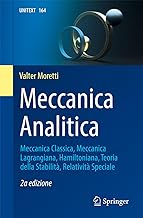
Valter Moretti is a Full Professor in the Department of Mathematics at the University of Trento. His academic career spans roles from Research Fellow to Full Professor, focusing on Mathematical Physics and Quantum Field Theory (QFT) in curved spacetime. He earned an MSc in Physics from Genova University and a PhD in Theoretical Physics from Trento University. Research Interests : Algebraic QFT, General Relativity, Quantum Mechanics, Operator Algebras, and Spectral Theory. His work bridges mathematical rigor with physical applications, particularly in quantum localization, entanglement, and curved spacetime phenomena. Publications : Authored 15+ recent papers on topics like quantum particle localization, entanglement certification, and QFT on curved backgrounds. Collaborated on a 2022 patent for generating entangled photon states. Awards : Holds a patent for a quantum-certified random number generator (2022). Supervision : Advised 8 PhD students, including N. Pinamonti, L. Franceschini, and C. van de Ven. Coordinated national and international research projects (e.g., H2020-MSCA-COFUND-2015). Labs & Collaborations : Affiliated with INFN, TIFPA-INFN, and Q@TN (Quantum@Trento). Organized conferences like Quantum Physics and Geometry (2014) and Quantum Machine Learning (2023). Teaching : Lectures on Analytical Mechanics, Quantum Relativistic Theories, and Special Relativity. Authored textbooks on Spectral Theory and Quantum Mechanics.
Luca Chiantini is a Full Professor at the University of Siena's Department of Information Engineering and Mathematical Sciences. Born in Siena in 1957, he earned his Mathematics degree from the University of Siena in 1979 and held academic positions at the Polytechnic of Turin, University of Naples, University of Rome 'La Sapienza', and others before joining the University of Siena in 1995. His research focuses on Algebraic Geometry, Commutative Algebra, and applications in Tensor Analysis and Multilinear Algebra. Chiantini's work explores projective varieties, secant varieties, Waring decompositions, and geometric complexity theory. He has authored over 100 publications, including studies on interpolation in higher codimension, Geproci sets, and Terracini loci. Education: Degree in Mathematics from the University of Siena (1979), followed by CNR grants and a Brandeis University fellowship (1982-1983). Academic roles include Department Director (2006-2012) and Dean of the Academic Board (2011-2012). Research Interests: Algebraic Geometry (e.g., projective varieties, secant varieties), Commutative Algebra (Hilbert functions, determinantal representations), and applied areas like tensor decomposition, geometric complexity, and algebraic statistics. His work bridges classical and modern algebraic geometry, with contributions to tensor rank, identifiability, and secant defectivity. Key Projects: Studies on interpolation, secant varieties, and geometric configurations. Collaborations on tensor analysis with applications in statistics and theoretical physics. Active in academic service and education, teaching advanced geometry and mathematics pedagogy.
Francesco Malaspina is a Full Professor at the Department of Mathematical Sciences (DISMA) of the Polytechnic University of Turin. His research focuses on vector bundles , projective algebraic geometry , and ACM (Arithmetically Cohen-Macaulay) bundles , particularly on varieties like quadrics, Grassmannians, and multiprojective spaces. He has contributed extensively to splitting criteria for vector bundles, cohomology properties, and moduli space classification. His work bridges abstract algebraic geometry with applications in mathematical physics and topological methods. Key research areas : Vector bundles, Ulrich bundles, instanton bundles, Castelnuovo-Mumford regularity, cohomology vanishing, projective varieties. Publications include studies on Ulrich bundles on Segre-Veronese varieties, instanton bundles on flag varieties, and cohomological properties of vector bundles. His articles often explore the interplay between algebraic structures and geometric intuition, emphasizing aesthetic-driven mathematical inquiry. Teaching spans linear algebra, geometry, and advanced topics for aerospace and pure/applied mathematics programs. He has also engaged in science communication, notably through his book Seven Simple Lessons in Mathematics; on Love, Death, Football, Meringues, and Geometry , which connects abstract math to humanistic themes.
Maria Chiara Brambilla is an Associate Professor in the Department of Industrial Engineering and Mathematical Sciences (DIISM) at Università Politecnica delle Marche, Faculty of Engineering. Her research specializes in algebraic geometry, with emphasis on moduli spaces, vector bundles, and secant varieties. She investigates fundamental structures in birational geometry and interpolation theory, contributing to advancements in the classification of geometric objects and their deformations. Research Focus: Her work explores: Birational properties of Mori dream spaces and blowups Defectivity and non-defectivity in Segre-Veronese varieties Terracini loci and their minimality conditions Geometric invariants of flag manifolds and hypersurfaces Algebraic boundaries in tensor rank theory Publication Trends: Recent articles (2021-2025) demonstrate deepening work on Terracini loci, twistor geometry, and movable divisors, frequently employing combinatorial and deformation-theoretic methods to resolve problems in higher-dimensional algebraic geometry.
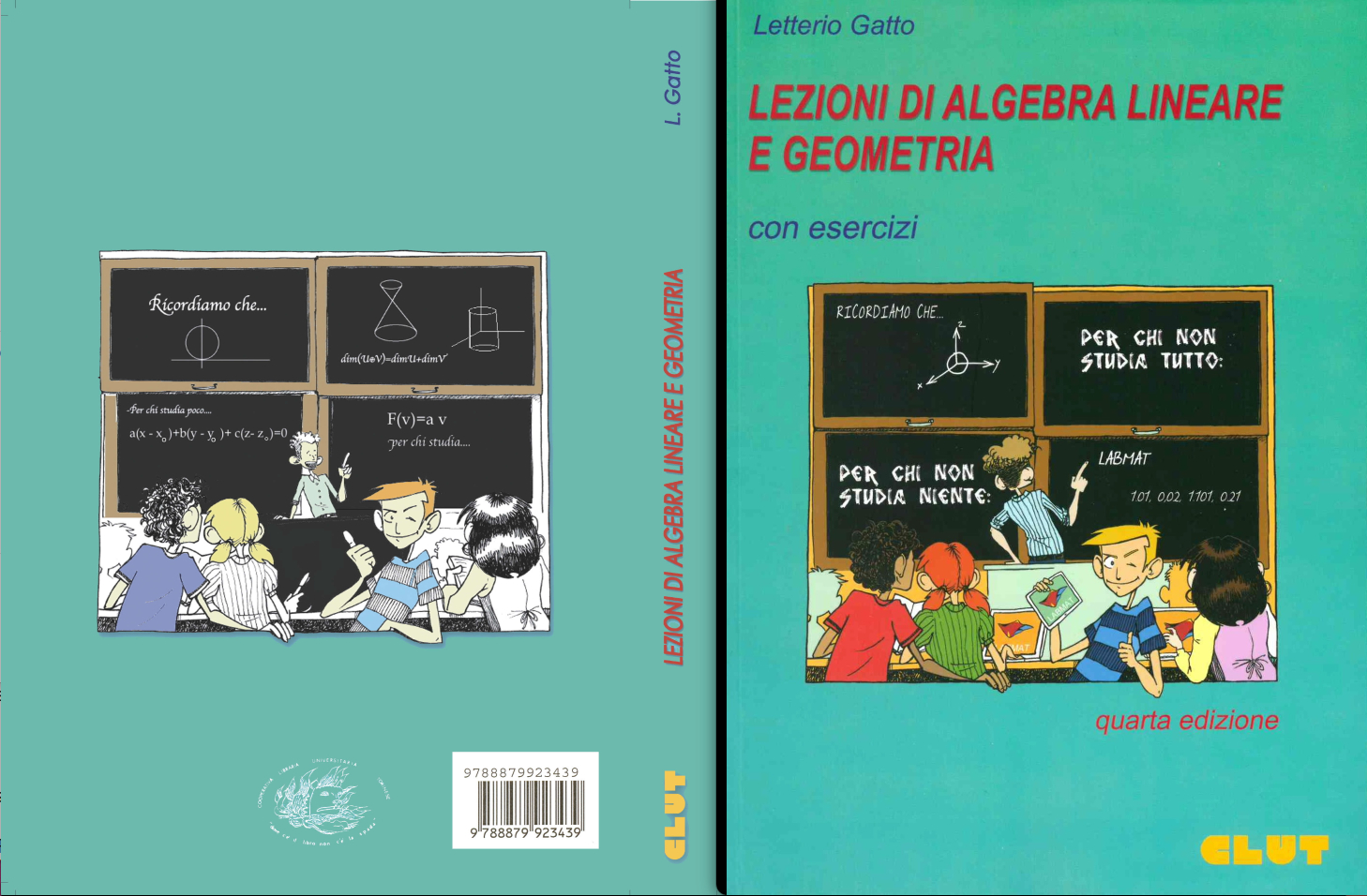
Letterio Gatto is a Tenured Associate Professor in the Department of Mathematical Sciences (DISMA) at Politecnico di Torino, Italy. His research focuses on algebraic geometry, commutative algebra, and their connections to mathematical physics. He has held visiting positions at Brazilian institutions including Fundação de Amparo à Pesquisa do Estado de São Paulo (FAPESP) and Conselho Nacional de Desenvolvimento Científico e Tecnológico. Gatto has been actively involved in international collaborations, particularly between Italy and Brazil, and has received several research awards including the Collectanea Mathematica's Distinguished Paper Award. His educational background includes a Laurea in Matematica from Università di Torino (1987, 110/110 e Lode), a Dottorato di Ricerca in Matematica from Consorzio Universitario Torino-Genova (1988-1992), a Visiting Ph.D. student position at Boston University (January-June 1990), and a Postdoc at Rijkuniversiteit te Utrecht (1994-1995) with a NATO fellowship. Gatto's research spans several interconnected areas in mathematics. His primary focus is on the application of Hasse-Schmidt derivations on exterior algebras to symmetric polynomials and Schubert calculus. He investigates vertex operators in Heisenberg's vertex algebra and their connections to bosonic and fermionic representations of infinite-dimensional Lie algebras. His work also extends to Wronskians and ordinary differential equations with indeterminate coefficients, as well as families of special Weierstrass points on complex algebraic curves. These research threads converge in his development of the theory of Hasse-Schmidt Derivations on Exterior Algebras (HiDEAs). Gatto's recent publications demonstrate a consistent focus on algebraic structures related to exterior algebras and their applications. His work bridges commutative algebra, representation theory, and algebraic geometry. A notable trend is the exploration of connections between Grassmann algebras, Clifford algebras, and Lie algebra representations. His research has increasingly incorporated vertex operator techniques and their applications to Schubert calculus. The collaborative nature of his work is evident through partnerships with mathematicians across Europe and the Americas. His major awards include: Collectanea Mathematica's Distinguished Paper Award (2022) MARM AWARD (Mentoring African Research in Mathematics) by London Mathematical Society Cientista Visitante fellowship from FAPESP (multiple periods) Gatto has served on PhD committees at Università degli Studi di Torino for multiple cycles (32nd-34th). He has been a scientific responsible for the MARM Partnership project (2024-2025) between Politecnico di Torino and University of Lubumbashi. His grant activities include the MARM program (2020-2022) mentoring mathematics research at the University of Namibia. He has organized several international meetings including 'Mathematics Building Partnership with Africa' (2023) and 'A Fall Meeting in Algebraic Geometry and Related Topics' (2017). Gatto is part of the 'Algebraic, Computational and Differential Geometry' research group at DISMA and has been an active peer reviewer for numerous mathematical journals.
Romeo Brunetti is an Associate Professor of Mathematical Analysis at the Department of Mathematics, University of Trento. His academic career includes roles such as 'Rientro dei Cervelli' fellow (2006–2010) and research positions at the University of Naples and the DFG (Germany). He specializes in foundational aspects of classical and quantum field theories, with a focus on quantum gravity, algebraic structures in QFT, and relativistic systems. Education: Bachelor’s Degree in Physics, University of Rome 'La Sapienza' (supervised by Prof. Marzio Cassandro and Prof. G. Parisi). PhD in Physics, University of Naples 'Federico II' (supervised by Prof. G. Marmo and Prof. R. Longo). Research Interests: His work explores perturbative quantum gravity, Bose-Einstein condensation in relativistic QFT, quantum spacetime coordinates, nonlinear dynamics in field theories, and classical relativistic scalar fields. He emphasizes rigorous mathematical approaches to quantum field theories in curved spacetimes. Publications: His articles span topics like renormalization in algebraic QFT, quantum gravity models, and time observables in quantum mechanics. The most recent studies address thermodynamic aspects of fermions and covariant approaches to effective quantum gravity. Awards: Featured Review in Mathematical Reviews (MR1736329). Conferences & Committees: Co-organized major events including 'Recent Mathematical Developments in Quantum Field Theory' (Oberwolfach, 2016) and 'Advances in Mathematics and Theoretical Physics' (Accademia dei Lincei, 2017). Active in promoting interdisciplinary dialogue between mathematics and physics. Labs/Teams: Collaborates extensively with international groups on algebraic QFT and quantum gravity, though no dedicated lab is explicitly mentioned in the text.
Giuseppe Zappalà is an Associate Professor of Geometry at the Department of Mathematics and Computer Science (DMI) of the University of Catania, Italy. He has been with the university since 1996, initially as a Researcher and promoted to Associate Professor in 2021. His academic home is firmly rooted in the University of Catania, where he completed both his undergraduate studies and PhD. His research focuses primarily on Commutative Algebra and Algebraic Geometry . More specifically, he investigates Hilbert functions of 0-dimensional subschemes of curves, arithmetically Gorenstein schemes, fat points in projective spaces, reducibility of Hilbert schemes, and Lefschetz properties. His work often bridges theoretical concepts with concrete geometric constructions. His publication record shows a consistent focus on the intersection of algebraic structures and geometric properties, with particular attention to graded algebras, Betti numbers, and special configurations of algebraic varieties. Over the years, his research has evolved from foundational work on subschemes to more specialized investigations of Gorenstein properties and Lefschetz phenomena. As an academic service contributor, Zappalà has served as a referee for national and international journals and as a reviewer for Zentralblatt MATH. He has been actively involved with the Pragmatic research school for 15 editions (1997-2012), which has trained numerous algebraic geometers from around the world. He teaches Linear Algebra and Geometry courses for both Computer Engineering and Computer Science degree programs at the University of Catania. His office hours are held Tuesday and Thursday from 10:00 to 12:00 in Studio 46, III Blocco, DMI.
Cristiano Bocci is a Full Professor at the Department of Information Engineering and Mathematical Sciences, University of Siena. His research focuses on Algebraic Geometry, Commutative Algebra, and their applications in sensor networks and statistics. He teaches courses like Computational Geometry and Analytical Geometry, and his work extends to interdisciplinary projects involving engineering and data science. Contact him at cristiano.bocci@unisi.it. Research Interests: Geometric constructions in projective spaces Hadamard products of varieties and ideals Applications of algebraic methods in sensor networks and granular material measurement Recent Trends in Publications: Over 2023-2024, Bocci has explored Hadamard products' algebraic properties, Gorenstein points in projective spaces, and sensor network designs. His work bridges pure mathematics with engineering solutions like LoRaWAN-based systems for granular material volume measurement. Grants & Advising: While specific grants aren't listed, his active publication record suggests ongoing research projects. No student advisees are explicitly mentioned. Labs/Teams: Collaborates on interdisciplinary teams applying algebraic geometry to sensor technology and data modeling.
Stefano Bonzio is an Associate Professor of Mathematical Logic at the Department of Mathematics and Computer Science, University of Cagliari, where he previously served as Assistant Professor (2021-2024). He held a Marie Curie Fellowship at the Artificial Intelligence Research Institute of the CSIC (Spanish National Research Council) and conducted postdoctoral research at the University of Turin, Polytechnic University of the Marche, Czech Academy of Sciences, and University of Cagliari. His educational background includes: PhD in Logic, University of Cagliari Master in "Logic, History and Philosophy of Science", University of Florence Bonzio's research centers on non-classical logics—particularly Kleene logics—and their algebraic foundations, with significant contributions to Algebraic Logic and Universal algebra (specializing in Plonka sums). His work bridges theoretical frameworks with practical applications in computer science, focusing on logical systems that handle partiality, inconsistency, and ignorance. This interdisciplinary approach connects mathematical structures with computational reasoning and philosophical inquiry. His recent publications (2023-2025) reveal a concentrated exploration of variable inclusion logics, residuated structures, and algebraic semantics for non-classical systems. Key themes include the structural analysis of Bochvar and McCarthy algebras, numerical semigroups, and formal models of ignorance, demonstrating consistent innovation in logical frameworks for computational and philosophical problems. Scientific recognition includes: Marie Curie Fellowship While no formal advisees are documented in available sources, Bonzio's academic trajectory indicates active mentorship through his postdoctoral collaborations. His research has been supported by prestigious European frameworks like the Marie Curie program, though specific grant details beyond this fellowship remain unreported. No dedicated laboratories or structured research teams are mentioned in current documentation, though his affiliations with multiple international institutions suggest collaborative network-based research practices.
Matteo Varbaro is a Full Professor at the Department of Mathematics (DIMA) of the University of Genova. His research focuses on Commutative Algebra and its interactions with Algebraic Geometry, Combinatorics, Topology, and Representation Theory. Teaching: Algebra 3, Commutative Algebra 2, Higher Algebra, Linear Algebra and Numerical Analysis. Contacts: matteo.varbaro@unige.it , +39 010 353 6943, Office 943, DIMA, University of Genova. His recent publications address topics like Gröbner deformations, determinantal facet ideals, singularities, Hilbert functions, and F-singularities. Collaborators include Winfried Bruns, Aldo Conca, and Anurag K. Singh. He coordinates the PhD program in Mathematics and Applications at the University of Genova and contributes to outreach initiatives like Möbiustrip, a mathematical board game for students.
Paola Bonacini is an Associate Professor in Geometry at the Department of Mathematics and Computer Science, University of Catania, since June 2021. She teaches Linear Algebra and Geometry for undergraduate engineering programs, including Electronics Engineering and Industrial Engineering. Research Interests: Focus on Discrete Mathematics (Design Theory, Voloshin colorings, Blocking Sets) and Algebraic Geometry (Lifting Problems in Codimension 2, Zero-dimensional Schemes in P1 × P1, Hilbert Functions). Scientific Awards: None explicitly mentioned. Collaborations: Active in the MATITA project and tutoring/academic orientation initiatives at the University of Catania. Publications: Over 15 recent works in journals like Discrete Mathematics , Mathematics , and Applied Mathematical Sciences , emphasizing Design Theory and Algebraic Geometry. Notable trends include equitable colorings, balancing/blocking sets for hypergraphs, and minimal free resolutions of zero-dimensional schemes. Contact: Office hours on Mondays and Fridays from 15:00–16:00 (or by appointment via Microsoft Teams). Office: Studio 41, III blocco, Viale A. Doria, 6, Catania.
Marco D'Anna is a Full Professor of Algebra at the Department of Mathematics and Computer Science, University of Catania, where he has worked since 1997. His academic career includes significant institutional roles including Head of the Master's Degree Course in Mathematics (2012-2015, 2018-2020) and Vice-director of the Department of Mathematics and Computer Science (2015-16). Dr. D'Anna earned his Mathematics degree with honors (110/110) from the University of Rome 'La Sapienza' in 1991, completed his PhD there in 1996 with a thesis on 'Canonical module of reduced rings of dimension one and their associated semigroups,' and conducted research visits at Purdue University under Professor William J. Heinzer. His research focuses on Commutative Algebra, particularly numerical semigroups, good semigroups (including value semigroups of curve singularities), one-dimensional rings, and ideal theory. He has published 43 scientific papers and a monograph, and has been scientific organizer of multiple international meetings including INdAM workshops in Cortona and Rome. As an educator, Professor D'Anna teaches Algebra and Commutative Algebra courses for both undergraduate and graduate Mathematics programs. He has supervised numerous bachelor's and master's theses (with four winning the Anile Prize in 2009, 2012, 2016, and 2022), advised eight PhD students to successful completion, and currently mentors one PhD student. Premio di Laurea 'Angelo Marcello Anile' for student theses (2009, 2012, 2016, 2022) Socio corrispondente residente of Acccademia Gioenia di Catania (2022) Professor D'Anna serves as coordinator of the Laboratory in Commutative Algebra and Algebraic Geometry and has been Principal Investigator for the local research project 'Proprietà locali e globali di anelli e varietà algebriche' (PIACERI 2020-22), while also participating in the national PRIN 2020 project 'Squarefree Gröbner degenerations, special varieties and related topics.' Since 2015, he has organized the Algebra and Algebraic Geometry seminar series at the University of Catania.
Ada Boralevi is an Associate Professor in the Department of Mathematical Sciences "G. L. Lagrange" (DISMA) at Politecnico di Torino, Italy. She is a prominent researcher in algebraic geometry, specializing in vector bundles, tensor decomposition, determinantal representations, and related algebraic structures. Her work bridges pure mathematics with applications in numerical analysis, mathematical physics, and computational algebra. PhD in Mathematics, University of Florence, 2008 MA in Mathematics, UCLA, 2006 Laurea in Mathematics, University of Florence, 2004 Her research interests lie at the intersection of algebraic geometry, commutative algebra, and multilinear algebra. She investigates homogeneous vector bundles, secant varieties, constant rank matrices, and tensor decompositions, with a focus on geometric and algebraic properties. Her work often involves moduli spaces, stability conditions, and equivariant constructions. She is particularly known for her contributions to the theory of instanton bundles and determinantal representations. The analysis of her recent publications reveals a sustained focus on algebraic structures derived from matrices and tensors. Her work spans from foundational algebraic geometry (e.g., sections of homogeneous bundles) to applied topics such as uniform determinantal representations and tensor decomposition. A recurring theme is the interplay between geometry and linear algebra, especially in the context of rank constraints and symmetry. Her collaborations with leading mathematicians highlight her active role in the international research community. She is actively involved in the mathematical community through service and leadership. She is a member of the European Women in Mathematics and the Unione Matematica Italiana. She has organized numerous conferences and summer schools, including the TAGSS series, which promotes women in mathematics. She has also served on organizing committees for MEGA 2017, Vector Bundles Days, and several workshops on tensors and algebraic geometry. Ada Boralevi mentors PhD students, including Stefano Canino, and participates in the doctoral college in Pure and Applied Mathematics at Politecnico di Torino. She has secured research contracts with institutions such as SISSA, TU Eindhoven, and IMPAN. Her teaching includes undergraduate courses in linear algebra and geometry, as well as advanced PhD-level topics on spaces of matrices and their applications. She is a key organizer of algebraic geometry activities in Turin, jointly between Politecnico di Torino and the University of Turin. She co-founded the TAGSS (Trieste Algebraic Geometry Summer School) with Valentina Beorchia and Barbara Fantechi, a series of schools taught by outstanding women mathematicians. Her leadership in these initiatives underscores her commitment to education and gender equity in mathematics.
Emanuele Ventura is a fixed-term tenure-track assistant professor in the Department of Mathematical Sciences "G. L. Lagrange" (DISMA) at Politecnico di Torino, Italy. His research focuses on algebraic geometry, algebraic combinatorics, and tensor mathematics, with applications in computational algebra and complexity theory. Research Interests: Algebraic and complex geometry Discrete mathematics and combinatorics Tensors and their geometric properties Commutative and non-commutative algebra Computational aspects of algebraic geometry His recent publications (2019–2025) center on tensor rank, secant varieties, strength of polynomials, and algebraic invariants, often in collaboration with leading researchers in the field. These works appear in top journals such as Advances in Mathematics , Journal of Symbolic Computation , and SIAM Journal on Matrix Analysis and Applications , reflecting a strong trend in the intersection of algebraic geometry and computational complexity. Scientific Awards: Anile Prize (2014) He is the Scientific Director of the PRIN-funded national research project AAGT - Applied Algebraic Geometry of Tensors (2025–2027), indicating leadership in competitive research grants. He teaches undergraduate courses like Linear Algebra and Geometry for Aerospace Engineering and has served as a lecturer in the PhD program in Pure and Applied Mathematics. He is affiliated with the research group on Algebraic Geometry, Commutative Algebra, and their Computational Aspects at DISMA.
Aldo Conca serves as a Full Professor in the Department of Mathematics (DIMA) at the University of Genoa, Italy, teaching Algebra courses across Computer Science, Mathematics, and Architectural Sciences degree programs including undergraduate and graduate levels (2025-2026 curriculum codes: 73027, 118396, 25905, 90694). His research expertise spans Commutative Algebra , Algebraic Geometry , and Invariant Theory , with specialized focus on Sagbi bases, power sum ideals, invariant rings of classical groups, and combinatorial properties of maximal minors. Methodologically, he integrates computational techniques with theoretical algebraic frameworks to address structural problems in ideal theory and algebraic invariants. Recent publications (2024-2025) demonstrate consistent advancement in computational commutative algebra, particularly regarding nonunimodal h-vectors in invariant rings, V-invariant properties, and Sagbi combinatorics. His work reveals profound connections between algebraic structures and combinatorial phenomena, with significant implications for understanding geometric moduli spaces and symmetric function theory.