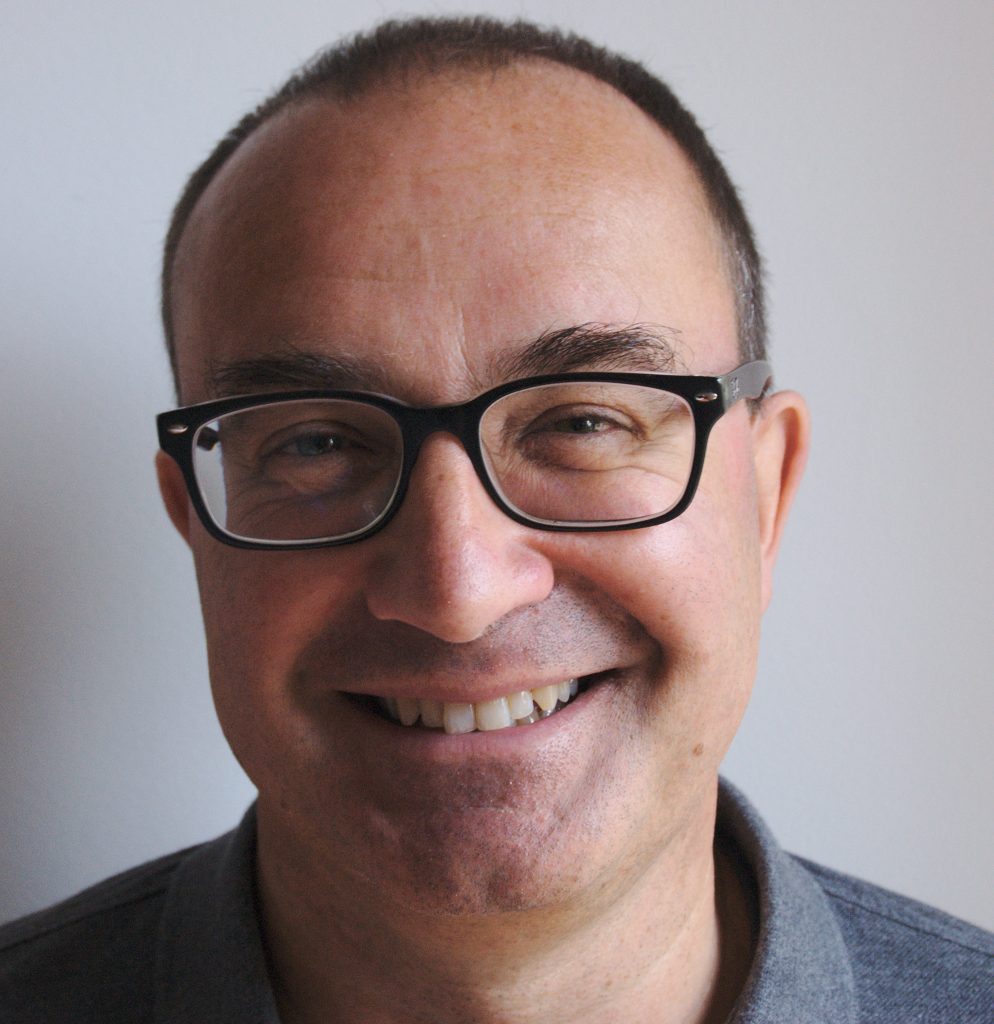
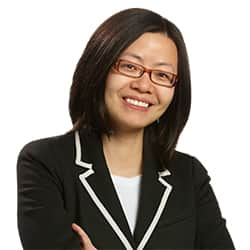
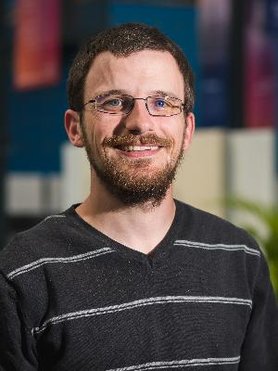
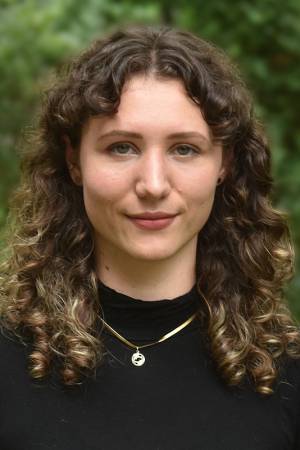
Matteo Cagnoni is a Researcher at the Department of Electronics and Telecommunications (DET) of Politecnico di Torino . His research focuses on Density Functional Theory , Quantum Chemistry , and Thermoelectric Materials for Solar Cells . He is actively involved in the European Union’s MIRACLE project , developing photonic meta-concrete for radiative cooling solutions. Research Interests: Development of cement-based radiative coolers for solar cell thermal management Computational discovery of intermediate-band solar cell materials Electronic properties of semiconductors and insulators Teaching: Electronic transport in crystalline and organic semiconductors Advanced experimental physics Scientific Contributions: Matteo has published extensively on radiative cooling, perovskite/silicon tandem solar cells, and thermoelectric materials. His work spans journals like Nature Communications , Advanced Functional Materials , and Progress in Photovoltaics , with a focus on simulation engineering , photonic devices , and energy-efficient materials . Labs & Collaborations: He works within the Microwave and Optoelectronics Group (MOG) at DET, collaborating with international institutions on EU-funded projects.
Nancy M. Wells is a Professor in the Department of Human Centered Design and serves as the Senior Associate Dean for Research and Graduate Education in the College of Human Ecology at Cornell University. Her work bridges environmental psychology and public health, examining how built and natural environments impact human health and behavior across the lifespan. Dr. Wells received a joint PhD in Psychology and Architecture from the University of Michigan and completed National Institute of Mental Health (NIMH) post-doctoral training at the University of California, Irvine. Her educational background uniquely positions her to investigate the intersection of physical environments and human wellbeing through both psychological and architectural lenses. Her research focuses on how environmental contexts—from homes to neighborhoods to schools—affect health outcomes, cognitive functioning, and resilience. A central theme examines nature's role in human resilience, particularly how natural environments buffer against adversity and challenge. She has conducted influential work on school gardens and their effects on children's physical activity, dietary habits, and learning. More recently, she has pioneered research on nature and autism, conducting a randomized controlled trial examining natural environments' effects on autistic youth wellbeing. Analysis of Dr. Wells' recent publications reveals consistent focus on nature's health benefits, with strong emphasis on experimental methodologies including randomized controlled trials and natural experiments. Her work spans environmental psychology, public health, and education, with particular attention to vulnerable populations including low-income communities and children of color. NSF Funding for environmental health research USDA Funding for school garden studies Robert Wood Johnson Foundation Funding MacArthur Foundation Funding Senior Associate Editor of Environment and Behavior (4 years) Research Advisory Board of Children and Nature Network Board of Directors for reDirect Dr. Wells actively mentors undergraduate and graduate students through the Wells Lab, involving them in all research stages from data collection to publication. Her research has been supported by multiple significant grants examining housing quality effects on mental health, neighborhood design impacts on physical activity, and school garden interventions. She leads interdisciplinary research teams that integrate perspectives from environmental psychology, public health, landscape architecture, and education. The Wells Lab operates as an integrated research-teaching-outreach unit that develops practical yet rigorous studies to assess causal relations between environment and health, creates valid measurement tools, and identifies causal pathways. Current projects include examining nature's effects on autistic youth wellbeing in partnership with The Center for Discovery in New York, and investigating multi-sensory design in urban public spaces.
David B. Lindell is an Assistant Professor in the Department of Computer Science at the University of Toronto, with affiliations to the Vector Institute and AXL. He is a founding member of the Toronto Computational Imaging Group. His research focuses on physically based intelligent sensing, integrating physical models, signal processing, and AI to advance sensing systems. Notable projects include imaging around corners, through scattering media, and developing machine learning algorithms for 3D scene reconstruction. Education: Ph.D. in Computational Imaging from Stanford University (advisor: Gordon Wetzstein). Awards include the 2024 Ontario Early Researcher Award and the Best Student Paper at CVPR 2025. His work combines computational imaging with applications in computer graphics and autonomous systems. Research interests span non-line-of-sight imaging, single-photon sensing, and neural representations. Key contributions include the Light-Cone Transform (Nature 2018), confocal diffuse tomography (Nature Communications 2020), and AutoInt (CVPR 2021). His lab develops systems for 3D reconstruction, transient imaging, and photon-efficient sensors. Selected grants and support: NSF CAREER Award, DARPA REVEAL program, and KAUST Visual Computing Center funding. Active collaborations with industry and academic institutions on autonomous driving and medical imaging applications.
Roswitha Skare is a Professor of Documentation Science at the Department of Language and Culture, UiT The Arctic University of Norway, within the Faculty of Humanities, Social Sciences and Teacher Education. She is actively engaged in research and teaching, focusing on documentation studies, public libraries, archives, museums (LAM sector), digitalization, and film history. Her research interests include: Documentation and document theory Paratext and digital documents Public libraries and their role in society Libraries and social media Migration and refugee services in libraries Film history, especially silent films and early documentaries Cultural memory and Sámi cultural resilience Institutional convergence in cultural policy Her recent publications (2019–2025) reveal a strong focus on public libraries during and after the Covid-19 pandemic, the role of libraries in supporting immigrants and refugees, theoretical developments in document studies, and historical film analysis—particularly Robert Flaherty’s Nanook of the North . She frequently collaborates with scholars such as Andreas Vårheim, Noah Lenstra, and Sigrid Stokstad. Her work appears in journals like Journal of Documentation , Library & Information Science Research , and Proceedings from the Document Academy . Roswitha Skare teaches courses such as: MDV-1001: Multimediale dokumenter: Historie, teori og analyse MDV-1203: Bibliotek og formidling MDV-1207: Dokumentinstitusjoner og digitalisering MDV-1206: Prosjektoppgave i bibliotek- og dokumentasjonsvitenskap She supervises bachelor’s, project, and master’s students in library and documentation science. She is a member of the research group Engaging Conflicts in a Digital Era (ENCODE) and participates in projects such as LAMCOM – Libraries, archives, and museums in the community and SAMCOM - Sámi cultural centers as community and cultural resilience infrastructure , which explore the societal roles of cultural institutions and Indigenous resilience. No scientific awards are listed in the provided text.
Deborah Fox is Associate Professor in Midwifery at the University of Technology Sydney (UTS), Faculty of Health, and a core member of the Centre for Midwifery, Child and Family Health. She serves as Co-lead of the Maridulu Budyari Gumal SPHERE Maternal and Women's Clinical Theme and Chair of the National Publicly Funded Homebirth Consortium. In 2024, she received the Faculty of Health Dean's Academic Excellence Award for Research (Mid Career Researcher), following her 2021 award as Highest Performing Early Career Researcher from the School of Nursing and Midwifery. Her research focuses on optimizing physiological processes and positive experiences for women with complex pregnancies, with particular emphasis on the mediation of technology in midwifery practice. Current projects include evaluation of non-invasive fetal ECG beltless and wireless fetal monitoring in labor and birth, and examining the social, economic and environmental impacts of telemonitoring and telehealth in pregnancy and postpartum care. Dr. Fox's scholarly work demonstrates consistent focus on technology's role in maternity care, women's experiences of monitoring during labor, and innovative approaches to midwifery practice. Her recent publications show increasing emphasis on digital health solutions, AI applications in women's health, and pandemic impacts on maternal care systems globally. Faculty of Health Dean's Academic Excellence Award for Research (Mid Career Researcher) 2024 Highest Performing Early Career Researcher award from School of Nursing and Midwifery 2021 Editorial Board Member, Women and Birth journal Dr. Fox is actively involved in higher degree research supervision and has developed innovative teaching resources, including an Objective Structured Clinical Examination for perinatal mental healthcare. She is scheduled to spend three months as a Visiting Scholar at the University of Oxford in 2025.
Alanson Sample is an Associate Professor in the Department of Electrical Engineering and Computer Science at the University of Michigan (since 2018), leading the Interactive Sensing and Computing Lab. His research focuses on Human-Computer Interaction, Cyber-Physical Systems, and wireless technology innovations. He holds a PhD in Electrical Engineering from the University of Washington (2011), with prior postdoctoral work there developing implantable medical devices. Before academia, Sample held senior roles at Disney Research (2013-2018) as Executive Lab Director and Principal Research Scientist, leading teams in Robotics, AI, Computer Vision, and HCI. Earlier, he worked at Intel Labs (2008-2013) on energy harvesting for wearables and IoT. Key research themes include wireless power systems, embedded sensing, and privacy-aware technologies. Over 150+ publications span topics like magnetic sensing (MagDesk), acoustic gesture recognition (HandSAW), and privacy-preserving activity tracking (PrivacyMic). His work bridges academic and industry innovation, particularly in scalable interactive systems and medical technology. Notable projects include the Quasistatic Cavity Resonance wireless charging system, RFID-based sensing platforms (WISP), and wearable health monitoring devices. His lab develops hardware-software co-design frameworks for energy-efficient embedded systems. Current research emphasizes medical applications, smart infrastructure, and ubiquitous computing interfaces.
Michele Zorzi is a Professor of Telecommunications at the School of Engineering, University of Padova, Italy, where he has held a faculty position since 2003. He leads the SIGNET (Signal processing and Networking) Research Group, focusing on cutting-edge wireless networking challenges including mmWave communications and underwater networks. His extensive publication record exceeds 600 papers in top-tier journals and conferences, reflecting significant contributions to the field through both theoretical and experimental work. He received his Laurea Degree (1990) and Ph.D. (1994) in Electrical Engineering from the University of Padova. Prior academic appointments include Politecnico di Milano (1993-1996), University of California San Diego (1995-1998), and University of Ferrara (1998-2003), where he progressed from Associate Professor to full Professor. His educational trajectory demonstrates deep roots in Italian academia with international exposure. Professor Zorzi's research spans wireless communications and networking, with current emphases on mmWave networking for vehicular systems, underwater acoustic/optical communications, non-terrestrial networks, and AI-driven networking solutions. His group conducts experimental validations including at-sea trials for underwater systems and testbeds for vehicular networks. Key projects include PRATA for predictive QoS in autonomous driving and IoT-based environmental monitoring of the Venice Lagoon, demonstrating practical applications of theoretical work. Analysis of his 2022-2025 publications reveals strong trends in applying artificial intelligence to networking challenges across diverse environments. There is significant emphasis on vehicular networks (predictive QoS, teleoperated driving), underwater systems (acoustic/optical communications, AUV swarms), and satellite networks (Starlink integration, NTN security). Experimental validation in real-world scenarios like the Venice Lagoon monitoring project and underwater sea trials characterizes his applied research approach. His scientific accolades include: IEEE Fellow (2007) IEEE Communications Society Best Tutorial Paper Award (2008, 2019) Stephen O. Rice Best Paper Award (2018) Multiple best paper awards at IEEE conferences (2005-2020) As principal investigator for numerous European and US research projects plus 20+ industry-funded initiatives, Professor Zorzi has mentored over 35 PhD students and post-docs. Graduates now hold prominent positions at institutions including Stanford, UCSD, CTTC, and Huawei. His SIGNET group maintains active international collaborations and contributes to open-source networking tools via GitHub, demonstrating commitment to community engagement. The SIGNET Research Group, housed within the Department of Information Engineering, operates specialized experimental facilities for mmWave and underwater communications. Current initiatives include AI-based predictive QoS frameworks for vehicular networks, underwater optical communication systems using ultraviolet light, and large-scale IoT deployments for environmental monitoring. The group's GitHub presence indicates strong open-science practices, while recent sea trials confirm hands-on experimental capabilities beyond theoretical work.
Jakob Foerster is an Associate Professor at the University of Oxford's Department of Engineering Science and a Supernumerary Fellow at St Anne's College. He leads the FLAIR lab, focusing on multi-agent reinforcement learning (MARL), human-AI coordination, and AI foundational research. Previously, he was a Research Scientist at Facebook AI Research (FAIR) and holds a DPhil from Oxford. His work has been cited over 5,000 times and includes seminal contributions like QMIX and the Hanabi Challenge. Research interests span compute-efficient scaling of AI, MARL applications in finance and bio, and ethical AI. He actively collaborates across academia and industry, co-organizing workshops like NeurIPS' Emergent Communication. His lab emphasizes open-ended RL, environment design, and scalable algorithms. Notable awards include the CIFAR AI Chair (2019) and NeurIPS Best Paper Runner-Up (2018). Current efforts include FLAIR's research on zero-shot coordination and the JaxMARL framework. He advises students in Oxford's Engineering DPhil and AIMS CDT programs.
Jungsang Kim is the Schiciano Family Distinguished Professor of Electrical and Computer Engineering and Professor of Physics at Duke University. He serves as Associate Director of the Duke Quantum Center and leads the Multifunctional Integrated Systems Technology group. Quantum Computing with Trapped Ions Quantum Information Science Photonic Device Development Quantum Communication Networks His research focuses on scalable quantum information processors using trapped atomic ions and advanced photonic technologies. Key innovations include microfabricated ion traps, optical MEMS, and cryogenic systems for quantum integration. Recent publications highlight trapped ion quantum simulation, high-fidelity gate design, and photonic error mitigation. His group develops practical quantum hardware and co-founded IonQ, the first publicly traded pure-play quantum computing company. Fellow, American Physics Society (2021) Stansell Family Distinguished Research Award (2016) Fellow, National Academy of Inventors Fellow, Optica (formerly OSA) Kim's work bridges quantum physics and engineering, with over 80 patents and leadership in Duke's quantum computing initiatives. He recently stepped down as IonQ's CTO while maintaining active research and strategic roles at Duke.
Dr. Wei Peng is a Professor in the Department of Media and Information at Michigan State University, specializing in health communication technology design and human-computer interaction. Her research explores behavior change mechanisms through interactive media. Ph.D. in Communication from University of Southern California (2006) Key research areas include: Psychological and social effects of interactive media AI-driven health promotion systems Conversational agents for wellness Digital games for physical activity Mobile health applications Combating health misinformation through technology Her 2024-2021 publications demonstrate expertise in AI ethics, health gamification, and technology-based behavior change. Grant collaborations include: National Science Foundation (NSF) - Sensor-enabled family routines for child obesity prevention Robert Wood Johnson Foundation (RWJF) - Exergame development Scientific recognition includes multiple ICA Top Paper Awards and MSU Teacher-Scholar honors. She actively serves on editorial boards of: Journal of Communication Health Communication Games for Health Journal BMC Public Health Currently advising in AI applications for health misinformation and persuasive technology research.
Dr. Akhilesh Jaiswal serves as Assistant Professor of Electrical and Computer Engineering at the University of Wisconsin-Madison, where his research pioneers device-circuit co-design for next-generation computing systems. His work focuses on enabling extreme-edge intelligence through processing-in-pixel technology, in-memory computing architectures, and bio-inspired neuromorphic systems. His academic credentials include: PhD in Nano-electronics from Purdue University (2019) MS from the University of Minnesota (2014) Bachelor of Technology from Shri Guru Gobind Singhji Institute of Engineering and Technology (2011) Dr. Jaiswal's research program centers on revolutionizing edge computing through hardware innovations that integrate sensing and processing. His device-circuit co-design approach leverages alternate state variables to create energy-efficient systems for real-time applications, with particular emphasis on retina-inspired sensors and photonic memory architectures. This work bridges semiconductor physics with AI acceleration needs, targeting applications from autonomous systems to biomedical devices. Analysis of his 2023-2025 publications reveals dominant themes in photonic SRAM-based in-memory computing (40% of output), retina-inspired motion processing (30%), and secure hardware architectures (20%). His team consistently develops novel bitcell designs that enable XOR logic execution within memory arrays while maintaining compatibility with CMOS fabrication processes. Recent work shows increasing focus on biomedical applications of processing-in-pixel technology. His distinguished recognition includes: Three consecutive ISI Exploratory Research Awards (2020-2023) IEEE Brain Community Best Paper Award (2022) 27 issued US patents with multiple pending applications Nomination for USC Moore Inventor Fellowship (2022) Dr. Jaiswal actively mentors graduate researchers through ECE 790/890/990 courses while securing exploratory funding through ISI and Keston Foundation awards. His patent portfolio demonstrates exceptional translational impact, with industry game-changer classifications from USPTO. The 2022 VLSI-SoC nomination and multiple research highlights in major outlets validate his contributions to hardware security and neuromorphic vision sensors. His laboratory develops integrated hardware platforms combining magnetic tunnel junctions, photonic memory, and CMOS image sensors to create unified processing-in-sensor systems. Current projects include retina-inspired motion segmentation for event cameras and electro-optic frequency transducers for quantum computing interfaces, with strong industry collaboration through patent licensing.
Robert J. Hamers is a Professor of Chemistry and the Steenbock Professor of Physical Science at the University of Wisconsin-Madison . He serves as the Director of the Center for Sustainable Nanotechnology , a multi-institutional collaboration, and is a Senior Editor for Accounts of Chemical Research . Additionally, he co-founded the startup Silatronix, Inc. and leads the ACS/UW-Madison Bridge to the Chemistry Doctorate Program . B.S. in Chemistry, University of Wisconsin-Madison (1980) Ph.D. in Chemistry, Cornell University (1986) Hamers' research focuses on surface chemistry, nanotechnology, and renewable energy , with specific interests in electrochemical energy storage, photoelectron emission mechanisms, and environmental impacts of nanomaterials . His group develops ultra-stable surface chemistries for energy devices and investigates charge-transfer processes at material interfaces . Recent publications highlight advances in diamond-based materials , organosilicon electrolyte additives , and environmental fate of nanomaterials . Scientific recognitions include the Wisconsin Distinguished Professor title. His work bridges fundamental surface science with applied technologies through collaborations with academic institutions, national laboratories, and industry partners like Dow Chemical . The Hamers Group actively trains graduate students and postdoctoral researchers in multidisciplinary approaches.
Jacky Bourgeois is an Assistant Professor of Data-Centric Design at Delft University of Technology's Faculty of Industrial Design Engineering (IDE), leading the Data-Centric Delft Design Lab. His work bridges Human-Computer Interaction, Data Science, and Participatory Design, focusing on methods like data donation to empower collaborative data exploration. He holds a computer science background, previously researching ubiquitous technologies for domestic energy practices of 'energy farmers' (solar households). Key projects include the PROMISE study on patient-led oncological care and the Data Donation initiative promoting ethical data practices. Education: Background in Computer Science; academic focus on sustainable design engineering and IoT. Teaching includes courses like 'Data-Centric Design for...' (2024) and 'Digital Product Development' (2023). Research Interests: Data as subjective inquiry material, data intimacy, data commons, and human-data interaction in home contexts. Notable contributions include PAIRcolator for collaborative data reflection and Tangi for 360° video insights. Awards include Best Paper at CHI 2025 and DIS '24 Best Paper. Grants & Collaborations: NWO-funded research on hospital sounds (2024), IoT Rapid Proto Labs for industry-academia partnerships, and ancillary role as a scientific employee at The Open University (2025–2027). Labs & Teams: Director of the Data-Centric Delft Design Lab; collaborates with the HCI Data & Design SIG. Current projects address ethical frameworks for data donation and patient-centered healthcare systems.
Ben Sparkes is a Research Fellow at the University of Adelaide's Faculty of Sciences, Engineering and Technology, affiliated with the School of Physics, Chemistry and Earth Sciences and the Institute for Photonics and Advanced Sensing. His work focuses on quantum technology development for next-generation computing and secure communications. Educational background: PhD in Physics, Australian National University (2013) Research interests span quantum information storage/manipulation, cold atom electron/ion sources for ultra-fast biological imaging, and sub-nanometer fabrication. Current DECRA-funded work develops fibre-based quantum networks for secure communications infrastructure. Key recognitions: McKenzie Fellowship for novel electron source development ARC DECRA Fellowship for quantum network research 2018 SA Tall Poppy Award for science outreach leadership Dr. Sparkes leads ARC-funded quantum technology projects and supervises graduate students. He actively participates in public engagement through the Amazing University of Adelaide Laser Radio program and presented at the 2019 Research Tuesday seminar on quantum mechanics' societal impact. He contributes to the Precision Measurement Group's mission of advancing quantum sensing technologies through interdisciplinary collaboration with South Australia's Department for Industry and Skills.
Andrea Bajcsy serves as an Assistant Professor in the Robotics Institute and School of Computer Science at Carnegie Mellon University, leading the Interactive and Trustworthy Robotics Lab (Intent Lab). Her work focuses on enabling robots to safely interact with open-world environments through novel algorithms in control theory and machine learning. Her educational background includes a Ph.D. in Electrical Engineering & Computer Science from UC Berkeley under Anca Dragan and Claire Tomlin, followed by a postdoctoral position with Jitendra Malik and industry experience at NVIDIA's Autonomous Vehicle Research Group. Research centers on quantifying robot confidence, computing safe interaction policies for nuanced hazards (tearing, spilling, breaking), and aligning AI with human values. Key methodologies integrate optimal control, reinforcement learning, dynamic game theory, and deep learning, applied to robotic arms, quadrotors, quadrupeds, and autonomous vehicles. Core areas include safety for physical human-robot interaction, robot learning for manipulation, and world modeling. Recent publications (2024-2025) reveal a concentrated effort on uncertainty-aware safety mechanisms, out-of-distribution adaptation, and language-based safety specification. Her work increasingly bridges conformal prediction with interactive learning while leveraging vision-language models for real-time policy steering, as evidenced by multiple CoRL, RSS, ICRA, and ICLR acceptances. Scientific Awards: NSF CAREER Award (2025) Advises four active PhD students (Kensuke Nakamura, Ravi Pandya, Junwon Seo, Yilin Wu) and leads research funded by the NSF CAREER grant. Organizes community initiatives including the Northeast Systems and Control Workshop and ICRA workshops on Safely Leveraging VLMs in Robotics and Public Trust in Autonomy. Directs the Intent Robotics Lab, which develops theoretical frameworks and practical implementations for open-world robot safety. The lab maintains strong industry ties through NVIDIA collaborations and emphasizes real-world deployment across multiple robotic platforms.