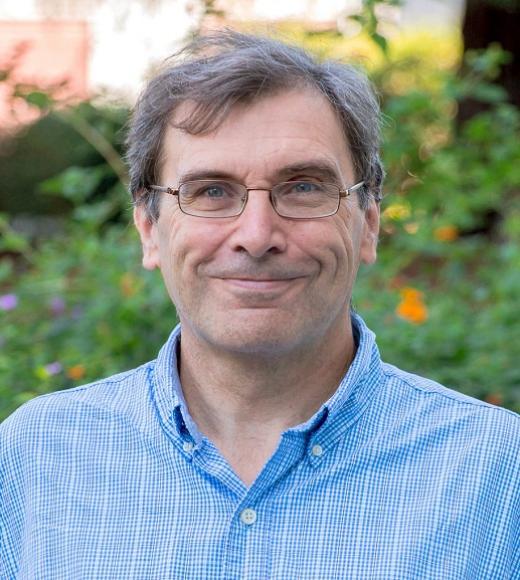
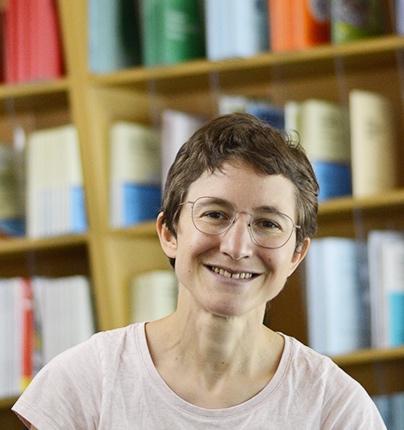
Patrice Koehl is a full-time Professor in the Department of Computer Science at the University of California, Davis. His research bridges computational biology, structural bioinformatics, and theoretical biophysics, focusing on geometric and physical modeling of biomolecular systems. He has made significant contributions to protein structure prediction, ion channel modeling, and development of computational methods for molecular simulations. Research interests include: Geometric modeling of biological macromolecules Optimal transport theory for shape analysis Statistical mechanics in biomolecular simulations Topological data analysis for cellular morphology Multi-scale modeling of viral structures Recent research trends show strong emphasis on: Protein conformational transitions using action minimization Persistence diagrams for morphological signatures Geometric approaches to assignment problems Computational methods for macromolecular surface analysis Interdisciplinary applications of physics to biological data
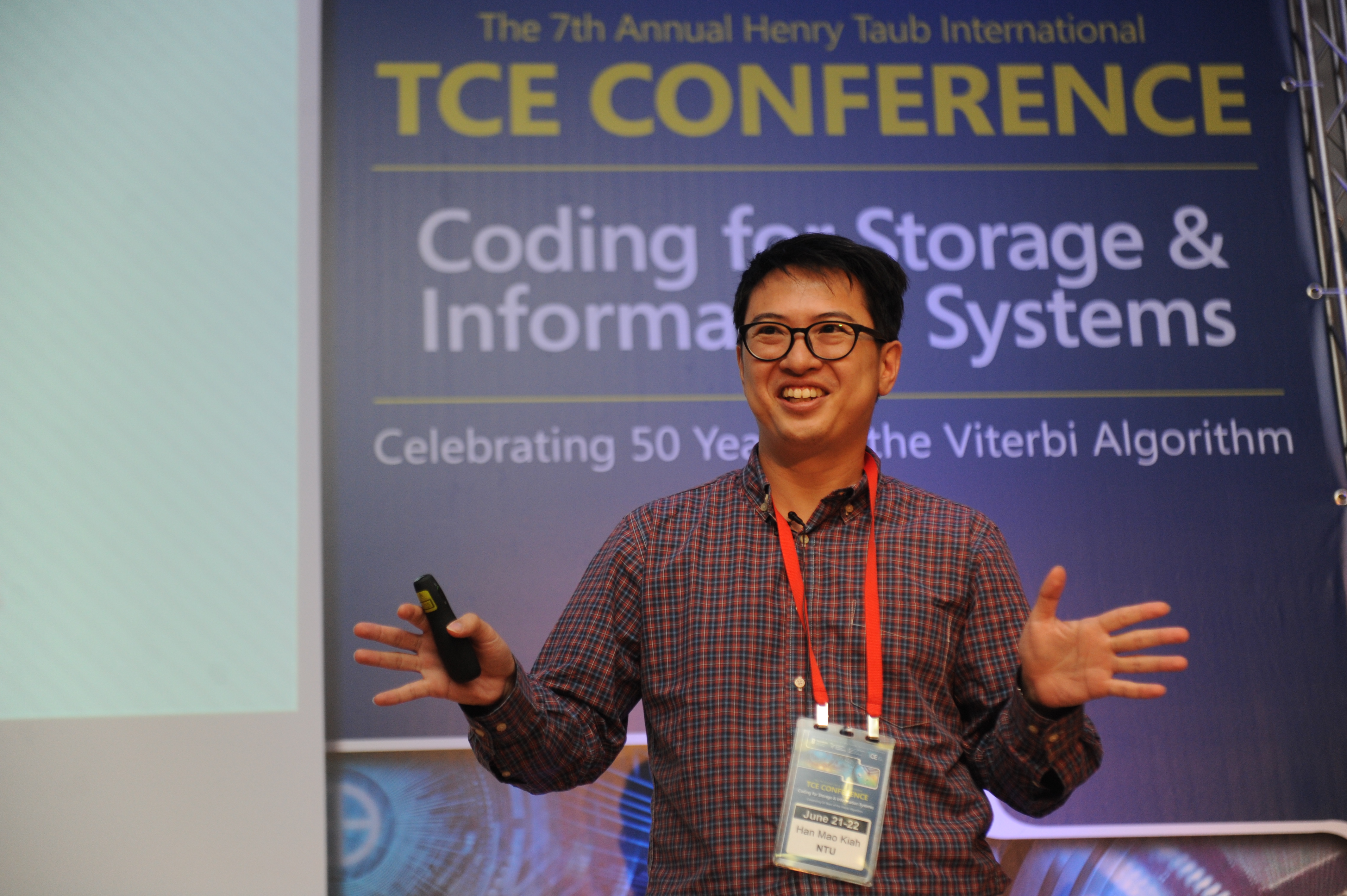
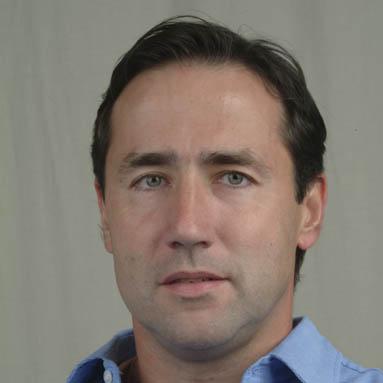
Han Mao Kiah is an Assistant Professor at Nanyang Technological University , specializing in Coding Theory and Combinatorics . He earned his Ph.D. in Mathematics at NTU under Yeow Meng Chee and held a postdoctoral position at the Coordinated Science Lab, University of Illinois at Urbana-Champagne with Olgica Milenkovic . Current Role: Assistant Professor, NTU, Department of Mathematics Education: Ph.D. in Mathematics (NTU), Postdoc (University of Illinois) His research focuses on Coding Theory for applications in DNA-based data storage , Reed-Solomon codes , and combinatorial designs . Recent work includes Private Information Retrieval , Sequence Reconstruction , and Error Correction in distributed systems. Key trends in his publications involve Reed-Solomon codes , Private Information Retrieval , and DNA sequence profiling with a focus on Efficient Algorithms and Constrained Coding for error control in emerging storage systems. ISITA Early Career Researcher Paper Award (2022, Researcher: D. T. Dao) Memorable Paper Award Finalist (2021, Student: J. Chrisnata) Best Student Paper Award (2020, Student: J. Chrisnata) Student Paper Award Finalist (2012)
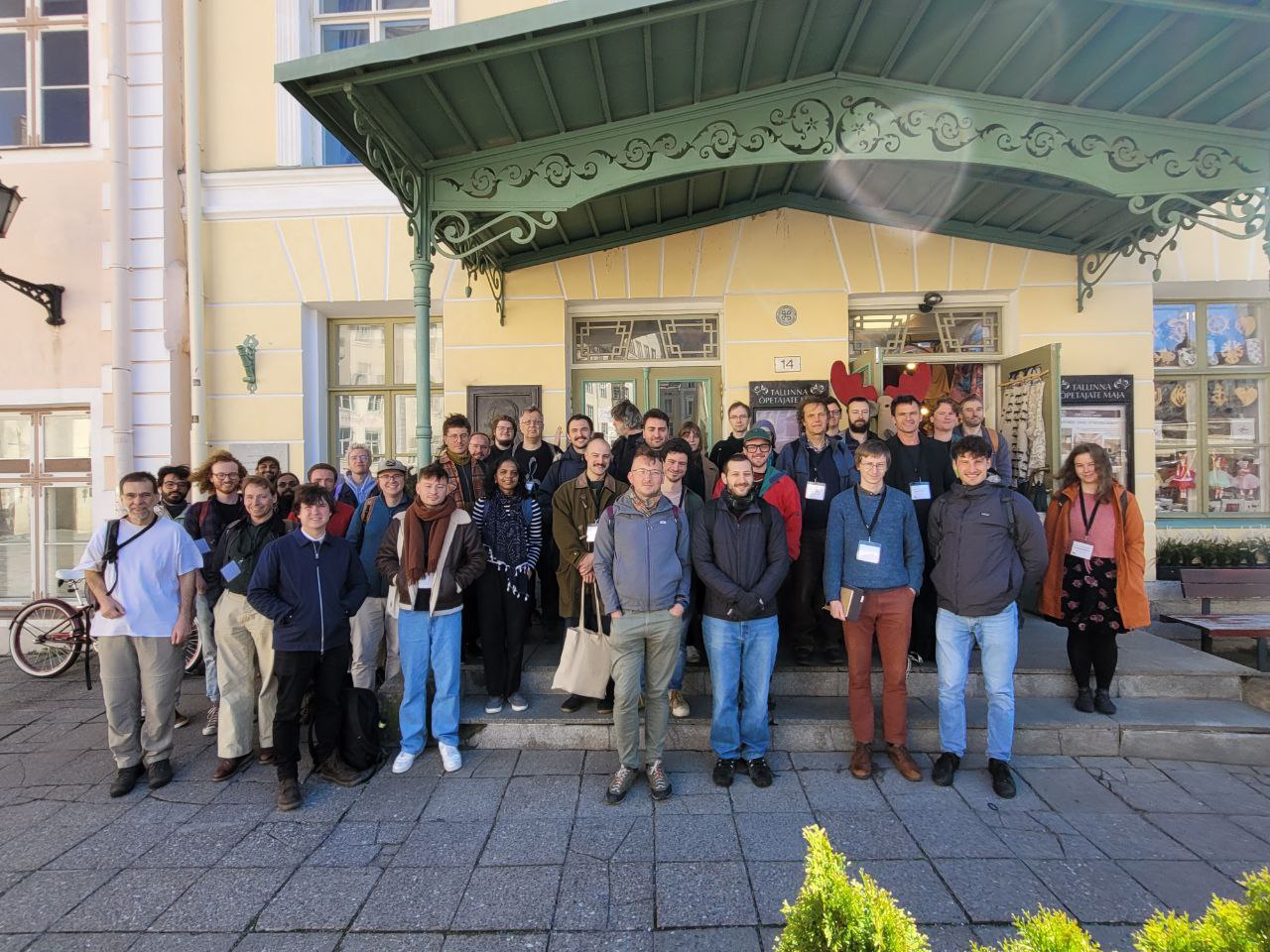
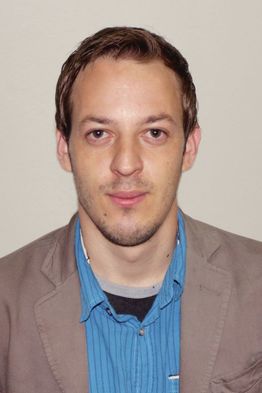
Amar Hadzihasanovic is an Assistant Professor at Tallinn University of Technology, affiliated with the Compositional Systems and Methods group, and a Scientific Advisor at Quantinuum. He specializes in category theory, higher-dimensional algebra, and their applications in quantum computing and formal systems. His recent work includes organizing the 110th Peripatetic Seminar on Sheaves and Logic (PSSL) and completing a book on higher-categorical diagrams with Cambridge University Press. Hadzihasanovic has been awarded grants from ARIA (Safeguarded AI programme) and the Estonian Research Council, supporting his research on diagrammatic rewriting and homotopy theory. His research interests span categorical foundations, diagrammatic sets, and computational aspects of higher-dimensional structures. Key contributions include model structures for (∞, n)-categories, acyclicity conditions in pasting diagrams, and formal axiomatizations of quantum systems. He has advised PhD students Alkis Ioannidis and Clémence Chanavat, and collaborates widely with institutions like the University of Cambridge and Quantinuum. Hadzihasanovic has delivered invited talks at conferences such as Category Theory 2024, the Nordic Congress of Mathematicians, and the Geometric and Topological Methods in Computer Science (GETCO). His teaching includes a course on category theory and diagrammatic reasoning at Kyoto University. His software, including the rewalt library, supports topologically sound higher-dimensional diagram rewriting.
Ian Wanless is a Research Professor at the School of Mathematics, Monash University. He specializes in combinatorics, with a focus on Latin squares, graph theory, and matrix permanents. His work bridges theoretical mathematics and applications in information technology, such as coding and experimental design. Wanless leads collaborative projects funded by the Australian Research Council, including studies on combinatorial structures and hypergraph matchings. He has authored over 120 peer-reviewed articles, with recent work addressing quantum states, Latin square properties, and quasigroup isomorphisms. Key Awards: Australian Mathematical Society 2009 Medal Collaborations: Global partnerships with institutions in the US, Europe, and Asia His research emphasizes universal solutions to combinatorial puzzles, such as Sudoku and the four-color theorem, while prioritizing theoretical rigor over direct applications.
Stefano Quer is an Associate Professor at the Department of Control and Computer Science (DAUIN), Politecnico di Torino. He holds a PhD in Electronic Engineering from the same institution and has been affiliated with DAUIN since 1996. Researcher (1996-2000) Associate Professor (2000-present) Visiting Faculty at UC Berkeley (1994-1995) Research Interests His work spans Formal Verification BDD/SAT Techniques Embedded Systems Hardware/Software Co-Verification Parallel Computing with applications in VLSI CAD, industrial IoT, and energy-efficient systems. Recent articles focus on GPU-accelerated graph algorithms, wireless sensor calibration, and AI-driven test optimization. Scientific Awards Best Paper Award, IEEE EURO-DAC'94 Academic Contributions Supervised PhD students Lorenzo Cardone and Andrea Calabrese Member of DATE, ICSOFT Technical Program Committees Topical Advisor for Sensors MDPI 60+ publications in IEEE/ACM venues
Chiara Epifanio is a researcher (INFO-01/A) at the University of Palermo , based in the Department of Mathematics and Computer Science . She holds regular office hours on Tuesdays 14:30–17:00 in Room 104, first floor, Via Archirafi 34, and can be reached at chiara.epifanio@unipa.it . Over the past fifteen years she has designed and taught a diverse portfolio of courses spanning Programming , Bioinformatics , Advanced Programming , Teaching Methodologies and Techniques for Computer Science and Pattern Discovery for Life Sciences . These offerings serve degree programmes in Mathematics, Computer Science, Statistics & Data Science, and the recently launched curricula in Data, Algorithms & Machine Intelligence and Computer Science & Artificial Intelligence . Her research lies at the intersection of combinatorics on words , string algorithms , and bioinformatics . She has made sustained contributions to the design of alignment-free distances for biological data, the theory of Sturmian words and their associated graphs, suffix automata tolerant to mismatches, and compact data structures such as linear-size suffix tries. The work repeatedly draws on deep results from formal language theory, automata theory, and discrete mathematics to solve practical problems in sequence analysis. Publications trend: From 2004 onward she has produced a steady stream of peer-reviewed articles that move from foundational combinatorial results on Sturmian words and critical factorization theorems toward application-driven studies on approximate string matching and genomic data mining. A marked acceleration is visible in the 2023 publications addressing k-Hamming and k-edit distances, reflecting current demands in large-scale biological data analytics. Scientific awards: None explicitly mentioned in the provided material. Advising & grants: No PhD or Master’s students are listed in the supplied pages, and no funded project descriptions are available. Laboratories & teams: While no specific lab is named, her teaching and research are embedded within the Department of Mathematics and Computer Science, which hosts groups in algorithms, discrete mathematics, and bioinformatics, and provides access to the university’s ATeN Center and other research infrastructures.
Irène Marcovici is a Professor at the University of Rouen Normandy, affiliated with the Raphaël Salem Mathematics Laboratory (LMRS) and leading the Probability and Dynamic Systems Team. Her research spans probability theory, cellular automata, stochastic processes, and combinatorics, with a focus on ergodicity, percolation, and self-organization phenomena. She collaborates with institutions like the GDR Fundamental Computer Science and its Mathematics and has contributed to journals such as Probability Theory and Related Fields, Annales Henri Lebesgue, and Theoretical Computer Science. Education: Habilitation à Diriger des Recherches (2021, University of Lorraine), PhD in Mathematics (2013, University of Paris Diderot) Research Focus: Marcovici's work explores probabilistic cellular automata, percolation models, and their applications in physics, computer science, and mathematics. Key projects include analyzing stability regions in queueing systems, developing decentralized diagnostics, and studying self-descriptive sequences. Her articles highlight interdisciplinary connections between discrete mathematics and stochastic dynamics. Notable Collaborations: She has co-authored publications with researchers like Jérôme Casse, Régine Marchand, Nazim Fatès, and Mathieu Sablik. Her team participates in the ALEA and SDA2 working groups under GDR Fundamental Computer Science and its Mathematics.
Andrzej Dudek is Professor of Mathematics at Western Michigan University, specializing in extremal and probabilistic combinatorics. His research examines Ramsey theory, random graphs, hypergraph problems, and combinatorial optimization through mathematical analysis. Funded by multiple Simons Foundation and NSA grants, he investigates threshold behaviors in generalized Ramsey numbers and structure emergence in random ordered graphs. His publications demonstrate consistent focus on bridging extremal combinatorics with probabilistic methods. Recent work establishes new bounds for Erdős-Gyárfás problems, analyzes Hamiltonian cycles in Dirac graphs, and characterizes unavoidable substructures in random matchings. Collaborative projects frequently address Ramsey-type questions at linear and quadratic thresholds. Supervised four PhD dissertations in combinatorics. Education includes PhD from Emory University (2008) and habilitation from Adam Mickiewicz University (2013). Recognitions include the Open Mind Prize (2010) and solution prize for an Erdős problem (2008). Organizes the Lake Michigan Workshop on Combinatorics and Graph Theory with NSF support.
Prof. Dr. Zorah Lähner is a Professor at the University of Siegen, leading research in the Department of Computer Vision. She will be transitioning to an Assistant Professor position at the University of Bonn starting January 2025. Her work bridges computer vision, machine learning, and quantum computing, focusing on fundamental geometric and algorithmic challenges in 3D shape analysis. Research interests span: Advanced shape matching methodologies Neural field representations on manifolds Quantum annealing applications in computer vision Scale-invariant correspondence frameworks Latent space alignment techniques Her publications demonstrate consistent innovation in geometric deep learning, with recent works exploring quantum-hybrid approaches for shape matching and neural fields for manifold learning. Publications predominantly appear in top-tier venues like CVPR, ICCV, and NeurIPS. While no specific awards are listed in the provided text, she maintains active collaborations across European institutions and supervises research in computer graphics and vision through her Lehrstuhl position.
Gabor N Sarkozy is a Professor in the Department of Computer Science at Worcester Polytechnic Institute (WPI). He holds a PhD from Rutgers University (1994) and completed a postdoc at the University of Pennsylvania (1994-1996). His research focuses on graph theory, discrete mathematics, and theoretical computer science, particularly the structure of large graphs and Ramsey-type problems. Education: BS, Eötvös University (1990); MS, PhD, Rutgers University (1994); Postdoc, University of Pennsylvania (1994-1996) His scholarly work spans over 100 publications, with notable collaborations with Endre Szemerédi, János Komlós, and András Gyárfás. Key contributions include algorithmic applications of the Blow-up Lemma, monochromatic cycle partitions, and advancements in Ramsey theory for hypergraphs and planar graphs. Professional highlights include the Good Teaching Award (1995) and the Doctor of the Hungarian Academy of Sciences (2009). He founded the Budapest Project Center, WPI's first project center in Eastern Europe, and remains actively engaged in educational data mining projects. Scientific Awards Good Teaching Award, 1995 Doctor of the Hungarian Academy of Sciences, 2009 His research trends over the past two decades show a transition from classical Ramsey theory and graph decomposition (1995-2010) to interdisciplinary applications in time series analysis and educational data mining (2011-2024), while maintaining core contributions to combinatorial graph theory. Advising and grants are not explicitly detailed in the provided texts, though his collaborative nature is evident through extensive co-authorships. He maintains active research groups at WPI and the Rényi Institute, with ongoing projects in Ramsey-type problems and algorithmic applications.
Margaret Bayer is a Professor in the Department of Mathematics at the University of Kansas, within the College of Liberal Arts & Sciences. She specializes in combinatorics and discrete geometry, with research focusing on convex polytopes, hyperplane arrangements, Eulerian posets, and flag vectors. Her work bridges combinatorics with algebraic geometry, particularly through connections to toric varieties. Her research explores the combinatorial structure of geometric objects, including face lattices of polytopes and the interplay between algebraic and geometric properties. Recent work includes studies on cut complexes of graphs, matching complexes, and applications of combinatorial methods in education and algorithm design. Bayer has authored/co-authored over 40 publications, including foundational works on flag vectors, the cd-index of Eulerian posets, and lattice polytopes derived from Schur polynomials. Her articles often address topics like polytope enumeration, topological properties of graph complexes, and combinatorial optimization in exam design. She serves as Book Review Editor for the Association for Women in Mathematics Newsletter and has advised numerous collaborative projects. Her teaching includes intermediate analysis and discrete mathematics courses.
Termeh Shafie is a full-time Professor in the Department of Politics and Public Administration at the University of Konstanz, specializing in Computational Social Science and Data Science. With a strong statistical foundation, she develops advanced methodologies for analyzing multivariate social networks while bridging archaeological network reconstruction with modern data science techniques through projects like NEXUS 1492. Key Research Areas: Multigraph modeling, network entropy analysis, isotope geoprovenance, and hypergraph representations Projects: NEXUS 1492 archaeological network reconstruction Her 15 most recent publications demonstrate significant contributions to network methodology (random multigraph models, centrality index analysis), archaeological applications (Caribbean attack networks, Iroquoian settlement patterns), and data privacy frameworks. Articles span 2012–2025 with interdisciplinary focus on statistical sociology, archaeological theory, and computational modeling. Current teaching includes courses on social network analysis, data science, and statistical learning. Office hours available via ILIAS booking system. Contact details provided for both academic and administrative correspondence.
Richard J. Cole is a Silver Professor of Computer Science at New York University's Courant Institute of Mathematical Sciences, part of the Faculty of Arts and Science. His research focuses on algorithm design, algorithmic economics, game theory, and parallel computing. He holds a Ph.D. in Computer Science from Cornell University (1982) and a B.A. in Mathematics from Oxford University (1978). Education: Ph.D., Computer Science, Cornell University, USA, 1982 B.A., Mathematics, Oxford University (University College), United Kingdom, 1978 His research spans algorithmic economics (market theory, mechanism design), parallel algorithms, and foundational areas like string matching and graph algorithms. Recent work emphasizes stable matching, non-quasi-linear agent mechanisms, and fair resource allocation. He has advised notable Ph.D. students including Yun Kuen Cheung and Vasilis Gkatzelis. Teaching includes undergraduate and graduate courses on algorithms, computational theory, and algorithmic aspects of the internet. His 15+ years of publications reflect contributions to theoretical computer science and interdisciplinary applications in economics. His work on parallel computing and resource-oblivious algorithms addresses multicore efficiency, while contributions to market equilibrium analysis and mechanism design highlight algorithmic solutions to economic challenges.
Tatiana Starikovskaya is an Assistant Professor (Maître de Conférences) in the Computer Science Department at École normale supérieure (ENS), Paris, France. She leads the PARSe project (ANR-20-CE48-0001) focusing on approximation and randomized string processing, and participates in AlgoriDAM (ANR-19-CE48-0016). Co-supervises PhD students T. El Ghazi and Gabriel Bathie Co-chaired CPM 2021; served on program committees for STACS, ESA, ICALP, and others Organized CPM summer school (2023) and 'New Horizons of Stringology' workshop (2024) Research Focus Her work centers on algorithms on strings , small-space algorithms , and streaming models , with applications in bioinformatics and data security. Recent research explores trade-offs between time/space complexity in pattern matching, wildcards, and error-tolerant string analysis. Publications Trends Her recent work spans streaming algorithms , compressed data processing , and approximate pattern matching , with collaborations on challenges like k-mismatch problems, Dyck edit distances, and language distance estimation. Education PhD in Mathematics, Lomonosov Moscow State University (2013) M.Sc. in Data Science (Moscow Institute of Physics and Technology/Yandex, 2009) M.Sc. in Mathematics, Lomonosov Moscow State University (2009)
Marko Đukanović serves as an Assistant Professor at the Department of Computer and Information Sciences within the Faculty of Natural Sciences and Mathematics at the University of Banja Luka. His academic career spans combinatorial optimization, graph theory, and bioinformatics applications, with significant contributions to algorithm design for complex computational problems. His research focuses on combinatorial optimization , particularly in graph domination problems and longest common subsequence variants . His work bridges theoretical computer science with practical applications in bioinformatics, social network analysis, and computational biology. Recent publications demonstrate expertise in developing advanced algorithms including biased random-key genetic algorithms, variable neighborhood search, and neural network-guided optimization techniques. Key publication trends show his specialization in solving constrained optimization problems on graphs, with growing emphasis on integrating machine learning components into traditional combinatorial algorithms. His 2024 publications in IEEE Transactions on Evolutionary Computation and Applied Mathematics and Computation represent significant contributions to the field. Best Paper Award at EvoStar Conference 2024 for 'A Neural Network Based Guidance for a BRKGA: An Application to the Longest Common Square Subsequence Problem' Dr. Đukanović actively participates in international academic collaboration, including recent panel discussions on knowledge transfer between Bosnia and Herzegovina and global expert communities. His work demonstrates strong international collaboration, particularly with researchers from TU Wien and institutions across Europe.