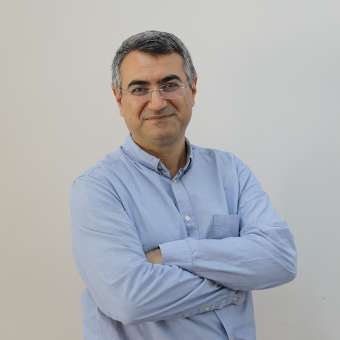
Fatih Ecevit is Full Professor of Mathematics at Boğaziçi University, serving as Vice Chair of the Mathematics Department. Former research associate at Max-Planck-Institut für Mathematik in den Naturwissenschaften, Leipzig (2005-2007). Research develops computational methods for high-frequency scattering problems, including: Boundary element methods for wave propagation Asymptotic analysis of scattering phenomena Galerkin formulations for integral equations Lattice sum evaluations in graph theory Principal investigator for TÜBİTAK-funded project: 'Hybrid integral equation methods for high-frequency scattering problems' (2017-2020). Teaches graduate and undergraduate courses in numerical analysis, partial differential equations, and real analysis.
Professor Cem Evrendilek is a faculty member in the Department of Computer Engineering at Izmir University of Economics, Turkey, holding the rank of Professor with current active status. His institutional email is cem.evrendilek@ieu.edu.tr. His research spans algorithmic complexity and geometric computation, with primary focus areas including: Computational Geometry (specializing in orthogonal polygon covering problems) Wireless Sensor Network Localization (energy-efficient methods and trilateration) NP-hard Problem Analysis (proving complexity for geometric and network problems) Approximation Algorithms for combinatorial optimization Analysis of his 2008-2018 publications reveals consistent work on geometric covering problems and sensor network localization. Key trends include proving NP-completeness for orthogonal polygon covering variants, developing energy-efficient mobile beacon localization techniques, and analyzing trilateration with noisy measurements. His work frequently intersects computational geometry with practical wireless network applications, demonstrating strong theoretical foundations applied to real-world constraints. Collaborative patterns show frequent co-authorship with Hüseyin Akcan (on localization algorithms), Burkay Genç, and Brahim Hnich (on computational geometry problems).
Prof. Şule Itır Satoğlu is a faculty member in the Department of Industrial Engineering at Istanbul Technical University, holding the rank of Professor since 2019. She has held multiple administrative roles, including Head of Department (2025–present), Vice Rector (2020–2024), and Vice Dean (2018–2020). Her research focuses on supply chain management, optimization, sustainable operations, and disaster response systems. She has a PhD in Industrial Engineering from Istanbul Technical University (2008), an MSc in Engineering Management (2002), and a BSc in Mechanical Engineering (2000). Her work emphasizes practical applications of optimization techniques in logistics, healthcare, and disaster management. Notable contributions include developing models for blood supply chains under uncertainty, UAV-based waste detection, and sustainable urban transport fleet electrification. She has collaborated on projects funded by public and private sectors, addressing issues like lean manufacturing integration with Industry 4.0 and RFID-enabled maintenance systems. Her publications span over two decades, with recent focus on multi-objective optimization in humanitarian logistics, smart waste collection systems, and energy-efficient drone surveillance. She is a member of the TMMOB Chamber of Mechanical Engineers and actively contributes to national technology initiatives through academic leadership roles.
Alp Bassa is a Professor of Mathematics at Boğaziçi University, affiliated with the Department of Mathematics. He holds a Ph.D. in Mathematics from Universität Duisburg-Essen (2007) and dual bachelor's degrees in Computer Engineering and Mathematics from Middle East Technical University (2004). His research focuses on Number Theory, Algebraic Geometry, and their applications in Cryptography and Finite Fields. Education: Ph.D. in Mathematics, Universität Duisburg-Essen, 2007 Bachelor of Science in Computer Engineering & Mathematics, Middle East Technical University, 2004 Research Interests: Professor Bassa investigates algebraic structures over finite fields, including Drinfeld modules, function fields, and their cryptographic applications. His work bridges Number Theory and Geometry, with contributions to coding theory and the construction of algebraic curves with optimal properties. Recent Projects: TÜBİTAK 2509: Curves over Finite Fields, Jacobian Varieties, and Abelian Varieties (2018–2020) BAP-10540: Curves over Finite Fields and Irreducible Polynomials (2015–2017) Teaching: Recent courses include foundational mathematics (Math 101, Math 102), advanced topics (Math 344, Math 525), and specialized courses in cryptography and algebraic geometry.
Dr. İsmail Arı is an Assistant Professor in the Computer Science department at Özyeğin University . He holds a PhD from the University of California, Santa Cruz (2004), MS from University of Maryland (2000), and BS in Electrical & Electronics Engineering from Boğaziçi University (1998).
Selçuk Karabatı is a Professor of Operations Management at the College of Administrative Sciences and Economics, Koç University (Turkey). His research spans retail operations, sustainable supply chains, and production systems optimization. He holds a PhD from the University of Texas at Austin and has previously taught graduate courses in Service Operations Management , Operations Strategy , and Sustainable Operations Management at Koç University. Education : PhD (University of Texas at Austin), MS (University of Southern California), BS (Boğaziçi University) Editorial Roles : Senior/Associate Editor at Production and Operations Management and IIE Transactions His research focuses on Supply Chain Management , Retail Operations , and Sustainable Operations , with applications in inventory control, pricing strategies, and production planning. Recent and historical publications reveal expertise in optimization frameworks , dynamic pricing , portfolio rebalancing , and retail analytics . While no explicit scientific awards are listed in the provided text, his work has consistently addressed challenges in inventory substitution, auction mechanisms, and logistics coordination.
Betül Boz is an Assistant Professor at the Department of Computer Hardware, Faculty of Engineering, Marmara University. She holds a B.Sc. and M.Sc. in Computer Engineering from Marmara University, and a Ph.D. in Computer Engineering from Boğaziçi University. Her research focuses on computer architecture, optimization, and evolutionary computing. B.Sc., M.Sc., and Ph.D. in Computer Engineering Her research interests include computer architecture, parallel algorithms, optimization techniques, and evolutionary algorithms applied to graph coloring and scheduling. Recent work explores cloud computing scheduling, register allocation, and bioinformatics applications like circRNA-disease prediction. She has published extensively in these areas, utilizing evolutionary computing and machine learning. Key trends in her publications include evolutionary algorithms for graph coloring (2015–2025), register allocation (2004–2024), and cloud computing optimization (2023). She also investigates biomedical applications such as circRNA-disease association prediction. She has advised one thesis, managed one project, and her work aligns with UN Sustainable Development Goals. Her research outputs include 14 WoS-indexed publications, 11 WoS citations, and an h-index of 25 on WoS.
Ferit Öztürk is a Professor in the Mathematics Department at Bogazici University, specializing in singularity theory, contact topology, and symplectic topology. He leads the Geometry/Topology Seminar and supervises numerous graduate students in these fields. His research bridges topological methods with applications in robotics and dynamical systems. Recent work includes exotic manifold construction, real contact structures on 3-manifolds, and Morse-Bott theory on Lie groups. Dr. Öztürk holds a Ph.D. from Middle East Technical University (2001) and has developed course materials on Morse Theory and Projective Geometry. Student Supervision: 12+ M.S./Ph.D. students in topology and geometry Research Tools: Contact branched covers, real algebraic models, geometric surgery
ZİYATTİN TAŞ is a Lecturer in the Mathematics Department at the Faculty of Arts and Sciences, Bingöl University. He holds a Ph.D. in Mathematics from Yüzüncü Yıl University (2005) after completing his M.Sc. at Harran University (1995) and B.Sc. at Yüzüncü Yıl University (1993). His research focuses on functional analysis, Banach spaces, graph theory, and topological descriptors. He has published extensively in international journals like Journal of Discrete Mathematical Sciences & Cryptography and Graphs and Linear Algebra . Educations: B.Sc. (1993), M.Sc. (1995), Ph.D. (2005) Research interests include metric geometry, topological indices of molecular structures, and mathematical properties of graphs. His recent work involves analyzing entropy measurements in hexagonal cycloarene structures and domination connectivity in paths/cycles. He has collaborated on studies applying topological descriptors to Remdesivir drug design and silicate carbide analysis. Over 20 peer-reviewed articles, including contributions to QSPR analysis of octanes and Petersen graph topological correlations. No explicit awards listed, but active in national/international conferences since 2007.
Şükran Uygun is an Associate Professor at Gaziantep University's Faculty of Arts and Sciences, Department of Mathematics, where she has held positions since 2003. She earned her PhD in Mathematics from Selçuk University (2013) and a Master's in Mathematics from Gaziantep University (2005). Education: PhD (2013) - Selçuk University MS (2005) - Gaziantep University BS (2002) - Gaziantep University Her research focuses on number theory, matrix analysis, and special sequences, particularly bi-periodic Pell/Jacobsthal sequences and their matrix representations. She has published extensively on spectral norms of circulant/Toeplitz matrices and applications to coding theory. Recent publications analyze advanced encryption schemes using Fibonacci matrices, complex Jacobsthal numbers, and binomial transforms of generalized sequences. Her work connects Pell/Jacobsthal sequences with Chebyshev polynomials and explores negative-index extensions. Awarded twice by TÜBİTAK for publication excellence, she has supervised 15 graduate theses and taught courses in numerical analysis, special functions, and differential equations.
Prof. Cevdet Aykanat is a Professor of Computer Engineering at Bilkent University, Ankara, Turkey. He earned his BS/MS in Electrical Engineering from METU and PhD from Ohio State University as a Fulbright scholar. His research focuses on parallel computing, sparse matrix algorithms, graph partitioning, and high-performance computing for big data. He has been affiliated with Bilkent since 1989 and has held roles like Associate Provost. Education: BSc/MSc (METU Electrical Engineering), PhD (Ohio State University Electrical & Computer Engineering). Research interests include parallel scientific computing, combinatorial optimization, distributed systems, and large-scale data analysis. His work spans over 100 publications in top journals like IEEE Transactions and SIAM, with 5,500 citations and an H-index of 40. Awards: 1996 TUBITAK Investigator Award, 2007 METU Parlar Science Award. He led 6 TUBITAK projects and participated in EU-funded projects like PRACE-1IP to PRACE-6IP. Publications emphasize efficient parallel algorithms for sparse computations, graph partitioning, and distributed systems. His work addresses latency reduction, load balancing, and scalable data processing in HPC environments. Grants: Funded by TUBITAK, Intel SSD, and EU programs. Academic service includes editorial roles at IEEE Transactions on Parallel and Distributed Systems.
Erdal Erel is a Professor of Operations Management (OM) and currently serves as the Vice Rector in charge of administrative and financial affairs at Bilkent University's Faculty of Business Administration. He holds a B.S. in Industrial Engineering from Istanbul Technical University (1981), an M.S. from Stanford University (1983), and a Ph.D. from Virginia Polytechnic Institute and State University (1987). His academic career has been dedicated to advancing research in Production Operations Management, focusing on manufacturing systems design, assembly/disassembly line balancing, scheduling, and project management. Erel's educational background includes: B.S. in Industrial Engineering, Istanbul Technical University (1981) M.S. in Industrial Engineering, Stanford University (1983) Ph.D. in Industrial Engineering and Operations Research, Virginia Polytechnic Institute and State University (1987) His research interests span several critical areas of operations management, including manufacturing systems design, assembly and disassembly line balancing, scheduling and sequencing methodologies, and project management. He has made significant contributions to robust optimization techniques applied to time-cost trade-offs and stochastic modeling in production systems. His work emphasizes practical solutions for complex operational challenges through advanced algorithms like ant colony optimization and beam search methods. Erel's publications reflect a focus on optimization in production systems, scheduling algorithms, and decision models under uncertainty. His research bridges theoretical advancements with real-world applications in manufacturing and service industries, addressing issues such as cost minimization, robust scheduling, and efficiency improvements in assembly line operations. Erel has contributed extensively to his field but no specific scientific awards are mentioned in the provided text. No specific information about advising students or grants is provided in the text. Erel's involvement in collaborative projects, including work with colleagues like I. Sabuncuoglu and J.B. Ghosh, highlights his role in interdisciplinary research teams focused on operational efficiency and advanced manufacturing technologies.
Dr. Milad Elyasi is an Assistant Professor in the Department of Industrial Engineering at Özyeğin University. He completed his Ph.D. in Industrial Engineering at Özyeğin University in 2022, following a Master’s degree from K.N. Toosi University of Technology (2012) and a Bachelor’s from University of Tabriz (2010). Education PhD in Industrial Engineering, Özyeğin University (2022) Master’s in Industrial Engineering, K.N. Toosi University of Technology (2012) Bachelor’s in Industrial Engineering, University of Tabriz (2010) His research focuses on large-scale optimization, decomposition algorithms, and combinatorial optimization, with applications in transportation and logistics system planning, manufacturing systems, and optimization under uncertainty. A key aspect of his work involves integrating machine learning to enhance operational efficiency and solve complex industrial and service system challenges. Dr. Elyasi has held postdoctoral research positions at IMT Atlantique (France) and HEC Montreal (Canada), contributing to advancements in optimization methodologies.
Batin Latif AYLAK serves as Associate Professor in the Department of Industrial Engineering at the Faculty of Engineering, Turkish-German University, Turkey. Previously, he held an Assistant Professor position at Hitit University starting in 2015. His academic career spans over a decade of research at the intersection of industrial engineering, logistics, and artificial intelligence. His educational foundation includes: Doctorate in Mechanical Engineering from University of Duisburg-Essen (2010-2015) Master's degree in Mechanical Engineering from University of Duisburg-Essen (2008-2010) Bachelor's degree in Industrial Engineering from Istanbul Kültür University (2001-2006) with full scholarship Dr. AYLAK's research pioneers the integration of artificial intelligence in supply chain optimization, with particular emphasis on sustainable logistics systems. His work bridges theoretical advancements with practical applications in blockchain implementation for supply chain transparency, machine learning-driven energy forecasting, and intelligent warehouse management. He has developed novel frameworks like SustAI-SCM for agentic AI in sustainable supply chains and contributed significantly to understanding digital transformation in Turkey's logistics sector. His publication trajectory (2021-2025) reveals a strategic evolution from foundational logistics research toward cutting-edge AI applications. Early work focused on optimization algorithms and blockchain integration, while recent publications demonstrate leadership in agentic AI systems for sustainability, advanced predictive modeling for renewable energy, and pandemic-responsive supply chain solutions. This progression highlights his adaptation to emerging technological paradigms while maintaining core focus on supply chain resilience. No scientific awards or fellowships were documented in the provided materials. Dr. AYLAK has secured competitive research funding including project BAP TAÜ - 2018BM0028 for digital trend analysis in Turkey's logistics sector. While his publications indicate collaborative research with multiple co-authors across institutions, no formal graduate student advisement relationships were specified in the available documentation.
Deniz Aksen is a Professor in the Department of Business - Operations Management and Information Systems at Koç University's College of Administrative Sciences and Economics. His research focuses on optimization problems in logistics, supply chain management, and facility location, with particular expertise in vehicle routing problems and interdiction models. Education: PhD in Operations Research from Purdue University (2003) Master's Degree in Industrial Engineering from Boğaziçi University (1996) Bachelor's Degree in Industrial Engineering from Boğaziçi University (1994) Professor Aksen's research centers on combinatorial optimization with applications in logistics and supply chain management. His work spans vehicle routing problems , facility location , interdiction models , and metaheuristic solution methods . He has made significant contributions to the understanding of r-interdiction problems where facilities must be protected against potential attacks, and has applied his methods to practical contexts including election logistics and waste collection systems . His approach often combines mathematical modeling with innovative heuristic and metaheuristic techniques to solve complex optimization problems that arise in real-world settings. Analysis of Professor Aksen's recent publications reveals a strong focus on bilevel and trilevel optimization models applied to security and logistics problems. His work frequently addresses the interdiction theme - studying how to optimally protect facilities against potential attacks or disruptions. The research shows increasing sophistication in modeling approaches, moving from basic vehicle routing problems to complex multi-level decision frameworks that incorporate protection and interdiction considerations. His applications span diverse domains including election logistics, waste management, and critical infrastructure protection, demonstrating the versatility of his methodological contributions to operations research. Professional Activities: Member of editorial boards for operations research journals Reviewer for leading journals in operations research and management science Active participant in international conferences on optimization and logistics