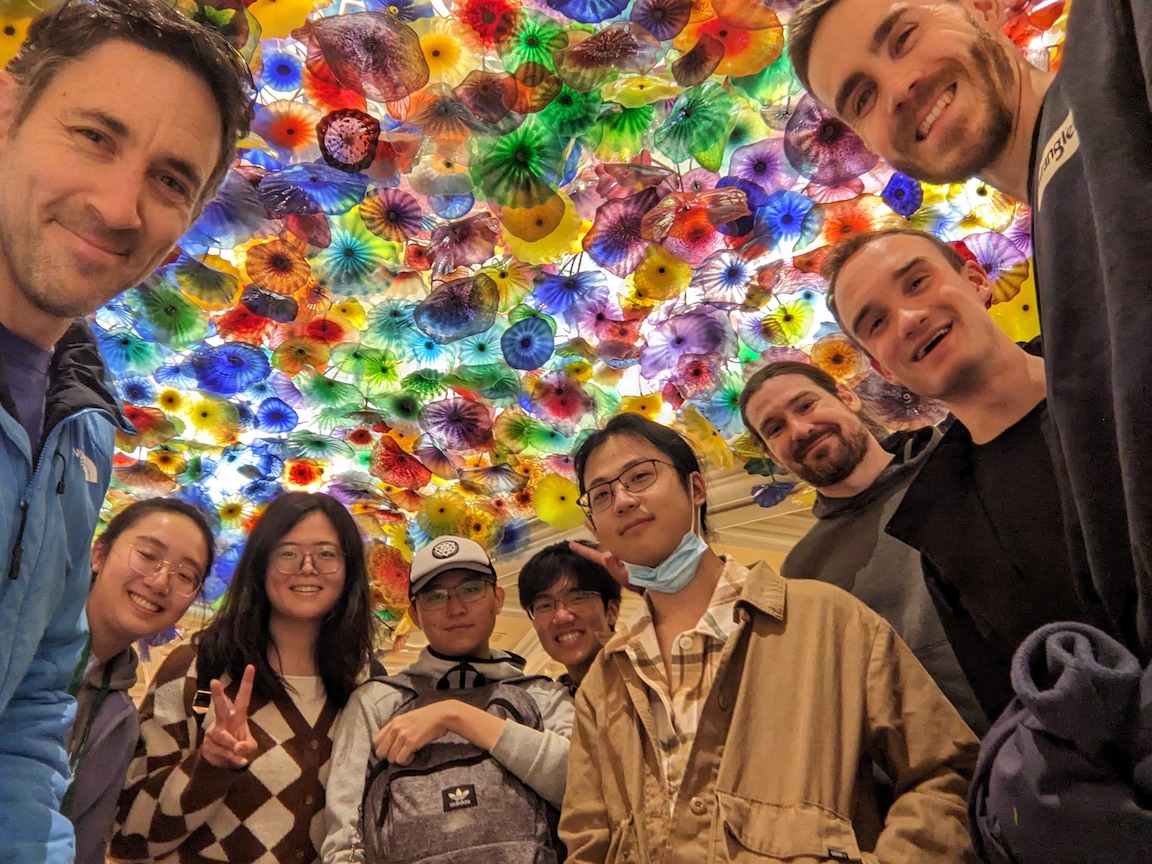
Spencer D. Brucks is an Assistant Professor of Chemistry at Harvey Mudd College. His research focuses on synthetic polymers inspired by natural systems, particularly exploring how polymer shape and stereochemistry influence function, with applications in sustainable materials and microbiome engineering. He holds an A.B. from Cornell University and a Ph.D. from Columbia University. Research Interests: Development of polymers mimicking natural materials for prebiotic and biomedical applications Investigating polymer stereochemistry's impact on degradability and antimicrobial properties Engineering materials to support beneficial bacteria in the human microbiome Teaching: Courses include Chemistry in the Modern World (Chem 42), Organic Chemistry (Chem 56/58), and Biochemistry (Chem 182/184). Labs/Teams: Leads a research group at Harvey Mudd, mentoring undergraduate students in interdisciplinary projects. Current members include Nicole Fang, Grey Karis-Sconyers, and Irene Jung. Past students have pursued roles in academia and industry.
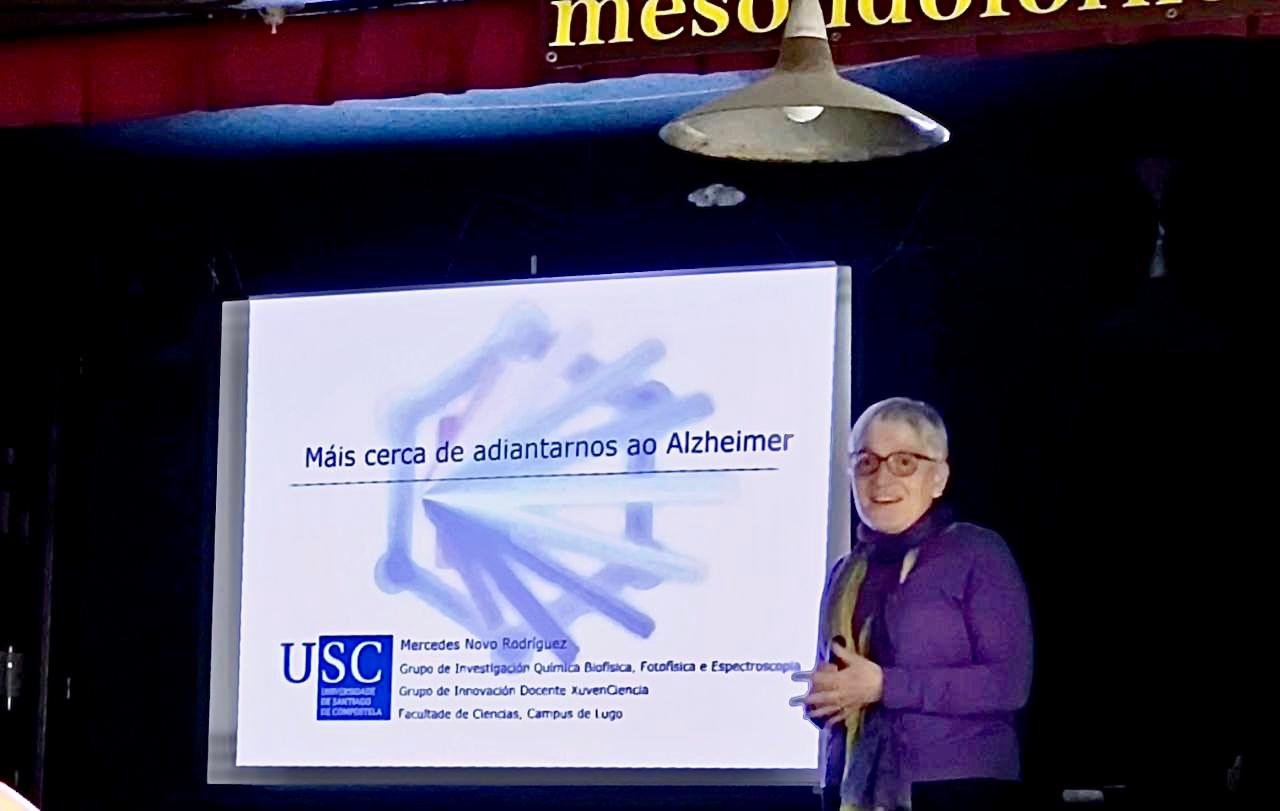
Mercedes Novo Rodríguez is a Full Professor of Physical Chemistry at the University of Santiago de Compostela (USC), based at the Lugo Campus. She holds a permanent position in the Department of Physical Chemistry and leads the Single Molecule Fluorescence Research Unit. Her research focuses on fluorescence spectroscopy, supramolecular systems, and biomolecular recognition, with significant contributions to Alzheimer's disease studies and amyloid aggregation mechanisms. She completed her PhD at USC under Professors Flor Rodríguez Prieto and Manuel Mosquera González and has held postdoctoral positions at prestigious institutions including the Max-Planck Institute and Katholieke Universiteit Leuven. She coordinates the XuvenCiencia outreach group, promoting scientific education among young people. Awards include the Extraordinary Doctoral Award (1991–1992) and National Full Professor accreditation (2015). Education: Bachelor's in Chemical Sciences (Physical Chemistry) – USC (1987) PhD in Photoinduced Proton Transfer Processes – USC (1991) Research Interests: Fluorescence-based techniques, supramolecular dynamics, biomolecular recognition, Alzheimer's disease biomarkers, and amyloid aggregation mechanisms. Her work integrates experimental and theoretical approaches to study molecular interactions. Articles Overview: Recent publications emphasize amyloid β aggregation studies, FCS applications, and CRISPR delivery systems. Themes include diagnostic tools for neurodegenerative diseases and protein dynamics analysis. Awards: Extraordinary Doctoral Award (1991–1992) National Full Professor Accreditation (2015) Teaching & Outreach: Supervises doctoral and master's theses, teaches physical chemistry courses, and coordinates XuvenCiencia, organizing science camps and teacher training programs. Labs/Teams: Leads the Single Molecule Fluorescence Unit and co-directs the Biophysical Chemistry, Spectroscopy, and Photochemistry group at USC.
Marine Soulié is a Researcher in Organic Chemistry at Avignon Université's UPRI laboratory (S2CB Team). Her work focuses on designing chemical tools to study membrane proteins, critical for understanding therapeutic targets linked to pathologies. She recently defended her PhD via the Validation of Acquired Experience (VAE) system after a decade of contract-based research contributions. Her team collaborates with academic and industrial partners, notably through the Chem2Stab joint laboratory. Key achievements include ANR-funded projects in 2024 and EUR Implanteus support for bio-sourced chemical tool development. Her research emphasizes fluorinated detergents and polymers for protein extraction/stabilization, with recent findings presented at Appicom Research Group conferences. She advocates for interdisciplinary teamwork and values academic values like freedom and public service. Labs/Teams: S2CB Team (UPRI) and Chem2Stab LabCom. Collaborations include Eurofins Calixar and CNRS-affiliated institutions.
Saverio E. Spagnolie is a Professor of Mathematics at the University of Wisconsin-Madison, with a courtesy appointment in Chemical & Biological Engineering. His research spans Fluid Mechanics, Soft Matter, Biophysics, and Applied Mathematics, focusing on complex fluids, elastic deformations, and biological systems. He leads the AMEP Lab and has organized seminars such as the Applied and Computational Math Seminar and the Physical Applied Math Journal Club. Research interests include fluid-structure interactions, nematic liquid crystals, microorganism locomotion, and viscous flow dynamics. Notable work includes studies on curvature-induced rigidity in elastic materials, arrested states in active suspensions, and dynamics in supersaturated fluids. Key contributions also involve the behavior of red blood cells in liquid crystals, programmable van der Waals interactions, and the hydrodynamics of bacterial polymorphism. His work has been recognized with awards such as the 2023 Milton van Dyke Award. Spagnolie collaborates extensively, mentoring numerous students and researchers. His funding comes from NSF and NIH grants, supporting projects on fluid dynamics and biological systems.
Dr. Tatiana Gambaryan-Roisman is an Adjunct Professor (Apl. Prof.) at Technische Universität Darmstadt, where she leads the research group Interfacial Transport and Complex Wetting . She holds a D.Sc. in Mechanical Engineering from Technion and completed her habilitation in Heat Transfer at TU Darmstadt. Her research explores interfacial phenomena, including droplet dynamics, evaporation/condensation, and heat transfer enhancement using nanostructured surfaces. Her work integrates experimental and computational methods to study: Drop impact on heated/deformable substrates Marangoni convection in thin films Wetting of porous and textured materials Nanoparticle assembly and battery interface engineering Recent publications focus on droplet coalescence, evaporation kinetics, and lithium-ion battery interfaces, demonstrating consistent innovation in thermal-fluid sciences. She coordinates EU projects like nanoPaInt and has led the Emmy Noether Research Group. Awards include: Ralf-Dahrendorf Prize for European Research (2019) Emmy Noether Grant (2002–2009) Minerva Fellowship (1998–2000) She serves on editorial boards for Experimental Thermal and Fluid Science and Current Opinion in Colloid & Interface Science , and organizes international conferences like Droplets 2021.
Sharon Glotzer is a Professor of Physics at the University of Michigan, affiliated with the Randall Laboratory and Homer A. Neal Laboratory. She is renowned for her research in self-assembly of colloidal particles, nanomaterials, and computational approaches to materials design. Elected to the National Academy of Engineering in 2019, her work bridges physics, chemistry, and computer science to engineer novel materials with applications in photonics, energy, and biomedicine. Her research group focuses on understanding how particle shape, entropy, and interactions drive complex ordered structures. Glotzer has pioneered methods for predicting and designing materials using machine learning and simulation tools like HOOMD-blue. She is also a leader in promoting open science and reproducible research practices. Her key contributions include the discovery of quasicrystalline colloidal phases, the development of entropy-driven assembly strategies, and the application of graph theory to study material networks. Awards include the National Academy of Engineering membership, highlighting her impact on engineering through fundamental materials science. Glotzer’s interdisciplinary approach addresses challenges in sustainable materials design and has inspired global collaborations in both academia and industry.
Professor Serkan Zorba serves as a Professor of Physics in the Department of Physics & Astronomy at Whittier College, where he has held a tenure-track position since 2005 after initially joining as a visiting professor in 2004. His academic journey began with a B.S. in Engineering Physics from Hacettepe University (1997), followed by M.A. (1999) and Ph.D. (2004) degrees in Physics from the University of Rochester. His research trajectory spans multiple physics domains with distinct evolutionary phases. Early work focused on organic semiconductor thin films (pentacene/perylene growth kinetics and electrical properties), transitioning to nanomaterials engineering (2009-2016) involving magnetic nanoparticles for optical modulation, liquid crystals, and plasmonics. Recent publications (2012-2023) reveal expansion into cosmological theory (dark energy/matter models) and physics-theology intersections , demonstrating exceptional interdisciplinary range from experimental condensed matter to theoretical cosmology. Publication trends indicate a clear chronological shift: pre-2010 work centered on materials characterization using AFM and photoemission, 2010-2016 emphasized nanoparticle applications in optics, while post-2012 research increasingly addresses fundamental cosmological questions and philosophical arguments about divine existence. This evolution reflects deliberate expansion from laboratory-based nanotechnology to theoretical and metaphysical inquiries. No scientific awards or honors are documented in the source materials. While specific advising details remain undisclosed, his publication record shows consistent mentorship through co-authored student research. No institutional grants or dedicated laboratories are explicitly referenced, though his nanoparticle work implies access to nanofabrication and optical characterization facilities at Whittier College.
Panaghiotis Karamanis is a CNRS Researcher at the Institute of Analytical Sciences and Physico-Chemistry for Environment and Materials (IPREM) within the Université de Pau et des Pays de l'Adour (UPPA), France. He holds a D.Sc. in Quantum Chemistry (2004) and a B.Sc. in Chemistry (1998), both from the University of Patras, Greece. His research focuses on computational design of nanomaterials, particularly semiconductor clusters, graphene-based systems, and ferroelectric materials. Key areas include quantum mechanical modeling of superatomic building blocks, nonlinear optical properties, and environmental applications of nanomaterials. He has contributed extensively to understanding molecular polarizabilities and cluster assembly mechanisms. Education: 2004: D.Sc. in Quantum Chemistry, University of Patras 1998: B.Sc. in Chemistry, University of Patras His recent publications (2023–2025) highlight advancements in ferroelectric thin films, antiproliferative drug design, and environmental nanotechnology. He has pioneered computational approaches to study cluster stability and pollutant interactions with engineered materials. His work bridges quantum chemistry with practical applications in energy, healthcare, and environmental remediation. He leads projects in IPREM’s nanomaterials group, collaborating on EU-funded initiatives for sustainable materials innovation. His lab focuses on synthesizing and characterizing novel materials using first-principles calculations and experimental validation.
Dr. José Ramón Leis Fidalgo is a Professor at the University of Santiago de Compostela, affiliated with the Faculty of Chemistry and the Department of Physical Chemistry. He leads the Reactivity and Catalysis (ReactyCat) research group. Specializes in Physical Chemistry with focus on reaction mechanisms, microemulsions, and surfactant systems. Key interests include Cyclodextrins , Reactivity in non-aqueous media , and Higher education dynamics . His work explores chemical reactivity modulation in micellar and microemulsion systems, utilizing techniques like kinetic analysis and spectroscopic characterization. Publications highlight mechanistic studies of nitrosation reactions , ester aminolysis , and Diels-Alder cycloadditions in confined environments. Additional scholarly contributions span chemical education , globalization in higher education , and surfactant dynamics . No awards or student advising details are publicly documented.
Zhi-Feng Huang is a Professor in the Department of Physics at Wayne State University, affiliated with the College of Liberal Arts and Sciences. His research focuses on theoretical and computational condensed matter physics, with emphasis on multi-scale modeling of complex systems, active matter, and nanomaterials. Key areas include phase field crystal modeling of defects in 2D materials, dynamics of inversion domains, and non-equilibrium phenomena in soft matter. Education: B.Sc. and Ph.D. in Physics from Tsinghua University, China. Research interests span: - Theoretical modeling of solid/soft material dynamics - Active matter systems and biological physics - Computational analysis of crystal growth and defect dynamics - Multi-scale material evolution and topology-driven phenomena Notable contributions include studies on graphene heterostructures, grain boundary dynamics in 2D materials, and active smectics. His work bridges mesoscale physics with nanoscale phenomena, leveraging advanced computational techniques. Awards: Fellow of the American Physical Society (2024), WSU Career Development Chair (2014), NSF CAREER Award (2009) Teaching: Courses include Advanced Condensed Matter Physics (Soft Matter), Quantum Mechanics I, and Biomedical Physics Labs/Teams: Leads a research group focused on computational condensed matter physics and active matter dynamics
Boris Nadgorny is a Professor of Physics and Astronomy at Wayne State University's College of Liberal Arts and Sciences. He serves as Director of the Magnetic Characterization Core Facility. His academic roles include tenure since 2012, with prior positions as Visiting Professor at MIT (2007), Associate Professor (2006–2012), and Assistant Professor (2001–2005). Education: Ph.D. in Physics from SUNY at Stony Brook; B.S. and M.S. from Moscow Institute of Physics & Technology. Research focuses on experimental condensed matter physics, emphasizing spin relaxation, transport phenomena, and magnetic properties in ferromagnets, magnetic oxides, superconductors, and percolation effects in nanocomposites. Recent work explores nanoparticle geometrical effects, percolation transitions, and magnetic property measurements in advanced materials. His publications span 30 years, with notable contributions to spin polarization measurements, magnetodielectric responses, and composite material behavior. Key awards include NSF CAREER (2003), Research Corporation Innovation Award (2003), and Alan Berman NRL Best Publication (1998). He administers grants for multidisciplinary research infrastructure and has advised numerous students through collaborative projects. Labs/Teams: Magnetic Characterization Core Facility at Wayne State, focusing on advanced instrumentation for magnetic property analysis. Courses taught include University Physics for Scientists/Engineers and graduate-level condensed matter physics.
Oleg D. Lavrentovich is a Trustees Research Professor at Kent State University, where he served as Director of the Liquid Crystal Institute from 2003-2011. He holds a Ph.D. and Doctor of Science in Physics and Mathematics from the Ukrainian Academy of Sciences. His research focuses on liquid crystals, soft matter physics, and electrokinetics, with applications in photonics, colloids, and active matter systems. Dr. Lavrentovich has held visiting appointments at Université Pierre et Marie Curie and Université Denis Diderot in France. Research interests center on anisotropic materials, topological defects in liquid crystals, electro-optic phenomena, and nanoparticle assembly. Recent work explores: Active colloids in liquid crystal environments Photopatterning of molecular orientations Electrically tunable optical devices Biological applications of liquid crystals Recent publications show strong focus on light-directed molecular control, liquid crystal-enabled electrokinetics, and defect-mediated colloidal assembly. Article keywords frequently include photonics, electro-optics, soft matter physics, and nanomaterials. Awards and honors include: Fellow of SPIE Fellow of American Physical Society Doctor Honoris Causa from Institute for Condensed Matter Physics, Ukraine Leads the Lavrentovich Research Group investigating experimental soft matter systems. Editorial roles include editorship of Liquid Crystals Reviews and associate editorship of Soft Matter.
Eugenio Anselmo Rodriguez Nuñez serves as a Professor in the Department of Applied Physics at the Faculty of Sciences, University of Santiago de Compostela. Academic background includes: Doctorate from University of Santiago de Compostela (1984) Thesis: "Thermodynamic properties of excess xylene+n-alcohol systems" Supervised by Dr. María Inmaculada Paz Andrade and Dr. Ramón Bravo Quintas His research centers on Physical Chemistry with specialized expertise in: Supramolecular assembly mechanisms Thermodynamic behavior of organic colloids Excess property analysis in solvent mixtures Intermolecular interactions in xylene-alcohol systems He actively contributes to the GI-1589 Supramolecular Chemistry and Physical Chemistry of Colloids research group, investigating complex fluid dynamics and molecular organization in heterogeneous systems.
Dr. Michal Marszewski is an Assistant Professor in the Department of Chemistry and Biochemistry at the University of Toledo, within the College of Natural Sciences and Mathematics. He joined the university in January 2021 and leads the Marszewski Research Group focused on nanomaterials for energy and environmental applications. Dr. Marszewski's educational background includes: M.Sc. from Military University of Technology, Poland (2010) Ph.D. from Kent State University (2016) Postdoctoral Scholar at University of California, Los Angeles (2016-2020) Dr. Marszewski's research program centers on the design, synthesis, and characterization of nanostructured materials with a particular focus on nanoporous materials. His work addresses critical challenges related to climate change, energy sustainability, and environmental protection. The research group develops novel synthesis paradigms to create materials with applications in green fuel production, CO 2 capture and conversion, and energy storage. Current research thrusts include high-entropy oxides, non-hydrolytic sol-gel processes, and bio-based materials. Nanoporous materials developed in the lab feature pores smaller than 100 nm that provide extremely large surface areas - one teaspoon can pack a surface area equivalent to a football field. Analysis of Dr. Marszewski's recent publications reveals a consistent focus on nanoporous materials, particularly silica-based aerogels and mesoporous structures. His work spans multiple disciplines including materials science, chemistry, physics, and environmental engineering. Key themes include thermal properties of nanomaterials, optical characteristics, and applications in energy conversion and environmental remediation. The research demonstrates strong interdisciplinary collaboration and practical applications for addressing global sustainability challenges. Dr. Marszewski has secured research funding resulting in over 40 peer-reviewed publications and two patent applications. His work on optically-transparent, thermally-insulating nanoporous coatings represents significant innovation in building energy efficiency. The Marszewski Research Group provides opportunities for students interested in the design, synthesis, and characterization of nanomaterials. The lab focuses on developing novel materials that address societal problems related to climate change, energy sustainability, and environmental protection.
Professor Juan R. Granja Guillán is a Full Professor at the University of Santiago de Compostela's Department of Organic Chemistry and principal investigator at the Singular Center for Research in Biological Chemistry and Molecular Materials (CiQUS). Awarded the 2024 Fèlix Serratosa Medal by the Royal Spanish Society of Chemistry for contributions to supramolecular chemistry, his career includes postdoctoral research at Stanford University and The Scripps Research Institute. Research leadership includes: Pioneering supramolecular nanotube development Designing transmembrane ion channel models Creating hybrid carbon/peptide nanomaterials Developing computational membrane interaction models Research programs focus on: Functional nanotube synthesis via cyclic peptide self-assembly Membrane-interacting biomaterials for antimicrobial/anticancer applications Dynamic covalent chemistry for nucleic acid delivery Supramolecular chemotherapeutic approaches Recent publications demonstrate advances in biomaterials for mitochondrial targeting, nanostructure modulation through isomerism, and biocompatible coatings for medical applications. The Granja/Montenegro/García-Fandiño research group maintains international collaborations and interdisciplinary approaches bridging chemistry, biology, and nanotechnology. Teaching and mentorship activities include doctoral supervision and leadership in developing visualization tools for scientific dissemination using augmented/virtual reality technologies.