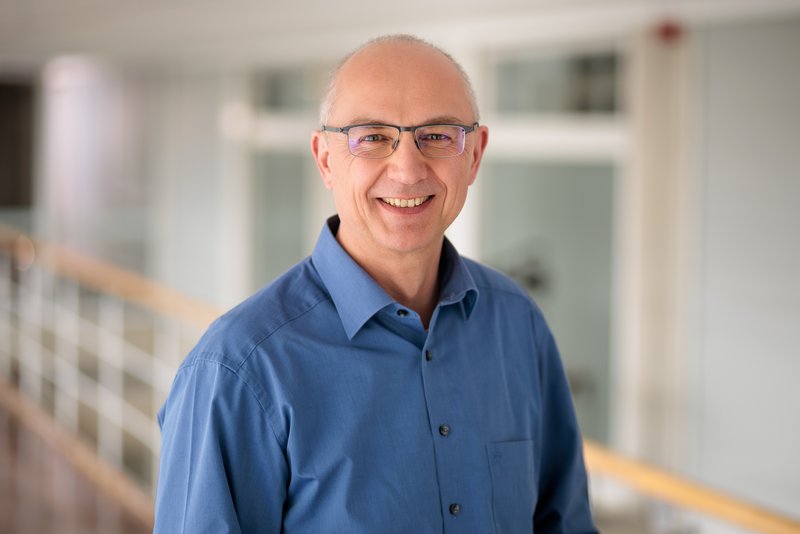
Prof. Peter Hertkorn is a full professor of Computer Science at Reutlingen University's Faculty of Computer Science, specializing in programming languages and databases. He holds leadership roles including Chair of the Examination Board for Media and Communication Informatics B.Sc. and BAföG Officer for the same program. His research focuses on model-driven software development, domain-specific languages, DevOps automation, interactive learning technologies, and distributed ledger technologies. He co-leads the Software Engineering and User Experience (swuxLAB) and Distributed Ledger Technologies (DLT-LAB) research groups. Education background includes a Diplom-Informatiker (master's equivalent) and Dr.-Ing. (PhD) from University of Stuttgart. Professional experience includes 5 years at T-Systems International GmbH and prior academic roles at University of Stuttgart. His teaching focuses on Software Engineering and Database Systems courses. Publications span interactive learning environments, collaborative innovation systems, and AR-based knowledge spaces. Active in academic service roles and interdisciplinary research collaborations since 2009.
Prof. Dr. Horst Oberquelle is an emeritus faculty member in the Department of Informatics at the University of Hamburg, associated with the Faculty of Mathematics, Informatics, and Natural Sciences. His primary role involves curating the Informatics Museum. He specializes in Human-Computer Interaction (HCI), Computer-Supported Cooperative Work (CSCW), and usability engineering. His research focuses on interdisciplinary design, user-centered systems, and the evolution of interactive technologies. Education details are not explicitly listed, but his academic career spans decades with contributions to HCI education and standards. Research interests include dynamic system design, collaborative systems, and the sociotechnical aspects of computing. Over 150 student theses have been supervised, reflecting his mentorship in HCI and related fields. Publications span from foundational HCI principles to applied research in groupware and usability. His work includes seminal contributions like the 'Memorandum on Human-Computer Interaction 2000' and editorship of key conferences like Mensch & Computer. He is a member of professional organizations like GI and FiFF. Notable projects include the development of the CommSy collaborative learning platform and contributions to the design of usable systems for freelancers and virtual organizations. His academic legacy includes shaping HCI education and fostering interdisciplinary collaboration in computing.
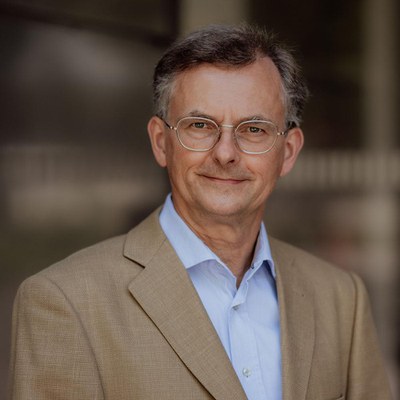
Prof. Dr. Gunnar Teege is a faculty member at the Institute for Computer Engineering within the Faculty of Computer Science at Bundeswehr University Munich. His career spans over two decades, focusing on distributed systems, virtualization, and formal verification of operating system components. He has led numerous research projects, including collaborations with institutions like the Runder Tisch GIS eV and the Bavarian State Office for Surveying and Geoinformation. Education: Diploma in Computer Science from Technical University of Munich (1985), Doctorate in Computer Science from TUM (1991) Affiliations: Member of GI (Gesellschaft für Informatik) and ACM (Association for Computing Machinery) Research interests include formal verification of software components for secure systems, virtualization frameworks, distributed systems, military communications, geospatial data interoperability via OpenGIS standards, computer-supported cooperative work (CSCW), and E-Learning platforms. His work often bridges theoretical and applied domains, particularly in defense IT systems and education technology. He has contributed to projects like Targeteam (XML-based adaptable teaching materials), HoBIT (high-security embedded systems), and MiKscHA (microkernel applications for high-security environments). His publications emphasize modularity, tailorability, and security in software design. Teaching activities at Bundeswehr University Munich include courses on operating systems, distributed systems, virtualization, and cybersecurity. Previously, he taught problem-based learning in computer science at TU Munich and developed virtual lectures for the Virtual University of Bavaria (vhb) from 2001–2005.
Prof. Dr. Alfred Taudes is a faculty member at the Vienna University of Economics and Business, affiliated with the Department of Information Processing and Process Management under the Institute for Production Management. His research spans Production Management, Strategic Management in High-Tech Industries, Real Options, Supply Chain Management, and SAP R/3 integration, with significant contributions to Quantitative Models of Learning Organizations. Key research areas: Production/Operations Management, Strategic High-Tech Industry Analysis, Real Options Theory Notable collaborations with researchers like Mild, Natter, and Dorffner Focus on empirical validation of models in marketing, supply chain optimization, and software platform decisions His publications demonstrate interdisciplinary trends combining Management Science , Information Systems , and Machine Learning . Recurring subfields include Neural Network Applications , Real Options Valuation , Consumer Behavior Modeling , and Process Migration in Distributed Systems . While no explicit scientific awards are listed, his work has been disseminated through leading journals and conference proceedings.
Prof. Dr. Stefan Edlich is a Professor at the Beuth University of Applied Sciences Berlin, leading the Data Science Master program and the Data Science Lab. He holds a Dr. med. Ing. and has authored 13 books, including the world's first NoSQL book. His research focuses on NoSQL databases, Big Data systems, AI applications in health, industry, and education, and data quality. Edlich organizes conferences on Big Data, functional programming, and Clojure, and manages the NoSQL Archive. He has been part of the Berlin Big Data Center (BBDC) since 2014. His work spans over 60 publications, with recent contributions in AI-driven healthcare, blockchain, and distributed systems. He advises students and maintains strong industry ties with companies like Zalando, Amazon, and IBM. His teaching excellence has earned him the 'Top 25 Lecturer' award multiple times at Beuth. Edlich's collaborations include projects like the MOMO mobile app for machine learning and the BBC-DaaS open-data platform. Research interests include data science applications in biodiversity, HCI innovations, and education technology. He actively contributes to open-source projects like Clarango (Clojure driver for ArangoDB) and advocates for data literacy through the Stifterverband initiative.
William J. Giraldo is a researcher in the fields of human-computer interaction, model-driven engineering, and interactive systems design. He has published extensively from 2007 to 2019, collaborating with prominent researchers such as Manuel Ortega, César A. Collazos, Ana I. Molina, and Oscar Pastor. His work appears in journals like Software Quality Journal , Information Systems , and Journal of Systems and Software , as well as conferences including Interacción, CAiSE, and CRIWG. His research interests include: Human-Computer Interaction (HCI) Model-Driven Engineering (MDE) Usability and quality in software modeling Interactive and groupware system design Educational technology and e-learning interfaces User interface development frameworks His recent publications focus on evaluating modeling language quality, integrating technical debt into MDE, participatory design for educational systems, and creating frameworks for UI development—especially for older adults and video-based systems. The articles show a consistent trend toward improving software quality, usability, and accessibility through model-based approaches. While no scientific awards are listed in the provided text, his collaborative work indicates strong integration within academic research networks in software engineering and HCI. He has contributed to advising and research teams, particularly in projects involving model-driven development of groupware and educational systems. His work often involves empirical studies and tool development, suggesting active engagement in both theoretical and applied research. William J. Giraldo has been involved in the development of frameworks such as the Activity Taxonomy (ATx) and tools for Android code generation from conceptual models, indicating a focus on practical, implementable solutions in software engineering and HCI.
Michael Hoeding is a Professor at the Brandenburg University of Technology in the Department of Economics . With expertise in network-based applications for commerce and electronic business, his work bridges databases, telecommunications, and enterprise systems. Specialization in database integration and legacy system modernization Key contributions to service-oriented architectures , XML , and SAP ERP optimization Focus on data warehousing (SAP-BI/SAP-BW) and wiki technology for knowledge management His research explores multimedia techniques in training and marketing, Oracle administration , and flash storage applications in database systems. He received the Forschungspreis (research award) from Otto-von-Guericke University Magdeburg in 1998. Notable recent work includes mobile learning applications , single-page website design , and Android development frameworks . His publications span topics from context-based querying to cooperative information systems , reflecting 25+ years of interdisciplinary research. Scientific Awards : Forschungspreis (1998) Grants : Research funding through Fraunhofer Institute participation Teaching : Courses in database systems , software engineering , and mobile applications
Prof. Wolfgang Prinz is affiliated with RWTH Aachen University and the Fraunhofer Institute for Applied Information Technology (FIT) in Sankt Augustin. He holds a professorship in the Department of Computer Science within the Faculty of Mathematics, Computer Science and Natural Sciences at RWTH Aachen. At Fraunhofer FIT, he leads the Cooperation Systems department and serves as deputy chair of the institute. His research focuses on innovative cooperation technologies, blockchain, Web3, mixed reality, and pervasive computing. Key areas include: Cooperative Software Systems and CSCW Groupware and Social Computing Enterprise 2.0 and Web 2.0 Blockchain and Decentralized Technologies Cooperative Knowledge Management Prof. Prinz teaches lectures, labs, and seminars on cooperation technologies, blockchain, and Web3. He is actively involved in supervising bachelor's and master's theses, particularly in blockchain-related topics. He also welcomes student research assistants (HiWi jobs) in this domain. While recent publications from his research group are listed, none are directly attributed to Wolfgang Prinz in the provided text. Therefore, no specific article trends can be reported. There are no scientific awards mentioned in the available information. Prof. Prinz advises students on thesis projects and leads research initiatives at Fraunhofer FIT. He is engaged in applied research collaborations, particularly in cooperation systems and emerging digital technologies. No specific grants are listed, but his leadership role suggests involvement in funded projects. He is a key member of the Cooperation Systems department at Fraunhofer FIT, which investigates cutting-edge topics such as blockchain, Web3, 5G, and mixed reality. His team works on both theoretical and applied aspects of cooperative technologies, bridging academic research with industrial applications.
Ludger Becker is an Academic Director at the University of Münster, where he has been working since December 2003. He currently serves as Head of the Information Security Unit since June 2023 and as CISO of the University of Münster since April 2023. Previously, he was Head of IVV5 from January 1998 to December 2023 and held positions as Senior Academic Councillor and Academic Councillor at the Institute of Computer Science at the University of Münster. Dr. Becker received his Doctor of Engineering (Computer Science) from the University of Siegen in July 1992 and completed his Diploma in Computer Science from the University of Dortmund in April 1989. His research spans several key areas in computer science, with particular expertise in database systems , geographic information systems , and software engineering . Dr. Becker has made significant contributions to spatio-temporal data management, developing frameworks for representing moving objects and efficient index structures for spatial queries. More recently, his work has expanded into health informatics, particularly in clinical data generation and literature database analysis. His teaching focuses on software engineering principles, databases, and object-oriented programming, as evidenced by his leadership of the Software Internship course. Dr. Becker's publication record shows a clear evolution from foundational work in spatial databases and GIS in the 1990s and early 2000s, through educational technology applications in the early 2000s, to more recent contributions in health informatics. His research consistently demonstrates expertise in data management challenges across multiple domains. Dr. Becker regularly teaches Software Internship, Databases, and Advanced Database Concepts courses at the University of Münster. His teaching materials show particular attention to software design processes, object-oriented principles, and modern development tools and frameworks, including detailed documentation on implementing @pre, @post, and @inv tags in Javadoc for specifying software contracts. As Head of the Information Security Unit and CISO, Dr. Becker oversees critical information security infrastructure and policies for the University of Münster, applying his technical expertise to protect academic data and systems across the institution's extensive network.
Prof. Dr.-Ing. Thomas Andreas Herrmann is a faculty member at the Department of Information and Technology Management (IMTM) within the Institute of Applied Work Science (IAW) at Ruhr-University of Bochum, Germany. With a career spanning decades, he specializes in socio-technical systems, human-computer interaction, and collaborative process design. Education : Master of Communication Science (1983) at University of Bonn, PhD in Computer Science (Software Engineering) at Technical University of Berlin (1986) Key Research : Design of socio-technical processes, creativity enhancement in service engineering, human-centered AI, privacy in collaborative systems, and organizational knowledge management. Article Trends : Recent work focuses on AI integration in socio-technical contexts, hybrid collaboration environments, and ethical system design. His publications bridge theoretical frameworks (e.g., heuristic evaluation) with practical applications in healthcare, education, and industrial settings. Grants & Projects : Led initiatives like KoLiBRI , MARIS , and SeeMe , funded by entities such as the German Federal Ministry of Education and Research (BMBF) and the European Union.
Prof. Dr. Petra Schubert is a Professor of Business Application Systems at the University of Koblenz-Landau, leading the Business Application Systems research group. She directs the Competence Center for Collaboration Technologies (UCT) and co-directs the Center for Enterprise Information Research (CEIR). Her work focuses on ERP systems, collaborative technologies, and digital workplace transformation. Education: Economics & IT Management from University of St. Gallen (PhD, Habilitation in Business Informatics from University of Basel). Prior roles include heading the Institute for Business Information Systems at FHNW and leading international projects like 3gERP at Copenhagen Business School. Research emphasizes enterprise collaboration systems (ECS), including the eXperience methodology for case studies and the IndustryConnect initiative. Projects like 2C-NOW investigate hybrid work practices using trace ethnography and log数据分析. She co-founded the UCT, operating the UniConnect platform, and collaborates with industry partners like HCL Technologies. Notable contributions include over 10 books on ERP implementation, 150+ case studies in eXperience databases, and participation in major conferences (HICSS, ECSCW). Her work bridges academic research with industry practice through initiatives like CEIR.
Prof. Wolfgang Prinz holds dual leadership roles as Vice Chair/Deputy Director at Fraunhofer Institute for Applied Information Technology (FIT) and Professor for Cooperation Systems at RWTH Aachen University. He leads the CSCW (Computer-Supported Cooperative Work) Research Department, driving innovation in collaborative technologies. His research bridges academic rigor and industrial application, with Fraunhofer FIT serving as a key implementation hub for his work. His research explores the intersection of human collaboration and digital systems, focusing on: Blockchain evolution : Developing applications for supply chains, education credentials, and administrative systems CSCW frameworks : Creating metrics for cooperative systems and social groupware Enterprise collaboration : Implementing Web 2.0/Enterprise 2.0 paradigms in organizational contexts Pervasive computing : Integrating games and IoT into cooperative environments Recent publications demonstrate strong emphasis on blockchain's transformative potential, accounting for over 60% of his 2018 research output. This work spans diverse domains including food safety, education, logistics, and identity management, consistently addressing security, decentralization, and regulatory compliance challenges. Prof. Prinz founded and directs the Fraunhofer Blockchain Lab, serving as both research facility and industry collaboration platform. He actively promotes knowledge transfer through workshops like 'Blockchain applications in administration and utilities' and delivers frequent keynote addresses at international conferences. His leadership extends to editorial roles in journals like Computer Supported Cooperative Work and conference chair positions for events including ACM GROUP and ECSCW.
Dr. Philipp Mock serves as a Research Fellow at the Leibniz Institute for Knowledge Media (IWM) in Tübingen, Germany, where he has been a core member of the Media Development Group since 2014. His technical expertise centers on developing machine learning algorithms and AI systems for human-machine interaction, with current responsibilities including software development and methodological consulting for ML applications. Education: PhD in Computer Science, University of Tübingen (2017) Diploma in Computer Science, University of Tübingen (2004-2011) Mock's research integrates Human-Computer Interaction with machine learning to analyze behavioral patterns through interaction data. His work spans multimodal interfaces, educational technology, and cognitive assessment systems, with particular focus on translating touch interaction metrics into predictors of cognitive states (ADHD risk, workload) and developing novel collaborative interfaces for tabletop displays. This interdisciplinary approach bridges computer science, cognitive psychology, and educational design to create adaptive systems that respond to user behavior in real-time. His publication trajectory reveals a clear evolution from foundational work on interactive surface technologies (2012-2015) toward sophisticated ML applications for behavioral analysis (2016-2018). Current projects like the longitudinal human-AI interaction study (2024-2026) demonstrate continued innovation in understanding long-term dynamics between users and intelligent systems, with strong emphasis on real-world educational and clinical applications. Mock actively contributes to multiple IWM research labs including Multimodal Interaction, Everyday Media, Perception and Action, and Knowledge Construction. His collaborative projects such as the human-AI interaction study span these labs, reflecting an integrated approach to studying how people interact with increasingly sophisticated AI systems across diverse contexts from museums to educational settings.