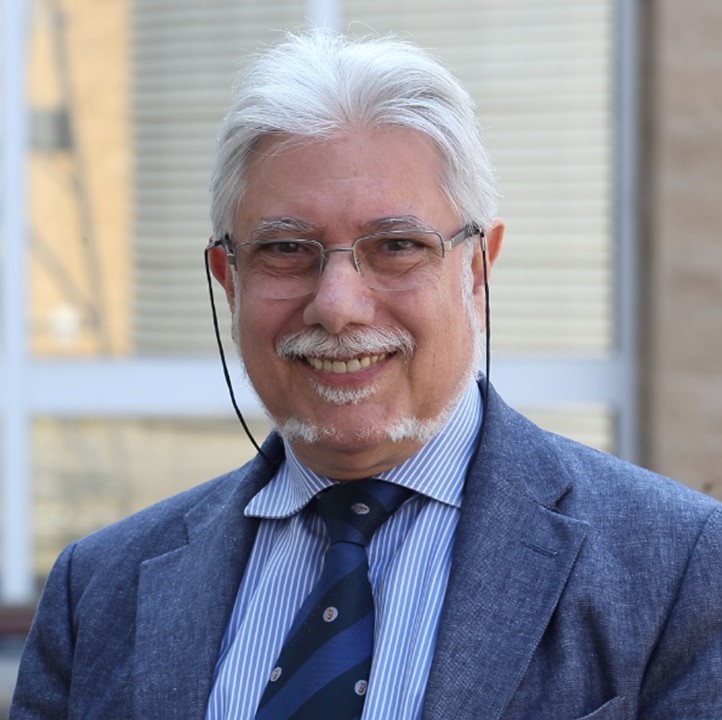
Claudio Luchinat is a Full Professor of Chemistry at the University of Florence, affiliated with the Department of Chemistry and the Magnetic Resonance Center (CERM). He co-founded CERM and currently leads the Interuniversity Consortium on Magnetic Resonance of Metalloproteins (CIRMMP). His research focuses on structural biology, paramagnetic NMR methodologies, and metabolomics. Notable contributions include integrating structural techniques (X-ray/NMR) for biomolecular accuracy, advancing Dynamic Nuclear Polarization (DNP) theory, and pioneering NMR-based metabolomics for disease biomarker discovery. Luchinat’s work spans metalloprotein studies, relaxometry applications, and MRI contrast agent development. He has been a key figure in metabolomics, publishing influential studies on Parkinson’s disease, cardiovascular risk, and cancer. His research bridges theoretical and applied domains, with global collaborations and invitations to international conferences as a keynote speaker. He holds roles as director of CERM and CIRMMP, and is recognized as a leading expert in structural and metabolic NMR. His lab develops novel statistical methods for metabolomics data analysis, emphasizing preanalytical standardization in multicenter studies.
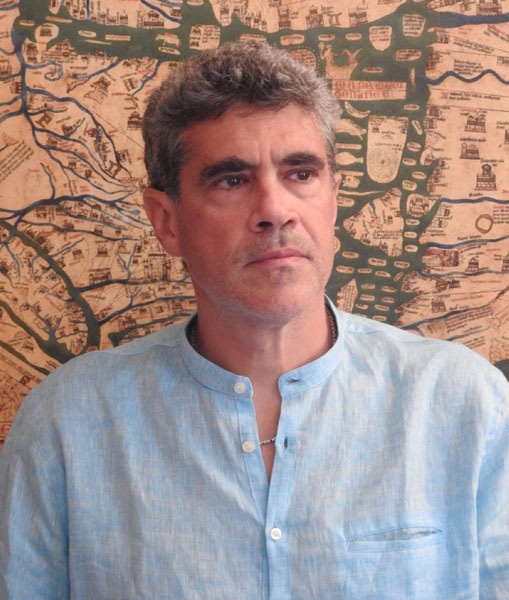
Valerio Acocella is a Professor at the Department of Science, University of Roma Tre, Italy. His academic career includes a Ph.D. in Earth Sciences from the University of Siena (1995-1999) and post-doctoral research on volcano-tectonics since 2001. He has held permanent research positions since 2006 and was promoted to Professor in June 2016. Acocella's research focuses on volcano-tectonics , caldera dynamics , volcano deformation , and dike propagation . He utilizes field studies, analogue/numerical modeling, and InSAR for analyzing tectonic and volcanic processes across global settings including Italy, Iceland, Ethiopia, Japan, and Central Andes. His recent publications (2022-2025) demonstrate expertise in magma flow rate analysis for eruption forecasting, caldera resurgence mechanisms, and volcano-tectonic interactions . Key projects include leadership of IAVCEI Caldera Commission (2010-2014) and research on Etna/Campi Flegrei volcanism. Valerio Acocella serves as Field Chief Editor for Frontiers in Earth Science , Editor in Chief for Frontiers in Volcanology , and Associate Editor for multiple journals including Journal of Volcanology and Geothermal Research . His work has resulted in >130 peer-reviewed publications with h-index 36 (ISI/Scopus) and 42 (Google Scholar) as of 2018.
Dr. Mohanad Al-Behadili is a Senior Research Associate in the Faculty of Technology at the University of Portsmouth, affiliated with the School of Mathematics & Physics and the Centre for Operational Research & Logistics. His research focuses on operational research, logistics optimization, scheduling algorithms, and unmanned systems. He holds a PhD in Operational Research, awarded in 2018. His work spans optimization methodologies such as swarm intelligence, facility location modeling, and multi-criteria decision analysis. Notable projects include optimizing emergency medical services in Hajj, developing routing strategies for unmanned vehicles in offshore wind farm inspections, and freight consolidation solutions in the Solent region. His research often addresses real-world challenges in transportation, energy, and healthcare sectors. Dr. Al-Behadili has contributed to over 14 peer-reviewed publications, including articles in Expert Systems with Applications , Baghdad Science Journal , and International Journal of Mathematics in Operational Research . His recent work explores the integration of autonomous systems and stochastic scheduling under dynamic conditions. He collaborates with industry partners and academic institutions to advance applications of operational research in complex logistics and transportation systems.
Dr. Xiang Song is a Senior Lecturer at the Department of Mathematics, University of Portsmouth, within the Faculty of Technology and School of Mathematics and Physics. He is affiliated with the Centre for Operational Research & Logistics and the Portsmouth AI and Data Science Centre. His research focuses on cutting and packing problems, operational research, logistics optimization, and artificial intelligence applications in supply chain management. He has held EPSRC-funded projects, including the LANCS Initiative in Foundational Operational Research (2008-2011) and contributed to projects like automated algorithm selection for cutting/packing problems (2004-2008). His research interests include unmanned vehicle routing for offshore inspections, maintenance planning for renewable energy infrastructure, stochastic supply chain modeling, and heuristic algorithms for complex optimization problems. He has published extensively in journals like European Journal of Operational Research and Expert Systems with Applications. His work bridges theoretical advancements with real-world applications in logistics, healthcare, and manufacturing. PhD: Jointly awarded by CIMS, Shenyang Institute of Automation (Chinese Academy of Sciences) and Université de Technologie de Troyes (2004) EPSRC Projects: Including strategic maintenance planning for offshore wind farms and blood supply network optimization in disaster scenarios His research outputs span 27 peer-reviewed articles, with recent work addressing carbon cost impacts on supply chains, multi-modal logistics in medical supply networks, and UAV/USV coordination for offshore inspections. He supervises PhD students and collaborates with industry partners on practical operational research challenges.
Madjid Soltani is an Adjunct Assistant Professor specializing in interdisciplinary research at the intersection of energy systems, biomedical engineering, and computational modeling. His work focuses on renewable energy storage technologies, nanomedicine, and personalized cancer therapies. He explores innovative solutions for energy transition challenges, including hydrogen production, battery advancements, and exergoeconomic assessments of energy systems. In biomedical applications, his research addresses drug delivery systems, tumor microenvironment modeling, and radiopharmaceutical therapies. His contributions span theoretical frameworks, computational simulations, and experimental validations. Key research interests include energy storage (e.g., compressed air, liquid air), theranostics, computational oncology, and exergoeconomic analysis. He has published extensively on topics such as biomass integration in energy systems, CRISPR-driven biosensors, and microfluidic tumor models. His work often bridges engineering and healthcare, emphasizing sustainability and precision medicine. Despite no explicit institutional affiliation listed, his research collaborations likely involve multidisciplinary teams in academia and industry. Research Themes: Renewable energy systems, nanomedicine, computational modeling, cancer therapy, exergoeconomics. Notable Contributions: Development of spatiotemporal models for radiopharmaceutical transport, optimization of energy storage frameworks, and bio-inspired thermal efficiency solutions.
Rex Ying is an Assistant Professor in the Department of Computer Science at Yale University's School of Engineering & Applied Science. His research focuses on developing expressive, scalable, and explainable algorithms for graph-structured data through graph neural networks and geometric learning. His work spans graph learning applications in recommender systems, anomaly detection, social network analysis, protein networks, drug discovery, and physical simulations. Key research thrusts include Non-Euclidean Foundation Models , Geometric Deep Learning , and Explainable AI for graph representations, with recent emphasis on hyperbolic geometry for hierarchical data modeling. Recent publications reveal strong trends in foundation models for scientific discovery (particularly spatial biology), hyperbolic adaptations of LLMs , and multimodal integration for biomedical applications. His lab actively bridges theoretical geometric learning with real-world applications in biology and physics. Baidu Scholarship 2019 Area Chair for LoG 2022 Conference Blue Sky Best Paper Award at ACM KDD 2025 NSF core program award on foundation models for scientific discovery Ying leads the Graph and Geometric Learning Lab, which develops open-source tools like PyTorch Geometric. He actively recruits PhD students for research on GNN frontiers, theoretical studies of graph learning, and applications in social/natural sciences. Recent grants include NSF funding for scientific foundation models and industry collaborations with Amazon/Ericsson. The lab maintains strong industry partnerships with telecom (Ericsson), healthcare (spatial omics), and social platforms, while organizing key workshops like Non-Euclidean Foundation Models at WebConf 2025 and Graph Signal Processing at GSP 2025.
Anurag Dalal is a PhD Research Fellow at the University of Agder's Department of Engineering Sciences, actively contributing to the Robotics and automation research group. His work focuses on cutting-edge computer vision and 3D reconstruction methodologies. His research interests center on Robotics , Computer Vision , and 3D Reconstruction , with specific expertise in neural rendering techniques and automated scene modeling. Current projects involve advancing Gaussian Splatting methodologies for real-time applications in robotics and virtual environments. Dalal's publication record demonstrates specialization in novel view synthesis and 3D scene representation, with a 2024 IEEE Access review establishing him as an emerging expert in point-based rendering techniques. His work bridges theoretical computer graphics with practical robotics applications. As a Research Fellow, he participates in the university's Robotics and automation research ecosystem, collaborating with senior researchers on projects involving 3D perception systems. His technical contributions support the department's focus on intelligent automation solutions.
Dr. Thomas Ploetz is a researcher at Newcastle University, specializing in human activity recognition, wearable technology, and machine learning applications across healthcare and agriculture. His work spans clinical applications such as stroke rehabilitation, mental health monitoring, and Parkinson's disease assessment, alongside agricultural advancements in livestock health and behavior analysis. He has pioneered methods using accelerometers and deep learning for automated health monitoring and behavior tracking in both humans and animals. Key projects include the WAVES initiative (using wristband accelerometers to motivate post-stroke arm exercises), automated detection of respiratory diseases in pigs, and the development of sensor-based systems for surgical skill assessment. His interdisciplinary collaborations involve experts from computer science, veterinary medicine, and clinical neuroscience. While no formal educational background is explicitly stated, his research demonstrates expertise in sensor data analysis, machine learning algorithms, and human-computer interaction. Dr. Ploetz's contributions include over 150 publications (selected in the articles list) on topics like activity recognition models, health monitoring systems, and smart environment technologies. His work emphasizes practical applications of ubiquitous computing in healthcare, agriculture, and education.
Dr. Robert Loftin is a Lecturer in Machine Learning at the University of Sheffield’s School of Computer Science. His research focuses on Ad Hoc Human-AI Cooperation, Human-AI Alignment, and Human-in-the-loop Machine Learning, with expertise in Deep Reinforcement Learning and Multi-Agent Systems. He holds a PhD from North Carolina State University (2019) and a Bachelor’s from Georgia Tech (2011). Postdoctoral work includes roles at Microsoft Research Cambridge and TU Delft, exploring AI applications in gaming and multi-agent cooperation. His research interests span AI ethics, human-robot interaction, and games, with a strong emphasis on practical applications of interactive learning. Recent work includes advancements in entropy-based coordination for multi-agent systems (2023–2025) and theoretical studies on cooperation in socially rational agent populations. He contributes to the Machine Learning research group and has published extensively in top venues like NeurIPS, AAMAS, and AAAI. Publications highlight innovations in curriculum design, exploration strategies, and adaptive feedback mechanisms. His work bridges theoretical foundations and real-world applications, particularly in cooperative and competitive multi-agent environments. Current projects explore safe team coordination and scalable strategies for high-dimensional state spaces.
Maurizio Caon is a Full Professor and Head of Institute at the Fribourg School of Management (HES-SO), specializing in Human-Computer Interaction and Digital Transformation. His research focuses on health technology interventions for aging populations and adolescents, with a particular emphasis on e-coaching systems, wearable devices, and participatory design. He leads EU-funded projects like NESTORE (2017-2021), developing virtual coaches for older adults' well-being, and PEGASO (2013-2017), targeting adolescent health through gamified mobile platforms. Education: Not explicitly stated in text, but expertise in Ergonomics and Information Systems is implied through research focus. Research Interests: Designing human-centered technologies for health promotion, including tangible interfaces, behavior change models, and cross-cultural co-design. Key areas include aging workforce strategies, digital self-tracking, and ethical data practices. His work bridges HCI, healthcare innovation, and social impact. Publications highlight innovations in e-coach systems (e.g., NESTORE's multi-domain pathway), wearable technology's psychological impact, and VR exergames for seniors. Projects involve partnerships with Politecnico di Milano, EIA HumanTech Institute, and international teams. Grants: Principal investigator and co-investigator on EU H2020 and FP7 grants totaling over 890,000 CHF. Team: Collaborates with researchers like Leonardo Angelini, Elena Mugellini, and Omar Abou Khaled on interdisciplinary projects. Labs/Teams: Leading the NESTORE and PEGASO teams, focusing on digital health solutions for aging and youth populations. Involved in design processes for inclusive public spaces and ergonomic interfaces for cyclists.
Azalia Mirhoseini is an Assistant Professor of Computer Science at Stanford University and founder of the Scaling Intelligence Lab. She also serves as a Senior Staff Scientist at Google DeepMind. Her research focuses on scalable and self-improving AI systems, including advancements in chip design automation, large language models, and reinforcement learning applications. Prior roles include co-founding the ML for Systems team at Google Brain. Education: BSc in Electrical Engineering from Sharif University of Technology; PhD in Electrical and Computer Engineering from Rice University. Awards include MIT Technology Review’s 35 Under 35 and Best ECE Thesis Award. Research highlights include AlphaChip (deep RL for chip layout optimization), Mixture-of-Experts (MoE) architectures, and Constitutional AI frameworks for alignment. Her work bridges AI and systems, addressing real-world challenges in hardware design and scalable AI. Key contributions span over 50 publications in top venues like Nature , NeurIPS , and ICLR . Media coverage includes MIT Tech Review, IEEE Spectrum, and WIRED. Teaching includes CS229s: Systems for Machine Learning. Labs/Teams: Scaling Intelligence Lab (Stanford), collaborations with Google Research/DeepMind. Advising/Grants: Mentors students through Stanford; her work is funded via industry-academic partnerships.
Jonggi Hong is an Assistant Professor in the Department of Computer Science at Stevens Institute of Technology, affiliated with the Charles V. Schaefer, Jr. School of Engineering and Science. He holds a PhD from the University of Maryland (2021) and MS/BS degrees from KAIST (2014/2012). His research focuses on accessibility technologies, human-computer interaction (HCI), and AI applications, particularly addressing challenges for visually impaired users through machine learning and assistive systems. He has conducted research at Microsoft Research, Adobe Research, and the Smith-Kettlewell Eye Research Institute. His work explores user-system interactions via quantitative and qualitative methods, including studies on speech/image recognition errors, VR training for blind photography, and wearable haptic interfaces. Key projects include teachable object recognizers for non-experts and error detection in digital content. Hong serves as a Workshop Chair and Program Committee member for the ACM SIGACCESS ASSETS conference, promoting inclusive design principles in technology. Publications span venues like CHI, ASSETS, and W4A, emphasizing real-world accessibility solutions. His grants and advising activities are not explicitly listed, but he leads research on assistive machines, inclusive design, and AI-infused systems. Hong actively contributes to professional societies like ACM and maintains affiliations with labs such as the Intelligent Assistive Machines Lab.
Subhabrata Mukherjee is a prominent researcher in the fields of Machine Learning and Natural Language Processing. His work focuses on advancing techniques such as model compression, multimodal learning, and credibility analysis. He holds a Ph.D. from Saarland University (2017), where he explored probabilistic graphical models for credibility analysis in online communities. His research spans topics including large language models (LLMs), knowledge distillation, and ethical AI. Key contributions include the development of retrieval-augmented generation frameworks, cost-efficient LLM architectures, and systems for mitigating misinformation. His work bridges theoretical advancements with practical applications in healthcare, social media, and multilingual systems. Collaborations with institutions like Microsoft and academic networks highlight his interdisciplinary approach to AI challenges. Research Highlights: Developed GraphRAG for integrating graph structures into generative models Pioneered Hybrid LLM architectures balancing efficiency and quality Advanced techniques for hallucination reduction in LLMs Contributed to fake news detection systems like DeClarE Explored experience-aware recommendation models His publications reflect sustained innovation across NLP, ML systems, and ethical AI, with impactful contributions to both academic conferences (ACL, NeurIPS, KDD) and industry research.
Tony Anosike is a Senior Lecturer in Logistics and Supply Chain Improvement at the College of Business, Law and Social Sciences. His research focuses on supply chain optimization, circular economy frameworks, sustainability in manufacturing, and the integration of lean practices with emerging technologies like IoT. He has contributed to over 15 peer-reviewed articles since 2014. Research highlights include: Developing a conceptual model for circular economy readiness in SMEs (2021) Exploring synergies between lean manufacturing and IoT (2021) Designing decision-support frameworks for sustainable product lifecycle management (2020) Analyzing electric vehicle adoption challenges in last-mile delivery (2021) His work bridges theoretical research and practical implementation, often using methodologies like systematic reviews and Delphi studies. No specific scientific awards are listed in the provided information. Advising and grant activity details are not explicitly stated in the text. Collaboration networks include researchers from Coventry University and institutions like IIM Shillong. His research outputs have been viewed over 4,381 times and downloaded 1,033 times, indicating significant academic engagement.
Aaron M. Yoder, PhD , is an Associate Professor jointly appointed in the Department of Biological Systems Engineering at the University of Nebraska–Lincoln (UNL) and the Department of Environmental, Agricultural and Occupational Health at the University of Nebraska Medical Center (UNMC). He devotes 10 % effort to UNL and 90 % to UNMC, directs or co-directs the Central States Center for Agricultural Safety and Health (CS-CASH) and Nebraska AgrAbility , and is a key faculty member of the Biomedical Engineering, Health, and Safety Systems emphasis area. Education & Certifications: PhD — field not explicitly stated in text, but research record indicates advanced training in agricultural safety/ergonomics/biomedical engineering. Research Interests: Yoder’s work sits at the intersection of engineering, public health, and behavioral science . He designs and evaluates technology-enabled interventions —from wearable sensors that monitor heat strain during field work to immersive virtual reality modules that teach youth safe tractor operation. His portfolio spans: ergonomic redesign of agricultural machinery for vulnerable populations (women, aging farmers, workers with disabilities); implementation-science approaches that translate evidence-based safety programs into real-world practice across U.S. states and low-middle-income countries; use of social marketing and narrative storytelling to shift attitudes and behaviors around roll-over protective structures (ROPS), all-terrain vehicles, and colorectal cancer screening in rural communities; real-time IoT dashboards for first responders and heavy-machinery operators that fuse environmental and physiological data to prevent injury and illness; mental health and substance-use surveillance among farming populations, with recent work in Nigeria and the Central States cattle-feeding sector. Publication Trends: Across the 15 most recent papers (2023-2025) a clear trajectory emerges: rigorous mixed-methods evaluation of large-scale safety interventions ; integration of wearable sensors, VR, and IoT into occupational health practice; and a growing global focus on low-resource settings. Heat-stress mitigation, cancer-screening promotion, and ATV/ROPS safety dominate the engineering–public-health interface. Scientific Awards & Recognition: No specific awards are enumerated in the supplied text. Funding, Leadership & Mentorship: Principal or Co-Investigator on numerous CDC/NIOSH and USDA-NIFA grants supporting CS-CASH, AgrAbility, and international collaborations. Leads multidisciplinary teams of engineers, epidemiologists, extension educators, and community partners across Nebraska, the Midwest, and sub-Saharan Africa. Active mentor to graduate students and post-doctoral fellows in Biological Systems Engineering and the College of Public Health (specific student names not provided). Labs & Centers: Yoder directs activities within the Central States Center for Agricultural Safety and Health (a CDC/NIOSH-funded Agricultural Safety and Health Center) and Nebraska AgrAbility (USDA-NIFA), leveraging state-of-the-art motion-capture, sensor fabrication, and VR development laboratories shared between UNL and UNMC.