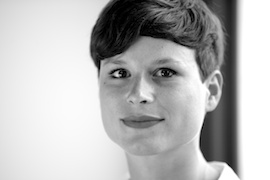
Kalja Kanellopoulos serves as a Researcher at the Institute for Media Research within the Faculty of Philosophy at Chemnitz University of Technology. Since April 2012, she has been integral to the DFG-funded Research Training Group 'CrossWorlds' (Connecting Virtual and Real Social Worlds), conducting interdisciplinary work at the intersection of social sciences and computer science to overcome constraints in media-mediated communication through studies of communication, emotions, sensomotorics, and learning. Her academic foundation includes a Magister degree (Master's equivalent) in Sociology, General Rhetoric, and Modern German Literature (2004-2011), featuring an international semester at the National and Kapodistrian University of Athens (2007-2008). Prior professional experience encompasses research assistance for the 'Historical Dictionary of Rhetoric' at Tübingen University (2010-2012) and industry work at CeveyConsulting GmbH (2006-2010). Kanellopoulos specializes in Qualitative Social Research, Science and Technology Studies, and Human-Computer Interaction, with concentrated focus on museum contexts. Her ethnographic doctoral project examines innovative communication at interactive museum interfaces under Prof. Claudia Fraas' supervision. She develops frameworks merging design thinking with social inquiry to investigate materialities and aesthetics of digital systems, emphasizing playful interaction and user experience in cultural spaces. Her 2012-2014 publications reveal strong thematic cohesion around interactive museum technologies, particularly multitouch and tabletop systems. These works demonstrate consistent application of Human-Computer Interaction principles to cultural education, with recurring emphasis on collaborative interfaces, visitor experience optimization, and interdisciplinary co-design. The research consistently emerges from CrossWorlds' collaborative environment, reflecting integration of social science methodologies with technical development. As an active member of ACM, Deutsche Gesellschaft für Soziologie (including its Qualitative Methods section), European Sociological Association, and Gesellschaft für Informatik (including Human-Computer Interaction groups), she bridges computational and social domains. Her DFG-funded CrossWorlds work (2012-2018) established platforms for examining virtual-real social connections through interdisciplinary teamwork. Kanellopoulos operates within CrossWorlds' interdisciplinary network of computer scientists and social scientists, contributing to projects that analyze communication constraints across virtual-real boundaries. Her team develops methodological approaches for studying interaction in cultural contexts, producing collaborative outputs for ACM conferences and INTERACT, while advancing understanding of digital systems in educational and heritage settings through materiality-focused investigations.