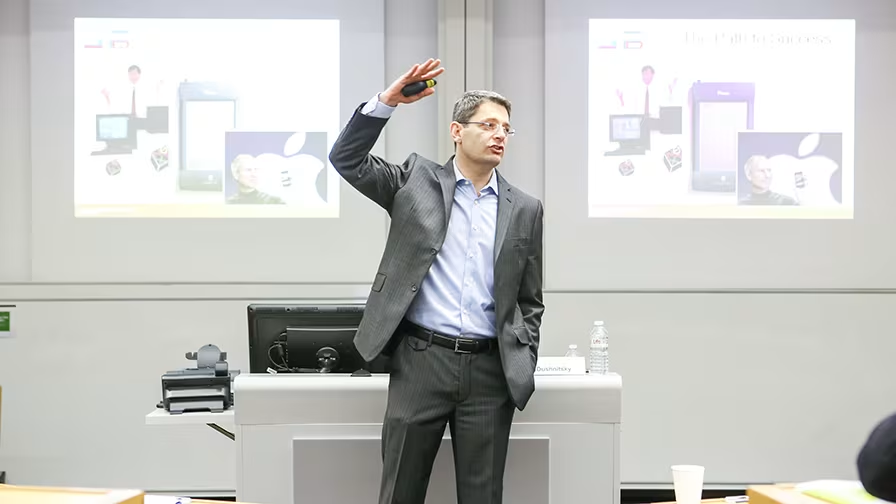
Professor Gary Dushnitsky is a Professor of Strategy and Entrepreneurship at London Business School. He holds a PhD from New York University and serves as a Senior Fellow at the Mack Institute for Innovation Management, Wharton School, University of Pennsylvania. Research Interests: Economics of innovation and entrepreneurship Corporate venture capital dynamics Crowdfunding and accelerator ecosystems Intellectual property rights in knowledge industries Recent Trends in Publications: His work spans venture capital ecosystems, platform business models, investor behavior, and innovation management. Notable topics include corporate-startup collaboration, environmental factors in funding decisions, and platform-enabled entrepreneurial growth. Scientific Awards: 2013 SMS Emerging Scholar Award 2009 Kauffmann Junior Faculty Fellowship Multiple best dissertation prizes Editorial Roles: Co-Editor at Strategic Entrepreneurship Journal and Senior Editor at Organization Science .
Thomas Bauer is a researcher at the University of Natural Resources and Life Sciences, Vienna (BOKU), affiliated with the Department of Agricultural Sciences. He specializes in geomatics, remote sensing, and geographic information systems (GIS) with a focus on land use monitoring, citizen science applications, and sustainable land management. PhD in Natural Sciences (2001, Vienna University of Technology) MSc in Natural Sciences (1996, University of Vienna) Research Interests include: Geospatial analysis for environmental monitoring Integration of citizen science data in ecological studies Remote sensing applications in agriculture and forestry Land use change detection and sustainable intensification Animal movement tracking using GPS and accelerometers He has presented at 18 international conferences (Austria, Colombia, Germany, Italy, Lithuania, Netherlands) and contributed to collaborative projects like the Roadkill citizen science initiative. His work bridges geospatial technology with environmental science, emphasizing practical implementation and interdisciplinary approaches.
Wei Hu is a full Professor and Ph.D. supervisor in the Department of Computer Science and Technology at Nanjing University, China. He earned his Ph.D. and B.S. from Southeast University in 2009 and 2005, respectively, and joined Nanjing University faculty in 2009. He has held visiting positions at Stanford University (2014-2015), University of Texas at Arlington (2016-2017), and University of Toronto (2017) as a visiting scholar/professor. Research Interests focus on Knowledge Graphs : Representation learning, foundation models, and error detection Databases : Entity alignment, crowdsourcing, and blockchain integration Digital Medicine : Collaboration with Nanjing University's National Institute of Health Data Science Publication Trends show expertise in knowledge graph reasoning, federated learning, and biomedical applications. Recent works include in-context learning for graph reasoning and blockchain-based data fusion systems. Scientific Awards include Huawei 2025 Challenges Spark Award ASE 2024 Distinguished Paper Award CHIP 2021 Best Paper Award CCKS 2018 Best English Paper Award Nanjing University Study Abroad Program Awardee (2013) IBM China Excellent Student (2008) Advising involves leading the Knowledge Fusion Group at Nanjing University, mentoring 18 current and former Ph.D. and Master's students. Professional services include editorial roles at Transactions on Graph Data and Knowledge and Big Data Research , plus committee memberships in CCF, CIPSC, and JSCS.
Bhaskaran Raman is a Professor in the Department of Computer Science and Engineering at the Indian Institute of Technology Bombay, where he leads research in networking systems with a focus on practical applications in developing regions. His work spans wireless networking, sensor systems, and mobile computing, with recent expansion into AI-assisted educational technologies. His research interests include wireless mesh networks for rural connectivity, transportation systems monitoring, mobile sensing applications, and educational technology. Notably, his lab has developed innovative solutions like Road-RFSense for traffic estimation in developing regions, FullStop for monitoring unsafe bus stopping behavior, and more recently, AI systems for automatic short answer grading with feedback. Analysis of his publication trends shows a consistent focus on practical networking challenges with strong emphasis on real-world deployment, particularly in resource-constrained environments. In recent years, he has expanded his research to include AI applications in education while maintaining his core expertise in systems research. Raman has mentored numerous graduate students who have become active researchers in networking and systems areas, with many continuing to collaborate with him on publications. His research has been supported by various grants focused on networking for developing regions and smart transportation systems. His lab at IIT Bombay focuses on building practical networking solutions with real-world impact, particularly for transportation safety and educational applications. The team combines expertise in wireless systems, mobile computing, and increasingly, artificial intelligence to address complex challenges in these domains.
Mauro Caputo is a Full Professor at the University of Salerno, Department of Industrial Engineering (DIIN), based at the Fisciano Campus in Building E, Room 018. With over 77 publications and 2,215 citations, he maintains regular reception hours on Mondays and Thursdays from 2:30 PM to 4:30 PM. His research bridges theoretical frameworks with practical applications across multiple industries, particularly in digital transformation and sustainable innovation. Professor Caputo's research spans several interconnected domains with a strong focus on supply chain management and digital transformation. His primary interests include the integration of emerging technologies like blockchain, IoT, and RFID within industrial contexts. He has extensively studied open innovation practices and their impact on business performance, with special attention to sustainable development applications. His recent work explores Industry 4.0/5.0 technologies, examining how AI and other digital tools can enhance production systems while advancing sustainable development goals. The smartphone industry has been a recurring case study in his research on knowledge management and component supplier relationships, where he employs patent analysis and big data techniques to measure innovation impact. Analysis of Professor Caputo's publication trends reveals a strategic evolution toward integrating digital technologies with sustainability objectives. His work demonstrates increasing focus on how Industry 4.0 technologies can be strategically implemented to achieve Sustainable Development Goals across supply chains. A notable pattern is his methodological approach, frequently employing patent analysis and big data techniques to measure innovation impact. His research increasingly addresses the metaverse and Web3 technologies, examining their business implications while maintaining a strong emphasis on triple bottom line considerations - environmental, social, and economic impacts of technological adoption. Professor Caputo has formed a productive research group with collaborators including Antonello Cammarano, Francesca Michelino, and Vincenzo Varriale. His work appears to have practical industry applications, particularly in the agri-food sector (as evidenced by his cheese supply chain research) and high-tech manufacturing. While specific grant information isn't detailed in the available materials, his extensive publication record suggests successful funding for multiple research projects focused on digital transformation and innovation management.
Professor Melissa Hart serves as the Associate Director - Training and Leadership at the ARC Centre of Excellence for 21st Century Weather , affiliated with the Institute for Marine and Antarctic Studies at the University of Tasmania. She specializes in urban climate research, thermal comfort, and air quality, with a focus on cross-institutional collaboration and climate education. Email: melissa.hart@utas.edu.au Co-Chair, World Climate Research Programme Training Academy Her research explores: Urban heat island effects and microclimate dynamics Integration of citizen science in climate monitoring Thermal comfort modeling and climate-sensitive design Impacts of extreme weather on educational environments Recent publications investigate: Machine learning applications for outdoor thermal sensation Building height variability in urban canopy flow Land surface temperature dynamics Smartwatch-based ambient temperature measurement Scientific recognition : UNSW Vice-Chancellors Award for Higher Degree Research Leadership She leads national researcher development programs and contributes to global climate discourse through modeling advancements and interdisciplinary studies.
Prof. Dr. Martin Przewloka is a faculty member at the Department of MND at Technische Hochschule Mittelhessen. His expertise spans technologies such as Augmented Reality, Virtual Reality, Image Recognition, Parallel Computing, and Industry 4.0, with a focus on applications in healthcare, logistics, and developing countries. Department of MND, Technische Hochschule Mittelhessen Email: martin.przewloka@mnd.thm.de His research interests include Mobile Applications , Real-time Systems , 3D Printing , and Internet of Things (IoT) . He explores how these technologies intersect with Industrial Process Management , Smart Grids , and Public Sector Innovations . Recent work highlights Generative AI in self-service retail and mobile health solutions for chronic disease management. Prof. Przewloka's publications reflect trends in Mobile Empowerment , Crowdsourcing , and In-Memory Computing . His 2024 articles address AI industrialization and gamification in healthcare, while earlier works (2013–2015) focus on disruptive mobile business models and SAP HANA's role in enterprise analytics.
Eike Mark Rinke is a Lecturer in Politics and Media in the School of Politics and International Studies , Faculty of Social Sciences , University of Leeds since 2019. He also serves as Co-Director of the Centre for Democratic Engagement , School Open Research Lead, and Local Network Lead for the UK Reproducibility Network (UKRN) . Previously he was a post-doctoral researcher at the Mannheim Centre for European Social Research (MZES) and a visiting scholar at the University of Washington and İzmir University of Economics . Education Dr. phil. Media and Communication Studies – University of Mannheim MA Media and Public Affairs – George Washington University BA Communication Studies and Social Sciences – University of Erfurt Research Interests Rinke’s work straddles empirical and normative dimensions of political communication. On the micro-level he examines how individual journalists and citizens discuss political events, while on the macro-level he evaluates the democratic quality of these discourses across campaigns, protests, and everyday life. A second major strand involves meta-research and open scholarship: he studies transparency, reproducibility, and the sociology of scientific practices, leading initiatives such as the UKRN Leeds hub, BITSS Catalyst activities, and SocArXiv moderation. Publication Trends Across the past fifteen years his peer-reviewed output has shifted from agenda-setting, framing, and anti-Americanism (2011-2016) toward open-science advocacy and meta-research (2019-2024). Recent high-impact articles in PNAS and Nature Human Behaviour illuminate hidden analytical variability in social-science findings, while comparative projects in International Journal of Press/Politics dissect outrage and civility in global public debates. Computational methods—topic modelling, sentiment analysis, multi-analyst designs—feature prominently in this corpus. Scientific Awards & Recognition ICA Outstanding Dissertation in Political Communication (2017) ICA Gene Burd Outstanding Dissertation Award (2015) AAPOR Burns “Bud” Roper Fellow Award (2016) APSA Political Psychology Distinguished Junior Scholars Award (2015) University of Leeds Research Culture Award – Open Research Practices (2024) Advising & Grant Activity Rinke supervises undergraduate and postgraduate modules on political communication and meta-research, and welcomes PhD applications in media & democracy, public deliberation, journalism studies, and open scholarship. While specific grant numbers are not provided, his coordination of 161 researchers in the PNAS many-analyst study illustrates capacity to secure large-scale collaborative funding. Labs, Teams & Networks Co-Director, Centre for Democratic Engagement Member, Centre for Contemporary Political Theory Local Network Lead, UK Reproducibility Network BITSS Catalyst, Berkeley Initiative for Transparency in the Social Sciences Moderator, SocArXiv open preprint archive Editorial Board member, Oxford Research Encyclopedia of Communication Associate Editor, Political Communication
Alexander Hartelt is a researcher at the Institute of Computer Science, Faculty of Mathematics and Computer Science, University of Würzburg. He works at the Chair of Artificial Intelligence and Knowledge Systems (Computer Science VI) focusing on computer vision applications for historical document digitization. His research interests include: Computer Vision for historical document analysis Layout recognition and segmentation algorithms Optical character recognition (specializing in handwritten documents) Deep learning-based information extraction Digital preservation of cultural heritage materials Hartelt's recent publications demonstrate strong focus on medieval music manuscripts and historical print digitization. His work combines contour-based segmentation, deep learning networks, and open-source tool development to address challenges in historical document processing. Key application areas include music notation transcription and OCR for aged printed materials. Hartelt has been actively teaching since Winter Semester 2020/21, supervising: Artificial Intelligence I exercises Current Trends in Artificial Intelligence seminars Software internship topics His primary research projects include: Corpus Monodicum : Researching, transcribing and editing historically significant monodic music collections using the Ommr4all transcription tool Segmentation of Old Prints : Developing algorithms for segmentation and transcription of historical printed materials using pixel classifiers, contour-based approaches, and baseline detection methods
J.C. Scholtes is an Extra-ordinary Professor of Text Mining at the Department of Knowledge Engineering, Faculty of Science and Engineering, University of Maastricht. He is also a Senior Research Fellow at the Dutch School for Information and Knowledge Systems (SIKS), a Board Member at IPRally, and a Venture Partner at ENDEIT Capital. M.Sc. in Computer Science from Delft University of Technology Ph.D. in Computational Linguistics from University of Amsterdam His research expertise spans Natural Language Processing, Machine Learning, and Artificial Intelligence, with applications in legal, medical, business, and regulatory domains. He focuses on text mining, machine translation, question-answering systems, and information extraction from unstructured data. Recent publications (2024–2025) emphasize context-aware machine translation, misinformation detection in recommendation systems, healthcare data analysis, and food science applications. Key themes include integrating deep learning architectures (e.g., Transformers), optimizing search and translation efficiency, and leveraging hybrid human-machine approaches. He has collaborated widely in industry and academia, notably deploying e-discovery software for institutions like the UN War Crimes Tribunals and FBI-ENRON. His career history includes leadership roles at ZyLAB (1987–2021) and prior service in the Royal Dutch Navy.
Fadila Bentayeb is an Associate Professor (HDR) at the University of Lyon 2, affiliated with the ERIC Laboratory and the Department of Informatics and Statistics (DIS). She leads the Complex Data Warehousing and OLAP research team (SID) and has served as Head of the first year of the Master's degree in Computer Science at the Institute of Communication (ICOM) since 2014. Her work bridges academic research and practical applications in data-intensive systems. HDR (Habilitation to Direct Research), University of Lyon 2 (2011) Ph.D. in Computer Science, University of Orléans (1998) Her research focuses on NoSQL data warehouses, text warehousing, and personalization systems, with emphasis on scalable architectures and context-aware analytics. Recent work explores AI-driven security in IoT networks and temporal modeling for evolving data structures. Key trends in her publications include: (1) Graph-based multidimensional modeling (GAMM framework), (2) Optimization of distributed big data warehouses using machine learning, (3) Medical text classification via hybrid CNN-LSTM models, and (4) Temporal data warehouse evolution. As part of the ERIC Laboratory’s leadership team, she contributes to strategic research directions and mentors students in advanced data systems. Her technical expertise extends to Hadoop/Spark optimization, OLAP cube design, and semantic integration of heterogeneous data sources.
Professor Brian Fitzgerald is a leading academic in software engineering and information systems. He holds the Frederick A Krehbiel II Chair in Innovation in Business and Technology at the University of Limerick and serves as Director of Lero – the Irish Software Research Centre. His work bridges academic research and industry collaboration, with a focus on global software development practices and innovation. University: University of Limerick Role: Director of Lero (Irish Software Research Centre) Rank: Professor His research interests span software engineering methodologies, including agile and lean approaches, open source/inner source development, global software engineering, and the impact of software on societal values through the TREES programme. He has contributed extensively to top-tier journals like MIS Quarterly, Information Systems Research, and IEEE Transactions on Software Engineering. Key Trends: Agile methods, open source adaptation, global collaboration frameworks, and ethical software engineering Recent Focus: Trustworthy, responsible, and efficient software engineering (TREES) with Huawei Professor Fitzgerald has received prestigious accolades such as the AIS Fellow award and best paper awards at ICIS and Open Source Software Conferences. He currently leads large-scale funded projects like the €6m Huawei collaboration and has served as President-Elect of the Association for Information Systems (AIS). Scientific Awards: AIS Fellow award (2017) ICIS Best Conference Theme Paper award (2000) Best Conference paper award (2005) He has mentored numerous researchers and contributed to editorial boards of leading journals, while maintaining a strong focus on translating academic research into industry impact through Lero’s initiatives.
Franka Grubišić is a Lecturer at Algebra Bernays University , with a focus on Computer Science , Geospatial Science , and Design . She holds a specialist undergraduate degree in Multimedia Computing (2019) and a graduate degree in Computer and Systems Sciences from Stockholm University (2023). Her work bridges creative and technical domains, including public transport systems, resilient societies, and humanitarian technology. Education: Specialist in Multimedia Computing (2019), Graduate in Computer and Systems Sciences (2023) Fields of Interest: Computer Science, Design, Sustainable Development, Geospatial Science Her research emphasizes geodesign , spatial data infrastructure , and human-centered technology , with applications in public services, crisis management, and smart cities. Recent publications highlight biomimetic geodesign , value mapping tools , and augmented reality cartography . She has received multiple Dean's awards , Rector's awards , and international recognitions. Her business consulting focuses on service design , user experience , and technical system optimization .
Marina Sirota is a Professor of Pediatrics at the University of California, San Francisco (UCSF) School of Medicine and the Acting Director at the Bakar Computational Health Sciences Institute. She leads the UCSF March of Dimes Prematurity Research Center and co-directs ENACT, a center focused on precision medicine for endometriosis. Dr. Sirota is also the founding director of the AI4ALL program at UCSF, which introduces high school girls to AI applications in biomedicine. Education: B.S. in Biomedical Computation, Stanford University (2006) M.S. in Biomedical Informatics, Stanford University (2006) Ph.D. in Biomedical Informatics, Stanford University (2010) Dr. Sirota's research focuses on developing computational integrative methods for disease diagnostics and therapeutics, with special emphasis on women's health. Her work spans biomedical informatics, integrative genomics, clinical data analysis, immune informatics, and data science. She applies advanced computational approaches to understand complex biological systems and translate findings into clinical applications, particularly in the areas of preterm birth, endometriosis, and Alzheimer's disease. Her recent publications demonstrate a strong focus on precision medicine applications across multiple disease areas including women's health, neurodegenerative disorders, and immunology. Dr. Sirota frequently employs cutting-edge techniques like single-cell genomics, transcriptomics, and AI-driven approaches to analyze complex biological data. Her research shows particular strength in sex-specific analyses and the application of computational methods to understand disease heterogeneity. Scientific Awards: AMIA Young Investigator Award (2017) Dr. Sirota has secured significant research funding from multiple sources including NIA, NLM, NIAMS, Pfizer, March of Dimes, and the Burroughs Wellcome Fund. Her current projects include studies on endometriosis, preterm birth, Alzheimer's disease, and immune-related disorders. She mentors numerous students and researchers in computational health sciences and has co-authored over 170 scientific publications. Her laboratory actively collaborates with clinical and basic science researchers across UCSF and other institutions. Dr. Sirota directs the Bakar Computational Health Sciences Institute at UCSF and leads multiple research centers focused on women's health, including the March of Dimes Prematurity Research Center and ENACT (Endometriosis: Novel Clinical Approaches Through Technology). Her team combines expertise in bioinformatics, machine learning, clinical medicine, and basic science to advance precision medicine approaches for complex diseases.
Anne-Marie Nussberger is a Research Scientist at the Center for Humans and Machines, Max Planck Institute for Human Development in Berlin, where she has worked since June 2021 under PI Prof. Iyad Rahwan. Her research investigates how intelligent machines shape human beliefs, values, and behavior through interdisciplinary approaches. Her academic background includes: Postdoctoral fellow at Center for Humans and Machines, Max Planck Institute for Human Development (2021–present) Doctoral candidate in Experimental Psychology, University of Oxford (2016–2021); Thesis: Social Decision-Making under Uncertainty MSc in Psychological Research, University of Oxford (2015–2016); Thesis: Opposing Effects of Outcome and Impact Uncertainty on Prosocial Behaviour BSc in Economics, University of Heidelberg (2011–2015); Thesis: The Effect of Intention on Consistent versus Compensatory Moral Behavior BSc in Psychology, University of Heidelberg (2010–2014); Thesis: On the Pursuit of Happiness: Psychology’s Part in Revising Socio-Political Indices Dr. Nussberger's work bridges social psychology , behavioral economics , and AI ethics , with core focus on moral decision-making under uncertainty , human-AI value alignment , and prosocial behavior in technological contexts . Her methodology combines experimental psychology, computational modeling, and large-scale behavioral data analysis to examine how algorithmic systems influence human cognition and social dynamics. Her publication record (2018-2023) reveals three dominant themes: (1) Cultural transmission in human-machine ecosystems ( Machine Culture ), (2) Moral psychology of risk and uncertainty in human-AI interactions, and (3) Public perception of AI trade-offs between accuracy and interpretability. These studies frequently appear in high-impact journals like Nature Human Behaviour and PNAS , demonstrating rigorous experimental designs and cross-disciplinary collaboration. As a core member of the Humans and Machines research team, she contributes to an interdisciplinary ecosystem integrating psychology, economics, computer science, and ethics to address societal challenges posed by intelligent systems. The team operates through experimental labs, computational modeling groups, and policy engagement initiatives focused on responsible AI development.