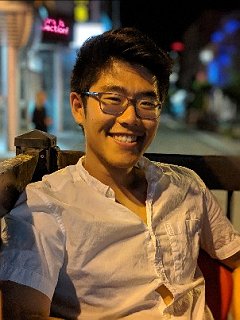
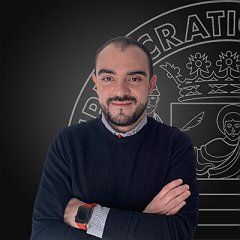
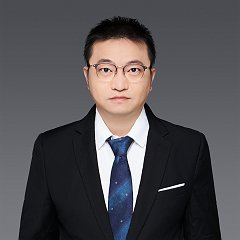
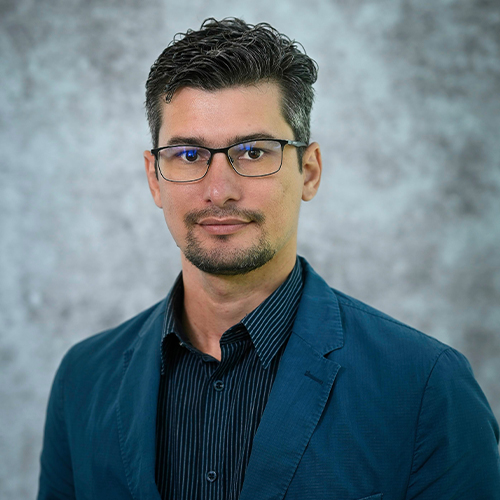
Vaibhav K. Anu is a prominent software engineering researcher with significant contributions to information security, requirements engineering, and computer science education. His work focuses on human error analysis in software development, vulnerability prediction, and integrating cybersecurity concepts into educational curricula. Core Research Areas: Software metrics, human error taxonomy, vulnerability detection, educational technology Recent Trends: Expanding into K-12 computer science education and AI for STEM learning Publication Highlights show interdisciplinary work spanning: • Security Governance - Taxonomy of security metrics • Educational Innovation - Developing AI case studies for middle school • Error Analysis - Creating systematic frameworks for requirements inspection Collaboration Network includes researchers from: Seton Hall University (Gursimran Walia) University of Alabama in Huntsville (Jeffrey Carver) Stevens Institute of Technology (Katherine Herbert)
Andrea De Lucia serves as Full Professor in the Department of Computer Science at the University of Salerno, Italy, maintaining an active research profile with office hours at Fisciano Campus (Building F2, Room 089) and correspondence via adelucia@unisa.it. His scholarly contributions span software engineering with particular emphasis on security, mobile systems, and emerging quantum applications. His research portfolio demonstrates evolving focus through distinct phases: 2018-2020 : Code smell analysis and mobile energy efficiency (e.g., Android energy consumption studies) 2021-2022 : Security vulnerability lifecycle and quantum software engineering foundations 2023-2025 : Ethical AI integration (fairness in ML engineering) and advanced exploit prediction Recent publications reveal strategic expansion into quantum-computing applications and AI ethics, maintaining core software engineering principles while addressing contemporary challenges in secure, reliable systems development. His work consistently bridges theoretical frameworks with empirical validation through large-scale studies. De Lucia actively contributes to the software engineering community as program committee member for premier conferences including ICSE, ASE, and ICSME across multiple years (2018-2026), demonstrating sustained leadership in the field.
Dong Jae Kim is a Professor at DePaul University in the United States, actively contributing to the software engineering community through research and conference service. He serves on program committees for major venues including ICSE, ESEC/FSE, ASE, and CASCON, and maintains a professional presence via his personal website and Twitter account. His academic profile reflects deep engagement with empirical software engineering research and emerging AI methodologies. Kim's research centers on Software Engineering with specialized focus on Software Testing and Mining Software Repositories. He investigates critical challenges in test code maintenance, particularly how object-oriented features like inheritance and interfaces impact test quality. His work increasingly integrates artificial intelligence, especially large language models, for tasks including log analysis, fault localization, and code generation. This dual emphasis on foundational testing principles and cutting-edge AI applications defines his scholarly identity. Analysis of Kim's publication trajectory from 2020-2026 reveals a strategic evolution toward AI-enhanced software engineering. Early work established empirical foundations in test smell evolution, while recent publications demonstrate sophisticated application of large language models to log parsing (LibreLog, LLMParser), fault localization (Order Matters!), and code generation (SOEN-101). The consistent thread through his research is rigorous empirical validation of practical tools, with growing emphasis on benchmarking open-source AI solutions for real-world software engineering problems. No scientific awards, fellowships, or medals were documented in available sources. Similarly, no information was found regarding graduate students advised by Kim or details of research grants secured. Laboratory affiliations, research teams, and collaborative projects remain unspecified in current records. Future research directions appear oriented toward refining AI-driven approaches for software maintenance tasks, particularly in log analysis and test code optimization, though explicit future work statements were not identified.
Fabio Palomba is an Associate Professor at the Software Engineering (SeSa) Lab within the Department of Computer Science at the University of Salerno, Italy. He leads research in software engineering with a particular focus on AI/ML systems engineering and has established himself as a prominent figure in empirical software engineering through his extensive publication record and leadership roles. Palomba received his European PhD degree in Management & Information Technology from the University of Salerno in 2017, with his thesis earning the prestigious 2017 IEEE Computer Society Best PhD Thesis Award. His academic journey included a Master's degree in Computer Science from the University of Salerno (2011-2013) with 110/110 magna cum laude, and a Bachelor's degree from the University of Molise (2008-2011). His research spans software maintenance and evolution, empirical software engineering, source code quality, and mining software repositories. More recently, his work has significantly expanded into AI/ML engineering, with particular emphasis on fairness in ML systems, code smells in ML pipelines, and the socio-technical aspects of developing AI-powered applications. Palomba has co-authored over 200 papers in international conferences and journals, establishing himself as a leading researcher in empirical software engineering with growing influence in Software Engineering for AI (SE4AI). Analysis of Palomba's recent publications reveals a strategic research direction toward addressing critical challenges at the intersection of traditional software engineering and AI/ML systems. His work tackles issues including ML-specific code smells, fairness-aware practices in ML engineering, vulnerability detection in software, and requirements engineering enhanced by large language models. This cohesive research agenda positions him at the forefront of ensuring the quality, reliability, and ethical considerations of AI-powered systems. 2017 IEEE Computer Society Best PhD Thesis Award ACM/SIGSOFT Distinguished Paper Awards (ASE'13, ICSE'15) IEEE/TCSE Distinguished Paper Award (ICSME'17) Best Paper Awards (CSCW'18, SANER'18) SNSF Ambizione grant (2019) IEEE Computer Society Technical Council of Software Engineering Rising Star Award (2023) 16 Distinguished/Outstanding Reviewer Awards Palomba has served in numerous leadership roles in the software engineering community. He was program co-chair of SANER 2024 and ICPC 2021, industrial track co-chair of SANER 2022, and NIER/ERA track co-chair of ASE 2022. He has served on editorial boards of prestigious journals including Springer's Empirical Software Engineering Journal (since 2021), Elsevier's Information and Software Technology Journal (since 2022), and IEEE Transactions on Software Engineering (since 2020). His research is supported by competitive grants including the SNSF Ambizione grant, one of Europe's most prestigious individual research awards. At the University of Salerno, Palomba leads the Software Engineering (SeSa) Lab, which focuses on empirical studies of software quality, maintenance, and evolution, with increasing emphasis on AI/ML systems engineering. His work bridges traditional software engineering concerns with the emerging challenges of AI/ML systems, making significant contributions to the development of practical tools and methodologies for improving the quality and reliability of modern software systems.
Dr. Tao Zhang is a Full Professor at the School of Computer Science and Engineering, Macau University of Science and Technology (MUST), Macau SAR. He serves as an Associate Editor for IEEE Transactions on Software Engineering (TSE), IEEE Transactions on Reliability (TRel), and the Journal of Systems and Software (JSS), and is an Editorial Board Member for Empirical Software Engineering (EMSE) and Science of Computer Programming (SCP). His educational background includes: Ph.D. in Computer Science from the University of Seoul B.S. in Automation and M.Eng in Software Engineering from Northeastern University, China Postdoctoral Research Fellow at Hong Kong Polytechnic University Dr. Zhang's research primarily focuses on three interconnected areas that represent the cutting edge of modern software engineering: AI for Software Engineering : Utilizing neural language models and large language models to create automated software engineering tools that help developers produce high-quality software. His work includes evaluating whether pretrained language models truly understand software engineering tasks and developing universal representations for bug reports. Software Security : Employing static analysis, AI technologies, and formal methods to detect malware, vulnerabilities, and privacy leaks in mobile apps and smart contracts. His research spans Android malware detection, smart contract vulnerability analysis, and state manipulation attacks in blockchain systems. Mining Software Repositories : Applying information retrieval and machine learning to extract meaningful insights from software artifacts to improve development efficiency. This includes work on app review analysis, change request localization, and code similarity metrics. His publications demonstrate significant impact across the software engineering community, with over 100 high-quality papers in top venues including ICSE, ESEC/FSE, ASE, TSE, TOSEM, EMSE, JSS, TIFS, and TDSC. Dr. Zhang has received numerous honors and recognitions: Distinguished Member, China Computer Federation (CCF), September 2025 Top Reviewer Award 2023, Journal of Systems and Software (JSS), April 2024 Distinguished Reviewer in 2023, ACM Transactions on Software Engineering and Methodology (TOSEM), February 2024 Senior Member of ACM (October 2020) and IEEE (February 2020) Best Paper Award, 16th Korea Conference on Software Engineering (KCSE), February 2014 As an academic leader, Dr. Zhang serves/served as General or Program Chair for numerous conferences including APSEC 2025, Internetware 2024, SANER 2023, and DSA 2021. He mentors a vibrant research group with multiple postdocs, PhD students, and master's students working on innovative projects in intelligent software engineering and security. His lab actively recruits highly motivated students interested in Data Mining, Artificial Intelligence, Software Security, and Software Engineering. Dr. Zhang leads the "Intelligent Software Data Analysis and Software Security" research team at MUST, which focuses on leveraging AI technologies to solve critical challenges in software development and security. The team maintains strong collaborations with international researchers and regularly publishes in top-tier venues.
Tim Menzies is a Full Professor at North Carolina State University with a diverse professional background that includes previous careers as a nurse, rocket scientist, taxi driver, and journalist. His primary research focuses on Search-Based Software Engineering (SBSE), software analytics, software product lines, Mining Software Repositories, and data mining and machine learning applications in software engineering. Dr. Menzies has maintained an active research profile with publications spanning from 2018 through 2026, serving on program committees and organizing tracks at major conferences including ASE, ICSE, and ESEC/FSE. His work consistently bridges theoretical research with practical applications, emphasizing solutions that are both technically sound and implementable in real-world settings. His research interests include: Search-Based Software Engineering (SBSE) Software analytics and data-driven approaches Software product lines and configuration Mining Software Repositories Machine learning applications in software engineering Fairness in software engineering tools Interpretable and explainable AI for software engineering His recent publications (2023-2026) reveal a strong trend toward making complex software analytics more accessible and understandable while maintaining performance. He has pioneered approaches that simplify models without sacrificing effectiveness, directly addressing the 'black box' problem that often hinders adoption of machine learning in practice. Dr. Menzies is known for his critical perspective on software engineering research, challenging assumptions in the field, particularly regarding deep learning applications. His work emphasizes practical, evidence-based approaches over theoretical elegance alone, reflecting his commitment to improving the research-practice connection in software engineering.
Michael English is an Associate Professor at the Department of Computer Science & Information Systems, University of Limerick, and an Academic Director of the ICT Learning Centre. He holds a PhD in Computer Science (2007) and MSc (1999) from the University of Limerick, and a BSc in Mathematics and Statistics from University College Cork (1996). His research focuses on software engineering (metrics, quality, clone detection, software evolution) and computer science education (undergraduate programming challenges). He lectures in software engineering, object-oriented programming, and course design. Education: BSc (Hons) Mathematics and Statistics, University College Cork (1996) MSc Computer Science, University of Limerick (1999) PhD Computer Science, University of Limerick (2007) Research Interests: His work spans software metrics for quality assessment, automated detection of code clones, and improving software maintainability. In education, he investigates barriers faced by early-stage programming students and pedagogical strategies like pair programming. Recent studies include industrial case studies on feature clones and text-mining StackOverflow to identify learning challenges. Professional Roles: Course Director for MSc in Software Engineering Member of Lero – the Research Ireland Centre for Software Design contributor to undergraduate/postgraduate curricula Research Trends: Recent articles emphasize industrial software analysis (e.g., feature clone detection in large systems) and leveraging machine learning for software engineering tasks. Educational work highlights the use of Q&A platforms to inform curriculum improvements and student support strategies. Labs/Teams: Active in Lero, Ireland’s National Software Engineering Research Centre.
Martin Raymond serves as a Postdoctoral Associate within the Neuroscience PhD Program at Brandeis University, conducting research from the Bassine Science Building (Room 344). His work investigates neural mechanisms of sensory perception with emphasis on gustatory and olfactory systems using rodent models and advanced neuroscientific methodologies. His academic credentials include: B.S. in Psychology from Eastern Michigan University (2016) M.S. in Experimental Psychology from Eastern Michigan University (2018) Ph.D. in Neuroscience from the University of Tennessee Health Science Center (2024) Raymond's research centers on neural plasticity in sensory processing, specifically examining how experience and behavior modulate cortical representations in taste and smell pathways. His experimental approaches integrate electrophysiology, optogenetics, and behavioral analysis to decode neural coding mechanisms in freely moving animals, with particular focus on conditioned responses and sensory adaptation. Publication analysis reveals consistent investigation of gustatory-thalamic-cortical circuitry and experience-dependent plasticity. Recent work explores conditioned taste aversion dynamics, thalamic relay organization, and odor representation modulation in piriform cortex, demonstrating methodological innovation through open-source hardware development for precise behavioral quantification. No scientific awards were documented in the source material. Student mentoring activities and research grant funding details were not specified in the available information. He maintains active collaborations with neuroscience research groups led by John Boughter, Michael Fletcher, and John Breza, focusing on molecular, cellular, and systems-level investigations of sensory processing.
Nikolaos Tsantalis is a Professor in the Department of Computer Science and Software Engineering. He serves as Associate Chair for Software Engineering and focuses on advancing software engineering practices through automated refactoring tools, empirical studies, and code quality analysis. His work emphasizes improving software maintainability, design quality, and developer productivity. Research Interests: Automated Refactoring (e.g., RefactoringMiner, JDeodorant) Code Smells and Design Patterns Empirical Studies on Refactoring Tool Support for Software Evolution Code Diffing and Tracking IDE Integration for Refactoring Key Contributions: Developed RefactoringMiner (2020), a tool for detecting refactoring operations in commit histories, and JDeodorant, a static analysis tool for identifying and resolving class-level design smells. His recent work explores leveraging LLMs and semantic embeddings for automated refactoring. Advising/Grants: No students are explicitly listed, but Tsantalis has contributed to numerous tool-based projects funded through academic collaborations. His research spans industry-academia partnerships to improve software development workflows. Labs/Teams: Leads research on automated refactoring and software maintenance through collaborations with IDE vendors and open-source communities.
Professor Jane Parker is a leading academic in food science at the University of Reading, serving as Founder and Director of the Flavour Centre. Her roles include PhD supervision, leadership in the Food Research Group, and organizing the BSF Flavour Course. She holds a BSc (Hons) in Chemistry from the University of St Andrews and a PhD in Physical Organic Chemistry from the University of Cambridge (C.Chem., MRSC). Her research focuses on the chemistry of flavour formation (e.g., Maillard reaction), food sustainability, and olfactory disorders post-COVID-19. She collaborates with industry via the Flavour Centre for contract research, training, and analytical services. Notable projects include understanding off-flavour development, controlling acrylamide in foods, and optimizing flavour in sustainable food systems. Her work bridges chemistry and sensory science, employing techniques like GC-MS-olfactometry and advanced analytical methods. Awards include the BSF Bill Littlejohn Medal (2018) and Horizon Europe funding (2024). She chairs the RSC Food Group and advises the Global Consortium for Chemosensory Research. Recent publications emphasize aroma compound identification (e.g., in cocoa, aged garlic), kinetic modelling of food reactions, and post-viral olfactory dysfunction. She has secured significant grants, including multiple GCRF awards, and maintains strong industry partnerships.
Valeria Pontillo is a Researcher in the Department of Informatics and Applied Informatics, focusing on software engineering, machine learning, and testing methodologies. Her work emphasizes empirical investigations into test smell detection, flaky test prediction, and security testing practices. She has contributed to datasets like E2EGit and led studies on test automation and anomaly detection. Pontillo's research has been recognized with the MSR 2025 Distinguished Dataset Award. She actively organizes workshops on topics like intelligent software assistants and security testing for complex systems. Her research interests include software quality, empirical software engineering, and static/dynamic analysis of test code. Recent work explores the impact of test smells on manual testing, cross-project flaky test prediction, and performance testing in open-source web projects. Collaborations involve analyzing test maintenance practices and developing frameworks like QuantuMoonLight for quantum machine learning experimentation. Pontillo's datasets and publications highlight a focus on practical applications of machine learning in testing, with over 14 peer-reviewed articles since 2021. She maintains active participation in academic events, contributing to both conference proceedings and workshop organization globally.
Mohamed Wiem Mkaouer is an Associate Professor in the Department of Computer Science, Engineering, and Physics at the College of Innovation and Technology, University of Michigan-Flint. He serves as Graduate Director for the Master’s in Software Engineering and Artificial Intelligence programs. Research Focus: At the intersection of Software Engineering and Artificial Intelligence, with emphasis on software quality assurance, systems refactoring, infrastructure-as-code analysis, technical debt management, and accessibility in software design. His work employs multi-objective evolutionary search and machine learning techniques. Publications: With 140+ peer-reviewed papers in top venues (TSE, TOSEM, EMSE, CHI, ASE), recent studies include infrastructure-as-code analysis in OpenStack, ChatGPT-assisted refactoring, and accessibility challenges in mobile platforms. Collaborative work appears with Ali Ouni, Eman Abdullah AlOmar, and Marouane Kessentini. Awards: Recipient of 6 best-paper/presentation awards and the 2020 RIT GCCIS Best-Emerging Scholar Award. Grants: Leads $4.5M in federally funded projects including NSF SHF grant for DevOps configuration drift detection (2026-2029, $600k), DARPA TRACTOR project (2025-2029, $381k), and NSF SURGE model grant (2025-2029, $3.37M as Co-Investigator). Professional Activities: Regularly publishes in IEEE/ACM conferences like ICSE, SANER, and MSR. Key contributions include tools like AntiCopyPaster, SATDBailiff, and tsDetect for code quality analysis.
Assoc. Prof. Feza Buzluca is affiliated with Istanbul Technical University as an Associate Professor in the Faculty of Computer and Informatics, Department of Computer Engineering . His academic career spans over two decades at ITU, including administrative roles like Vice Dean (2015-2018) and Faculty Board Membership (2016-). PhD in Control and Computer Engineering from Istanbul Technical University Fields: Computer Software, Communication Networks, Object-Oriented Modeling, Microservices His research focuses on software quality assessment , particularly for microservices architectures using fuzzy logic and code metrics. He explores object-oriented systems through machine learning for defect prediction, module extraction, and design pattern analysis. Recent work includes embedded software testing prioritization and cognitive radio network optimization . Key projects: Personal website and ORCID profile highlight 41 research outputs (2001-2024) and 1 project on microservices-based e-payment systems . Collaborations span IEEE/ACM conferences and journals like Journal of Systems and Software . Contact: Office 4318, Ayazaga Campus, 34000 Istanbul | buzluca@itu.edu.tr
Martin Vechev is a Professor in the Department of Computer Science at ETH Zurich, leading the Secure, Reliable, and Intelligent Systems (SRL) Lab. His research bridges programming languages, software analysis, and emerging domains like quantum computing, with significant contributions to static analysis, abstract interpretation, and machine learning for code. His primary research interests include programming languages, static analysis, abstract interpretation, and quantum computing. Vechev has pioneered scalable techniques for software verification, particularly in concurrency and security analysis, and has recently driven innovations at the intersection of programming languages and quantum software development. His work emphasizes practical applications while maintaining theoretical rigor. Analysis of Vechev's recent publications reveals a strategic evolution toward quantum programming languages and machine learning integration. His lab has shifted from traditional static analysis to developing foundational frameworks for quantum circuit synthesis (e.g., Silq, Unqomp) and robust neural network certification, addressing critical challenges in quantum resource management and AI safety. The SRL Lab under Vechev's direction focuses on building intelligent systems that are inherently secure and reliable through advanced program analysis techniques. The lab's research spans theoretical foundations to industrial-strength tools, with strong emphasis on quantum software engineering and the application of machine learning to code understanding and generation.
Wesley Klewerton Guez Assuncao serves as an Associate Professor in the Department of Computer Science within the College of Engineering at North Carolina State University. Previously, he held positions as a University Assistant/Senior Researcher at Johannes Kepler University Linz in Austria, Postdoctoral Researcher at Pontifical Catholic University of Rio de Janeiro in Brazil, and Assistant/Associate Professor at Federal University of Technology - Paraná in Brazil. His academic journey includes a Ph.D. in Computer Science from the Federal University of Paraná with a visiting period at Johannes Kepler University. Dr. Assuncao's research spans several critical areas in modern software engineering. His primary interests include Software Modernization (reverse engineering, re-engineering, and migration), Variability Management (variability mechanisms, software customization, and software reuse), and Software Quality (technical debt, code smells, and software refactoring). He also investigates Model-Driven Engineering (model inconsistency detection, repair generation, and change propagation), Collaboration in Systems Engineering (change synchronization, tool flexibility, and conflict awareness), Software Testing (regression testing, integration testing, and test case selection/prioritization), and AI4SE (Generative AI, Machine Learning, and Evolutionary Algorithms for Software Engineering). His recent publications reveal a strong focus on software modernization challenges, particularly regarding legacy systems transformation, microservices architecture, and the application of AI techniques in software engineering. The research shows increasing integration of Large Language Models in addressing software evolution problems, with emphasis on empirical validation through industrial collaborations. His work consistently bridges theoretical foundations with practical applications, as evidenced by multiple industry partnerships and real-world case studies. Dr. Assuncao has received numerous prestigious awards including Distinguished Reviewer Awards from FSE and SANER conferences, a Young Researcher Award from Johannes Kepler University, and multiple Best Paper Awards from top software engineering conferences. His research has been recognized with ACM SIGSOFT Distinguished Paper Awards and IEEE Computer Society TCSE Distinguished Paper Awards. In terms of academic service, he serves as Co-editor of the In Practice track at the Journal of Systems and Software and has held various leadership roles in major conferences including ICSE, SANER, MSR, and SPLC. He has successfully secured substantial research funding totaling approximately USD 1.91 million from sources including the Austrian Science Fund, Brazilian National Council for Scientific and Technological Development, and state-level Brazilian research foundations. Dr. Assuncao leads the Wolfpack Innovations in Software Engineering Research (WISER) Lab at NC State University, where he supervises graduate students working on cutting-edge software engineering research problems. His lab maintains strong collaborations with international institutions and industry partners including Dynatrace and ITPRO Consulting & Software GmbH.