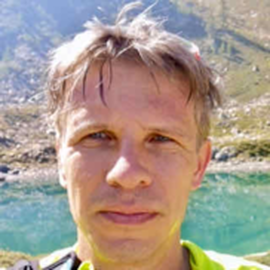
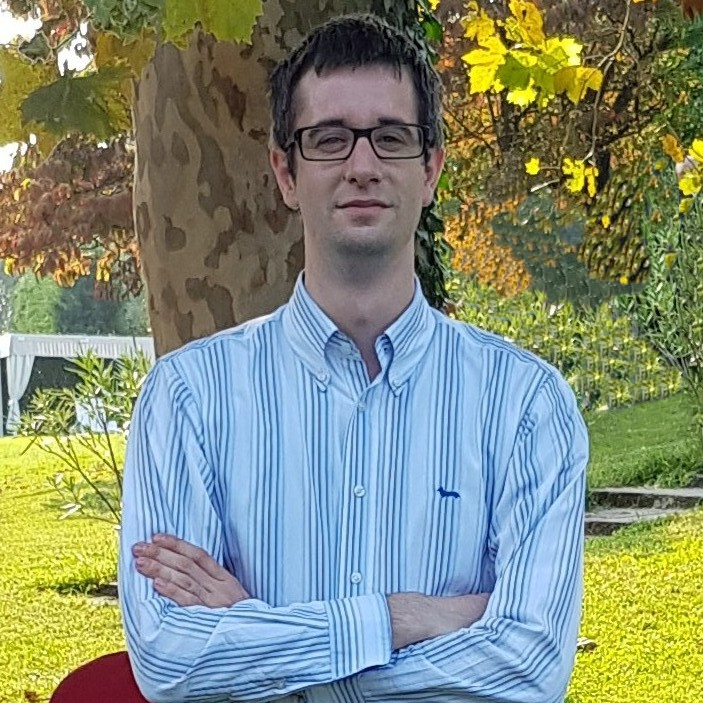
Giuseppe PAGNONI is an Associate Professor at the Department of Biomedical, Metabolic and Neurosciences of Università di Modena e Reggio Emilia . His research spans neuroscience , computational modeling , meditation , and brain network analysis . He teaches courses such as Neural Systems Modeling for Bioengineering students and Human Physiology and Pathophysiology in Medicine programs, with a focus on predictive coding , default mode network , and emotional valence processing . Pagnoni has contributed to ENIGMA-Meditation , a global initiative exploring meditation's neuroscientific basis, and developed sparse Bayesian models for analyzing brain network individual differences. His work on Alzheimer's disease investigates anosognosia mechanisms through resting-state fMRI, while other studies examine ghrelin's role in obesity-related reward processing and oxytocin's effects on social anxiety . He employs dynamic causal modeling and predictive processing frameworks to study cognitive effort, mind wandering, and neuromorphic learning. His methodological expertise includes functional MRI , independent component analysis , and computational simulations .
Alberto Oliveri is an Associate Professor at the University of Genoa in the Department of Naval, Electrical, Electronic and Telecommunications Engineering. He teaches courses including Circuits and Systems, Nonlinear Circuits and Systems, Power Management, and Elements of Electrical Technology for undergraduate and graduate programs in Electronic Engineering, Information Engineering, Industrial Technologies, and Chemical Engineering. His research focuses on advanced topics in power electronics and control systems, with particular emphasis on: Modeling and optimization of magnetic components (inductors) for switch-mode power supplies FPGA implementation of nonlinear model predictive control algorithms Synthetic inertia solutions for renewable energy grid integration Embedded control systems for power converters Advanced modeling of ferrite-core and amorphous-core inductors His recent publications (2022-2025) demonstrate a consistent focus on improving power conversion efficiency through advanced control strategies and hardware implementation. Research themes include predictive control optimization, magnetic component characterization under saturation conditions, renewable energy grid support functions, and embedded algorithm development for real-time power system monitoring.
Joanna Cecilia da Silva Santos is an Assistant Professor in the Department of Computer Science and Engineering at the University of Notre Dame , where she leads the Security and Software Engineering research lab (S 2 E) . She earned her Ph.D. and M.Sc. in Computing and Information Sciences from Rochester Institute of Technology (RIT) and a B.Sc. in Computer Engineering from Federal University of Sergipe (UFS) . Research Interests: Her work focuses on the intersection of Software Engineering and Software Security , with specific emphasis on Code Generation , Program Analysis , Software Architecture , and Quantum Software Engineering . Recent projects include evaluating large language models for code generation, detecting regular expression denial-of-service vulnerabilities, and creating taint-based analysis tools for Java security. 2025: Code generation benchmarks, LLM performance in programming assignments 2024: Frameworks for secure code generation, ReDoS analysis, static analysis of deserialization 2023: GitHub Copilot complexity prediction, vulnerability characterization 2022: Transformer-based code smell detection, security evaluation datasets Scientific Awards: 2017 Best Paper Award at ICSA 2020 JOBS Workshop Research Pitch Competition Winner 2023 Distinguished Reviewer at ESEC/FSE 2014 CAPES Scholarship for Masters at RIT 2013 3rd Place Paper at XIII ERBASE Her research group engages in empirical studies of code vulnerabilities, automated security tools, and educational applications of language models, with funding reflected in multiple peer-reviewed publications.
Li Li is a Professor of Software Engineering at Beihang University , China. Previously, he served as an ARC DECRA Fellow and Senior Lecturer at Monash University , leading the SMart software Analysis and Trustworthy computing (SMAT) research lab at the Department of Software Systems and Cybersecurity. His academic journey includes a Ph.D. in Software Engineering from the University of Luxembourg (2016), supervised by IEEE Fellow Prof. Yves Le Traon and Dr. Jacques Klein. Research Interests Li's research focuses on Mobile Software Engineering (Mobile Security, Quality Assurance) and Intelligent Software Engineering (SE4AI, AI4SE). He applies static code analysis , dynamic program testing , and machine/deep learning to enhance software security and reliability. Key areas include Android API evolution, automated patch validation, and multi-language code analysis frameworks like Scalpel for Python. Scientific Recognition ARC DECRA Fellowship Rising SE Research Star Top-5 Most Impactful Early Career SE Researchers (2020, 2017) 5 Best/Distinguished Paper Awards across PLDI, WWW, ASE, MSR, and SANER Academic Contributions He has contributed to foundational Android analysis tools (e.g., AndroZoo++, DroidRA) and developed scalable systems for distributed program analysis (Seads). His work appears in top venues like ICSE, ESEC/FSE, ASE, ISSTA, POPL, and TSE.
Alessandra Melonio is an Associate Professor in Computer Science at the Department of Environmental Sciences, Computer Science and Statistics, Ca' Foscari University of Venice. Her research focuses on Human-Computer Interaction (HCI), particularly designing tangible solutions with children and teens in educational contexts. She has over 60 peer-reviewed publications and has contributed to international conferences like ACM CHI, TEI, and INTERACT. She holds editorial roles in journals like the International Journal of Child-Computer Interaction and has collaborated with institutions such as the Free University of Bozen-Bolzano and the University of Trento. Education: Ph.D. in Computer Science (2016) from Free University of Bozen-Bolzano; Master's in Computer Science and Automation Engineering (2011) from University of L'Aquila. Research Interests: Interaction design, physical computing, technology-enhanced learning, and participatory design with children. Her work emphasizes inclusivity, ethical design, and educational innovation. Key Awards: Winner of the 'Best Idea for Digital Innovation' award (2017), 'Best PhD Student 2016', and 'Best Conference Paper at itAIS 2011'. Teaching: Courses include Human-Centered Design, Information Visualization, and Coding for Digital Humanities. Collaborations: Partnerships with universities in Italy, Denmark, Finland, and the U.S., and involvement in tech transfer initiatives like the Smart Data Factory.
Vincenzo Della Mea is an Associate Professor of Information Processing Systems at the University of Udine's Department of Mathematical, Computer and Physical Sciences. His research focuses on medical informatics, digital pathology, biomedical ontologies, and AI applications in healthcare. He holds abilitation to full professorship and is a member of the WHO Italian Collaborating Centre for International Classifications (WHO-FIC), ICHI Task Force, and ESDIP's Executive Board. He leads the EU MSCA Doctoral Network BosomShield (2022-2026) and previously managed the AIDPATH Marie Curie project. As an editor for journals like Digital Health and Journal of Pathology Informatics , he bridges academia and practice. Beyond academia, he is a poet with awards, including the Nelle terre dei Pallavicino Prize for his 2004 collection Algoritmi , and organizes interdisciplinary events merging science and literature. Education & Roles : Holds a professorship in Computer Science and teaches courses on web technologies, medical informatics, and AI across multiple degree programs. Previously served as Vice-President of SIBIM (Italian Biomedical Informatics Society). Research Interests : Specializes in digital pathology, medical AI, telemedicine, and standardization of health classifications like ICD-11 and ICF. His work emphasizes ontology harmonization and machine learning for clinical decision support. Recent Contributions : Published on WHO classification harmonization, AI-driven pathology tools, and energy-sector LLM applications. Active in editorial roles and international collaborations, including the HEROHE Challenge for breast cancer analysis. Awards & Recognition : 2023 – Poetry collection Clone 2.0 (neurally generated) 2005 – Nelle terre dei Pallavicino Award Grants & Projects : Led EU-funded projects (AIDPATH, BosomShield) and contributed to initiatives like the ICD-11 Mortality Coding System. Collaborates with institutions like AcegasApsAmga on AI for utilities. Labs & Initiatives : Involved in digital pathology workflow optimization and educational platforms for medical coding and AI ethics.
Marco Scialdone is a Lecturer at the European University of Rome, specializing in Information Technology Law and Legal Categories related to Technology. He holds a PhD from the same university (2016) and Master’s degrees from La Sapienza University of Rome (2005). A Fellow of the IAIC – Italian Academy of the Internet Code, he focuses on AI ethics, digital rights, and consumer protection law. His research bridges legal frameworks with emerging technologies like artificial intelligence and robotics. Education: PhD in Legal Categories and Technology (2016), European University of Rome Master’s in Computer Law (2005), La Sapienza University of Rome LL.B. in Law (Cum Laude, 110/110), LUISS Guido Carli University Research Interests: His work explores the intersection of law and technology, including AI governance, digital copyright, consumer rights in the digital age, and the legal implications of robotics. He emphasizes ethical AI development, regulatory challenges in digital markets, and public administration digitization. Recent studies analyze algorithmic bias in judicial systems and the legal protection of user-generated content. Publications & Expertise: Authored over 20 publications, including monographs like Living with Artificial Intelligence (2021) and The Legal Protection of User-Generated Content (2018). His articles address topics such as non-human creativity rights, predictive justice models, and cross-border copyright conflicts. He has served as an expert in AI policy (Italian Government’s High-Level Group on AI, 2018) and on the Permanent Advisory Committee for Copyright (2019). Professional Roles: Head of Litigation & Academic Outreach at Euroconsumers (since 2021) Former lecturer at La Sapienza University (2015–2018) and University of Perugia (2007–2012)
Lerina Aversano is an Associate Professor in the Department of Engineering (DING) at the University of Sannio, specializing in Information Processing Systems (ING-INF/05). Her research focuses on the intersection of business processes and information technology, with particular expertise in business/IT alignment, process mining, and machine learning applications. Her research interests include: Business/IT alignment and strategic integration Machine learning and deep learning applications in healthcare diagnostics Process mining and predictive analytics for business processes Software engineering and service-oriented computing Semantic integration of heterogeneous data sources Over her extensive career, Aversano has published 145 research items with a clear evolution from foundational work in business/IT alignment to cutting-edge applications of AI in healthcare and business process management. Her most recent publications demonstrate expertise in explainable AI for process prediction, AI applications in medical diagnosis (including Parkinson's and thyroid diseases), and security for IoT systems, showing her ability to adapt to emerging technologies while maintaining focus on core alignment issues between business needs and technological solutions. She maintains an active research group with frequent collaborations with Mario Luca Bernardi, Marta Cimitile, Martina Iammarino, and Maria Tortorella, producing significant contributions to information systems literature. Her work appears in reputable venues including IEEE conferences, Springer publications, and journals like Information and Software Technology.
Elia Distaso is an Assistant Professor at the Department of Mechanics, Mathematics & Management, Politecnico di Bari, Italy. His research focuses on fluid dynamics, hydrogen combustion, and computational modeling. University: Politecnico di Bari Department: Mechanics, Mathematics & Management Academic Rank: Assistant Professor Email: elia.distaso@poliba.it His work spans hydrogen engines , CFD simulations , and hydraulic systems , with recent publications addressing auto-ignition mechanisms, cavitation phenomena, and sustainable aviation technologies. He specializes in leveraging numerical methods for combustion and fluid flow analysis. His 15 most recent publications highlight trends in computational fluid dynamics, including boundary condition modeling, pressure-velocity coupling, and OpenFOAM® applications. Key subfields include hydrogen combustion dynamics , lubricant oil reactivity , cryogenic heat exchanger design , and piezohydraulic pump analysis .
Massimo Zucchetti is a Full Professor at Politecnico di Torino, Department of Energy (DENERG), where he has been teaching Radiation Protection and Nuclear Power Plants. He maintains a significant international presence as a Research Affiliate at the Plasma Science and Fusion Center at MIT, a position he has held since 2005. His academic journey began at Politecnico di Torino, where he graduated in Nuclear Engineering in 1986 and completed his PhD in Energetica between 1986-1990. He progressed through the academic ranks at Politecnico di Torino from Associate Professor (1998-2002) to Full Professor (2002-present), with prior research experience at the European Commission Joint Research Centre. Zucchetti's research spans nuclear fusion engineering, radioactive waste management, and energy policy. His work focuses particularly on controlled thermonuclear fusion, nuclear safety, and radioactive waste management, with emphasis on tritium transport in fusion reactors, safety analysis of fusion power plants, and environmental impact assessment. He has led multiple significant research projects including TITANS (Tritium Impact and Transfer in Advanced Nuclear reactorS, 2022-2025), components for ITER (2008-2010), and innovative materials for fusion reactors (2004-2006). As coordinator of the IEA Program on Environmental, Safety and Economic Aspects of Fusion Power, he plays a key role in international fusion research collaboration. His recent publications show a clear trend toward practical applications of fusion technology, particularly in the ARC (Affordable Robust Compact) reactor design. These works emphasize neutronics, thermal-hydraulics, tritium management, and safety analysis for compact fusion systems. His research demonstrates increasing focus on making fusion energy more commercially viable through innovative engineering solutions while maintaining rigorous safety standards. The interdisciplinary nature of his work connects nuclear engineering with environmental science and energy policy. Fellow of Plasma Science and Fusion Center, MIT (2015-present) Research Affiliate Fellow at Laboratory for Nuclear Science, MIT (2005-2015) Nomination for 2015 Nobel Prize in Physics for research on advanced fuel nuclear fusion Editor-in-Chief of multiple journals including International Journal of Ecosystems and Ecology Science and Journal of International Environmental Application & Science Zucchetti actively mentors PhD students in the Energetica program at Politecnico di Torino, with current advisees working on topics ranging from multiphysics modeling in ARC-class reactors to innovative materials for next-generation nuclear reactors. He coordinates significant research grants from competitive funding programs including EURATOM and PRIN. His laboratory work focuses on fusion reactor components, particularly breeding blankets and tritium management systems. The TESIN research group within DENERG serves as his primary research team, working on thermal-hydraulic analysis, neutronics, and safety assessments for advanced nuclear systems.
Dario Duca is a Full Professor in the Department of Physics and Chemistry at the University of Palermo . His research focuses on computational chemistry and catalysis, particularly using Density Functional Theory (DFT) and microkinetic modeling to study reaction mechanisms on nanoscale catalysts. He teaches General and Inorganic Chemistry (10 CFU) and Higher Inorganic Chemistry (8 CFU) for the Chemistry degree program. Fields of Interest: Computational chemistry, catalysis, DFT, materials science, nanotechnology, surface chemistry, reaction kinetics His recent work includes DFT studies of CO/H2 purification over MnO2 catalysts, biomass conversion using halloysite nanotubes, and platinum particle growth in zeolites. He has developed computational tools like the Empathes code for transition state analysis. Contact: dario.duca@unipa.it | Office hours: Mon-Fri 1:00-2:00 pm, Sat 10:00-13:00 at Ed.17, University of Palermo.
Alice Sciortino is a Researcher at the Department of Physics and Chemistry - Emilio Segrè within the School of Science at the University of Palermo. Her position code PHYS-03/A indicates a research-focused academic track in the Italian university system. She maintains regular office hours on Tuesdays from 11:30 to 12:30 through the university's student portal system. Her research centers on advanced photonic nanomaterials with particular expertise in carbon nanodots , quantum dot superstructures , and metal-organic frameworks . Key research themes include: Nanoscale light emission and lasing phenomena Design of optical sensors for environmental and biomedical applications Photocatalytic systems for environmental remediation Hybrid nanomaterial interfaces for energy transfer Ultrafast photophysical characterization of nanomaterials Analysis of her recent publications (2023-2025) reveals a strong trajectory toward multifunctional nanoplatforms combining optical, magnetic, and catalytic properties. Her work increasingly bridges fundamental photophysics with practical applications in environmental monitoring and biomedicine, particularly in heavy metal detection (Hg²⁺, Ni²⁺) and tissue engineering. The publication record shows consistent high-output research with frequent collaborations across Italian institutions. While no formal scientific awards are documented in the provided materials, her extensive publication record in high-impact journals demonstrates significant scholarly contributions to nanophotonics and materials science. Dr. Sciortino's research program appears to focus on experimental nanomaterials development with strong emphasis on optical characterization techniques. Her work on carbon dot-MOF hybrids and quantum dot superparticles suggests leadership in designing next-generation photonic nanomaterials with tunable properties. The consistent funding evident from her publication output likely supports laboratory infrastructure for nanomaterials synthesis and advanced optical spectroscopy.
Massimo Delledonne is a Full Professor in the Department of Biotechnology at the University of Verona. His research focuses on clinical genomics, functional genomics, structural genomics, and metagenomics. He teaches modules such as Genetics and Human Genomics across undergraduate and graduate programs, including Molecular and Medical Biotechnology and Medical Bioinformatics. Affiliations: Department of Biotechnology, University of Verona Committees: Faculty Board of PhD in Biotechnology, Biotechnology Teaching Committee Spin-offs: EDIVITE s.r.l., Microbion S.r.l., Enerzyme s.r.l. (among others) His research interests include genome assembly, single nucleotide variant analysis, and applications of next-generation sequencing technologies. Projects span plant and human genomics, with a focus on crop improvement, disease diagnostics, and microbial interactions. Recent work includes studies on lupin diversity, common bean evolution, and grapevine genetics. Key projects include IBEARAD (Bioinformatics for Agricultural Resilience) and SYMPHONY (Phaseolus vulgaris genome analysis). He leads interdisciplinary efforts in genomic medicine, plant genomics, and environmental genomics.
Marco Grangetto serves as Full Professor in the Department of Computer Science at the University of Turin, coordinating research in image processing and computer vision. His expertise spans wavelets, image/video coding, data compression, error resilient video coding, and biomedical image processing, with significant contributions to ISO JPEG2000 standardization and editorial roles in IEEE Transactions on Multimedia. His educational background includes a PhD in Electrical and Communications Engineering (2003) and MSc in Telecommunications Engineering (1999), both from Politecnico di Torino. His research integrates Artificial Intelligence and Deep Learning with medical imaging and fundamental compression theory , producing innovations in neural network pruning, capsule networks, and entropy-based models. Recent work focuses on Covid-19 diagnosis from chest X-rays and efficient 3D scene modeling. His publication trends reveal dual trajectories: applied medical AI (Covid-19 diagnostics, lung cancer segmentation) and theoretical advances (learned compression, contrastive learning, bias mitigation). This bridges clinical validation with information-theoretic foundations, particularly in resource-constrained environments. Scientific recognition includes: Premio Optime by Unione Industriale di Torino (2000) Fulbright Grant for research at UC San Diego (2001) He maintains leadership through IEEE editorial positions, ISO standardization participation, and MPAI membership. His research group develops medical datasets (UniToChest, UniToPatho) while advancing neural network efficiency for clinical deployment. Current projects focus on entropy minimization techniques and unbiased representation learning for healthcare applications.
Federico Reghenzani is an Assistant Professor at Politecnico di Milano in the Department of Electronics, Information and Bioengineering. His research focuses on computer science, embedded systems, fault tolerance, high-performance computing, real-time systems, and compiler technology. He leads the HEAP Lab where his team investigates reliability engineering and hardware-software co-design for safety-critical applications. Reghenzani's research examines software-based approaches to hardware fault tolerance, compiler technologies for reliability enhancement, and resource management in high-performance computing environments. His work has significant applications in aerospace systems, real-time embedded platforms, and next-generation computing architectures. His publications demonstrate a consistent focus on improving system reliability through compiler techniques, fault injection methodologies, and hardware-software co-design. The research spans theoretical frameworks, practical implementations, and experimental validation across diverse computing environments.