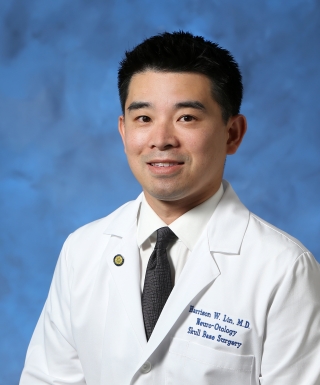
Harrison W Lin, MD is an Associate Professor in the Department of Otolaryngology-Head and Neck Surgery at the University of California, Irvine School of Medicine . He is a board-certified otolaryngologist with clinical expertise in hearing disorders, skull base surgery, and facial paralysis. Dr. Lin is a principal investigator at the UC Irvine Center for Hearing Research , focusing on translating basic science findings into clinical trials. Medical Education: Keck School of Medicine, University of Southern California Residency: Harvard Medical School Fellowship: UC San Diego School of Medicine Dr. Lin's research interests span hearing and balance disorders , neurotology , and skull base tumors . He investigates acoustic neuromas , meningiomas , cochlear implants , and facial nerve repair . His publications (over 50) focus on head and neck surgery , hearing loss , and ENT clinical case studies . Recent works include studies on sensorineural hearing loss , pediatric parapharyngeal tumors , and impact of dizziness on geriatric patients . Dr. Lin has received the Physicians of Excellence award from the Orange County Medical Association in 2019 and 2021-2023 . He leads clinical trials for auditory and vestibular disorders and contributes to medical education through pathology quiz case reports . As a principal investigator at the UC Irvine Center for Hearing Research , Dr. Lin's lab focuses on hearing restoration and balance disorder management . He also serves as a clinical mentor for otolaryngology trainees and contributes to pediatric ENT and head and neck oncology literature.
Professor Massimiliano Tani Bertuol is a distinguished academic specializing in economics at UNSW Canberra's School of Business, where he has served as Professor since 2015. His professional affiliations extend beyond UNSW as he is an Associate Investigator/Member at CEPAR; Ageing Futures; uDASH; AI Institute; and Cyber security (IFCYBER). Additionally, he maintains international connections as a Research Fellow at the Institute for the Future of Labor (IZA) in Germany since 2005, an Associate Member at Macquarie University's Centre for Workforce Futures since 2018, and a Research Fellow at the Global Labor Organization (GLO) in Maastricht since 2016. His educational background reflects a strong foundation in economics and business, having earned a PhD in Economics from the Australian National University (2003), a Master of Science in Economics from the London School of Economics (1992), and a Bachelor's degree in Business/Economics from Bocconi University in Milan, Italy (1989). His academic journey has positioned him as a leading researcher in human capital economics with international recognition. Professor Tani Bertuol's research centers on human capital development and its economic implications. His work examines how human capital can be fostered, efficiently transferred internationally through migration, and how it affects productivity, innovation, and economic growth at both firm and national levels. His research spans multiple regions including Australia, Europe, the US, Africa, and China, with particular focus on migration economics, labor market outcomes, and the economic impacts of education and skills. His current research agenda includes non-pecuniary incentives, behavioral/financial decisions in China, occupational licensing, language skills and economic assimilation, AI-human interactions in health contexts, and labor mobility and productivity. Analysis of his recent publications reveals significant interdisciplinary trends bridging economics with public health, environmental science, and technology. His work connects migration dynamics with economic outcomes, examines household financial behaviors through gender lenses, and investigates the complex relationships between environmental factors like air pollution and economic activities including education investment and entrepreneurship. More recent work explores AI applications in health and the economic implications of pandemic responses, demonstrating his ability to address contemporary challenges through rigorous economic analysis. 2023: UNSW ARC Postgraduate Council (Arc PGC) award for excellence in research supervision 2011: Vice-Chancellor Award for Teaching Excellence 2011: Faculty Award for Teaching Excellence for teaching economics Professor Tani Bertuol has successfully supervised 4 PhD students to completion, with 1 submitted dissertation and 5 currently under supervision. His active research program is supported by significant grant funding including an ARC Linkage Project (2023-27) on regional Australia's skills shortages and high-skill refugees' employment ($354,811), an ARC Discovery Project (2019-23) on migrant aging and wellbeing ($478,000), and a NUW Alliance grant (2021-23) on hearing screening and academic outcomes ($73,367). He serves as Associate Editor for Social Indicators Research and Higher Education Research & Development, contributing to scholarly discourse in his fields of expertise. His teaching portfolio includes courses in data analytics, finance, and professional executive education focused on cost-benefit analysis and data communication. He teaches ZBUS2333 Data Analytics and Visualisation, ZBUS8105 Finance and Investment Appraisal, and ZBUS8149 Introduction to Finance, demonstrating his commitment to developing the next generation of economics professionals with both theoretical knowledge and practical skills.
Professor Stefan Bleeck is a Professor of Hearing Science and Technology at the University of Southampton, leading the Hearing and Balance Centre and directing the Institute of Sound and Vibration Research (ISVR). His research focuses on the intersection of hearing science, audiology, and signal processing, with specialties in bio-inspired auditory modeling, speech intelligibility in noise, cochlear implants, and auditory evoked potentials. He holds a PhD in computational neuroscience and has held roles including Head of the Hearing and Balance Centre. Awards include Vice-Chancellor's Teaching Awards (2009) and Google Research Awards (2012). Education: Diploma in Physics (University of Darmstadt, 1995), PhD in Computational Neuroscience (University of Darmstadt, 2000). Research spans experimental, computational, and clinical approaches to improve hearing aids and cochlear implants. Active projects include developing speech enhancement algorithms, antiphasic speech tests for hidden hearing loss, and neural-space speech processing. Supervises multiple PhD students in engineering and computer science. Publications highlight advancements in speech enhancement, bio-inspired models, and cross-linguistic hearing tests. Collaborates with institutions like Google and the European Union on projects funded by EPSRC, Cancer Research UK, and others. His work aims to enhance speech understanding for hearing-impaired individuals through innovative signal processing and auditory modeling.
Dr. Jackie Nelson is an Associate Professor in the Department of Psychology at The University of Texas at Dallas, affiliated with the School of Behavioral and Brain Sciences. She directs the Family Research Laboratory and the Psychology Master’s program. Her research focuses on family dynamics, particularly parent-child interactions, family stress, and child social-emotional development. She earned her Ph.D. in Human Development and Family Studies from the University of North Carolina at Greensboro (2011), following a B.A. in Psychology from Elon University (2006). Education: Ph.D., Human Development and Family Studies, University of North Carolina at Greensboro (2011) M.S., Human Development and Family Studies, University of North Carolina at Greensboro (2008) B.A., Psychology, Elon University (2006) Research Interests: Dr. Nelson investigates how family systems influence emotional and behavioral development, including parental responses to children’s emotions, the impact of stress on family interactions, and the role of coparenting in child development. She emphasizes the bidirectional nature of family relationships and environmental influences. Awards: She received the 2016 Aage Møller Teaching Award for her contributions to undergraduate and graduate education in child development and family psychology. Lab/Teams: Her work is conducted through the Family Research Lab, focusing on observational studies of family interactions and longitudinal analyses of developmental outcomes.
Associate Professor Yan Wong is a faculty member at Monash University's Department of Electrical and Computer Systems Engineering and Monash Biomedicine Discovery Institute. His research focuses on neural prosthetics, brain-machine interfaces, and restoring sensory functions through cutting-edge neural recording and stimulation techniques. He leads the Neurobionics Laboratory, advancing technologies like the Gennaris vision system, a wireless cortical implant for restoring vision in the blind. Yan holds a PhD in Biomedical Engineering from UNSW and has conducted postdoctoral research at New York University and the University of Melbourne. His work bridges engineering and medicine, addressing critical healthcare challenges such as quadriplegia, epilepsy, and hearing loss. He actively supervises students and contributes to teaching biomedical engineering courses at Monash, fostering the next generation of researchers. Key research interests include visual cortex stimulation, cochlear implants, spike-LFP interactions in movement planning, and endovascular neural interfaces. He has led or collaborated on multiple ARC-funded projects, including studies on neural prosthetic efficacy, chronic pain modulation, and visual attention mechanisms. His interdisciplinary approach integrates neuroscience, biomedical engineering, and clinical translation, aiming to deliver impactful medical technologies. Yan’s contributions have advanced neural prosthetics toward commercialization, with a focus on improving healthcare outcomes through innovative biomedical solutions.
Mara Mills is an Associate Professor and Ph.D. Director in the Department of Media, Culture, and Communication at New York University’s Steinhardt School. She directs NYU’s Center for Disability Studies and co-edits the journal *Catalyst: Feminism, Theory, Technoscience*. Her interdisciplinary work bridges disability studies, STS, and sound studies, focusing on the histories of assistive technologies and digital media. Mills holds degrees in Biology (BA/MA), Literature (BA), Education (MA), and a PhD in History of Science from Harvard University. Her research explores disability and media through projects funded by the NSF, NEH, and Mellon Foundation. Notable works include *How to be Disabled in a Pandemic* (2025) and *Crip Authorship* (2023). Awards include the IEEE History Prize and Walter Benjamin Award. Mills teaches courses like *Disability, Technology, and Media*, emphasizing accessibility frameworks. She coordinates public humanities initiatives and has advised on AI ethics, cochlear implants, and ventilator allocation protocols. Key grants include NSF support for pandemic disability studies and NEH funding for cochlear implant research. Her public writing appears in *Artforum*, *Aperture*, and *Public Books*. Upcoming projects include a book on time-stretching technology with Jonathan Sterne and a history of information theory.
Richard M. Rosenfeld is a Professor of Otolaryngology at SUNY Downstate Health Sciences University , Brooklyn, NY. He served as Department Chair and Residency Program Director for 13 years and is recognized globally as the #1 expert in tympanostomy tubes and #2 expert in otitis media (Expertscape.com). His expertise spans evidence-based medicine , guideline methodology , lifestyle medicine , and pediatric middle ear problems . Education : Hamilton College (undergraduate), University at Buffalo (MD), SUNY Oswego (MBA), University of Pittsburgh (MPH) Clinical Practice : 185 Montague Street, Brooklyn, NY 11201 Languages : Spanish, Russian Research Interests focus on systematic reviews , pediatric otolaryngology , chronic rhinosinusitis , and plant-forward nutrition . His work bridges ENT surgery with public health and guideline development . Recent Publications include guidelines on tympanostomy tubes , ankyloglossia , and opioid prescribing , with articles in The Lancet , NEJM , and Frontiers in Nutrition . Research trends emphasize quality improvement , non-opioid pain management , and lifestyle interventions . Scientific Awards : Five Distinguished Service Awards from AAO-HNS Legend in Otolaryngology, AAO-HNS Hall of Distinction Castle Connolly Top Doctor (1999–2023) New York Magazine Top Doctor (2002–22) Advising & Grants : No specific students or grants listed, but his leadership roles include Past Editor-in-Chief of Otolaryngology Head and Neck Surgery Journal and founder of the International Society for Otitis Media . Labs & Teams : Not explicitly mentioned, but his clinical work at SUNY Downstate integrates guideline development and quality improvement initiatives in otolaryngology.
Wilhelmina Mulders is an Associate Professor at the University of Western Australia (UWA), based in the School of Human Sciences. She holds dual roles in teaching and research, coordinating neuroscience programs and the Master of Clinical Audiology. Her research focuses on auditory neuroscience, particularly brain plasticity linked to hearing loss, tinnitus, and cochlear implant fibrosis. She has secured over $3.5 million in grants since 2001 from organizations like the NHMRC and Telethon Trust. Education: PhD in Neuroanatomy (Nijmegen, 1997), followed by a postdoc in hippocampal anatomy. Joined UWA’s Auditory Lab in 1997, becoming a tenured faculty member in 2015. Research Interests: Explores auditory system dynamics, including how hearing loss impacts cognition and tinnitus. Techniques include electrophysiology, behavioral studies, and gene/protein expression analysis. Recent work addresses cochlear implant fibrosis and pediatric hearing assessment tools. Awards: School of Human Sciences Research Mentorship Award (2022) Channel 7 Telethon Grants (2021, 2022) Teaching & Grants: Coordinates multiple courses (e.g., NEUR5011, PHYL5501) and leads 15 active grants, including projects on auditory processing interventions and pediatric audiology equipment. Labs & Teams: Active in the Auditory Laboratory at UWA, collaborating on projects like silk-based tympanic membrane repair and auditory cued exercise for children.
Dr. S. Marshal Isaacs is a distinguished Professor of Emergency Medicine at the University of Texas Southwestern Medical School and a senior faculty member at Parkland Hospital's Emergency-Trauma Center. As Medical Director of the Dallas Fire-Rescue Department (DFR), he oversees one of the nation's busiest EMS systems (500 daily incidents, 400+ paramedics). His career includes 12 years as Medical Director for the San Francisco Fire Department, renowned for advancing prehospital care, AED programs, and clinical trials. He collaborates closely with EMS leaders like Drs. Ray Fowler and Kathy Rinnert to enhance Dallas' BioTel System, a 15-municipality EMS federation. Dr. Isaacs' academic roles include NIH-funded research through the ROC consortium and teaching EM residents. His clinical expertise spans otology/neurotology, surgical innovation (e.g., endoscopic ear surgery), and radiation oncology for skull base tumors. He co-authored key NAEMSP texts and pioneered bacteriophage therapy for mastoiditis. Awards include the prestigious Michael K. Copass Award for EMS excellence. Education: Union College, SUNY Stony Brook Medical School (1988), residency at Allegheny General Hospital (Pittsburgh), and a Stanford University EMS fellowship. He served as SFGH's Chief Flight Physician and UCSF faculty before joining UTSW. Current initiatives include the Dallas EMS Vision Process and interdisciplinary NIH projects.
H-Dirksen Bauman is a Professor of Deaf Studies at Gallaudet University, affiliated with the Arts and Humanities School. His work centers on Deaf cultural studies, audism, and the intersection of disability studies with broader sociocultural frameworks. He has contributed significantly to redefining academic discourse through concepts like 'Deaf Gain,' emphasizing the value of deafness as a mode of human diversity rather than a deficit. Bauman’s research spans sign language literature, sensory politics, and architectural design for Deaf communities (DeafSpace). He has taught courses such as Language, Culture, and Power and Enforcing Normalcy: Deaf and Disability Studies , reflecting his commitment to critical pedagogy. His scholarly contributions include foundational texts on audism and co-editing Deaf Gain: Raising the Stakes for Human Diversity . He has held leadership roles including Director of ASL Connect and advisor to the Deaf Studies Digital Journal. Awards include the Maryland State Arts Council’s Independent Artist Award and recognition for bilingual literary works. His work bridges academia, artistry, and activism to challenge ableist norms and advocate for deaf-centered frameworks in education, architecture, and policy.
Overview Rebecca Millman is an Academic Senior Lecturer at the Manchester Centre for Audiology and Deafness (ManCAD) and Co-Director of Research & Innovation at the Division of Psychology, Communication, and Human Neuroscience at the University of Manchester. She holds roles as a Manchester Gold mentor and staff coordinator for Audiology Peer Mentoring. Affiliations & Funding Co-Investigator on a £1.8M Medical Research Council project (2021–2026) on recreational noise exposure NIHR Manchester Biomedical Research Centre Programme Lead for 'Hearing and Brain Health' (2022–2027) EU-funded Co-Investigator on EASYLI (2024–2027), addressing occupational listening fatigue Research Focus Her work combines psychoacoustics and cognitive neuroscience to study auditory perception, particularly aging-related changes and hearing loss effects on the brain. Key interests include speech-in-noise perception, listening effort, and dementia-related hearing challenges. Teaching Module Lead for Audiology Research Project (HCDI 38880) and Introduction to Psychology and Lifespan Development (HCDI 11601). Supervises MSc and DClinSci dissertations in audiology and clinical sciences. Awards HCDH Teacher of the Year 2017/18 Grants & Supervision Active in mentoring PhD and postdoctoral researchers, including studies on working memory and cochlear implants. Currently supervises Yupeng Wu (irrelevant speech effect) and Julia Thomas (occupational listening fatigue).
Ismo Linnosmaa is a Professor of Health and Social Economics at the University of Eastern Finland (UEF), affiliated with the Department of Health and Social Management within the Faculty of Social Sciences and Business Studies. He also serves as Deputy Head of the Department. His research focuses on healthcare cost-effectiveness, aging population economics, long-term care markets, and pharmaceutical policy. Key research interests include evaluating the economic impact of health and social services for elderly populations, analyzing markets for healthcare and pharmaceuticals, and assessing cost-effectiveness of interventions. He leads the Health Economics Research Group and contributes to projects like the EXCELC project and SustAgeable initiative exploring social and healthcare effectiveness. Linnosmaa has published extensively on topics such as ASCOT (Adult Social Care Outcomes Toolkit) applications, cost-effectiveness of medical treatments (e.g., cochlear implants, parenting programs), and policy analyses of drug utilization and pricing. His work frequently involves cross-national comparisons (e.g., Austria, England, Finland) to evaluate quality-of-life outcomes and healthcare system performance. He has collaborated on major grants including the EU-funded Joint Action on Cardiovascular Diseases and Diabetes (2023–2027), MEDIFF (evaluating medication use in older adults), and GuideGap (analyzing guideline adherence in prescribing). His research bridges economic theory with practical healthcare policy, emphasizing evidence-based approaches to improve service efficiency and equity. Linnosmaa’s expertise includes economic modeling, health technology assessment, and outcomes measurement, with a focus on translating findings into actionable policy recommendations for aging societies. He has advised on healthcare reforms and participated in national surveys like the Finnish Meds75+ database initiative.
Dr. Mingfeng Wang is a Senior Lecturer in Robotics and Autonomous Systems at Brunel University London, affiliated with the Department of Mechanical and Aerospace Engineering within the College of Engineering, Design and Physical Sciences. His research focuses on specialized robotic systems including continuum, legged, soft, precision farming, and miniaturized robots. Chartered Engineer (CEng) with Engineering Council UK Fellow of the Higher Education Academy (FHEA) Member of IEEE, IEEE-RAS, IMechE, and IFToMM Editorial roles: Associate Editor of International Journal of Advanced Robotic Systems (JCR-Q3); Associate Editor of Frontiers in Robotics and AI (JCR-Q2); Editor of Information Processing in Agriculture (JCR-Q1), Biomimetic Intelligence and Robotics (JCR-Q1), and STEM Education Research expertise includes: Continuum Robotics : Design of extra-slender continuum robots (diameter-to-length ratio Legged Robotics : Parallel mechanism-based biped and hexapod robots for extreme environments Miniaturized Robotics : Active locomotion and drug delivery in capsule endoscopes Soft Robotics : Compliant end-effectors and bio-inspired designs Precision Farming : Laser weeding systems and agricultural automation Key scientific awards: BRIEF award (2022) TAROS Best Paper Post Nomination (2022) IFToMM Asian-MMS Best Paper Award (2014) Recent publications focus on: Cochlear implant surgery robotics Passive compliance in train fluid servicing Snake-biomimetic sealing surfaces Parallel kinematic manipulators Capsule endoscope image enhancement Professional services include conference organization (TAROS 2023/2024 Steering Committee; TAROS 2024 Programme Chair) and journal refereeing for IEEE-ASME Transactions on Mechatronics and Scientific Reports.
Kristina Backer is an Assistant Professor in the Department of Cognitive and Information Sciences at the University of California, Merced. Her research focuses on cognitive neuroscience, auditory processing, and the intersection of sensory systems with higher-order cognition. She employs methods such as EEG, fMRI, and behavioral experiments to investigate topics like bilingualism effects, neuroplasticity in aging, and multisensory integration mechanisms. Her work explores how auditory and visual systems interact, particularly in phenomena such as the McGurk illusion and the continuity illusion in musicians. She also examines how auditory cues influence motor timing and the neural mechanisms underlying attentional modulation in short-term memory. Backer’s studies often involve clinical populations, such as children with cochlear implants and older adults with hearing loss, to understand the cognitive and neurophysiological impacts of sensory deficits. Key research themes include the temporal dynamics of sensory processing, the neural basis of cross-modal perception, and individual differences in cognitive abilities linked to language experience and aging. Her experimental methods emphasize electrophysiological techniques combined with computational modeling to dissect neural correlates of perception and cognition. Backer’s publications highlight advancements in understanding auditory-motor integration, neuroplasticity in bilingualism, and the development of rapid diagnostic tools for sensory pathway assessment. Her research bridges fundamental neuroscience with clinical applications, aiming to improve rehabilitation strategies for auditory and cognitive impairments.
Professor Mark Weal is a faculty member in the Department of Electronics and Computer Science at the University of Southampton. He holds roles as Co-Director of the Web Science Institute, Director of the Centre for Doctoral Training in Web Science Innovation, and Web Science Trust Fellow. His research focuses on digital health interventions, behavioral change technologies, and semantic web applications. Notably, he co-leads the LifeGuide project, a £45M initiative developing online health interventions for conditions like diabetes, cancer, and respiratory illnesses. Research interests include social media analytics for disaster management, semantic web infrastructures, and information systems design. He has supervised multiple PhD students in web science and digital health domains. Professor Weal has received significant grant funding from bodies like MRC, EPSRC, and the European Commission. Key achievements include over 45 million pounds in research funding and leadership in interdisciplinary projects. His work spans technical innovation and societal impact, addressing challenges in healthcare accessibility and digital infrastructure governance.