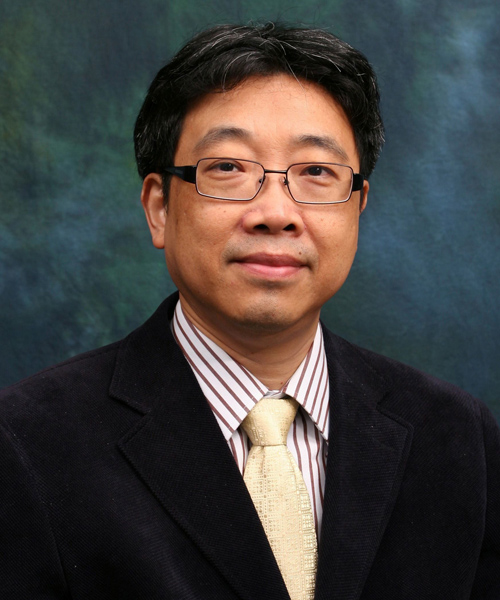
Xiaoming Liu is the Anil K. and Nandita Jain Endowed Professor of Engineering and MSU Foundation Professor in the Department of Computer Science and Engineering at Michigan State University . Holding a Ph.D. from Carnegie Mellon University (2004), he leads cutting-edge research in computer vision and machine learning. Research Interests : Computer Vision Pattern Recognition Image and Video Processing Machine Learning Medical Image Analysis Multimedia Retrieval Recent Research Trends : Focus on 3D object detection and depth estimation Development of robust biometric recognition systems Integration of radar-camera fusion for autonomous systems Advancements in self-supervised and multimodal learning Exploration of adversarial AI security Creation of interpretable forgery detection frameworks Teaching : Spring 2013: CSE891-006 Computer Vision Seminar Fall 2012-2015: CSE803 Computer Vision Spring 2014-2017: CSE 471 Media Processing and Multimedia Contact Information : Email: liuxm@cse.msu.edu Office: EB 3137, Michigan State University Phone: +1 (517) 355-2359
Rashmi Vinayak is an Associate Professor in the Computer Science Department at Carnegie Mellon University, with a courtesy appointment in the Electrical and Computer Engineering Department. She is a member of both the Systems group and Theory group at CMU and leads TheSys research group. She is also affiliated with the Parallel Data Lab (PDL). Her educational background includes a Ph.D. from UC Berkeley in 2016, followed by postdoctoral studies at the same institution. Rashmi's research spans the intersection of computer/networked systems and information/coding theory. Her current focus is on robustness and resource efficiency in data systems across storage, communication, and computation. Key thrusts include storage systems, caching systems, and systems for machine learning. Her work on SIEVE, a cache eviction algorithm, has been widely adopted by industry including VMware, Google, Redpanda, and numerous open source libraries. Her recent publications demonstrate a strong trend toward practical systems research with theoretical foundations, particularly in caching algorithms, storage systems, and machine learning infrastructure. Many of her papers have received best paper awards and industry adoption. Notable awards include: Sloan Research Fellowship (2023) IEEE Information Theory Society Goldsmith Lecturer (2023) NSF CAREER Award (2020) Multiple USENIX NSDI Community (Best Paper) Awards VMware Systems Research Award (2021) Facebook and Google Research Awards Rashmi has supervised numerous PhD, Master's, and undergraduate students, many of whom have gone on to prestigious positions at Harvard, Google, Meta, and other leading institutions. Her research has been generously funded by NSF, Sloan Foundation, Open Compute Project, Google, Facebook/Meta, VMware, and Amazon Web Services. She actively collaborates with industry partners including Google, Microsoft, NetApp, Facebook, Cisco, Intel and Cloudera. She leads TheSys research group which focuses on designing next-generation data systems that are robust, efficient, and performant. The group takes a multi-disciplinary approach spanning computer systems, information theory, and machine learning.
Xing Gao is an Assistant Professor at the University of Delaware, affiliated with the Department of Computer and Information Sciences and jointly with the Department of Electrical and Computer Engineering. His office is located at 316B FinTech Innovation Hub on the STAR Campus. He holds a PhD from the College of William and Mary (2018) and a BS from Beijing Institute of Technology (2011). Research Interests: Cybersecurity in Software Supply Chain, Web 3, High-Performance Computing, Large Language Models, with a focus on Security, Cloud Computing, and Mobile Computing. Education: PhD | 2018 | College of William and Mary BS | 2011 | Beijing Institute of Technology His recent work explores cybersecurity vulnerabilities in cloud gaming services (CCS'22), container registries (USENIX-SEC'22), and software supply chains, with specialized attention to GPU cache attacks (USENIX-SEC'24) and Ethereum smart contracts (WWW'24). His research spans theoretical and applied aspects of system security, including CI/CD pipelines (CCS'24), SDN backdoors (INFOCOM'23), and hardware-level threats (ACSAC'21). Scientific Awards NSF CAREER Award (2024) NSF CRII Award (2020) NDSS Distinguished Poster Award (2016) He serves as Registration Chair for ACM/IEEE Symposium on Edge Computing (2023) and Publicity Co-Chair for IEEE Conference on Communications and Network Security (2022). He is actively involved as TPC Member in multiple top-tier conferences including USENIX Security (2026,2025), CCS (2026,2025,2024), and IEEE DSN (2024). He has also reviewed for journals like IEEE Transactions on Dependable and Secure Computing. Labs & Teams X-Lab at the University of Delaware, a research group focused on cybersecurity in emerging technologies.
Maher Elshakankiri is an Assistant Professor, Teaching Stream at the University of Toronto's Faculty of Information. He holds a Ph.D. in Computer Engineering from Ain Shams University (Egypt), followed by a postdoctoral fellowship at the University of Regina. His research focuses on IoT, Wireless Sensor Networks (WSN), and pedagogical integration of technology and gaming. He has supervised over 100 student projects and authored a book on WSNs. Education: Ph.D. in Computer Engineering, Ain Shams University, Egypt M.Eng., B.Eng. in Engineering, Ain Shams University, Egypt Postdoctoral Fellowship, University of Regina, Canada Research Interests: IoT in healthcare, agriculture, and sports Active learning classrooms and technology in education Wireless communication protocols (V2V, UAV, RFID) Leadership & Grants: Director, Bachelor of Information (BI) Program (2024–present) Coordinator, Information Systems and Design (ISD) Concentration (2023) SSHRC Grant: 'Gaming in teaching towards a more inclusive class' (2022–2023) Professional Activities: Member, SCC IoT & Digital Twins Standards Committee Reviewer for journals including Wireless Networks , Telematics and Informatics , and Computational Intelligence Technical Program Committee member at multiple conferences Teaching: Courses include INF1340 (Programming for Data Science), INF1005/1006 (IoT Workshops), and INF452 (Information Design Coding).
Cao Jiannong is currently a Chair Professor and Director of the University Research Facility in Big Data Analytics at Hong Kong Polytechnic University . He has held academic roles including Assistant Professor at City University of Hong Kong and University Lecturer at the University of Adelaide and James Cook University. His research spans Cloud and Edge Computing , Parallel and Distributed Systems , Big Data Analytics , and Wireless Sensing . Ph.D. in Computer Science, Washington State University (1990) MSc in Computer Science, Washington State University (1986) BSc in Computer Science, Nanjing University, China (1982) His work focuses on solving theoretical and practical challenges in distributed computing , mobile cloud systems , and wireless sensor networks . Recent projects include coupled network embedding models for heterogeneous networks and SDN architectures for vehicular communication. His research also pioneers WiFi-based non-invasive health monitoring and fault-tolerant sensor deployment for structural health applications. Dr. Cao's publications highlight advancements in network embedding , edge computing , and WSN optimization . Key papers address multi-user computation partitioning , energy-efficient SHM systems , and consensus protocols for mobile networks. These works have been cited over 15,000 times, with an h-index of 60. Ministry of Education (China) Natural Science Award (2018) Distinguished Member, ACM (2017) Fellow, IEEE (2014) Best Paper Awards at IEEE DSAA, SMARTCOMP, and WCNC Dr. Cao has advised multiple PhD students, including Linchuan Xu and Weigang Wu , whose research on WSN-based SHM and coupled network embedding has practical impact. His leadership includes directing Hong Kong Polytechnic University's Big Data Research Facility and serving on technical committees for IEEE INFOCOM and ACM/IEEE conferences.
Rong Zheng is a Professor in the Department of Computing and Software and a member of the School of Biomedical Engineering at McMaster University, Canada. She holds a Tier-1 Canada Research Chair in Mobile Computing and serves as Acting Chair of the Computing and Software department from July to December 2025. She is also an Associate Member of the Electrical & Computer Engineering department. Education: Ph.D. in Computer Science, University of Illinois, Urbana-Champaign, USA Master of Engineering (thesis) in Electrical Engineering, Tsinghua University, Beijing, China Bachelor of Engineering in Electrical Engineering, Tsinghua University, Beijing, China Dr. Zheng's research lies at the intersection of mobile computing, wireless networking, and machine learning, with a strong focus on applications for aging populations. She directs the NSERC Smart Mobility for the Aging Population CREATE program. Her work encompasses sensor development, wireless network design, and mobile data analytics to address real-world challenges in healthcare, mobility, and data center monitoring. She has developed innovative solutions like the MacQuest campus navigation app and has captured first prize in indoor localization competitions. Her recent publications demonstrate a clear trajectory toward applying wireless sensing technologies (particularly acoustic, Wi-Fi, and mmWave) to health monitoring and mobility assessment for older adults. There's a strong emphasis on developing efficient edge computing solutions that can process data in real-time on resource-constrained devices, as exemplified by her TeamNet framework for collaborative inference on the edge. Her work bridges theoretical advances with practical applications that have social impact. Scientific Awards: Tier-1 Canada Research Chair in Mobile Computing US National Science Foundation CAREER Award (2006) Joseph Ip Distinguished Engineering Fellow (2015-2018) Dr. Zheng leads the Wireless System Research Group (WiSeR) at McMaster University, which has secured significant funding including a $1.65M NSERC CREATE grant for smart mobility research for older adults. Her research has been supported by multiple funding agencies including NSERC, NSF, UH GEAR, and DURIP. She actively mentors graduate students and has developed specialized courses including CAS 772 (Mobile Data Analytics) and CAS 781 (Mobility in the Aging Population). The WiSeR group conducts impactful research on communication, networking, and data analytics issues in Cyber Physical Systems, with applications spanning healthcare, smart infrastructure, and data center monitoring. Their work on data center infrastructure monitoring networks has been featured in EurekAlert and Data Center Dynamics, and they've made significant contributions to indoor localization technology.
Maria Apostolaki is an Assistant Professor of Electrical and Computer Engineering at Princeton University. Her research focuses on designing secure, reliable, and high-performance networked systems, integrating expertise in networking, security, blockchain, and machine learning. She holds a Ph.D. from ETH Zurich (2021) and an M.Eng. from the National Technical University of Athens (2015). Education: Ph.D., ETH Zurich 2021 | M.Eng., NTUA 2015 Her work investigates challenges in network security, distributed systems, and adversarial resilience. Notable contributions include SABRE (protecting Bitcoin from routing attacks) and TANGO (collaborative route control). She has advised multiple graduate students in computer science and engineering. Key honors include the NSF CAREER Award and the IRTF/IETF Applied Networking Research Prize (2018). Her lab explores cutting-edge topics like contextual robustness in ML-driven network functions and formal methods for secure systems. Advising: 6 advisees in COS/ECE domains Grants: NSF CAREER Award, innovation grants for AI/robotics Her TANGO framework enables secure cross-domain routing, while recent work addresses vulnerabilities in Ethereum PoS and BGP routing protocols.
Máté Szabó is an Assistant Professor at the University of Debrecen , affiliated with the Faculty of Informatics and the Department of Information Technology . His email contact is szabo.mate@inf.unideb.hu . He works in areas such as Machine Learning , Smart Cities , and Mobile Computing . His research spans topics like microservice architecture for ensemble models, Markov modeling of traffic flows, and distributed machine learning on mobile platforms. He has explored neural models for conversational AI and gamification in programming education through Minecraft-based challenges. His work also addresses edge computing and data parallelism in mobile environments. His publications (2016–2024) reflect trends in machine learning deployment on Android platforms smart city traffic analytics gamified educational tools cognitive modeling of numerical understanding microservice-based model integration .
Oana Balmau is an Assistant Professor in the School of Computer Science at McGill University, where she leads the Data-Intensive Storage and Computer Systems Laboratory (DISCS Lab). She also holds a status-only appointment at the University of Toronto and serves as a working group chair for MLPerf Storage. Her research focuses on creating storage infrastructure that enables fast and energy-conscious insights from data, with particular emphasis on storage and persistent memory technologies for machine learning, data science, and edge computing workloads. Dr. Balmau's research interests span computer systems, with specific focus on: Design and implementation of efficient key-value stores Storage systems for machine learning workloads Edge computing infrastructure Persistent memory technologies Performance optimization of data-intensive systems Her recent work has led to significant contributions in storage benchmarking through the MLPerf Storage benchmark and in edge computing frameworks. The MLPerf Storage benchmark has become an industry standard for evaluating storage performance in machine learning environments, while her work on hierarchical edge computing addresses security and performance challenges in distributed edge environments. Her publications show consistent high-impact contributions to top systems venues, with recent work focusing on processing-in-memory virtualization, stream processing reconfiguration, and efficient data preprocessing pipelines. Dr. Balmau has received numerous awards for her research, including: SEC 2024 Best Paper Award for "Falcon: Live Reconfiguration for Stateful Stream Processing on the Edge" MLCommons Hero Award 2023 for leadership as MLPerf Storage working group chair ACM SIGOPS Dennis M. Ritchie Doctoral Dissertation Award 2021 Honorable Mention CORE John Makepeace Bennett Award 2021 for the best Computer Science doctoral dissertation in Australia and New Zealand USENIX ATC 2019 Best Paper Award for "SILK: Preventing Latency Spikes in Log-Structured Merge Key-Value Stores" As an educator, Dr. Balmau teaches courses on advanced computer systems, operating systems, and principles of computer systems design at McGill University. She has served on program committees for top systems conferences including SOSP, SIGMOD, FAST, and EuroSys, and has co-organized workshops on resource-efficient machine learning and edge computing. She leads the DISCS Lab, which focuses on two main research directions: Systems for ML (including the MLPerf Storage benchmark) and Edge computing (including frameworks for fast and secure edge computing in hierarchical edge environments).
Owen R. White is a Professor in the Department of Epidemiology & Public Health at the University of Maryland School of Medicine, serving as Associate Director of the Institute for Genome Sciences and Associate Director of Research Collaboration & Development. He leads a team of 25 scientists and engineers developing genomic annotation pipelines and data analysis tools for state-of-the-art research in microbiome and multi-omic studies. His academic background includes: BS in Biotechnology from the University of Massachusetts (1985) PhD in Molecular Biology from New Mexico State University (1992) Postdoctoral Fellowship in Genome Informatics at the Institute for Genomic Research (TIGR) (1994) Dr. White's research spans bioinformatics, genomics, transcriptomics, and metagenomics with emphasis on data management, metadata standards, ontologies, and cloud systems. His work has been foundational for large-scale initiatives like the Human Microbiome Project (HMP) and Integrative Human Microbiome Project (iHMP), generating over 50,000 datasets totaling 10 terabytes of multi-omic data. Analysis of his recent publications reveals a strong trend toward neuroscience multi-omics (BRAIN Initiative), cloud-based data infrastructure, and ethical data sharing frameworks. His work consistently bridges microbiome research with emerging fields like single-cell analysis and Alzheimer's disease biomarker discovery through integrated data platforms. Notable awards include: Benjamin Franklin Award for Open Access in the Life Sciences (2015) Kumho Science International Award in Plant Molecular Biology and Biotechnology (2001) As Principal Investigator for major NIH-funded centers, he has secured sustained support for the HMP Data Analysis and Coordination Center and iHMP Data Coordination Center. His team's work combines fee-for-service models with collaborative research funding to maintain cutting-edge genomic analysis capabilities. The Institute for Genome Sciences houses his computational team responsible for developing production annotation pipelines, database systems, and visualization tools that serve researchers across the University of Maryland School of Medicine and national consortia.
Peter Pietzuch is a Professor in the Department of Computing at Imperial College London, where he leads the Large-Scale Data & Systems (LSDS) group. He also serves as the Director of Research and is a Visiting Researcher at Microsoft Research Cambridge. Pietzuch holds a Ph.D. from the University of Cambridge and a B.A. from Girton College. His research spans distributed systems, cloud computing, big data processing, and systems security. Key interests include: Scalable architectures for cloud-native applications Efficient stream processing and machine learning systems Trusted execution environments and secure cloud infrastructure Optimization of serverless computing and distributed databases His recent publications focus on adaptive machine learning frameworks, secure cloud resource management, and high-performance stream processing systems. Trends show strong emphasis on hardware-software co-design, confidential computing, and fault-tolerant architectures. Awards include: Best Paper Award at Middleware'03 He actively advises PhD students and secures grants for projects like Faasm (serverless computing) and Teechain (blockchain security). His LSDS group collaborates with industry partners including Microsoft Research. Pietzuch teaches undergraduate and graduate courses including Scalable Systems for the Cloud and Operating Systems . He co-founded the ACM DEBS conference and serves on steering committees for EuroSys and Middleware.
Chita R. Das is a Professor at Pennsylvania State University, known for extensive contributions in computer architecture, machine learning, and high-performance computing. Their research focuses on optimizing hardware-software co-design for edge computing, cloud infrastructure, and energy-efficient systems. Key areas include FPGA acceleration, GPU optimization, and serverless computing frameworks. Das collaborates frequently with institutions like AMD and Intel, addressing challenges in parallel computing and distributed systems. Their work bridges theoretical advancements with practical applications in recommendation systems, bioinformatics, and real-time video processing. Research interests span across hardware acceleration techniques, cloud resource management, and sustainable computing. Notable projects include adaptive training frameworks for intermittent power environments and neural-augmented game streaming for mobile platforms. Das's publications often address performance bottlenecks in modern architectures and propose novel solutions for latency and energy efficiency. Recent articles highlight innovations in serverless computing cost optimization, low-bandwidth VR streaming, and FPGA-based bioinformatics tools. Their contributions are characterized by interdisciplinary approaches combining computer architecture with machine learning and embedded systems.
Yang Liu is a tenured Associate Professor at the Department of Management and Engineering , Linköping University, Sweden, and an Adjunct Professor at the University of Oulu, Finland. His expertise spans smart manufacturing, clean energy transition, and Industry 4.0 applications. He holds an M.Sc. and D.Sc. from the University of Vaasa, Finland. Research & Awards: Liu's work focuses on sustainable systems, decision support systems, and AI-driven energy efficiency. He has authored over 140 Web of Science publications, including top 0.1% ESI Hot Papers. He is ranked among the world's top 2% scientists (Stanford-Elsevier) and leads globally in 'big data analytics in manufacturing' and 'Industry 4.0-driven circular economy' research. Leadership & Projects: He leads projects like FlexSUS (EU Horizon 2020) and PERSEUS, developing tools for smart urban energy planning and 15-minute city models. He serves as Editor-in-Chief of Cleaner Engineering and Technology and Guest Editor for multiple journals. His research emphasizes bridging data science with sustainability challenges in manufacturing and energy systems. Key Achievements: Top-ranked in global citations, ESI Highly Cited Papers, and industry-driven sustainability frameworks. Grants: Leads EU-funded projects and collaborates with Siemens Energy on energy transition solutions. Labs & Teams: Part of the Environmental Technology and Management (MILJÖ) division and Unit for Product Service Innovation (MILJOPSI) at Linköping.
Heather Zheng is the Neubauer Professor of Computer Science at the University of Chicago, co-directing the SAND Lab (Security, Algorithms, Networking and Data) with Prof. Ben Y. Zhao. She holds IEEE (2015) and ACM (2023) Fellowships, and was recognized as MIT TR35 (2005) for cognitive radio research. Her work bridges mobile/IoT security, adversarial ML, and generative AI ethics. Zheng earned her PhD in Electrical and Computer Engineering from University of Maryland in 1999, with prior roles at Bell-Labs, Microsoft Research Asia, and UCSB. Education: PhD in Electrical and Computer Engineering, University of Maryland, College Park (1999) Research Focus: Explores cutting-edge challenges in: Security implications of mobile/IoT sensors (e.g., bracelet-of-silence countermeasures) Adversarial machine learning defense mechanisms (e.g., Blacklight attack detection) Generative AI governance (Glaze, NightShade copyright tools) Awards: ACM Fellow (2023) IEEE Fellow (2015) World Technology Network Fellow Labs & Collaborations: Leads SAND Lab focusing on security, ML, and networked systems. Active in UChicago's Systems Group exploring cloud/edge computing architectures.
Dr. Bin Tang is a Professor in the Department of Computer Science at California State University, Dominguez Hills. He holds a Ph.D. in Computer Science from Stony Brook University (2007) and dual M.S. degrees in Computer Science and Materials Science from the same institution. His research focuses on algorithmic solutions for data placement in networks, with applications in robotic sensor systems and cloud data centers. He has led multiple NSF-funded projects including 'Edge-Based Approach to Robust Multi-Robot Systems' and 'Optimal Resource Allocation in Policy-Driven Data Centers'. Dr. Tang mentors students in research competitions and has supervised numerous graduate theses. He teaches courses in operating systems, algorithms, computer networks, and cloud computing.