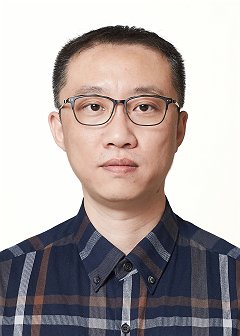
Merlijn Sebrechts is a postdoctoral researcher and policy officer at Ghent University's Faculty of Engineering and Architecture, Department of Information Technology (EA05). His work focuses on cloud-native technologies, edge computing, and secure system design. Research areas include Kubernetes, WebAssembly, and confidential computing He teaches computer science courses in the Information Engineering Technology program Expertise spans trusted execution environments, software supply chain security, and cloud orchestration His recent publications analyze edge computing security, lightweight virtualization, and intent-based resource management. Key contributions include decentralized orchestration frameworks and benchmarks for cloud performance. Merlijn maintains strong ties to open-source ecosystems through involvement with Kubernetes, Docker, and the Ubuntu community.
Michael Humber is an Associate Research Professor in the Department of Geographical Sciences at the University of Maryland, College Park. He holds a B.S. (2011), M.P.S. (2013), and Ph.D. (2019) in Geography from the same institution. His research focuses on remote sensing, spatial statistics, and geospatial data management with applications to agriculture and wildfire detection. Deputy Director for NASA's ACRES consortium Data Lead for NASA Harvest Lead Scientist for UMD Climate Resilience Network's Climate-Smart Agriculture Member of UMD-NASA Fire Science Team His work develops satellite-based data products for agricultural decision-making, including web/mobile apps and HPC/cloud systems. He also leads the transition of NASA's fire products (MODIS/VIIRS) to cloud-native architectures to reduce latency and costs. Recent efforts include real-time Landsat fire detection systems and collaborative frameworks engaging local stakeholders in research design. Publications emphasize global burned area mapping validation, crop monitoring frameworks in Africa and Latin America, and integrating Earth observations into food security policies. His contributions include the NASA Harvest platforms for in-situ data collection and the Crop Monitor for Early Warning. Grants and partnerships span NASA initiatives, international organizations (e.g., GEOGLAM), and state-level projects in Maryland. He collaborates with institutions across the Americas, Africa, and Asia to strengthen agricultural resilience through geospatial innovation.
Sławomir Zieliński is a Lecturer at the Institute of Computer Science within the Faculty of Computer Science at AGH University of Science and Technology in Kraków. His academic role involves teaching and research focused on cloud technologies and educational informatics. He maintains an office at D-17, ul. Kawiory 21, and can be contacted via email at slawek@agh.edu.pl or phone at +48 12 328 33 77. Zieliński's research explores intersections between cloud computing and educational technology, particularly: Cloud-native applications and serverless architectures for environmental monitoring Automated orchestration of educational services in cloud environments IoT-enhanced collaborative learning platforms Software-defined networking optimizations Remote teaching methodologies and pandemic-responsive education systems Performance evaluation frameworks for distributed systems His work demonstrates consistent innovation in adapting cloud infrastructure to educational challenges. Recent publications (2015-2024) reveal strong thematic focus on cloud-based educational technologies, distributed systems optimization, and pandemic-era teaching solutions. Dominant research threads include: Cloud infrastructure for remote education (6+ publications) Performance evaluation methodologies for networks and cloud services (4 publications) IoT integration in educational ecosystems (3 publications) Serverless computing applications in environmental systems
Mario Baldi is an Associate Professor (on leave) of Information Processing Systems at the Department of Control and Computer Engineering , Politecnico di Torino , and concurrently a Fellow in the Office of the CTO, Adaptive and Embedded Computing Group, at AMD, San Jose, CA. His career blends deep academic research with extensive industry R&D leadership. Education M.Sc. (Summa Cum Laude) in Electrical Engineering, Politecnico di Torino, 1993 Ph.D. in Computer and System Engineering, Politecnico di Torino, 1998 Research Focus Baldi’s research spans programmable data planes, software-defined networking, big-data analytics for network management, network security, high-performance switching architectures, optical networking, QoS mechanisms, and multimedia/voice-over-IP systems . He is especially known for pioneering work on P4 -based programmable networks and SmartNIC architectures. Publication & Patent Impact Across 150+ refereed papers and 35+ US patents (plus European filings), his recent output concentrates on machine-learning-driven network data-plane functions , disaggregated stateful network services , and cloud-grade DPUs . The 2021–2024 articles emphasize real-time inference directly in the network data plane and modular SDN programming. Awards & Honors Best Paper Award, IEEE ICC 2007 Best Paper Award, IEEE ISCC 2008 Best Paper Award, IEEE GreenComm 2009 Best Paper Award, ACM/IEEE WI/IAT 2014 Grants & Projects Baldi has served as Principal Investigator or Scientific Coordinator on numerous EU Framework and Italian national projects (PRIN, FAR), leading consortia on energy-efficient packet networks, trusted software execution, wireless mesh architectures, and streaming media delivery. Teaching & Mentoring He has taught graduate courses on Enterprise Network Technologies, Computer Network Technologies and Services, Networks/Cloud/Application Security at Politecnico di Torino since 2003. He has also supervised PhD collegi for the Computer and Systems Engineering doctoral program (cycles 19–23) and held visiting/adjunct positions across four continents. Labs & Teams Previously headed the NetGroup (Computer Networks Group) at Politecnico di Torino (2001–2007) and co-chairs the p4.org Architecture Workgroup , driving open standards for programmable networking.
Karl Norrman is an Industry doctoral student and Researcher at the Department of Theoretical Computer Science (TCS) at KTH Royal Institute of Technology, concurrently working as a Security Researcher at Ericsson Research since 2001. His academic appointment at KTH is part-time (20% time allocation), while he spends the majority of his time (80%) at Ericsson, where he holds the formal title of Expert Mobile Network Security. He is supervised by Professor Mads Dam for his doctoral studies and receives partial research funding from the Wallenberg AI, Autonomous Systems and Software Program (WASP). His educational background includes: PhD candidate in Computer Science at KTH Royal Institute of Technology, Department of Theoretical Computer Science (ongoing). Research focuses on formal modeling and proofs for cryptographic protocols using pen-and-paper proofs and mechanized proof-support tools such as Tamarin and EasyCrypt. Master's degree in Computer Science from Stockholm University, Department of Mathematics (2001). Thesis: "RTP Security in 3G Networks." During this work, he contributed to the development of the Secure Real-time Transport Protocol (SRTP), standardized in IETF as RFC 3711. Norrman's research centers on formal methods for security protocol verification , with particular expertise in cryptographic protocol analysis, modeling, and mechanized proof techniques. His work bridges theoretical computer science and practical security applications, focusing on making formal verification tools accessible for industrial adoption. Key research areas include 5G/6G security architectures, privacy-preserving mechanisms for mobile networks, authentication and key agreement protocols, and software security. He advocates for "goal oriented and motivated security designs" that balance theoretical rigor with practical implementation constraints while specializing in translating complex security requirements into implementable solutions for telecommunications infrastructure. Analysis of Norrman's publication history reveals a consistent evolution from foundational work on SRTP (2002-2007) through LTE security analysis (2014-2015) to pioneering 5G security research (2016-2020) and now 6G security exploration (2024). His work demonstrates methodological progression from analyzing existing protocols to designing novel security mechanisms and developing verification frameworks like OpenSAW. A distinctive pattern is his focus on industrial applicability —ensuring theoretical security models translate to real-world implementations, particularly evident in his work on USIM-compatible protocols and error-correcting authentication for noisy wireless channels. Recent publications increasingly address cross-domain challenges like secure federated learning in mobile networks, reflecting the expanding scope of telecommunications security. Professional engagement: Reviewer for ACM CCS 2023, EURO S&P 2023, ACM CCS 2022, NordSec 2022, Vietcrypt 2006, IEEE Telecommunications Journal Active contributor to 3GPP security standardization processes Co-author on multiple Ericsson whitepapers shaping industry security practices Norrman maintains a unique dual affiliation that enables direct translation of academic research into industrial security solutions. At KTH, he contributes to the Theoretical Computer Science group's formal methods research, while at Ericsson he applies these techniques to real-world security challenges in mobile network development. His work on OpenSAW exemplifies this bridge between academia and industry, creating practical tools for automated security testing of component-based software systems. This position allows him to identify emerging security challenges in next-generation networks while maintaining theoretical rigor in his approach.
Dimitrios Soudris is a Professor at the School of Electrical and Computer Engineering, National Technical University of Athens (NTUA), leading the Microprocessor and Digital Systems Lab (MicroLab). Previously, he served as Lecturer, Assistant, and Associate Professor at Democritus University of Thrace from 1995 to 2008. Diploma in Electrical Engineering (1987), University of Patras PhD in Electrical Engineering (1992), University of Patras His research focuses on Embedded Systems , Reconfigurable Architectures (FPGAs) , Hardware Accelerators for data centers/space/cloud, Edge Computing , and Low Power VLSI Design . Recent publications highlight trends in: AI/ML acceleration for edge and space applications Secure FPGA architectures for 6G networks Energy-efficient heterogeneous memory systems Approximate computing techniques Transformer optimization for low-power contexts Scientific Awards: INTEL and IBM awards (project LPGD #25256) HiPEAC, DAC, and ISCA awards (2010–2024) XILINX Open Hardware Design Contest (2017, 2019, 2021) He has coordinated >70 R&D projects funded by the European Commission, ENIAC-JU, ESA, and industry partners. As Associate Editor of ACM TODAES and conference chair (PATMOS, VLSI-SOC), he contributes to academic leadership. His lab, MicroLab, specializes in hardware-software co-design for emerging computing paradigms.
Professor Kim Jong-hyun serves in the Department of Information Security at Sejong University, directing the Network Security Lab which develops core security technologies for cyberattack response, cloud security, and mobile communications security in evolving digital environments. The lab actively participates in international standardization efforts. His research spans critical cybersecurity domains: Network and 5G Security Drone (UAV) Security Systems AI-Driven Malware Detection Cloud Infrastructure Protection Mobile Communications Vulnerability Analysis Base Station Authentication Mechanisms 2024 publications reveal concentrated research on wireless security challenges, particularly fake base station threats in 5G networks, container security in cloud-native environments, and deep learning applications for UAV location integrity. His work bridges theoretical models with practical implementations for next-generation network security. No scientific awards are documented in the provided materials. Professor Kim actively supervises graduate research through Master's thesis and Doctoral Dissertation courses in the Graduate School of Information Security, while teaching specialized courses including Mobile Communications Security and Advanced C Programming. His advising focuses on emerging security threats in telecommunications infrastructure. The Network Security Lab (Se212C) functions as an operational hub for hands-on security research, with interview procedures requiring direct email contact for prospective students.
Sonia Fahmy is a Professor and Associate Department Head in the Department of Computer Science at Purdue University. She joined Purdue in 1999 and was recently elevated to IEEE Fellow status. Fahmy is a member of CERIAS (Center for Education and Research in Information Assurance and Security) and has made significant contributions to network architectures and protocols research. Research Interests: Design and evaluation of network architectures and protocols Network support for virtual reality applications Network measurement and management Cellular networks optimization and security Network experimentation methodologies Professor Fahmy's research has evolved to address emerging challenges in networking, with recent work focusing on virtual reality networking, 5G security, and quality-of-experience optimization. Her publications reveal a consistent trajectory from fundamental network protocol design toward addressing the specific requirements of modern applications like VR and volumetric video streaming. Scientific Awards: IEEE Fellow National Science Foundation CAREER Award (2003) Professor Fahmy has successfully mentored numerous PhD students who have gone on to careers at leading technology companies and academic institutions. Her research has been supported by substantial funding from the National Science Foundation, Department of Homeland Security, and industry partners including Cisco, Meta, Juniper Networks, and AT&T. She leads several active research projects including network support for virtual reality applications (NSF and Meta projects), network measurement and management (Juniper Networks and GENI Project), cellular networks security (NSF projects), and network experimentation (DHS and NSF projects).
Umakishore Ramachandran is a Professor in the School of Computer Science at Georgia Institute of Technology's College of Computing, where he directs the Embedded Pervasive Lab. He received his Ph.D. from the University of Wisconsin-Madison in 1986 and has led transformative initiatives including the Online MS in Computer Science (OMSCS) program. His research spans distributed systems, edge computing, and real-time sensor networks, with applications in smart surveillance and connected vehicles. His research interests include architectural design of parallel/distributed systems, large-scale situation awareness using camera networks, cloud-edge continuum optimization, and latency-sensitive applications for geo-distributed infrastructures. Recent work focuses on elevating edge computing to parity with cloud resources. His publications show strong emphasis on edge computing innovations (MicroEdge, FogStore), real-time video analytics (EVA, ClairvoyantEdge), and adaptive mobile systems (Foresight). Trends include multi-tier architectures, quality-of-experience optimization, and scalable processing for IoT workloads. Major Awards: IEEE Fellow (2014) NSF Presidential Young Investigator (1990) ACM/IFIP Middleware Best Paper (2022) 3x College of Computing Dean's Awards He has advised 40+ PhD students, with recent graduates at Google, Microsoft, and academia. Current NSF/CPS grants support his work on geo-distributed latency-sensitive applications. He co-leads the STAR Center and Samsung-funded embedded software programs. His Embedded Pervasive Lab develops systems like Stampede (stream processing) and DFuse (sensor fusion), with testbeds in the Aware Home and transportation networks. Teams collaborate with Intel, Microsoft, and Bosch on edge-AI deployments.
Brian Dietrick is a Senior Teaching Instructor in the Department of Computer Science at East Carolina University. His office is located in Slay 110, and he can be contacted via email at dietrickb23@ecu.edu or by phone at 252-737-4979. His teaching expertise encompasses: Web Application Architecture and Development Cross-Platform Mobile Application Engineering Full-Stack Software Development and Systems Integration Relational Database Architecture, Administration, and Optimization Agile Methodologies for Software Project Management DevOps Practices for Continuous Integration and Deployment His research focuses on two primary domains: Programming language design and implementation techniques Cloud-native computing architectures and scalable infrastructure solutions
Mohammad Hamdaqa is an Associate Professor at the Department of Computer Engineering and Software Engineering at Polytechnique Montréal (Canada), where he leads the Software and Emerging Technologies Lab. He received his PhD in Software Engineering from the University of Waterloo in Canada in 2016 and holds multiple advanced degrees including a Master of Applied Science in Software Engineering and an MBA with a minor in Management Information Systems. His educational background includes: Ph.D. in Electrical and Computer Engineering, University of Waterloo, Canada Master in Electrical and Computer Engineering, Concordia University, Canada Master in Business Administration, New York Institute of Technology, USA Bachelor in Computer Engineering, Jordan University of Science and Technology, Jordan Dr. Hamdaqa's research focuses on the intersection of software engineering and emerging technologies. His work explores how software engineering approaches can be tailored to address the complexities of architecting, building, and deploying applications for new platforms like Cloud Computing and Blockchain. He is particularly interested in how emerging technologies can advance software creation, evolution, and management practices. His research spans model-driven software engineering, cloud computing, blockchain, and the application of AI in software development processes. His recent publications demonstrate a strong focus on smart contract security, infrastructure as code, model-driven engineering, and the application of large language models in software engineering tasks. His work bridges theoretical software engineering concepts with practical applications in cutting-edge technology domains, with particular emphasis on addressing security, sustainability, and maintainability challenges in next-generation software systems. Dr. Hamdaqa has received recognition through service on program committees for major software engineering conferences including ASE, ICSE, MODELS, and SANER. He serves on the editorial board of Service Transactions on Internet of Things and is a Member of the IEEE Computer Society and the Association for Computing Machinery. He has supervised multiple Master's students to completion, with recent theses focusing on OCL generation, smart contract auditing, epidemiological modeling, and infrastructure as code security. His current research group continues to explore innovative approaches at the intersection of software engineering and emerging technologies. Dr. Hamdaqa leads the Software and Emerging Technologies Lab at Polytechnique Montréal, which brings together researchers and students to investigate cutting-edge challenges in software engineering for new technology platforms. The lab focuses on practical solutions that balance theoretical rigor with real-world applicability.
Roumen Nikolov is an Associate Professor in the Department of Computer Science at the University of Library Studies and Information Technologies in Sofia, Bulgaria. He is an active researcher with 19 publications generating over 10,773 reads and 81 citations, specializing in the integration of information technology across education, environmental management, and urban development. As a core member of Elena Shoikova's Lab, his work bridges theoretical frameworks with practical implementations of emerging technologies. His research spans Smart Education systems, Blockchain applications, Smart City ecosystems, and Forest Management solutions. Key interests include developing competence-based learning models for digital natives, creating energy-efficient smart home environments, and establishing interoperable standards for urban IoT infrastructure. His publications consistently emphasize sustainability, user-centered design, and the socio-technical implications of digital transformation in both educational and ecological contexts. Analysis of his 15 most recent publications reveals a pronounced interdisciplinary trajectory where computer science fundamentals converge with environmental science and educational theory. Dominant themes include the application of Big Data analytics in urban ecosystems, blockchain-enabled industrial innovation, and the conceptualization of smart learning environments. His work demonstrates particular strength in translating technical capabilities into tangible solutions for Bulgaria's national ICT strategy implementation and sustainable regional development. Nikolov maintains extensive collaborative networks across Bulgarian academic institutions including the Technical University of Sofia and Bulgarian Academy of Sciences. His primary research vehicle is Elena Shoikova's Lab, which focuses on advanced ICT applications in education and environmental management. Current projects emphasize cloud-based educational architectures, smart forest ecological management systems, and the development of service-oriented smart home solutions that prioritize energy efficiency and user experience.
Jay Deslauriers serves as a Research Fellow at the University of Westminster's Centre for Parallel Computing and holds a Teaching Fellow position at Imperial College London spanning both the Graduate School and Business School. With five years at Westminster following prior service as a full-time Lecturer in the School of Computer Science & Engineering, his career bridges advanced cloud research and technical education. His research focuses on cloud and container orchestration with emphasis on vendor-agnostic solutions across the cloud-edge continuum. Key projects include leading MiCADO framework development for the EU Horizon 2020 DIGITbrain (Digital Twins in Manufacturing) and ASCLEPIOS (secure healthcare cloud platform) initiatives. His technical expertise spans Kubernetes, Docker, TOSCA standards, and infrastructure-as-code implementation. Research outputs show consistent publication trends in Decentralized orchestration frameworks (2023-2025) Digital twin deployment systems (2021-2022) Cloud-agnostic application management (2018-2020) with recent work emphasizing microservices in edge computing environments. His professional engagement includes Society of Research Software Engineering membership (since 2019) AdvanceHE fellowship (since 2020) supporting his dual focus on technical infrastructure and research education. Current supervision interests center on cloud/container orchestration, Docker/Kubernetes implementation, and statistical methods for resource optimization. His MiCADO framework remains central to multiple EU-funded projects with ongoing development for cloud-edge continuum applications.
Hamed Hamzeh serves as Lecturer in Data Science at the School of Computer Science and Engineering, University of Westminster, and is affiliated with the Centre for Parallel Computing. His academic credentials include a Ph.D. in Cloud Computing from Bournemouth University and an MSc in Data Science from Istanbul Sehir University, Turkey. Dr. Hamzeh's research centers on cloud-native resource management, computer networks, and multi-agent systems, with groundbreaking work on fairness in cloud resource allocation. He developed novel algorithms including H-FFMRA and MRFS that address multi-resource scheduling in heterogeneous environments. His expertise spans AWS, Kubernetes, Python, and optimization techniques, bridging theoretical cloud computing with industrial applications in orchestration and resource management. Analysis of his 11 publications (2017-2023) reveals an evolving research trajectory: beginning with network bandwidth allocation (2017), advancing to cloud resource fairness (2018-2021), and culminating in cloud-to-things continuum orchestration (2023). This progression demonstrates increasing system complexity while maintaining core focus on fairness metrics across distributed environments. Dr. Hamzeh actively contributes to the academic community as technical committee member for IEEE ICCCS and Distributed AI conferences, and as reviewer for Springer's Journal of Grid Computing and Journal of Supercomputing. His service reflects recognition within cloud computing research circles. Prospective students receive supervision in Cloud Computing, Artificial Intelligence, Machine Learning, Software Engineering, and Computer Networks. Current research opportunities emphasize practical implementation of resource allocation algorithms in cloud-native environments through the Centre for Parallel Computing.
Wei Chen is a Research Fellow at the Institute of Software, Chinese Academy of Sciences, where he serves as a PhD and Master's supervisor. He leads the Software Engineering Technology R&D Center and maintains affiliations with the University of Chinese Academy of Sciences and its Nanjing College. Dr. Chen has established himself as a leading figure in intelligent software engineering research within China's academic community. His primary research focuses on four interconnected areas: intelligent code maintenance and quality assurance (particularly Python ecosystem compatibility based on domain knowledge), reliability assurance of complex IoT systems in human-machine-object convergence scenarios, cloud-native system development with emphasis on Function-as-a-Service optimization, and quality assurance of deep learning frameworks in resource-constrained environments. Dr. Chen's work consistently bridges theoretical advances with practical applications, maintaining strong industry collaborations with major Chinese technology companies. Analysis of Dr. Chen's recent publications reveals a strategic integration of AI techniques with traditional software engineering challenges. His research shows increasing emphasis on leveraging large language models for IoT component synthesis, sophisticated dependency management solutions for Python ecosystems, and innovative approaches to testing autonomous systems. The work demonstrates both theoretical depth and practical utility, with many publications leading to implemented tools and systems. Second Prize of Science and Technology Progress Award of China Institute of Electronics (2022) First Prize of Science and Technology Progress Award of China Institute of Electronics (2021) ACM SIGSOFT Distinguished Paper Award (2023) Special Prize of the 4th China Software Open Source Innovation Competition (2021) First Prize in the 4th China Software Open Source Innovation Competition (2021) OW2 Programming Contest First Prize (2016) Dr. Chen has mentored over ten graduate students who have achieved notable success in academic competitions and industry placements. His laboratory (TCSE, http://tcse.cn/) currently manages multiple significant research projects including 'Complex IoT System Reliability Assurance Key Technology Research' (2025-2028), 'Intelligent Development, Testing, and Maintenance of Cloud-native Software Ecosystems' (2024-2027), and 'Traffic Infrastructure Digital Industrial Software Architecture and Core Technology Standard System' (2021-2024). The lab maintains active collaborations with Huawei, Alibaba, Tencent, and other leading technology enterprises.