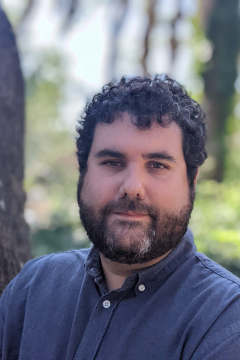
Professor Dimitrios I Gerogiorgis holds the Personal Chair of Process Systems Engineering at the University of Edinburgh's School of Engineering (Institute for Materials & Processes). His research focuses on pharmaceutical manufacturing optimization, biochemical processes, oil & gas systems, and high-temperature materials processing. He has contributed to over 50 peer-reviewed publications, including seminal works on continuous pharmaceutical manufacturing (CPM), smart drilling fluids, and beer fermentation dynamics. Education: PhD/MSc in Chemical Engineering (Carnegie Mellon University) and Diplomas in Chemical Engineering (Aristotle University) and Translation (Institute of Linguists). Professional memberships include AIChE, IChemE, TMS, and ASEE. Research emphasizes multi-objective optimization, techno-economic analysis, and CFD modeling. Key projects include: (1) CPM cost-benefit analyses for ibuprofen/artemisinin, (2) nanoparticle-enhanced drilling fluid rheology, and (3) beer fermentation temperature manipulation simulations. His work bridges fundamental process modeling with industrial-scale implementation.
Milind Kandlikar is a Professor jointly appointed at the School of Public Policy and Global Affairs (SPPGA) and the Institute for Resources, Environment and Sustainability (IRES) at the University of British Columbia. His research focuses on the intersection of technology innovation, human development, and global environmental challenges. He is a leading expert in climate adaptation, environmental policy, and the governance of emerging technologies. Kandlikar currently leads the Climate Adaptation, Resilience, and Empowerment (CARE) Program, a multi-university initiative training over 2,000 students in Canada and France to address climate crises through interdisciplinary approaches. His work spans cross-national comparisons of agricultural biotechnology regulation, air quality in Indian cities, nanotechnology risks, sustainable transportation, and climate change impacts on development. He has taught courses such as 'Science, Technology, and Public Policy' and contributed to policy frameworks for energy systems, environmental governance, and global development. Key research themes include climate resilience, equitable transitions to clean energy, and the socio-technical dimensions of innovation. His publications emphasize interdisciplinary solutions to complex environmental challenges, integrating policy analysis, technological assessment, and stakeholder engagement. Despite no explicitly listed awards, his leadership roles and prolific publication record reflect significant recognition in environmental and policy research. Kandlikar’s contributions extend to global initiatives like the CARE Program and collaborations with institutions such as Sciences Po and the University of Toronto. His research often bridges academic rigor with practical policy applications, addressing real-world challenges in climate adaptation and sustainable development.
Rob Lindsay is a Reader in Corrosion Science and Engineering at the University of Manchester's School of Materials. He holds leadership roles as Director of the Materials for Demanding Environments (M4DE) Centre for Doctoral Training and as PGR Director. With over 25 years of research experience, he has authored ~80 publications, focusing on corrosion mechanisms, surface chemistry, and oxide interfaces. His work employs advanced techniques like vibrational sum frequency spectroscopy and synchrotron-based probes, aligned with the Henry Royce Institute's MS4DE theme. Research Interests: His core areas include mechanistic understanding of corrosion-related surface properties, oxide structure analysis, and corrosion inhibition mechanisms. Current topics span atmospheric corrosion at humid interfaces, nanoscale corrosion processes, and protective coatings. Collaborations with theoreticians and industry partners enhance experimental insights. Key Highlights: - Established acid-dependent corrosion inhibitor interfaces (2022) - Revealed deficiencies in sweet corrosion scales (2021) - Explained asymmetric XPS peaks in atomic adsorbates (2020) - Identified drivers for TiO₂ superhydrophilicity (2019) Professional Activities: Member of Faraday Division Council (2019-2022), EPSRC Peer Review College (2016-present), and editorial board for Metal journal. Supervises 32+ PhD students through M4DE CDT, focusing on materials performance challenges. Leads datasets on corrosion scales and inhibitor studies, available via Mendeley and institutional repositories. Labs & Teams: His group develops advanced spectroscopic tools at the Photon Science Institute and collaborates internationally. Research contributes to UN Sustainable Development Goals related to clean energy and infrastructure resilience.
Dr. Kapil Chauhan is a Senior Lecturer in the School of Civil Engineering at the University of Sydney. He is affiliated with the Centre for Wind, Waves and Water and has been at the University since 2015. His research focuses on fluid dynamics, particularly turbulent boundary layers, with applications in sustainable transport, pollution dispersion, and urban infrastructure design. Research Interests: Dr. Chauhan's work examines fluid flow dynamics in air and water, emphasizing turbulence mechanisms in engineering and environmental contexts. Key areas include drag reduction in aircraft/ship design, pollutant dispersion modeling in urban environments, and natural ventilation strategies for energy-efficient buildings. His expertise spans experimental and numerical approaches to boundary layer analysis. Publications: His recent work includes studies on convective heat transfer in turbulent winds, pollution dispersion around buildings, and fluid-structure interaction in tall structures. Articles often bridge fundamental fluid mechanics with practical applications in urban planning and renewable energy systems. Affiliations: He collaborates with interdisciplinary teams in civil engineering, environmental science, and mechanical engineering. His lab facilities include access to advanced wind tunnel testing and computational fluid dynamics tools.
Professor Yuan Chen is a faculty member in the School of Chemical and Biomolecular Engineering at the University of Sydney. He holds a PhD from Yale University and a bachelor’s degree from Tsinghua University. His research focuses on carbon materials for sustainable energy and environmental applications, including advanced batteries, supercapacitors, and water treatment technologies. He is a Fellow of the Royal Society of Chemistry and the Royal Australian Chemical Institute. Key roles include Editor for Carbon (Elsevier) and Chair of the Australian Carbon Society. Research interests revolve around translating carbon nanomaterial properties into practical applications like energy storage (e.g., lithium-ion batteries, zinc-based systems) and environmental solutions (e.g., membranes, antibacterial coatings). Recent projects explore carbon materials from methane pyrolysis and electrocatalysts for CO 2 reduction. His work emphasizes scalability and environmental impact reduction. Notable achievements include the Australian Research Council Mid-Career Industry Fellowship (2024) and Excellence in Review Awards (2015) . He supervises students in areas like zinc-ion batteries and carbon nanotube chirality control. Collaborations span institutions globally, with affiliations to the Sydney Environment Institute and the Net Zero Institute. Publications highlight innovations in carbon-based materials, including electrode design for batteries and electrocatalytic systems. He actively engages in industry partnerships to commercialize research outcomes.
Professor Craig E. Banks holds a Personal Chair in Chemistry at Manchester Metropolitan University, leading the Electrochemistry Group. His research focuses on electrochemistry, additive manufacturing, and sustainable materials, addressing global challenges like clean energy and circular economy principles. He has pioneered innovations in 3D-printed electrochemical sensors and recycled materials, contributing to over 660 publications with an h-index of 105. Education: BSc (Hons) Chemistry, DPhil (Oxford), PGCHE, FHEA, FRSC. Research interests include supercapacitors, batteries, 2D materials, electrosynthesis, and environmental sensing. Key projects include TRANSFORM-CE (plastic recycling), ShaREPAIR (electronic waste reduction), and CIRMAP (concrete waste reuse). Recipient of major awards: Royal Society of Chemistry Tilden Prize (2023), Harrison-Meldola Memorial Prize (2011), and multiple Research.com Leadership Awards. Editorial roles include Editor-in-Chief of Journal of Carbon Research and co-Editor-in-Chief of Talanta Open . Labs/Teams: Leads MMU Electrochemistry Group and collaborates internationally. Advises students like Dale Brownson (RSC Belcher Award winner). Active in PrintCity and Circular Economy Network initiatives.
Professor Herman Potgieter is a distinguished metallurgist and chemist at Manchester Metropolitan University, specializing in waste transformation, sustainable metal extraction, and advanced materials. He holds visiting professorships at Wuhan Institute of Technology, Aalto University, and Tshwane University of Technology. His research focuses on novel methods for recovering critical metals from low-grade ores and industrial wastes, with emphasis on environmental sustainability and clean energy applications. Education & Professional Background: Trained as a metallurgist and chemist, Potgieter has extensive experience in academic and industrial metallurgy. He has served as an external examiner for over 40 universities globally, including the University of Pretoria, University of Johannesburg, and Manchester University. His professional affiliations include Fellowships with the South African Academy of Engineering, IOM3 (Institute of Materials, Minerals and Mining), and the Royal Society of Chemistry. Research Interests: His work spans hydrometallurgical processes, photocatalytic waste treatment, ionic liquid applications in metal recovery, and corrosion science. Key projects include optimizing gold extraction from refractory tailings and developing nanostructured materials for energy storage and environmental remediation. His research emphasizes sustainable resource utilization and pollution mitigation. Awards & Recognition: Honors include the 2019 Fellowship from the South African Academy of Engineering, 2012 IOM3 Fellowship, and lifetime membership in the Materials Corrosion Society of South Africa. He contributes to academic governance as an editorial board member for journals like Corrosion Engineering, Science and Technology and the South African Journal of Science. Advising & Grants: Supervises PhD and MSc students globally, with current projects on water treatment, nanomaterial synthesis, and ionic liquid leaching. His grants focus on advancing metallurgical technologies for resource efficiency and environmental compliance. Collaborates with industries to scale laboratory innovations into industrial processes. Labs & Teams: Leads multidisciplinary teams in Manchester and South Africa, integrating metallurgical engineering, chemistry, and environmental science. Active in lab-scale to pilot-plant research, including the design of CO2 sorption systems and photocatalytic reactors for industrial waste treatment.
Carlos Cartagena-Sánchez is an Assistant Professor of Physics, Engineering, and Astronomy at Beloit College. He holds a B.S. from West Chester University and a Ph.D. from Bryn Mawr College. His research focuses on plasma turbulence and its applications in fusion energy and astrophysics, with emphasis on magnetic fluctuations and plasma wind tunnel experiments. He is actively involved in the CHIMERAS Project, advancing collisionless plasma studies for astrophysical systems. Dr. Cartagena-Sánchez is committed to fostering inclusive, student-centered learning environments and has contributed to experimental setups like the Bryn Mawr Experiment (BMX) and the Bryn Mawr Plasma Laboratory (BMPL). Education: B.S., Physics, West Chester University Ph.D., Physics, Bryn Mawr College Research Interests: Plasma turbulence, magnetic confinement systems, fusion energy technologies, and astrophysical plasma dynamics. His work bridges experimental plasma physics with computational modeling, emphasizing turbulence intermittency and anisotropy in magnetized plasmas. Recent Research Trends: His articles (2020–2025) explore magnetic turbulence in laboratory setups, plasma wind tunnel diagnostics, and the interplay between kinetic and MHD regimes. Key themes include Taylor scale measurements, nozzle dynamics, and self-organized magnetic structures. Awards: No scientific awards explicitly mentioned in the provided texts. Advising & Grants: While no specific grants or advisees are listed, his teaching philosophy emphasizes mentorship in both classroom and laboratory settings. His experimental work suggests collaborative projects with institutions like the Bryn Mawr Plasma Laboratory. Labs/Teams: Collaborates with the Bryn Mawr Experiment (BMX) team and the CHIMERAS Project consortium, focusing on advanced plasma turbulence research and fusion energy applications.
Dortmund University of Applied Sciences and ArtsGermany
Prof. Dr. Andrea Schütze is a full professor at the Department of Microelectronics and Circuit Technology, Technische Universität Dresden. Her research focuses on nanoelectronics, energy-efficient systems, and bio-inspired circuits. She leads the Nanoelectronics and Circuits Group and directs the Dresden Center for Emerging Technologies. Education: PhD in Electrical Engineering, TU Dresden (2007) Diploma in Microelectronics, TU Ilmenau (2003) Research Interests: Andrea Schütze pioneers bio-inspired circuits for neuromorphic computing and develops ultra-low-power mixed-signal systems for IoT. Her work bridges nanoelectronics with biomedical applications, emphasizing energy-efficient architectures and novel device integration techniques. Publications: Recent articles highlight advancements in nanoelectronic devices, neuromorphic circuits, and 3D stacked CMOS integration. Her work frequently addresses emerging technologies like quantum dots and spintronics. Awards: 2018 IEEE Women in Engineering International Leadership Award 2020 German Future Prize Grants & Advising: Current EU Horizon 2020 grant (€4.2M) for bio-inspired computing. Supervises 5 PhD students and 12 master's students in topics ranging from neuromorphic hardware to energy harvesting circuits. Labs & Teams: Leads the TU Dresden Nanoelectronics Lab, collaborating with Fraunhofer Institute for Integrated Circuits (IIS). Active in EU-funded Clean Sky 2 consortium for energy-efficient avionics systems.
Xiaoyu Zhang is an Associate Professor in the Department of Mechanical & Aerospace Engineering at Old Dominion University (ODU), affiliated with the Batten College of Engineering and Technology. He holds a Ph.D. in Mechanical Engineering from the University of Connecticut and completed postdoctoral research at Idaho National Laboratory (INL) from 2010-2013. His research focuses on clean energy technologies including fuel cells (SOFC, PEMFC), photoelectrochemical water splitting, high-temperature electrolysis, and nuclear fuel materials. Education: Ph.D., Mechanical Engineering, University of Connecticut (2010) M.S., Engineering Mechanics, Nanjing University of Aeronautics & Astronautics (2005) B.S., Aerospace Engineering, Nanjing University of Aeronautics & Astronautics (2002) Research interests emphasize sustainable energy systems with notable work in: Hydrogen production via high-temperature electrolysis Advanced materials for fuel cells and nuclear applications Electrochemical reactor design for clean energy His grants include a $169,725 REU Site grant (2016-2019) training undergraduates in electrochemical technologies for clean fuels. Labs/Teams: Principal investigator for the Hydrogen Energy Laboratory at ODU, collaborating with Idaho National Laboratory on nuclear-hydrogen systems. Active in interdisciplinary research bridging materials science and energy engineering.
Víctor López Domínguez is an Assistant Professor and Principal Investigator at the Institute of Advanced Materials (INAM) of Jaume I University in Castelló, Spain, where he leads the Spintronics for Advanced Devices Lab (SPINAD Lab). His research focuses on developing next-generation spintronic devices for computing and sensing applications. His academic background includes: PhD in Nanoscience and Nanotechnology (2014) from University of Barcelona Physics Degree (2009) from University of Barcelona López Domínguez's research centers on electrical transport in magnetic materials, magnetization dynamics, and voltage-controlled spintronic devices. His work bridges fundamental physics with practical applications in neuromorphic computing, probabilistic systems, and nanoscale sensors. Key focus areas include antiferromagnetic spintronics, skyrmion manipulation, and energy-efficient computing paradigms that leverage spin-orbit torque and voltage control mechanisms. His 15 most recent publications reveal a strong emphasis on antiferromagnetic memory devices, voltage-controlled magnetism, and neuromorphic applications. The research spans from fundamental material studies to device integration, with significant contributions to silicon-compatible spintronic memory, probabilistic computing hardware, and magnetomechanical sensors. His scientific recognition includes: CIDEGENT grant (2022) from Generalitat of Valencia López Domínguez secured the CIDEGENT grant to establish his research group at INAM, supported by Jaume I University and INAM. His lab trains undergraduate, master's, and PhD students in experimental spintronics while collaborating with international clean rooms and industry partners. Current projects focus on implementing novel computing paradigms using spintronic devices. The SPINAD Lab maintains comprehensive facilities for material fabrication, device characterization, and nanofabrication through Spanish clean room networks. The group collaborates extensively with Northwestern University (where López Domínguez previously worked) and participates in international research consortia focused on next-generation computing technologies.
Maite Moreira is a Professor of Chemical Engineering at the University of Santiago de Compostela (Department of Chemical Engineering, School of Engineering), holding this position since 2012. She earned a Degree in Chemical Engineering (1992) and a Ph.D. (1997) from the same institution. Her postdoctoral research included stints at Wageningen Agricultural University (Netherlands) and the University of Arizona (USA). She has supervised numerous doctoral and master’s students, including Sabrina De Boer (2025) and Cristina Cambeses (2025). Her research focuses on Bioprocess Engineering , particularly in bioremediation of pollutants using white-rot fungi, development of bioreactors for wastewater treatment, and nanotechnology applications. She also specializes in Life Cycle Assessment (LCA) and circular economy strategies for industries like fisheries and dairy. Notable projects include the EU-funded NANAQUA initiative (2024) addressing nanomaterials in water treatment and the MORAI ocean climate model project (2024). Recognition includes the 2018 Technology Transfer Award in Galicia and a best presentation award at a 2018 LCA conference. She collaborates with entities like Augas de Galicia and has authored over 140+ publications, emphasizing clean technologies and sustainable design.
Dr. Md Mostain Belal is a Lecturer in Logistics and Supply Chain Management at the School of Business and Creative Industries, University of the West of Scotland (UWS), since 2022. He specializes in sustainable supply chain management, green logistics, and Industry 4.0 applications. Currently coordinating modules in Logistics Management, Supply Chain Management (MBA), and Operations in Business (undergraduate), he also possesses cohort leadership experience in higher education. Education: PhD in Logistics & Supply Chain Management (University of Middlesex, UK), MBA (UK), and BEng (University of Dhaka, Bangladesh). Research focuses on green operations, circular economy, and sustainable pharma logistics. Supervised 9 Master's projects (2022) exploring topics like EV battery supply chains, Industry 4.0 in logistics, and sustainability in automotive sectors. Awarded the 'Post graduate research presentation competition' (2018) and actively contributes to UN SDGs 7 (Clean Energy), 9 (Industry Innovation), 12 (Responsible Consumption), and 13 (Climate Action).
Gunnar Klaus Prause is a Professor at the Department of Business Administration, School of Business and Governance at Tallinn University of Technology (since 2023). He holds a 0.25 FTE position, reflecting his active engagement in research and academic leadership. Previously, he served as a Professor at Wismar Business School (since 1994) and held administrative roles including Vice-Rector of Research at Wismar University (2007–2010) and Vice-Dean of Research and International Relations at Wismar Business School (2005–2007). His academic career spans over three decades in business administration and economics. His research focuses on logistics, sustainability, digital transformation, and maritime supply chains. Specific interests include green energy applications (e.g., ammonia as marine fuel), smart city/port integration, blockchain for supply chain resilience, and circular economy models. He leads/coordinates projects such as the Centre of Excellence in Circular Economy for Strategic Mineral and Carbon Resources (2024–2030) and generative AI-driven ESG education curricula (2025–2027). Dr. Prause has secured over €7 million in EU and international grants, including projects on Baltic Sea region competitiveness, clean shipping platforms, and SME internationalization. His work bridges academic research with practical applications in logistics, energy, and policy. He has authored/co-authored 263 publications, emphasizing peer-reviewed articles and conference papers on topics like sustainable port operations, digital transformation challenges, and ammonia safety in maritime contexts. His research outputs frequently address interdisciplinary challenges at the intersection of technology, environment, and business strategy.
Dr. Sam Salem is an adjunct assistant professor in the Department of Electrical & Computer Engineering at Clarkson University’s Coulter School of Engineering & Applied Sciences. He is also affiliated with the Center for Electric Power System Research (CEPSR). Prior to his academic role, he spent nearly two decades at GE Renewable Energy and GE Power in Schenectady, NY, with additional experience in the oil and gas industry and engineering consulting. His expertise spans renewable energy, electrical machines, power systems, lightning protection for wind facilities, and technology management. Education: Ph.D. (1995), M.Sc. (1986), B.S. (1982) – Ain Shams University MBA (1998) – Wilfrid Laurier University Dr. Salem’s research interests focus on renewable energy integration, power system resilience, and advanced diagnostics for electrical machines. He has contributed to standards development, including revisions to the IEEE Std. 67-2005 and led a Cigre working group on generator refurbishment decisions. His work emphasizes practical applications, such as black-start systems using renewables and cost-effective energy storage solutions. His publications highlight trends in wind turbine diagnostics, electrical discharge impact analysis, and monitoring strategies for large-scale systems. With 22 U.S. patents as a co-inventor, his innovations address challenges in renewable energy and power systems. Professional Contributions: Member of the American Clean Power Task Force on Electrical Systems Former US National Member, Cigre Subcommittee on Electric Machines (2006–2012) Co-author of multiple IEEE and Cigre guides and standards Dr. Salem’s advisory and collaborative efforts include leadership in international conferences and technical talks on wind energy advancements. His current affiliations and past industry roles position him at the intersection of academic research and industrial application in sustainable energy systems.