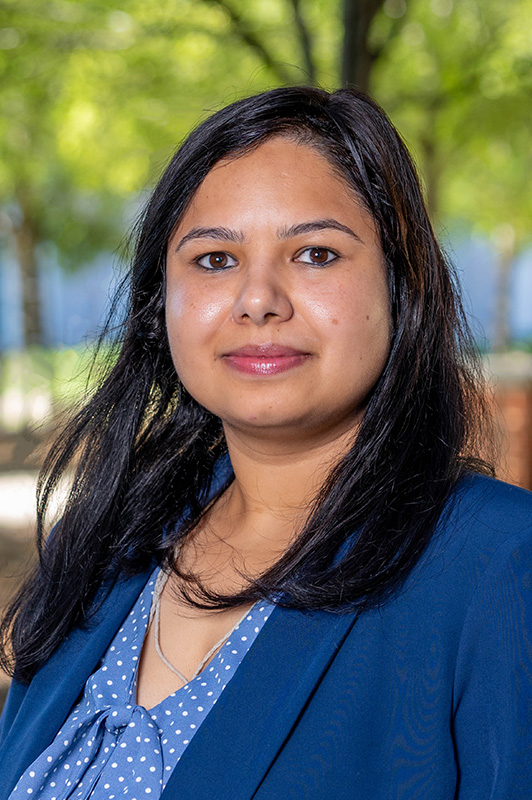
Neha Sharma is an Assistant Professor in the Department of Civil and Environmental Engineering at Auburn University. Her research focuses on nutrient recovery, electrochemical resource recovery, water reuse, trace metal cycling, and pollutant fate and removal.
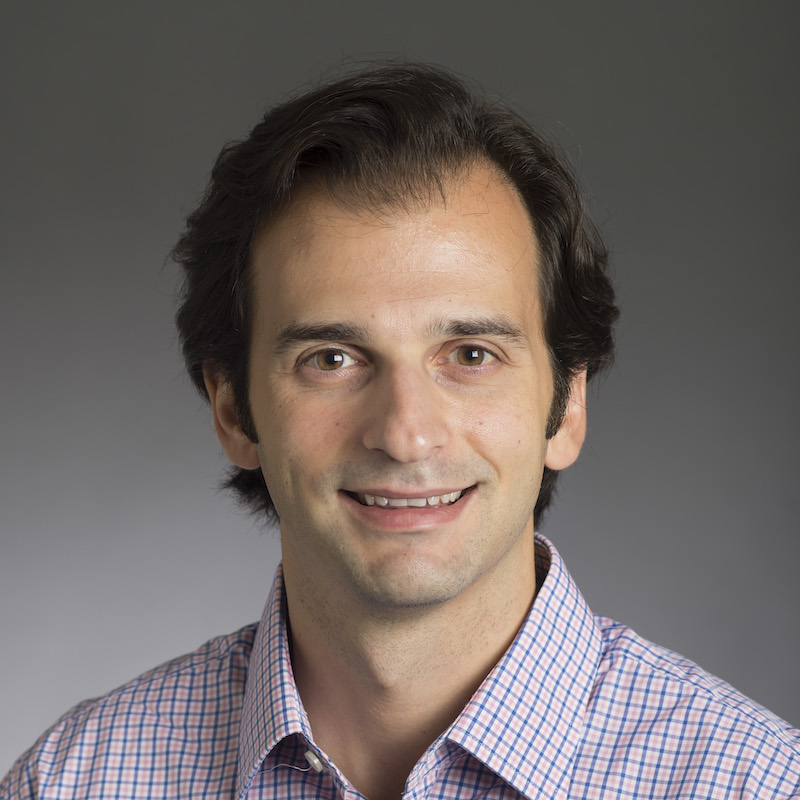
Geoffrey Pleiss is an Assistant Professor in the Department of Statistics at the University of British Columbia's Faculty of Science. He is also a CIFAR AI Chair at the Vector Institute and an inaugural member of CAIDA's AIM-SI (AI Methods for Scientific Impact) cluster. His work bridges statistical theory, machine learning, and computational methods with applications across various scientific domains. Pleiss received his PhD from the Computer Science department at Cornell University in 2020, where he was advised by Kilian Weinberger and worked closely with Andrew Gordon Wilson. Prior to his faculty position at UBC, he was a postdoctoral researcher at Columbia University with John P. Cunningham. His research focuses on the intersection of deep learning and probabilistic modeling, particularly on developing heuristic and approximate notions of uncertainty from machine learning models. His work has significant implications for reliable and optimal decision-making in experimental design and scientific discovery. Major research thrusts include neural network uncertainty quantification, Bayesian optimization, Gaussian processes, and ensemble methods. Pleiss develops theoretical frameworks while maintaining strong connections to practical applications across scientific domains. An analysis of his recent publications reveals a strong focus on uncertainty quantification in deep learning models, with particular attention to the limitations and capabilities of ensemble methods in the era of overparameterized models. His work increasingly addresses practical challenges in Bayesian optimization for scientific discovery, especially in materials science. There's also a growing emphasis on computational efficiency in Gaussian process methods, reflecting his commitment to making advanced statistical techniques accessible for real-world applications. CIFAR AI Chair Pleiss currently advises several graduate students including Donney Fan (PhD, Computer Science), Tim G. Zhou (MSc, Computer Science), Zachary Lau (MSc, Statistics), Nathan Cantafio (BSc, Statistics), and Tristan Cinquin (Research Intern at Vector Institute). His research is supported by multiple funding sources including his CIFAR AI Chair position, which provides significant research resources for advancing machine learning methodologies with scientific impact. Pleiss co-created and maintains GPyTorch, a highly efficient and modular implementation of Gaussian processes in PyTorch designed for speed, modularity, and prototyping. He is also involved with CoLA (Compositional Linear Algebra), a library for structured linear algebra operations in JAX and PyTorch that enables fast linear algebra computations by automatically exploiting matrix structure.
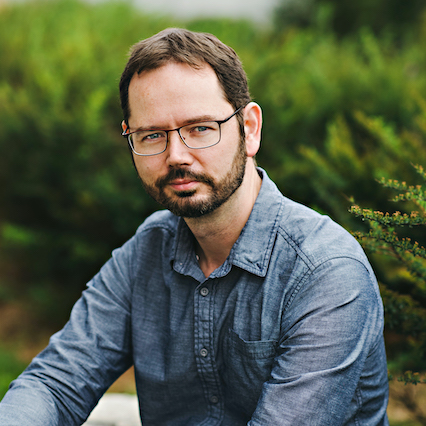
Dr. Sungjin Kim is an Assistant Professor in the Department of Chemical and Biological Engineering at The University of New Mexico (UNM). He earned his Ph.D. in Materials Science and Engineering from MIT (2020) as a Samsung Scholarship Fellow, with prior degrees from KAIST (M.S. 2011, B.S. 2009) and exchange experience at Georgia Tech (2008). His research focuses on bioinspired, energy-efficient materials design for sustainability and healthcare. Education: Ph.D., MIT (2020) M.S. and B.S., KAIST (2011, 2009) Exchange Student, Georgia Tech (2008) Research Interests: Dynamic crosslinking in polymers, bioinspired mineralization for CO2 utilization and hard-tissue engineering, vitrimers for recyclable composites, and sustainable additive manufacturing. His work bridges fundamental chemistry (e.g., metal-coordinate bonds) and applied engineering (e.g., 3D printing). Notable Publications (2025-2022): Explore polyisocyanurate foams, dynamic vitrimer composites, and bioinspired mineralization strategies. Common themes include sustainable materials, dynamic bonding, and hybrid organic-inorganic systems. Awards: Samsung Scholarship Fellow (2014-2019) Government Scholarship (Korea, 2009-2011) Research Report of the Year Award (2012, SKC Co., Ltd.) Outstanding New Researcher Award (2011, SKC Co., Ltd.) Students: Advisees include graduate students Leila Shahriari and Michael Nelwood, and undergraduates Tyrus Antonson and Jacqueline Buenviaje. Former members include Catherine Biju (M.S. candidate) and Lillian Elam (undergraduate).
Albert Presto is a Research Professor in the Department of Mechanical Engineering at Carnegie Mellon University with a courtesy appointment in Civil and Environmental Engineering. He serves as Director of the Center for Atmospheric Particle Studies (CAPS) and is a Faculty Affiliate at the Steinbrenner Institute for Environmental Education and Research. His work spans multiple interdisciplinary collaborations across environmental science, engineering, and public health domains. Department of Mechanical Engineering, College of Engineering Center for Atmospheric Particle Studies (CAPS) Steinbrenner Institute for Environmental Education and Research Africa Clean Air Network Advisory Council Health Effect Institute's Energy Review Committee Presto's research focuses on pollutant emissions from energy extraction and consumption and their subsequent atmospheric transformations. His work examines how gas and oil wells emit methane, how vehicles emit carbon monoxide and particulate matter, and how these pollutants undergo oxidation in the atmosphere to create secondary pollutants like ozone and secondary particulate matter. His approach combines ambient measurements, laboratory experiments, source testing of pollution sources, and atmospheric models to provide a holistic view of pollutant emissions and transformations. His recent publications reveal a strong emphasis on air quality monitoring technologies, particularly low-cost sensor networks deployed internationally. There's a clear trend toward studying air pollution in African cities (especially Nairobi, Kampala, and Addis Ababa), examining spatial and temporal variability of particulate matter, and investigating the health impacts of air pollution exposure. His work increasingly integrates machine learning approaches for pollution forecasting and leverages international collaborations to address global air quality challenges. Member of Africa Clean Air Network Advisory Council Collaborator with US embassies worldwide on air quality data collection Quoted in The Guardian on inequality of air pollution exposure, specifically noting how people of color are more likely to be exposed to harmful air pollution Collaborated on research regarding chemicals released during the Ohio train derailment Presto actively collaborates with medical professionals to develop neighborhood-by-neighborhood studies of pollutant exposure and to understand relationships between emissions and health effects like childhood asthma. His work includes investigating racial-ethnic exposure disparities to airborne pollutants and examining how proximity to pollution sources like fast-food restaurants affects pediatric asthma outcomes. He has received seed funding from the Scott Institute for Energy Innovation for research in clean hydrogen production, AI hardware efficiency, and decarbonizing transportation. As Director of CAPS, Presto leads a research team focused on atmospheric particle studies with applications ranging from local Pittsburgh air quality to global monitoring initiatives. His lab develops and deploys advanced air quality monitoring technologies, including low-cost sensor networks that have been implemented in multiple cities across Africa. The CAPS research group works at the intersection of environmental engineering, atmospheric science, and public health to address critical air quality challenges worldwide.
Mark Crowley is an Associate Professor in the Department of Electrical and Computer Engineering at the University of Waterloo, with a cross-appointment in the Cheriton School of Computer Science. He is a member of the Waterloo Artificial Intelligence Institute (WAII) and the Waterloo Institute for Complexity and Innovation (WICI), and serves as National Secretary of the Canadian Artificial Intelligence Association (CAIAC). His educational background includes a Ph.D. and M.Sc. in Computer Science from the University of British Columbia, where he worked in the Laboratory for Computational Intelligence, and a B.A. in Computer Science from York University. He completed a postdoctoral fellowship at Oregon State University working with Tom Dietterich's machine learning group. Crowley's research focuses on developing dependable and transparent algorithms to augment human decision-making in complex domains with multiple agents, spatial structure, or uncertainty. His work spans Reinforcement Learning , Deep Learning , Ensemble Methods , and Manifold Learning . He frequently collaborates with researchers in applied fields including Computational Sustainability, Sustainable Forest Management, Autonomous Driving, Medical Imaging, and Material Design. His research is motivated by both theoretical opportunities and real-world challenges such as forest fire management, automotive applications, and medical imaging. His recent publications demonstrate a strong focus on addressing challenges in reinforcement learning, particularly around observation costs, multi-agent systems, and causal representation learning. His work on ChemGymRL provides a significant contribution to digital chemistry and material design through reinforcement learning frameworks. The textbook Elements of Dimensionality Reduction and Manifold Learning represents a major contribution to the theoretical foundations of machine learning. Crowley actively supervises graduate students, with recent thesis completions including Shayan Shirahmadi Gale Bagi (PhD, Feb 2025) and Oleksandra Nahorna (MASc, Dec 2024). His lab, UWECEML (Waterloo ECE Machine Learning Lab), focuses on developing new algorithms at the intersection of Machine Learning, Optimization, and Probabilistic Modeling. He teaches courses including ECE 457C (Reinforcement Learning), ECE 657A (Data & Knowledge Modelling & Analysis), and ECE 457B (Fundamentals of Computational Intelligence). His blog Computationally Thinking explores AI, machine learning, and the societal impact of these technologies.
Michael J. Aziz is the Gene and Tracy Sykes Professor of Materials and Energy Technologies at Harvard University's John A. Paulson School of Engineering and Applied Sciences (SEAS). He serves as Area Chair for Materials Science and Mechanical Engineering and is a Faculty Associate at the Harvard University Center for the Environment. His research focuses on electrochemical engineering for energy and environmental applications, including redox flow batteries, carbon capture, and sustainable energy technologies. Aziz leads the Aziz Group, which develops grid-scale energy storage solutions and innovative methods for CO₂ removal. He holds equity in Quino Energy, a startup commercializing his battery research, and serves as Chief Scientist and Board Member. His work bridges fundamental materials science with practical engineering, emphasizing ClimateTech solutions. Key contributions include aqueous organic redox flow batteries, quinone-based carbon capture systems, and wearable energy storage devices. Education & Affiliations: Affiliated with SEAS since joining Harvard, his academic roles include coordinating the Graduate Consortium for Energy and Environment (2009–2018). His lab (Materials Science Group) is located at McKay 504, with administrative support from Sabrina Azinheira. Research Interests: Aziz's group investigates electrochemical energy storage, CO₂ capture via electrochemical systems, and novel materials for sustainable technologies. They employ advanced techniques like operando electrochemical fluorescence microscopy to study porous electrode dynamics and battery degradation mechanisms. Their work emphasizes scalability and real-world applicability, such as grid-scale battery infrastructure and decarbonization strategies. Recent Trends in Publications: Aziz's recent work emphasizes carbon capture innovations (e.g., acid-base concentration swing methods), hydrogen storage under ambient conditions, and electrochemical synthesis of industrial chemicals like hydrogen peroxide. His group also develops open-source tools like RFBzero for battery modeling and explores bioinspired materials (e.g., self-gelling hydrogel batteries). Awards & Recognition: While no personal awards are explicitly listed in the text, his team members (e.g., Dawei Xi) have received accolades such as the 2025 Carbon Future Young Investigator Award. Aziz's contributions have been recognized through industry partnerships and startup ventures. Advising & Industry Impact: Aziz advises PhD students focusing on electrochemical systems (e.g., Jordan Sosa, Tommy George). His industry engagement includes licensing intellectual property to Quino Energy, which achieved a manufacturing milestone in 2024 for grid-scale battery systems. His research bridges academia and industry, addressing climate challenges through technological innovation. Labs & Teams: The Aziz Group includes interdisciplinary researchers from electrochemistry, chemical engineering, and materials science. Collaborators include institutions like MIT and industry partners. Current projects target next-gen batteries, CO₂ removal systems, and scalable energy storage solutions.
Prof. Dr. Gonzalo Guillén Gosálbez is a Full Professor at the Department of Chemistry and Applied Biosciences , ETH Zürich. He holds a PhD in Process Systems Engineering (UPC, 2005) and has held academic positions at Imperial College London (Reader), University of Manchester (Senior Lecturer), and Universitat Rovira i Virgili (Assistant/Associate Professor). His research focuses on Sustainable Chemical Processes , integrating life cycle assessment, optimization techniques, and planetary boundary analysis to evaluate and design low-carbon technologies. Current position: Full Professor, ETH Zürich (2019–present) Prior roles: Imperial College London (2016–2019), University of Manchester (2014–2016), URV Spain (2008–2014) Education: PhD (UPC, 2005), MEng/BEng (University of Murcia) His research explores CO2 valorization , green methanol synthesis , circular marine fuels , and planetary boundary compliance in energy and chemical systems. Recent work emphasizes machine learning for process modeling, single-atom catalysis , and decentralized ammonia production . Scientific contributions include 15+ peer-reviewed articles (2023–2025) in journals like Nature Chemical Engineering , ACS Sustainable Chemistry & Engineering , and Energy & Environmental Science . Key themes: Optimization of hybrid fossil/renewable carbon systems Environmental impacts of energy transitions Catalyst design for sustainable chemistry Life cycle assessment of emerging technologies Awarded UPC Top Doctoral Student Award and Top National Student Award , he combines process systems engineering with sustainability metrics to address global challenges in chemical and energy systems.
Dr Henry Moss is a Researcher at the Department of Applied Mathematics and Theoretical Physics within the School of Physical Sciences at the University of Cambridge. His work focuses on machine learning applications in climate modeling, Bayesian optimization, and Gaussian processes, bridging computational mathematics with environmental science and chemistry. His research interests include: Bayesian optimization for environmental and chemical systems Reinforcement learning in climate modeling Gaussian processes for molecular property prediction High-throughput machine learning in scientific domains Interpretable AI for coastal flooding prediction Hybrid ML-physics modeling Dr Moss's publications highlight his contributions to federated learning for climate models, sparse Gaussian process techniques, and multi-objective optimization frameworks. These works span applications in weather prediction, chemical engineering, and oceanography. Email: hwm26@cam.ac.uk
Vikramaditya G. Yadav is an Associate Professor at the University of British Columbia (UBC) in the Department of Chemical and Biological Engineering, Faculty of Applied Science. He directs the Master of Engineering Leadership (MEL) Program in Sustainable Process Engineering and leads the BioFoundry research group. Education: B.A.Sc., University of Waterloo (2007) Ph.D., Massachusetts Institute of Technology (2013) Postdoctoral Associate, Harvard University (2014) His research spans sustainable chemical manufacturing, metabolic engineering, and biotechnology. Key areas include: Designing biosynthetic enzymes for biomass valorization Developing bioremediation strategies for industrial water quality Creating innovative drug delivery systems and tissue engineering solutions Advancing synthetic biology for pharmaceutical and bioenergy applications His recent work focuses on ocular drug delivery, cannabinoid biosynthesis in E. coli, lignin-based nanoparticles for cancer therapy, and computational analysis of plant secondary metabolites. Collaborations with start-ups, industry, and medical labs drive innovation in Canada's bioeconomy. Professional Leadership: Chair, Biotechnology Division of the Chemical Institute of Canada Associate Editor, The Canadian Journal of Chemical Engineering He is affiliated with UBC's BioProducts Institute and contributes to project-based learning pedagogy.
Michael McAlpine is a Professor in the Mechanical Engineering department at the University of Minnesota . He also holds affiliations with the Biomedical Engineering and Electrical and Computer Engineering departments. His research focuses on 3D printing functional materials & devices , Nanoscale inks , Biomedical devices , Bioelectronics , and Flexible Microsystems . Research Interests : 3D Printing, Biomedical Engineering, Nanotechnology, Flexible Electronics, Microfluidics Labs : ME 361/363 Contact : mcalpine@umn.edu , (612) 626-3303, ME 117 Recent Research Trends include 3D Printed Biomedical Devices , Flexible Electronics , and Bioprinting Applications . His work spans from Spinal Organoid Formation to Programmable Drug Release Capsules . Scientific Award : Circulation Research 2020 Best Manuscript Award
Mark Foster is an Associate Professor in the Department of Electrical and Computer Engineering at Johns Hopkins University, with a primary appointment in the Whiting School of Engineering. He is also a Fellow of the Hopkins Extreme Materials Institute. His research focuses on developing ultrahigh-speed optical systems at the intersection of photonics and electronics, emphasizing photonic devices and information theory to advance imaging, sensing, and communications technologies. Applications include quantum-optical systems, ultrawide-bandwidth microwave photonics, and terahertz-rate imaging systems. Dr. Foster received his BS (2003), MS (2007), and PhD (2008) in Applied and Engineering Physics from Cornell University. Before joining Johns Hopkins in 2010, he served as a postdoctoral associate there. His work has been funded by the NSF, IARPA, DTRA, and NIH, resulting in over 200 publications and eight patents. He has held leadership roles, including chairing the IEEE Photonics Society’s Baltimore chapter (2011–2014). Research Highlights: World-leading imaging systems achieving terahertz frame rates Quantum-optical platforms and nonlinear photonic materials (e.g., NbTiOx) Secure authentication via physically unclonable functions (PUFs) Applications in fusion energy diagnostics and medical imaging His awards include the NSF CAREER Award (201?), DARPA Young Faculty Award, and ONR Young Investigator Award. Current projects explore machine learning-resistant PUFs, multi-modal imaging systems, and photonics for extreme environments.
Zhanwei Wang is an Unpaid employee at the Department of Applied Mechanics and the Federated labs AI and Robotics at Vrije Universiteit Brussel. His research focuses on soft robotics, self-healing materials, fluid dynamics, and vacuum technology. He holds a PhD in Mechanical Engineering from VUB (2024), focusing on encoding physical intelligence into soft robotics via smart materials and continuum mechanics. Prior degrees include a Master's in Chemical Process Equipment (Northeastern University, China, 2020) and a Bachelor's in Process Equipment and Control Engineering (Northeastern University, China, 2017). His work emphasizes interdisciplinary innovation in robotics, sustainability, and material science. Key Research Areas: Self-healing robots, 3D printing for robotics, fluid dynamics in soft systems. Recent Collaborations: Peer reviews for Sensors Journal, IEEE Robotics & Automation Letters, and the 2025 IEEE/RSJ IROS conference. His publications explore adaptive robotic systems, sensor integration, and sustainable material solutions. He participated in the IMEC ITF World 2024 conference and contributed to media discussions on self-locking suction cups for robots.
Aberham Hailu Feyissa is an Associate Professor at the National Food Institute of the Technical University of Denmark , specializing in process modeling and sustainable food engineering. His research bridges complex transport phenomena with practical food manufacturing challenges. Ph.D. in Food Process Engineering, Technical University of Denmark MSc in Food Science, K.U.Leuven and Universiteit Gent BSc in Chemical Engineering, Bahir Dar University His work focuses on coupled mass and heat transfer during solid food processing, aiming to develop robust first-principles models for predictive process optimization. Key applications include Ohmic heating , digital twin technology , and bioactive ingredient extraction . Recent publications highlight his contributions to sustainable food processes , including insect-based feed modeling , seaweed bread kinetics , and clean-label cheese formulation . His methodological innovations span FTIR spectroscopy , computational fluid dynamics , and kinetic modeling . Supervisor for PhD students S. S. Turgut , M. E. Jabali , and Dahal S. Principal Investigator for projects like Modelling and Digitalisation of Food Processes and Sustainable Extraction of Bioactive Insect Fractions Active in conference presentations and peer review , he drives advancements in food process understanding through mechanistic modeling and mathematical simulation .
Michael Baldea is an Associate Professor in the Department of Chemical Engineering at the University of Texas at Austin . He holds a Ph.D. in Chemical Engineering from the University of Minnesota (2006), with prior degrees from 'Babeş-Bolyai' University in Romania (M.Sc. 2001, Diploma 2000). His research group develops theoretical and computational methods for Process and Energy Systems Engineering , focusing on integrated decision-making, performance optimization, and process intensification with industrial validation. Education: Ph.D., Chemical Engineering, University of Minnesota (2006) M.Sc., Interface Process Engineering, 'Babeş-Bolyai' University (2001) Diploma, Chemical Engineering, 'Babeş-Bolyai' University (2000) Research Thrusts: Integrated decision-making in chemical/energy supply chains Process performance monitoring and optimization Process integration and intensification Key applications include grid-responsive chemical plants, intensified distillation/column designs, and renewable energy integration for building systems. Scientific Awards: Frank A. Liddell, Jr. Fellowship NSF CAREER Award (2015-2020) Moncrief Grand Challenges Faculty Award (2014) AIChE Outstanding Young Researcher Award (2017) Implementation : His group has translated research into commercial tools through partnerships with industrial test beds and is working to integrate methods into commercial simulators. They explore predictive approaches for building energy management and strategic capital investment analysis in next-generation energy systems.
David Duvenaud is an Associate Professor at the University of Toronto , holding a Canada Research Chair in Generative Models and a Schwartz Reisman Chair in Technology and Society . He is cross-appointed to the Department of Computer Science and Department of Statistical Sciences . A Sloan Research Fellow and founding member of the Vector Institute , his work bridges deep probabilistic models , AI safety , and scientific computing . PhD in Machine Learning (University of Cambridge, 2014) Postdoc in Hyperparameter Optimization (Harvard University, 2016) Co-founded Invenia (energy forecasting company) His research spans foundational Neural Ordinary Differential Equations (NeurIPS 2018 Best Paper) and Automatic Chemical Design (ACS Central Science 2018) to recent work on AGI governance (2025) and AI safety (2024). Key contributions include stochastic variational inference , implicit differentiation frameworks , and antisymmetrization layers for quantum Monte Carlo. Recent publications (2024-2025) focus on systemic existential risks from AI , many-shot jailbreaking attacks , and epistemic uncertainty quantification . His group trains energy-based models with scalable MCMC samplers and develops invertible neural architectures (e.g., Residual Flows NeurIPS 2019). He also explores human-AI alignment through LLM Processes (NeurIPS 2024) and Sycophancy in Language Models (ICLR 2024). Canada Research Chair (2025) NSERC Grant (2025) Sloan Research Fellow (2021) Schwartz Reisman Chair (2021) Best Paper Award (NeurIPS 2018) Distinguished Paper Award (ICFP 2021) His students include James Requeima , Jesse Bettencourt , and Raymond Douglas . He teaches courses on Statistical Methods for Machine Learning and Differentiable Inference . Current work (2025) investigates systemic human disempowerment through incremental AI capabilities and sabotage risk mitigation via hyperparameter-aware evaluations.