Alexey Petrov is a Professor and Endowed Chair serving as Department Chair of Physics and Astronomy at the University of South Carolina's McCausland College of Arts and Sciences. He joined USC in 2022 after a 21-year tenure at Wayne State University (WSU), where he held professorial roles since 2001 following postdoctoral work at Cornell University and Johns Hopkins University. He earned his Ph.D. in Physics from the University of Massachusetts Amherst in 1997. His research focuses on effective field theories applied to electroweak interactions, QCD, CP-violation, and heavy flavor physics. He authored textbooks including Effective Field Theories (2016) and Indirect Searches for New Physics (2021), and organized conferences. His work is funded by NSF and DOE grants. Notable awards include the 2005 NSF CAREER Award, 2015 APS Fellow distinction, and WSU's Charles H. Gershenson Distinguished Faculty Fellowship (2018). He advises the WSU Society of Physics Students and contributes to Symmetry factor blog and The Conversation platform. He serves on the editorial board of Advances in High Energy Physics .
Associate Professor Gary Hill is affiliated with the School of Physics, Chemistry and Earth Sciences at the University of Adelaide. His research focuses on astroparticle physics, with key interests in neutrinos, cosmic rays, gamma rays, and dark matter. He contributes to major experiments such as IceCube (South Pole neutrino detector), the Pierre Auger Observatory (cosmic ray measurements), and the SABRE experiment (dark matter search in Stawell, Victoria). His work includes studies on neutrino oscillations, Lorentz symmetry tests, cosmic ray anisotropy, and high-energy astrophysics. Collaborations with international teams like the IceCube Collaboration highlight his involvement in large-scale experiments. He is eligible to supervise Masters and PhD students in these areas. Key projects include analyzing neutrino interactions using Earth absorption, measuring atmospheric neutrino fluxes, and exploring cosmic ray energy spectra. His research bridges theoretical physics with experimental observations, aiming to uncover fundamental physics principles.
James Pinfold, PhD, FRSC is a Professor of Physics at the University of Alberta's Faculty of Science. He holds dual roles as a Distinguished University Professor and a Visiting Professor at King's College London. His research focuses on fundamental particle physics, particularly the Standard Model and beyond, with leadership roles in major experiments like ATLAS, OPAL, and MoEDAL at CERN. He has discovered neutral currents, contributed to the Higgs boson discovery, and pioneered cosmic ray research through initiatives like the ALTA project. Education: PhD (1977) and BSc (1972) from University College London, with a Royal College of Science Associate degree. Academic leadership includes directorships of the Centre for Subatomic Research and spokesperson roles for MoEDAL-MAPP, ATLAS-Canada, and others. Research interests span collider physics, cosmic rays, and new physics searches. Awards include the Breakthrough Prize in Fundamental Physics (2025), Killam Prize (2018), and Fellow of the Royal Society of Canada (2013). Teaching emphasizes hands-on research engagement, highlighted by the ASTECH award for educational cosmic ray projects. Current leadership includes coordinating ATLAS detector upgrades and planning the Cosmic-MoEDAL experiment. His work bridges high-energy physics with global collaborations, fostering student involvement through initiatives like the FUTURA project.
Emmerich Kneringer is an Associate Professor at the Institute for Astro- and Particle Physics, Faculty of Mathematics, Computer Science and Physics, University of Innsbruck. He is a key member of the Experimental Particle Physics research group and actively contributes to the ATLAS collaboration at CERN. His research focuses on experimental high-energy physics, particularly Higgs boson physics, top quark physics, electroweak interactions, and searches for physics beyond the Standard Model, including supersymmetry, dark matter, and exotic particles. He also works on advanced data analysis methods such as neural simulation-based inference and machine learning applications in particle physics. Dr. Kneringer's recent publications (2023–2025) show a strong trend in precision measurements (e.g., Higgs and top properties), combination of search results, and innovative analysis techniques. His work spans detector performance, cross-section measurements, and searches for new phenomena in proton-proton and heavy-ion collisions. He is actively involved in public outreach, delivering lectures on astronomy, cosmic radiation, and particle physics to schools and the public, including events like Masterclasses and the Long Night of Research. Experimental Particle Physics Higgs and Top Quark Physics Machine Learning in Physics Beyond Standard Model Searches Heavy-Ion Physics Dr. Kneringer has no listed scientific awards in the provided text. He advises no named students in the material. His research is conducted within the ATLAS collaboration, a large international team at CERN, and he contributes to both physics analysis and detector performance studies. He also participates in educational initiatives, including public lectures and training programs.
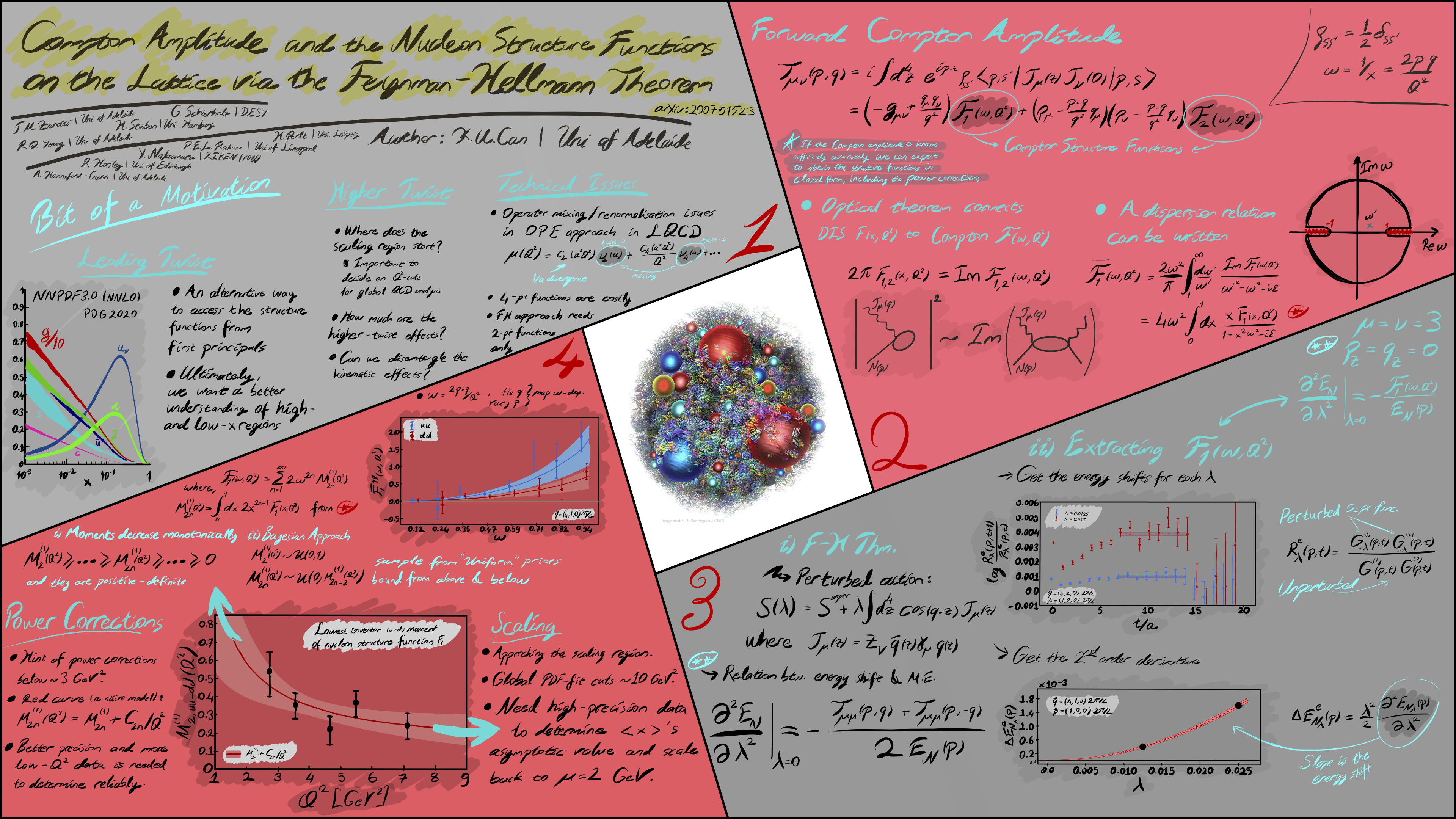
Dr. Kadir Utku Can is a Researcher at the University of Adelaide, affiliated with the School of Physics, Chemistry and Earth Sciences within the Faculty of Sciences, Engineering and Technology. His primary research focus is investigating the nature of strong interactions using lattice Quantum Chromodynamics (QCD), particularly studying hadron structure functions, form factors, and spectra through computer simulations. Current research interests include nucleon structure via Compton amplitudes, charmed baryon spectra, and generalized parton distributions. His work emphasizes computational methods to explore quark-gluon dynamics, with recent studies focusing on nucleon structure functions, parity-odd interactions, and transition matrix elements. He is eligible to supervise Masters and PhD students in theoretical and computational particle physics. Key contributions include lattice QCD calculations of charmed baryon spectra and Compton amplitude analyses, published in high-impact journals and conference proceedings. Recent publications (2022–2025) highlight advancements in lattice techniques for parton distribution functions, Feynmann-Hellmann theorem applications, and renormalization group equations. His research bridges computational simulations with experimental data, contributing to fundamental particle physics understanding.
Anna Lipniacka is a Professor in the Department of Physics and Technology at the University of Bergen, Norway, actively contributing to experimental particle physics through the ATLAS experiment at CERN's Large Hadron Collider. Her research spans Higgs boson physics, top quark studies, dark matter searches, and supersymmetry investigations. Her primary research interests include: High Energy Physics Experimental Particle Physics Dark Matter Supersymmetry Quantum Mechanics (teaching focus) Recent publications (2023-2025) demonstrate her leadership in analyzing LHC collision data, with significant contributions to Higgs boson property measurements, top quark physics, and innovative searches for exotic phenomena like magnetic monopoles and vector-like quarks. Her work increasingly incorporates machine learning techniques for event classification and anomaly detection in high-energy datasets. As a core member of the Subatomic Physics research group at the University of Bergen, she collaborates extensively within the global ATLAS collaboration while teaching foundational courses like Nonrelativistic Quantum Mechanics (PHYS201), shaping the next generation of particle physicists.
Prof. Stefan van Waasen serves as Director of the Peter Grünberg Institute's Integrated Computing Architectures division (PGI-4) and holds a Full Professorship in Communication Systems at the University of Duisburg-Essen. His work bridges quantum computing, neuromorphic systems, and cryogenic electronics development. Director, Integrated Computing Architectures (PGI-4) Full Professor, Communication Systems, University of Duisburg-Essen Research Focus: Electronic Systems for Quantum & Neuromorphic Computing Research Interests center on quantum dot electronics, memristor-based architectures, and cryogenic CMOS technology. His group develops scalable control systems for qubits and neuromorphic networks, with particular emphasis on power management and signal integrity at ultra-low temperatures. Publication Trends reveal a technical focus on quantum computing interfaces, neuromorphic hardware, and particle detector systems. His recent work includes co-simulation tools for cryogenic electronics optimization and novel architectures for memristor arrays in machine learning applications. Laboratory Involvement includes leadership at Forschungszentrum Jülich's Peter Grünberg Institute (PGI-4), where his team works on integrated circuits for quantum and neuromorphic computing platforms.
Jorge Segovia González is a Professor at Universidad Pablo de Olavide, affiliated with the Department of Physical, Chemical and Natural Systems within the College of Engineering. His research focuses on Applied Physics, Particle Physics, and Quantum Chromodynamics, particularly in the study of quark models, meson spectroscopy, and multiquark systems. He earned his PhD in 2012 from the Universidad de Salamanca, where he studied spectroscopy and decay mechanisms of heavy quark mesons under the supervision of Dr. David Rodríguez Entem. His work spans topics like Constituent and chiral quark models Tetraquark and pentaquark systems Generalized Parton Distributions Strong decay formalisms Proton-antiproton scattering Electromagnetic form factors of hadrons . Recent publications (2024–2025) emphasize theoretical advancements in tetraquark systems, Monte Carlo simulations, and applications of QCD to meson structure. His research contributes to understanding hadron stability, quark interactions, and experimental signatures at facilities like the Jefferson Lab and Electron-Ion Collider (EIC).
Monica D'Onofrio is a Professor at the University of Liverpool, serving as Head of Research and Deputy Head of the Department of Physics. She is a leading experimental particle physicist with expertise in Standard Model processes and new physics searches at hadron colliders, including Supersymmetry (SUSY), Weakly Interacting Massive Particles (WIMPs), leptoquarks, and long-lived particles. Her work spans collaborations with CDF (2000–2011), ATLAS (2001–Present), and FASER (2020–Present). Key roles: STFC Advanced Fellow (until 2014), member of PDG Collaboration (since 2016), author of SUSY experimental review. Leadership: Convener of ATLAS Supersymmetry working groups (2012–2017), team leader of Liverpool ATLAS/FASER groups. Her research drives modern data-analysis tools, particularly AI/ML, applied to particle physics and interdisciplinary fields like medical physics and neuroscience via the MUCCA consortium. She coordinates departmental research in particle physics, nuclear physics, accelerator science, and condensed matter physics, fostering cross-area initiatives in quantum technologies, sustainable tech, and AI/data science. Recent projects include the ATLAS ITk tracking software development, upgrades for the High Luminosity LHC (HL-LHC), and contributions to future facilities like LHeC, Forward Physics Facility (FPF), and Future Circular Collider (FCC). Her scientific awards include the Halliday Prize (2009) for STFC Advanced Fellowship excellence. Grants: UKRI Experimental Particle Physics Consolidated Grants (2022–2026, 2019–2025), STFC projects (2009–2014). Teaching: Module coordinator for Neutrinos and Dark Matter (PHYS492) and Particle Physics (PHYS377), supervising quantum mechanics and thesis projects.
Volodymyr Aushev is Professor in the Department of Nuclear Physics, Faculty of Physics, Taras Shevchenko National University of Kyiv, Ukraine. He simultaneously maintains a senior-researcher affiliation with the Institute for Nuclear Research of the National Academy of Sciences of Ukraine. His career spans four decades, beginning in 1978 at the Institute for Nuclear Research (Kyiv) and expanding through long-term visiting-scientist engagements at DESY (Germany), the Max-Planck Institutes, and Fermilab (USA). Education & Training: PhD studies focused on polarised recoil β-active nuclei and nuclear spin physics at low energies. Extensive specialised training in Quantum Chromodynamics, heavy-flavour physics, top-quark physics and neutrino physics through participation in HERA-B, ZEUS, D0, LHCb, Belle II, DUNE, WA105 and FCAL collaborations. Research Interests: Professor Aushev leads the Kyiv high-energy physics group whose principal goal is understanding the fundamental constituents of matter and their interactions at the highest energies. His work centres on experimental particle physics , with major themes including: Quantum Chromodynamics and parton distribution functions; Production and decay of charm, beauty and top quarks; Neutrino oscillations and astrophysical neutrinos; Development of radiation-hard detectors and advanced instrumentation for collider and neutrino experiments. Recent Publications Overview (2010-2016): The twelve highlighted papers reflect an intensive focus on HERA ep/γp data (ZEUS), Tevatron pp̅ data (D0) and early DUNE/Belle-II planning . Analyses span precision measurements of structure functions, heavy-quark cross-sections, top-quark properties and searches for exotic hadrons, underlining a commitment to multi-TeV energy-frontier physics and long-baseline neutrino science. Scientific Awards & Recognition: Author of ≈120 peer-reviewed papers in high-energy physics and ≈30 in nuclear physics, averaging 33.4 citations each. Group leader for Ukrainian participation in ZEUS, D0, Belle II, DUNE, WA105 and FCAL collaborations. Advising & Outreach: Professor Aushev mentors a vibrant team of post-doctoral researchers, PhD and master’s students within the Kyiv high-energy physics group. He teaches lecture courses on High-Energy Physics , Nuclear Astrophysics , Dark Matter , Neutrino Physics and Modern Experiments in High-Energy Physics , and leads outreach programmes to inspire school pupils and undergraduates. Laboratories & Teams: He heads the Kyiv High-Energy Elementary Particle Physics Group , comprising three faculty members, post-docs, PhD students and undergraduates. The group is responsible for detector R&D (radiation-hard calorimeters, micro-strip monitors), software development and physics analyses for international experiments in Europe, the United States and Japan.
Pablo Vazquez Regueiro is a Professor at the Faculty of Physics, Department of Particle Physics, University of Santiago de Compostela. He is affiliated with the Galician Institute of High Energy Physics (IGFAE) and the GAES High Energy Physics Group. Education: Ph.D. from University of Santiago de Compostela (2000) - Thesis: Development and construction of electronics for microstrip detector readout Research Interests: His work focuses on experimental particle physics, including detector technology, microstrip electronics, and high-energy collision analysis. Key contributions involve CP violation studies, baryon spectroscopy, and trigger system development. Scientific Contributions: His publications highlight expertise in LHCb collaborations, detector simulation, and data analysis techniques. Research spans Higgs boson properties, dark matter searches, and hadronization mechanisms. Labs & Teams: Actively participates in IGFAE and GAES High Energy Physics Group activities, contributing to international collaborations like LHCb.
David H. Miller, M.D. serves as Associate Professor of Medicine at Weill Cornell Medical College and Associate Attending Physician at NewYork-Presbyterian Hospital, where he has provided clinical cardiology services since 1981. His expertise spans coronary artery disease, valvular heart disorders, and acute cardiac care management within the Department of Medicine. Dr. Miller's educational foundation includes: M.D. from University of Virginia School of Medicine (1976) Internal Medicine Internship at The New York Hospital (1977) Internal Medicine Residency at The New York Hospital (1979) Cardiology Fellowship at The New York Hospital-CUMC (1982) His research program focuses on therapeutic interventions for acute myocardial ischemic syndromes, investigating thrombolytic agents in myocardial infarction, revascularization for cardiogenic shock, and anticoagulant strategies post-angioplasty. Complementing this, he examines ethical dimensions of end-of-life cardiac care including DNR decision-making and advance directives in critically ill patients. Recent publications span critical care innovations (2024 ECMO blood loss study) and unexpected particle physics contributions (2009-2010 charmonium/D-meson research), suggesting interdisciplinary collaboration beyond cardiology. Professional recognition includes: Alpha Omega Alpha Honor Society membership Fellowship in the American College of Cardiology Affiliation with the American College of Physicians Membership in the American Heart Association Council on Clinical Cardiology Administratively, Dr. Miller directs the 20-bed Cardiac Care Unit at NewYork-Presbyterian Hospital and contributes to medical ethics policy through the hospital's Committee on Medical Ethics, though specific grant funding or trainee mentorship details aren't documented in available sources.
Andrey Golutvin is a Professor and Chair in Physics at the Department of Physics within the Faculty of Natural Sciences at Imperial College London. He is based at the Blackett Laboratory on the South Kensington Campus and serves as a leading researcher in particle physics. His work is primarily associated with the High Energy Physics Group and the Physics of Particles research area at Imperial. Professor Golutvin's research focuses on searches for new fundamental particles which are very weakly-interacting. His primary research activity is the Search for Hidden Particles (SHiP) experiment, which he proposed in 2013 to search for light, new particles. The SHiP experiment aims to search for a wide range of light and weakly interacting particles that could solve major problems in particle physics, including the matter-antimatter asymmetry in the Universe, neutrino masses and mixing patterns, and dark matter candidates. Under his leadership, the SHiP collaboration has grown from 16 authors in the original Letter of Intent to 250 authors from 33 institutes in 16 countries. CERN management approved the experiment in March 2024. His recent publications reveal a strong focus on rare particle decays, precision measurements in B physics, neutrino detection, and searches for physics beyond the Standard Model. His work spans both theoretical investigations and experimental analyses, with significant contributions to the LHCb experiment where he served as spokesperson from 2008-2011 and previously led the LHCb calorimeter project from 1998-2008. His research often involves collaborations with major international laboratories and has resulted in numerous high-impact publications in journals like Nature, Physical Review Letters, and Journal of High Energy Physics. Professor Golutvin has advised various international laboratories on scientific policy, serving on committees including the INFN scientific committee at LNF (Italy), the Belle Advisory Committee at KEK (Japan), and CERN's Scientific Policy and Large Hadron Collider committees. His work with the search engine company Yandex applied machine learning tools to signal-background separation in particle physics, demonstrating his interdisciplinary approach to research problems. His laboratory and research activities are centered around the High Energy Physics Group at Imperial College London, with significant involvement in the LHCb experiment at CERN and the SHiP experiment. He collaborates extensively with researchers across the globe, as evidenced by the large international author lists on his publications. His work continues to push the boundaries of particle physics, particularly in the search for physics beyond the Standard Model through both direct searches at colliders and dedicated experiments like SHiP.
Dr. Trevor Vickey is a Reader in Particle Physics and Astrophysics at the School of Mathematical and Physical Sciences, University of Sheffield. He is an active researcher working with the ATLAS collaboration at CERN's Large Hadron Collider, focusing on precision measurements of the Higgs boson and searches for physics beyond the Standard Model. His research interests span multiple areas of high energy physics, including Higgs boson properties, searches for Beyond Standard Model Higgs bosons, investigations of new physics in tau lepton final states (including graviton, third-generation leptoquarks, Z' bosons, and supersymmetry), top quark properties, tau lepton identification techniques, and silicon detector technology. His work leverages the full capabilities of the ATLAS detector to probe fundamental questions in particle physics. Dr. Vickey's publication record shows consistent productivity with numerous high-impact papers in leading journals including Journal of High Energy Physics, Physics Letters B, and Physical Review D. His recent work (2023-2025) demonstrates expertise across multiple frontiers of particle physics, from precision Higgs measurements to exotic searches for new particles. The publications reveal a strong focus on analyzing data from LHC Run 2 and early Run 3, with particular emphasis on Higgs physics, top quark physics, and searches for new phenomena. As a member of the ATLAS collaboration, Dr. Vickey contributes to one of the largest scientific collaborations in history, working alongside thousands of researchers worldwide. His position at the University of Sheffield places him within a strong UK particle physics community that has made significant contributions to the ATLAS experiment since its inception.
Dr. Alex Finch is an Honorary Researcher in the Department of Physics at Lancaster University. He is a member of the T2K collaboration, where he develops event display software for neutrino detector interactions, and contributes to the proposed HyperK experiment. Previously, he worked on photon-photon collisions as part of the ALEPH collaboration at CERN. Lancaster University, Physics Department T2K Collaboration ALEPH Collaboration (CERN) His research focuses on long baseline neutrino experiments and photon-photon collisions , investigating fundamental aspects of the Standard Model. At Lancaster, he contributes to detector software development and neutrino oscillation analysis using T2K data. Recent publications highlight his work on neutrino oscillation parameters , photon structure functions , and detector instrumentation . These span experimental particle physics, data reconstruction algorithms, and high-energy collision analysis. Dr. Finch also teaches C++ programming within the department, supporting technical skill development in physics research.