Jonathan Santo is a Professor of Psychology at the University of Nebraska at Omaha (UNO), where he serves as Director of the Graduate Developmental Psychology Program and as a faculty member in the Office of Latino/Latin-American Studies. His research explores peer relations, cultural differences in self-esteem, and classroom-level influences on child and adolescent development, with a focus on improving school environments and fostering positive social interactions. ORCA Faculty Fellow His research spans broad areas including Developmental Psychology , Social Support Systems , and Cross-Cultural Peer Dynamics , with specific attention to peer victimization , self-continuity , school climate , and developmental trajectories in Brazilian and Colombian youth . Recent publications analyze topics like hikikomori experiences , friendship security , and HPA axis dysregulation in adolescents. Scientific awards include the ORCA Faculty Fellow recognition. His work often involves longitudinal assessments of peer relationships cross-cultural comparisons (Brazil, Colombia, China, Nigeria, Singapore, U.S.) policy-focused blog posts on family separations and school interventions
Adam Reed is an Associate Professor in Social Anthropology at the University of St Andrews, School of Philosophical, Anthropological & Film Studies. His research spans multiple interconnected fields including legal anthropology, urban studies, literary anthropology, and the anthropology of ethics. With extensive fieldwork experience in Papua New Guinea, the UK, and Australia, Reed has developed a distinctive approach to understanding social phenomena through ethnographic engagement with diverse communities. His research interests form five interconnected strands: Legal Anthropology focusing on cultures of incarceration in Papua New Guinea Anthropology of the City examining London through walking tour guides and digital journal keepers Anthropology and Literature studying literary societies and reading practices Anthropology of Ethics investigating animal welfare campaigning in Scotland Anthropology of Migration analyzing Papua New Guinean experiences in Western Australia Reed's recent publications reveal a strong trajectory toward ethical subjectivity and human-animal relationships, with numerous 2023-2025 works exploring moral dilemmas in animal protection, silence practices in zoos, and character theory. His work increasingly bridges anthropology with literary studies, philosophy, and environmental science, demonstrating interdisciplinary reach while maintaining ethnographic depth. His scientific recognition includes prestigious awards such as the Junior Research Fellowship at Clare College, Cambridge (1997), Emslie Horniman Award from the Royal Anthropological Institute (1994), and multiple early-career funding awards. Reed has led three major research projects including 'Listening to the Zoo' and 'Compatriot Sociality' focusing on Papua New Guinean migrants. As an active academic, Reed has supervised 9 postgraduate students, participated in 59 scholarly activities including conference organization and invited talks, and maintains strong engagement with both theoretical debates and practical applications of anthropological knowledge, particularly regarding sustainable development goals related to ethical practices and cultural understanding.
Dr. He Wang is an Associate Professor in the Department of Computer Science at University College London (UCL), affiliated with the Virtual Environment and Computer Graphics (VECG) group and the UCL Centre for Artificial Intelligence. He holds a Visiting Professorship at the University of Leeds and previously served as an Associate Professor and Lecturer there, as well as a Senior Research Associate at Disney Research Los Angeles. His research focuses on computer graphics, vision, and machine learning, with notable contributions to crowd simulation, generative models, and physics-informed neural networks. Dr. Wang earned his BEng from Zhejiang University and his PhD from the University of Edinburgh, followed by postdoctoral work at the University of Edinburgh's School of Informatics. He has been recognized as a Turing Fellow and serves as an Academic Advisor to the Commonwealth Scholarship Council and an Associate Editor of Computer Graphics Forum . His research spans cutting-edge topics including 3D reconstruction, adversarial attacks on motion recognition, and AI-driven groundwater modeling. He has supervised six PhD students to completion and actively engages in collaborative projects, consultancy, and grant evaluations. His lab welcomes students through dedicated recruitment channels.
Siyu Tang is an Assistant Professor in the Department of Computer Science at ETH Zürich, where she leads the Computer Vision and Learning Group (VLG) at the Institute of Visual Computing. Her research focuses on computational models for human perception and digitalization through computer vision and machine learning. Her educational background includes: PhD in Computer Science, Max Planck Institute for Informatics (2017), supervised by Prof. Bernt Schiele Master of Science in Media Informatics, RWTH Aachen University Bachelor of Science in Computer Science, Zhejiang University, China Dr. Tang specializes in human-centric computer vision, developing statistical models for motion analysis, pose estimation, and digital human creation. Her work integrates machine learning with optimization techniques to enable machines to interpret human activities from visual data, with applications spanning virtual reality, healthcare, and human-computer interaction. Key research thrusts include generative models for content creation, egocentric vision, and human motion synthesis. Her recent publications (2024-2025) demonstrate intense focus on 3D human modeling and neural rendering, with Gaussian splatting emerging as a dominant technique for efficient avatar creation and scene reconstruction. Significant themes include text-driven motion synthesis using diffusion models, relightable avatars, surgical training applications, and egocentric multimodal pretraining. This work bridges computer vision, graphics, and machine learning to advance human digitalization. No scientific awards were mentioned in the provided text. Dr. Tang leads the VLG research group at ETH Zürich, mentoring PhD and Master's students in human-centric AI. She previously secured an early career research grant from the Max Planck Institute for Intelligent Systems to establish her independent research program. Her group actively pursues funding for projects in human motion analysis, 3D reconstruction, and generative modeling, with strong industry and clinical collaborations. The Computer Vision and Learning Group (VLG) operates within ETH's Institute of Visual Computing, maintaining dedicated facilities for motion capture, 3D scanning, and high-performance computing. The team collaborates internationally with institutions like the Max Planck Society and focuses on scalable solutions for real-world human digitalization challenges, including surgical training systems and immersive virtual environments.
Brad Knox is a Research Associate Professor in the Department of Computer Science at the University of Texas at Austin . His work bridges machine learning, human-computer interaction, and computational cognitive science, with a focus on developing systems that learn from human feedback. Key research areas: Reinforcement Learning, Human-AI Interaction, Reward Design, Autonomous Systems Notable contributions: TAMER framework for human-guided learning, empirical studies on reward misdesign, and human preference modeling for autonomous agents Research Trends : His recent work (2023-2025) emphasizes reward alignment, safety in autonomous systems, and preference-based learning frameworks. Earlier studies (2012-2020) established foundational methods for integrating human feedback into reinforcement learning architectures and exploring behavioral signatures in decision-making. Scientific Honors : Bert Kay Dissertation Award (2013) Victor Lesser Distinguished Dissertation Award (IFAAMAS, Runner-up, 2013) NSF SBIR Grant (PI, 2016) NSF Graduate Research Fellowship (2008-2011) IEEE Intelligent Systems AI 10 to Watch (2013) Teaching & Leadership : Knox served as Principal Lecturer for MIT's Interactive Machine Learning course (2013) and held organizational roles at major conferences including Reinforcement Learning Conference (Scheduling Chair, 2025) and RLDM workshop (Co-chair, 2022).
William H. Nienhauser, Jr. is the Halls-Bascom Professor of Classical Chinese Literature in the Department of Asian Languages and Cultures at the University of Wisconsin–Madison, College of Letters and Science. He is a leading authority on early Chinese literature, historiography, and poetry, with a particular focus on Sima Qian’s Shiji and the poetry of Du Fu. He has held visiting and research positions in China, Japan, Germany, and Taiwan, and remains academically active, including a 2018 appointment as Visiting Professor at Nankai University. His research interests include early traditional Chinese fiction, historiography, chuanqi and zhiguai tales, and the application of modern Western critical theories to Chinese literary texts. He is deeply engaged in the translation and annotation of classical works, especially the Shiji , often in collaboration with graduate students. His scholarship bridges philology, literary theory, and historical contextualization, contributing significantly to the global understanding of pre-modern Chinese literature. Nienhauser’s publications reveal a sustained focus on textual analysis, narrative structure, and the interplay between history and literature. His work spans from early Shijing poetry to Tang dynasty fiction, with a strong emphasis on Sima Qian’s historiographical methods and legacy. He has also contributed foundational reference works and critical editions, shaping the field of Chinese literary studies. His scientific awards reflect the international recognition of his scholarship: Woodrow Wilson Fellowship ACLS Fellowship NEH Fellowship Fulbright-Hayes Fellowship Japan Foundation Fellowship German Research Foundation Fellowship Alexander von Humboldt Foundation Fellowship Humboldt Foundation Lifetime Achievement Award (2003) Nienhauser has advised numerous graduate students in collaborative research projects, particularly on the Shiji and Du Fu. He has secured major fellowships and grants from prestigious organizations including the NEH, ACLS, Fulbright-Hayes, and the Humboldt Foundation, enabling extended research and translation work. His editorial roles, especially as a founding editor of Chinese Literature: Essays, Articles, Reviews (CLEAR), have been instrumental in advancing the field. While no formal lab or research center is mentioned, Nienhauser leads a major international collaborative translation project on the Shiji , involving scholars and students across institutions. His seminars and graduate courses foster a close-knit research community focused on classical Chinese texts.
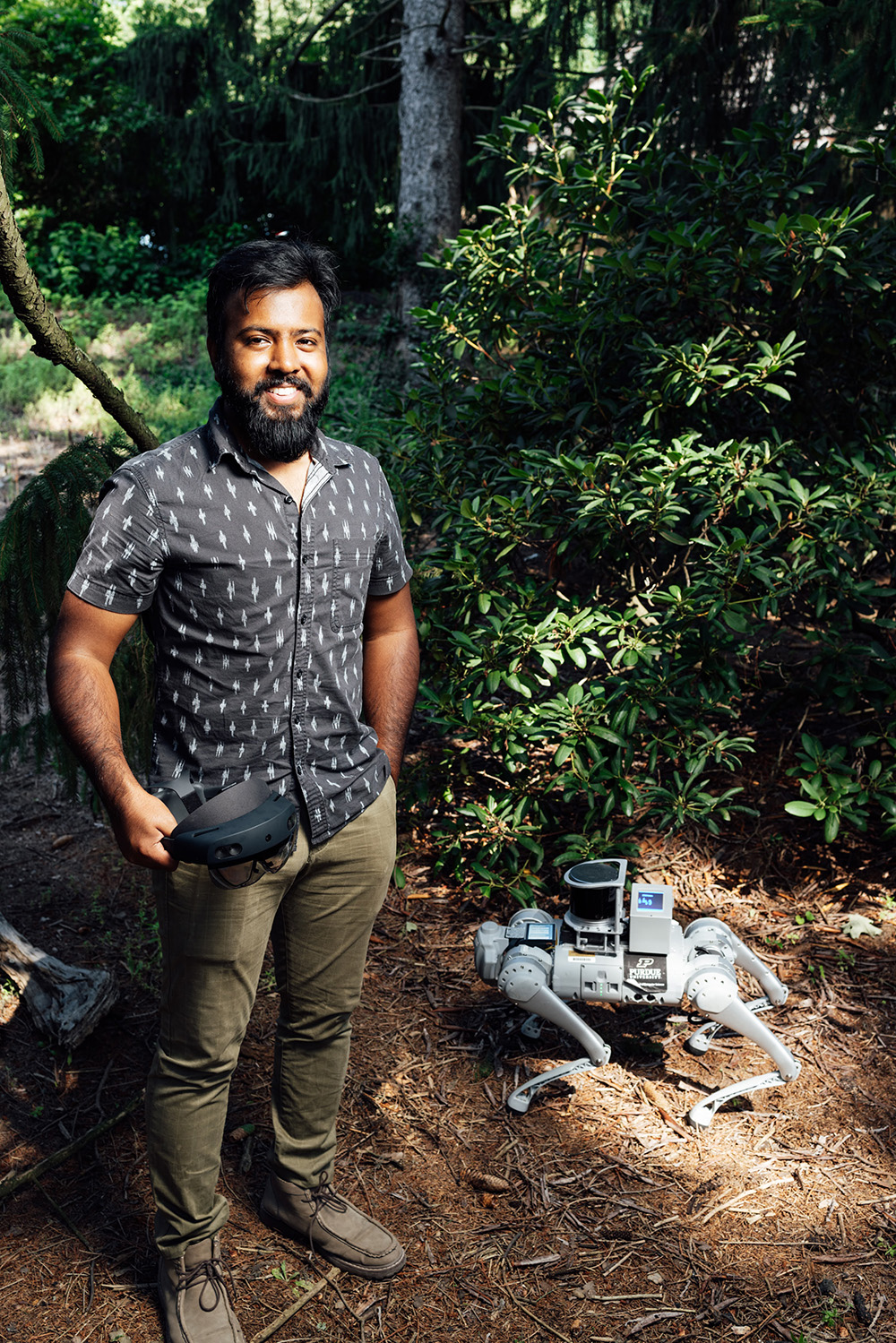
Dr. Aniket Bera is an Associate Professor in Computer Science at Purdue University and holds an Adjunct Associate Professor role at the University of Maryland at College Park (UMIACS). He directs the IDEAS Lab at Purdue and previously served as a Research Assistant Professor at UNC Chapel Hill. His research focuses on Affective Computing, Computer Graphics (AR/VR), AI & Robotics, Social Robotics, and medical AI applications for mental health diagnostics. Affiliations: Purdue University (Primary), University of Maryland (Adjunct), UMIACS Career: Joined Purdue in 2017, extensive industry collaborations with Disney Research, Intel, and C-DAC Research Interests: Affective Computing: Emotion perception via gait analysis, speech, and facial/body expressions AR/VR: Redirected walking, virtual environments, and human motion modeling Medical AI: AI-driven mental health detection systems (e.g., VidSole dataset) in collaboration with medical schools Key Contributions: Developed Project Dost (mental health initiative) Received 2020 Brain & Behavior Seed Grant ($X) for emotion-gait research Authored 65+ papers (1,800+ citations) with awards at IEEE VR 2021 Funding & Leadership: Serves as Senior Editor for IEEE RA-L (Planning/Simulation) Conference Chair for ACM SIGGRAPH MIG 2022 Labs/Teams: IDEAS Lab (Purdue), UMD GAMMA Group
Kerri Kotta is a Professor of Music Theory and Head of Musicology at the Estonian Academy of Music and Theatre. She holds a PhD in Musicology (2004) and an MA in Composition (1997) from the same institution. Her research focuses on music theory, tonal analysis, Estonian music history, and contemporary composition, with special expertise in the works of Eduard Tubin and Dmitri Shostakovich. She coordinates the International Eduard Tubin Society and edits the composer's complete works. Her research interests span music theory , compositional techniques , Estonian cultural heritage , and interdisciplinary performance studies . Recent publications explore modernism in Estonian art music, Beethoven's structural rhetoric, and socio-psychological dimensions of contemporary opera. Kotta received the Reet Neimar Criticism Award (2023) for her contributions to music scholarship. She leads the project How to share the ardor? Conveying complex musical structures through animated scores (2024-2025), funded by the Estonian Ministry of Culture. Administratively, she chairs the Estonian Musicological Society (2013–present) and the International Eduard Tubin Society (2015–present), while serving on the board of the Estonian Composers Union (2022–present).
Andrew Campana is an Assistant Professor of Asian Studies at Cornell University's College of Arts and Sciences, specializing in modern and contemporary Japanese literature and media. His research explores the possibilities and limitations of expression during media transitions, with particular focus on poetry, digital media, and disability studies. His academic journey includes a Ph.D. in East Asian Languages and Civilizations from Harvard University and an Honors B.A. in East Asian Studies from the University of Toronto. Campana's first book, Expanding Verse: Japanese Poetry at the Edge of Media , published by the University of California Press in 2024 as an open access work, examines Japanese poetic practice from the 1920s to the present as poets engaged with evolving media technologies including film, tape recording, television, and the internet. As a researcher, Campana's work bridges literary studies, media studies, game studies, and disability studies, with current projects exploring how poetry became a key site of digital experimentation in Japan. His research methodology combines traditional literary analysis with hands-on creative practice, informed by his experiences at MIT's Trope Tank laboratory. His scholarly interests span Japanese media history, disability representation in literature and gaming, digital poetics, and gender studies. His research has received significant media attention, including features in the Cornell Chronicle ('Poets in Japan Experiment at the Edge of Media' and 'Japanese Poets Open New Ways of Thinking About Media'), The Statesman, and interviews on NPR's Academic Minute and the Curiosity Daily podcast discussing his work on gaming and accessibility. As an educator, Campana teaches courses including 'Introduction to Japan,' 'Japanese Poetry,' and 'The Glitch: Errors, Disability, and the Edges of Digital Media' (ASIAN 4703/6703), guiding students through interdisciplinary explorations of Japanese literature, media, and digital culture. His teaching reflects his commitment to understanding media transitions through both theoretical and practical lenses.
Dr. Jason Ney is an Associate Professor of English and the Director of the Writing Center at Colorado Christian University, where he has been a faculty member since 2013. He is affiliated with the College of Undergraduate Studies and the School of Humanities and Social Sciences, teaching courses in American Literature, Creative Writing, and Literary Criticism and Theory. Ph.D., English - Literary Studies, University of Denver M.A., English and Comparative Literature, University of Cincinnati B.A., English, Cedarville University Dr. Ney's research spans creative nonfiction and film criticism, with a strong focus on ethical issues in narrative truth and memory. He is a noted scholar of film noir and cinematic adaptations of American literature, particularly works like The Great Gatsby and The Scarlet Letter . His academic interests include semiotics, literary theory, and the intersection of faith and storytelling. His recent publications reflect a deep engagement with noir cinema, mid-century Hollywood, and the psychological dimensions of identity in film. He has contributed audio commentaries and critical essays to numerous Blu-ray and DVD releases, and his creative nonfiction has appeared in respected anthologies and journals. His work often explores moral ambiguity, personal transformation, and cultural memory. Dr. Ney is actively involved in academic and public scholarship, presenting at conferences and co-running CCU’s annual film series. He mentors students in creative writing, many of whom have achieved publication. While no formal scientific awards are listed, his sustained contributions to film and literary criticism demonstrate significant scholarly impact. He also contributes to the Augustine Honors Program and has delivered presentations on writing center pedagogy and graduate education. His leadership in the Writing Center reflects a commitment to student development across disciplines.
Dr. Gan Sheuo Hui serves as Lecturer in Animation at LASALLE College of the Arts, Singapore, with extensive international engagement through visiting positions at National University of Singapore (NUS), Kyoto Seika University, and the Sainsbury Institute for the Study of Japanese Arts and Cultures. Her academic profile bridges Japanese animation scholarship with Southeast Asian cultural contexts through fieldwork-driven research. Her educational qualifications include: PhD in Human and Environmental Studies from Kyoto University, Japan Master of Communication (Screen Studies) from University of Science Malaysia Bachelor of Communication (Film Studies) from University of Science Malaysia Dr. Gan's research examines Japanese anime, manga, and popular culture through lenses of authorship, censorship, and cultural hybridity, with particular focus on transnational adaptations in Southeast Asia. She integrates theoretical frameworks with empirical fieldwork involving creators, curators, and fans across Asia and the West, emphasizing practical production aspects alongside critical analysis. Her interdisciplinary approach connects film studies, media theory, and cultural anthropology. Her scholarly trajectory reveals consistent exploration of animation aesthetics (especially limited/selective animation), historical evolution of Japanese animation, and hybrid cultural forms in Southeast Asia. Key thematic threads include re-evaluating animation techniques beyond Western paradigms, analyzing global anime circulation, and documenting local adaptations of manga in Malaysia. This body of work demonstrates strong methodological integration of archival research, industry analysis, and ethnographic observation. Scientific recognition includes: Two-year Japan Society for the Promotion of Science (JSPS) Grant for postdoctoral research on Japanese anime history Sainsbury Institute for the Study of Japanese Arts and Cultures Fellowship Dr. Gan has secured competitive research funding including the JSPS grant, and maintains active international collaboration through invited lectures at institutions like Sorbonne, Tokyo University, and Keio University across 20+ countries. Her teaching innovations include NUS modules incorporating Japan-based field studies, reflecting her commitment to experiential learning in Japanese visual culture. While specific student advising isn't detailed, her pedagogy emphasizes creator-fan industry ecosystems. Her research network spans the Archive Center for Anime Studies (Niigata University), Kyoto Seika University's Manga Department, and global symposia, facilitating cross-institutional knowledge exchange on animation history and contemporary media practices.
Gül Varol is a permanent researcher at École des Ponts ParisTech's IMAGINE group, an ELLIS Scholar, and Guest Scientist at Max Planck Institute. She holds a PhD from Inria Paris/ENS with awards from ELLIS and AFRIF. Her academic service includes Program Chair at ECCV'24 and Area Chair roles at major conferences. Current affiliations: IMAGINE group (École des Ponts ParisTech), Max Planck Institute Previous roles: Postdoctoral researcher at University of Oxford Her research focuses on vision-language applications, particularly in 3D human motion synthesis, sign language technology, and audio description generation. Key techniques include text-conditioned diffusion models, temporal context modeling, and synthetic data utilization. Scientific contributions recognized through: Google Research Scholar award (2023) ELLIS PhD Award (2020) AFRIF PhD thesis award (2020) Best application paper at ACCV'20 Recent publications demonstrate expertise in: Text-driven 3D motion editing (MotionFix, 2024) Cross-dataset generalization studies (TMR++, 2024) Temporal action composition frameworks (TEACH, 2022) Sign language dense annotation methods (BOBSL, 2022) Zero-shot audio description generation (AutoAD-Zero, 2024) She actively contributes to dataset development including BOBSL (British Sign Language corpus) and SURREACT synthetic action dataset, while pioneering new evaluation metrics for audio description quality and motion retrieval benchmarks.
Deanne L. Westerman is a Professor and Cognitive Area Coordinator in the Department of Psychology at Binghamton University. Her research focuses on human memory processes, particularly recognition memory, familiarity, and attributional factors influencing memory decisions. She holds a PhD and MA from Case Western Reserve University and a BS from John Carroll University. Her work explores how perceptual and conceptual fluency impact memory judgments, with recent studies examining effects of photos/screenshots on memory impairment and emotional image processing. She has received the Chancellor's Award for Excellence in Teaching (2002-2023). Currently accepting graduate students for Fall 2024. Key research areas: Recognition memory, metamemory, cognitive bias, and memory illusions. Methodological expertise includes experimental design, memory paradigms, and cognitive neuroscience techniques.
Alison Baker is a Senior Lecturer at the University of East London within the School of Childhood and Social Care. She specializes in Education and teaches modules on inclusion, Primary English, children's literature, and reflective practice in Primary Teaching. PhD candidate researching white working-class children in children's fantasy fiction Areas of expertise: Social class representation, reading for pleasure, inclusive pedagogy Research Focus: Investigates how social class portrayal in fantasy literature impacts children's reading engagement, with particular attention to working-class disempowerment in fictional narratives. Her work bridges literary analysis with educational practice through projects like the UEL Goodreads discussion group. Key Publications: Contributions on social class in Harry Potter, children's comics, and critical reading pedagogy. Notable works include analyses of social capital in fantasy fiction and the use of social media for teacher development. External Roles: Served as Children's Programme Coordinator at Eastercon 2019 (Ytterbium) and currently sits on the Editorial Board of the Journal of Historical Fiction.
Professor Jochen J. Brocks is a faculty member at the Research School of Earth Sciences (RSES) at the Australian National University (ANU). He holds a PhD in Organic Geochemistry from the University of Sydney (2002) and a Diplom Chemie (~MSc Chemistry) from the University of Freiburg, Germany. His research focuses on Paleobiogeochemistry, using molecular fossils (biomarkers) to study ancient ecosystems and evolutionary processes, including the origin of life and the emergence of complex organisms. He is particularly interested in the conditions that led to the appearance of multicellular life and the role of primary producers in mass extinctions, as well as the potential existence of a 'lost world' of complex life in Earth's early oceans. He previously served as a Junior Fellow of the Harvard Society of Fellows (2001–2004). His research group, Brocks Geobiology, explores topics such as the molecular signatures of early organisms, the geochemical record of ancient oceans, and the preservation mechanisms of organic matter in sedimentary deposits. Brocks collaborates on projects like the biogeochemistry of salt lakes and the analysis of Precambrian rocks to trace microbial diversity. Education: PhD (Organic Geochemistry, University of Sydney, 2002), MSc (Chemistry, University of Freiburg, Germany). His research interests span the intersection of organic geochemistry and paleontology, with a focus on applying biomarker analysis to understand Earth's history. Recent work includes studies on the environmental aftermath of Snowball Earth glaciations, the origins of Dickinsonia as an early animal, and the preservation of ancient biomolecules in extreme conditions like evaporites and concretions. Brocks has contributed to significant debates in the field, such as reinterpreting steroid biomarkers to challenge early animal evolution timelines and identifying novel preservation mechanisms for plant fossils. His work often integrates experimental geochemistry with field studies, particularly in northern Australia and Mauritania, to explore the co-evolution of life and Earth's systems. Awards: Junior Fellow of the Harvard Society of Fellows (2001–2004). He supervises multiple research projects, including those investigating the Velkerri Formation and the McArthur River deposit. Brocks also collaborates on initiatives like the Sedimentary Geochemistry and Paleoenvironments Project, which synthesizes global data to inform Earth history. His lab work emphasizes the development of analytical techniques to distinguish syngenetic biomarkers from contaminants in ancient samples.