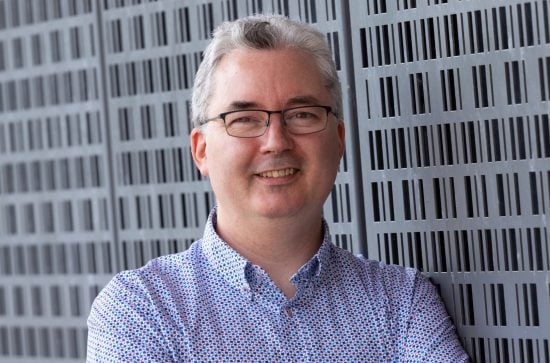
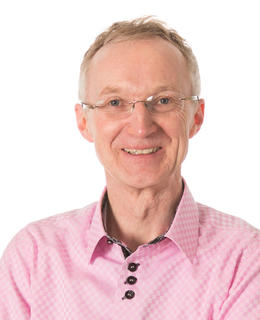
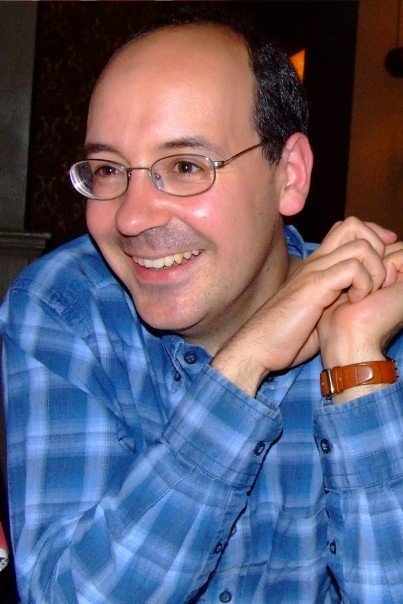
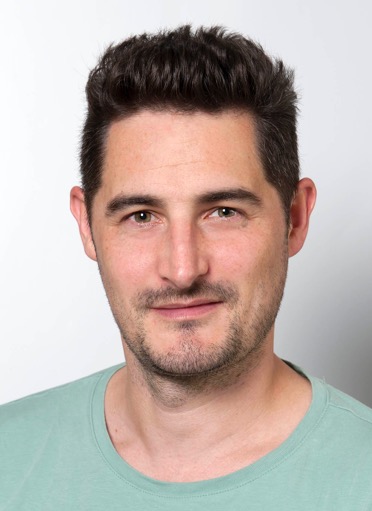
Professor Damien Woods is a faculty member at Maynooth University's Faculty of Science & Engineering, specifically affiliated with the Department of Computer Science and the Hamilton Institute. He leads groundbreaking research in DNA computing, molecular programming, and optical computing, focusing on self-assembly, algorithmic design, and computational complexity. ERC Consolidator Grant: 'Computationally Active DNA Nanostructures' SFI ERC Support Award EIC Pathfinder Challenge Grant: 'DISCO - DNA Infrastructure for Storage and Computation' His research projects explore programmable DNA storage, molecular robotics, and robust self-assembly systems. Recent publications span diverse topics like algorithmic DNA tile assembly, thermodynamic stability, and computational universality in nanosystems. Awards include ERC and SFI grants, with a focus on bridging theoretical computer science and experimental molecular biology. Scientific Contributions include: 2022: 'Turning Machines' - Molecular Robotics 2019: 'Diverse Molecular Algorithms' in Nature 2017: 'A Cargo-Sorting DNA Robot' in Science
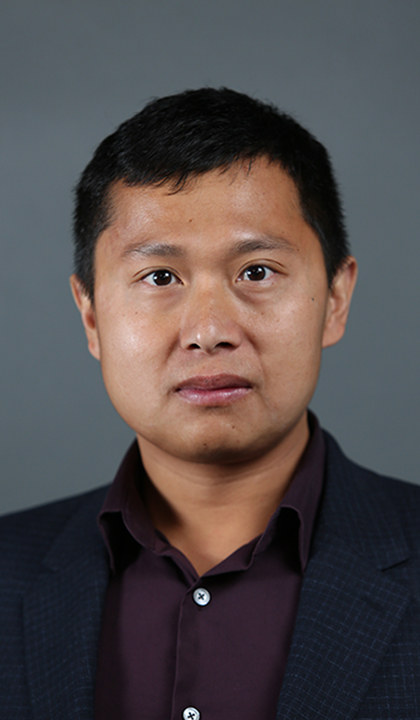
Kenan Li, Ph.D., is an Associate Professor in the Department of Epidemiology and Biostatistics at Saint Louis University’s College for Public Health and Social Justice. He joined SLU in August 2022 and teaches courses such as Statistical Learning, R for Spatial Analysis, and Environmental Determinants of Health. His research bridges data science, GIS, and public health, focusing on spatial computation, environmental exposures, and community resilience. Ph.D. in Environmental Sciences, Louisiana State University M.S. in Environmental Sciences, Louisiana State University B.S. in Environmental Sciences and Applied Mathematics, Nankai University, China Dr. Li’s research interests lie at the intersection of spatial computation, environmental health, and community resilience . He develops geo-AI frameworks , integrated geo-cyber-infrastructures , and biostatistics algorithms using big data, deep learning, and sensor data. His work emphasizes understanding human-environment interactions, urban sustainability, and health disparities. His recent publications from 2023 to 2015 reveal a strong trend in spatial modeling of population dynamics , machine learning for environmental exposure analysis , and resilience assessment in vulnerable coastal regions. He has pioneered methods like Dynamic Time Warping Self-Organizing Maps and Wavelet-based Shapelet Discovery to extract meaningful patterns from high-frequency sensor data. His scientific awards include the Taylor Geospatial Institute Seed Grant (2023) , the Saint Louis University 2023 Health Research Grant , and selection for the Scholarly Undergraduate Research Grants and Experiences . He has secured funding from NSF, NIH, USC Keck School of Medicine, and the US Army Corps of Engineers. Dr. Li has advised and collaborated on numerous research projects, particularly in interdisciplinary teams studying the Mississippi River Delta and urban health interventions. He has been involved in NIH/NIBIB-funded projects and led research on emergency management of trail systems in Los Angeles County. He is actively involved in building research labs and teams focused on spatial data science and public health analytics , having previously worked at USC’s Spatial Sciences Institute and Population and Public Health Sciences Department.
Ben Larson is an Assistant Professor in the Department of Biological Sciences at Rensselaer Polytechnic Institute (RPI), affiliated with the Center for Biotechnology and Interdisciplinary Studies (CBIS). His research bridges biological physics, cell biology, and evolutionary principles to study complex cellular behaviors without nervous systems. BA in Physics, Reed College (2012) Postbaccalaureate Research Fellow, NIH NHLBI (2012-2014) PhD in Biophysics, UC Berkeley (2019) Postdoctoral Scholar, UCSF (2019-2024) Research Focus: The Larson Lab applies interdisciplinary tools from physics and computation to investigate sensorimotor activity in unicellular organisms like Euplotes , exploring how cells achieve sophisticated behaviors through cytoskeletal dynamics and finite-state mechanisms. Key themes include cellular decision-making, evolutionary biophysics, and multicellular morphogenesis. Scientific Awards: 2013 Orloff Science Award 2016-2019 NSF Graduate Research Fellowship 2016 Society of General Physiology Scholar 2020-2023 Merck Postdoctoral Fellowship 2022 Porter Prize for Research Excellence (ASCB)
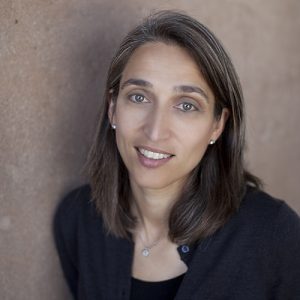
Sandy Irani is a Full Professor at the University of California, Irvine (UCI) in the Department of Computer Science within the Donald Bren School of Information and Computer Sciences. She received her Ph.D. from UC Berkeley in 1991 and has been at UCI since 1992. Her research focuses on algorithm design, computational complexity theory, and quantum computing, with notable contributions to online algorithms and quantum complexity theory. She currently serves as Associate Director of the Simons Institute for the Theory of Computing at UC Berkeley, a role she has held since 2022. This position allows her to collaborate with researchers across theoretical computer science and related disciplines. Irani’s teaching excellence is recognized through the UCI Distinguished Faculty Award for Teaching (2021), and she has contributed to education through her zyBook on Discrete Mathematics, used by over 94,000 students globally. Her work bridges foundational computer science with practical applications, including power management strategies and distributed computing algorithms. Notably, she has collaborated with industry leaders like Mike Luby on optimizing distributed systems. Her research in quantum computing explores computational problems inspired by condensed matter physics, aiming to understand quantum advantage over classical systems. She has also authored influential papers on topics like cache hierarchy design, scheduling algorithms, and the theoretical limits of electronic structure calculations. Awards: ACM Fellow (2022), UCI Distinguished Faculty Award for Teaching (2021). Key Roles: Associate Director, Simons Institute; Vice Chair, Computing Division at UCI. Recent Projects: Quantum algorithms for condensed matter systems, maximal independent set algorithms in distributed networks.
Nuno Pinto is a Senior Lecturer in Urban Planning and Urban Design at the University of Manchester's School of Environment, Education and Development. He holds a PhD in Planning from BarcelonaTech (Spain) and a Civil Engineering degree from the University of Coimbra (Portugal). Previously, he held academic positions at the University of Coimbra and served as a Researcher at the Polytechnic Institute of Leiria. His research focuses on quantitative approaches to urban planning, including decision support systems, urban simulation, integrated transport planning, and big data applications. He is particularly known for his work on cellular automata models and agent-based simulations in urban policy analysis. Nuno has secured significant funding, including a £663k EPSRC grant for the 'Resilience Beyond Observed Capabilities Network+' and a £19k Turing-Manchester grant for VR analytics in digital twins. Teaching expertise spans data science applications in planning, GIS, and decision-support methods across multiple master's programs. He advises on PhD topics combining quantitative methods with Iberian/Latin American urban contexts. Nuno is a Fellow of the Higher Education Academy and recipient of the 2011 Breheny Prize for outstanding urban planning research. Notable projects include 'Synthetic Cities' digital twin frameworks, peri-urban climate change analyses (PERI-CENE), and cross-border collaborations like the FAPESP-University of Manchester initiative. Current research explores smart city strategies in Latin America and carbon accounting systems. Supervised over a dozen PhD students, including works on mobility decision systems, metropolitan data analytics, and serious gaming for urban participation. Active in professional networks such as the COST TU1408 Air Transport and Regional Development initiative.
Jim Crutchfield is a Distinguished Professor of Physics at the University of California, Davis, where he also serves as Director of the Complexity Sciences Center. He holds additional affiliations as President and Scientific Director of the Art & Science Laboratory in Santa Fe, External Faculty at the Santa Fe Institute, General Member of the Telluride Science Research Center, and Visiting Scholar at the Redwood Center for Theoretical Neuroscience. His work bridges physics, computation, and complex systems. Education: B.A. summa cum laude in Physics and Mathematics, University of California, Santa Cruz (1979) Ph.D. in Physics, University of California, Santa Cruz (1983) Crutchfield's research centers on computational mechanics , a framework he pioneered to quantify how natural systems store, process, and transmit information. His interests span nonlinear dynamics, evolutionary dynamics, information engines, quantum computation, and pattern discovery. He explores how structure emerges in complex systems, from cellular automata to biological evolution and neural networks. His recent work focuses on thermodynamic computing, causal inference, and the physics of intelligence. His publications reveal a consistent focus on the interplay between information, energy, and computation in physical systems. Themes include the thermodynamics of information engines, causal architecture in time series, emergent organization, and intrinsic computation in quantum and classical domains. These works span disciplines such as physics, computer science, biology, and cognitive science. Scientific Recognition: Postdoctoral Fellow, Miller Institute for Basic Research in Science IBM Postdoctoral Fellow, Condensed Matter Physics Distinguished Visiting Research Professor, Beckman Institute Bernard Osher Fellow, San Francisco Exploratorium NSF Graduate Fellow UCB Chancellor’s Fellow Crutchfield has advised over two dozen PhD students in physics, computer science, and mathematics, contributing significantly to the next generation of complexity scientists. He has led major interdisciplinary initiatives, including NSF-funded museum exhibits and workshops on network dynamics, collective cognition, and evolutionary dynamics. He has also been active in public discourse through talks, films, and publications on the philosophy of complexity. He leads research groups exploring the dynamics of learning, pattern discovery, and distributed intelligence, often in collaboration with institutions like the Santa Fe Institute and Caltech. His work continues to shape the theoretical foundations of complex systems science.
Mohammed Y Niamat is a full-time Professor in the Department of Electrical Engineering and Computer Science at the University of Toledo's College of Engineering . His research focuses on hardware security, FPGA vulnerabilities, and blockchain applications in cybersecurity. Research Interests : Physical Unclonable Functions (PUFs), FPGA Security, Blockchain-based Security Frameworks, IoT Security, Smart Grid Authentication, Machine Learning Vulnerability Analysis Publications : Over 85 publications from 1986-2024, with recent works on integrations of blockchain and PUFs for secure supply chains, neural network modeling attacks on PUFs, and hardware Trojan detection techniques. Collaborations : Co-authored with Junghwan Kim (4), Weiqing Sun (2), Richard Molyet (1). Recent Article Trends : 2024 works on zero-trust architecture for FPGA supply chains using blockchain and ROPUFs; 2023 studies on IoT device authentication, hardware Trojan detection, and NFT-based IP protection; 2021-2019 research on machine learning attacks against PUFs, lightweight cryptographic designs for IoT, and BER optimization in wireless systems.
Vera Popovich is a researcher in the Department of Mechanical Engineering at Delft University of Technology and a member of Team Vera Popovich. Her work focuses on advanced manufacturing techniques and material behavior analysis. Education: MSc in Engineering (implied PhD) Her research spans additive manufacturing, microstructure engineering, and material degradation mechanisms: Specializes in additive manufacturing processes and their impact on material microstructure. Investigates hydrogen embrittlement in high-strength steels. Pioneers texture control for corrosion resistance in NiTi alloys. Studies fatigue crack propagation in bi-material systems. Recent publications highlight computational modeling of grain structures, interface mechanics in wire-arc additive manufacturing, and advanced characterization techniques for material degradation. She contributes to editorial activities as an editor for Applied Sciences . Scientific Awards: 2012 Poster Prize: X-ray diffraction stress analysis in silicon solar cells She collaborates on projects like the Rhizome initiative (2021-2022) for off-Earth habitat robotics and participates in public engagement, including a 2023 media feature on Delft's 3D-printing lab.
Naratip Santitissadeekorn is a Senior Lecturer in Data Assimilation at the School of Mathematics and Physics, University of Surrey, where he is affiliated with the Mathematics at the Interface Group. His work bridges mathematics, data science, and real-world applications in urban planning, crime analysis, and geophysical fluid dynamics. Dr. Santitissadeekorn received his PhD from Clarkson University in 2008, with a dissertation titled "Transport Analysis and Motion Estimation of Dynamical Systems of Time-Series data." His doctoral research was supervised by Professor Erik Bollt. Following his PhD, he completed two significant postdoctoral positions: from 2008-2011 at the University of New South Wales, Sydney, Australia, working with Professor Gary Froyland on numerical techniques for finite-time Lagrangian coherent set identification, with applications to delimiting the polar vortex and Agulhas rings; and from 2011-2014 at the University of North Carolina-Chapel Hill, working with Professor Chris Jones on data assimilation projects. Dr. Santitissadeekorn's research focuses on inverse problems and data assimilation in geophysical fluid dynamics, the applications of Lagrangian Coherent Structures (LCS), and computational ergodic theory. His work combines theoretical mathematics with practical applications, particularly in urban growth modeling and crime analysis. He has developed innovative methods for identifying coherent structures in fluid flows, estimating transition probabilities from spatiotemporal data, and creating data-driven frameworks for urban expansion scenarios. His research demonstrates how mathematical techniques can be applied to solve real-world problems in environmental science, urban planning, and public safety. An analysis of Dr. Santitissadeekorn's recent publications (2020-2023) reveals a strong focus on urban expansion modeling and network analysis. His work on urban growth has evolved from basic cellular automata models to sophisticated frameworks that manage uncertainty through parameter clustering and growth mode identification. His research on Hawkes processes has advanced ensemble-based filtering techniques for analyzing count data in large networks. These publications demonstrate a consistent pattern of applying mathematical rigor to complex spatiotemporal phenomena, with increasing emphasis on data-driven approaches and practical applications. Dr. Santitissadeekorn has made significant contributions to data assimilation methods, particularly through the development of the extended Poisson-Kalman filter (ExPKF) for urban crime modeling. His teaching includes courses in Algebra and Bayesian Statistics, reflecting his expertise in both theoretical and applied mathematics. While specific awards are not mentioned in the available information, his extensive publication record in high-impact journals demonstrates recognition within his field. Dr. Santitissadeekorn's research has practical implications for urban planning and law enforcement. His work on urban expansion models helps planners understand different growth trajectories, while his crime modeling research contributes to improved police patrolling strategies. His interdisciplinary approach, combining mathematics, computer science, and domain-specific knowledge, positions him at the forefront of applying data science to societal challenges.
Christian Jacob is a Professor in the Department of Computer Science within the Faculty of Science at the University of Calgary . He holds a B.S. in Computer Science and a Doctor of Engineering Science from Erlangen University . His research focuses on nature-inspired algorithms, biocomputing, and agent-based simulations applied to biological systems and education. Key initiatives include the LINDSAY Virtual Human Project , which uses immersive virtual reality to explore human anatomy and physiology. He contributes to the university's strategic priorities in Digital Worlds and Health and Life initiatives. His work integrates evolutionary algorithms, cellular automata, and swarm intelligence into creative and medical applications. Notable achievements include the ASTech Award (2015) from Alberta Science and Technology. His projects emphasize interactive education through tools like LeukemiaSIM , Eukaryo , and the Giant Walkthrough Gut . Jacob also explores visualization techniques, such as evoVision3D and LifeBrush , to enhance scientific understanding. His research bridges computational methods with real-world applications in healthcare, architecture, and game design. Collaborative efforts include developing agent-based models for immune systems, nervous responses, and crowd behavior. Jacob's work spans interdisciplinary fields, blending computer science with biology, engineering, and the arts.
Réka Szabó is an Assistant Professor at the Bernoulli Institute for Mathematics, Computer Science and Artificial Intelligence, University of Groningen, Netherlands, since October 2022. Her academic trajectory includes a postdoctoral fellowship at Université Paris-Dauphine (2019–2022) and a Ph.D. in Mathematics (2015–2019) at the University of Groningen under Daniel Valesin. Education: B.Sc. in Mathematics, Budapest University of Technology and Economics (2008–2011) M.Sc. in Applied Mathematics, Budapest University of Technology and Economics (2011–2015) M.Sc. in Computer Science, University of Trento and Eötvös Lóránd University (2012–2014) Ph.D. in Mathematics, University of Groningen (2015–2019) Réka’s research focuses on Interacting Particle Systems and Percolation Theory , with significant contributions to understanding phase transitions, critical behavior, and stochastic dynamics in models like the Contact Process, Oriented Percolation, and Bootstrap Percolation. Her work combines rigorous mathematical analysis with applications to statistical physics and complex networks. She is actively involved in academic service, including organizing the Workshop On Randomness and Discrete Structures (WORDS 2025) and co-organizing the Probability and Statistics Seminar in Groningen. Réka teaches advanced courses such as Stochastic Processes, Interacting Particle Systems, and Mathematics and its Environment.
Dr. Dandolo Flumini is a Researcher at the Zurich University of Applied Sciences (ZHAW), School of Engineering, specializing in Applied Complex Systems Science. His research focuses on artificial life, morphological computation, blockchain applications, and computational modeling. He serves as team member or project lead in multiple interdisciplinary initiatives including Bio-HhOST (bio-hybrid tissues), Agroforestry Carbon Token System, and blockchain-based voting solutions. His primary research interests include: Complex Systems Science : Emergent behaviors in biological and artificial systems Morphological Computation : Physical systems performing computational tasks Artificial Chemistry : Programmable chemical systems using droplet networks Blockchain Applications : Decentralized finance and voting systems Computational Ethics : Responsible implementation of AI and modeling Flumini's recent publications (2019-2023) demonstrate strong focus on microfluidic systems, droplet agglomeration physics, programmable chemistry, and ethical AI. His work frequently appears in artificial life and computational modeling venues, with increasing emphasis on real-world applications in sustainability and decentralized systems. He maintains active collaborations through the Applied Complex Systems Science research group at ZHAW, contributing to projects involving microfluidic device design, blockchain architectures, and bio-hybrid tissue engineering.
Ralph WILLOX is a Professor in the Department of Basic Analysis at the University of Tokyo's Graduate School of Mathematical Sciences. His research focuses on integrable systems, particularly discrete and ultradiscrete nonlinear dynamical systems, with applications to cellular automata and natural phenomena modeling. Research Areas : Integrable systems, Hirota's bilinearization method, Sato theory, discretization/ultradiscretization techniques. Affiliations : Mathematical Society of Japan, Japan Society of Industrial and Applied Mathematics (JSIAM), Councilor at the Solvay Institutes' International Physics and Chemistry Institutes. Teaching : Instructs Mathematics IA (Master's Program, Science 1) and Applied Mathematics XB (Graduate School of Mathematical Sciences). His work bridges algebraic methods with computational simulations, exploring how discrete systems retain essential dynamics of continuous models. Recent publications analyze generalized QRT mappings, ultradiscrete KdV solutions, and predator-prey system discretizations. Advisory Roles : Advisory Board member for the Journal of Physics A: Mathematical and Theoretical. Activities : Active in academic dissemination through seminars, conferences, and collaborative research projects.
James Martin is a Lecturer at the Department of Statistics, University of Oxford . He is affiliated with St Hugh's College and has been actively involved in organizing probability seminars since 2018. Research Interests Probability theory Random graphs and percolation Interacting particle systems Models of random growth and coagulation-fragmentation Queueing networks Combinatorial games Teaching Courses: Prelims Probability , Part A Probability , Part B Statistical Lifetime Models , Part C Probabilistic Combinatorics His publications focus on probability theory , statistical physics , and combinatorial structures . Recent work includes studies on last-passage percolation, multispecies exclusion processes, and integrable probability models. James Martin collaborates with researchers from institutions such as Uppsala University, University of Cambridge, Imperial College London, and Kyoto University. He has been a key organizer for the Oxford Probability Seminar since 2018.
Alvaro Köhn-Luque is an Associate Professor at the Oslo Center for Biostatistics and Epidemiology, University of Oslo, and Group Leader at the Department of Medical Genetics, Oslo University Hospital. His work bridges mathematical modeling with clinical applications, particularly in cancer research. His academic background includes a PhD in Mathematical and Computational Biology from Complutense University of Madrid (2012), preceded by multiple Master's degrees in Mathematics and Physics from Spanish universities. Dr. Köhn-Luque's research focuses on mathematical oncology , developing computational models to understand cancer dynamics and improve treatment strategies. His work spans multiscale modeling of tumor growth, personalized cancer medicine through computer simulations, and biomarker discovery using machine learning approaches. He has made significant contributions to modeling breast cancer progression and treatment response, particularly in the context of endocrine therapy and CDK4/6 inhibition. His recent publications demonstrate a strong trend toward integrating mechanistic learning approaches that combine mathematical models with machine learning techniques. This hybrid methodology allows for more accurate prediction of treatment outcomes while maintaining biological interpretability. His work frequently involves collaboration with clinical researchers to ensure models are grounded in real patient data and have direct translational potential. Computational modeling of tumor heterogeneity and drug response Development of methods for phenotypic deconvolution in cancer cell populations Integration of multi-omics data for personalized treatment prediction Application of birth-death processes to model tumor evolution Creation of user-friendly computational tools for biomedical researchers Dr. Köhn-Luque has supervised multiple PhD students including Even M Myklebust, Salim Ghannoum, and Xiaoran Lai, and has secured funding for projects including RESCUE, BigInsight, and Integreat. His research demonstrates a consistent trajectory from theoretical mathematical biology toward increasingly clinically relevant applications in personalized cancer medicine.