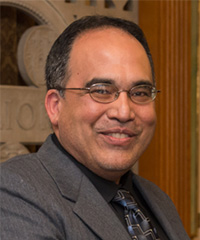
Jacob Fox is a Professor at Stanford University, specializing in Combinatorics and Probability. His research focuses on extremal combinatorics, Ramsey theory, graph theory, and additive combinatorics. He advises students like Maya Sankar. His work explores structural and enumerative aspects of graphs, hypergraphs, and combinatorial configurations. Recent studies include advancements in Ramsey numbers, sumset theory, and probabilistic methods in discrete mathematics. Key research areas include Ramsey numbers for sparse structures, hypergraph properties, and applications of combinatorial geometry. His publications often bridge theoretical insights with algorithmic applications. No scientific awards are listed in the provided text. His advising includes Maya Sankar, with research aligned to combinatorial problems. Collaborative projects involve extremal graph theory and probabilistic combinatorics. No labs or dedicated research groups are explicitly mentioned.
Afonso S. Bandeira is a Professor in the Department of Mathematics (D-MATH) at ETH Zurich, where he conducts research at the intersection of mathematics, statistics, and computer science. He maintains strong affiliations with several interdisciplinary research centers including the Institute For Operations Research (IFOR), the Max Planck ETH Center for Learning Systems, the ETH Foundations of Data Science, and the ETH AI Center, with a courtesy appointment at D-ITET. Bandeira actively teaches courses including Mathematics of Signals, Networks, and Learning, and Mathematics of Data Science. His research focuses on High Dimensional Probability, Random Matrices, Mathematical Statistics, Theoretical Computer Science, Combinatorics, and Mathematical Optimization. Bandeira's work often explores the theoretical foundations of data science, examining phase transitions in statistical problems, computational barriers, and the geometry of high-dimensional spaces. He maintains a research group blog called Randomstrasse101 that emphasizes open problems in his field. Analysis of his recent publications reveals a strong focus on matrix and tensor concentration inequalities, synchronization problems, nonconvex optimization landscapes, and computational-statistical tradeoffs in high-dimensional inference. His work bridges theoretical mathematics with practical applications in machine learning and data analysis, particularly examining where computational limitations arise in statistical problems. Bandeira actively mentors students and researchers, currently supervising several doctoral candidates including Daniil Dmitriev, Konstantin Donhauser, Anastasia Kireeva, Kevin Lucca, Chiara Meroni, Gil Kur, Petar Nizic-Nikolac, and Almut Roedder. He emphasizes that students working with him should participate in the DACO seminar and group meetings, and encourages prospective students to have completed his Mathematics of Signals, Networks, and Learning or Mathematics of Data Science courses. He leads a research group focused on the mathematics of data science, with regular group meetings and seminars. Bandeira has developed comprehensive lecture notes including 'A Tour Through the Mathematics of Signals, Learning, and Networks' (2025) and 'Mathematics of Machine Learning' (2021), and previously authored 'Ten Lectures and Forty-Two Open Problems in the Mathematics of Data Science' (2015).
Brett Kolesnik is a Research Fellow in the Department of Statistics at the University of Warwick. His research focuses on probability theory, random structures, bootstrap percolation, and interactions with combinatorics. He has held postdoctoral fellowships at UC Berkeley, San Diego, and the University of Oxford, and was a Senior Demy at Magdalen College. His work includes organizing workshops on bootstrap percolation and collaborating with leading researchers in probability and combinatorics. Education: PhD in Mathematics from the University of British Columbia (advised by Omer Angel). Notable awards include the NSERC Postdoctoral Fellowship and the Florence Nightingale Bicentennial Fellowship in Statistics. Research interests span bootstrap percolation models, random graph dynamics, and stochastic processes. Recent work includes studies on Brownian map geometry, tournament score sequences, and Coxeter group structures. Selected articles explore topics such as critical beta-splitting processes, Catalan percolation, and random walks on algebraic structures. His publications appear in top journals like Electronic Journal of Probability and Annals of Applied Probability . Awards include the Florence Nightingale Fellowship and NSERC Postdoctoral Fellowship. Professional involvement includes organizing the 2024 BIRS workshop on Bootstrap Percolation and contributing to interdisciplinary collaborations in probability and combinatorics.
Professor Martin Liebeck is a Professor of Pure Mathematics and Head of the Pure Mathematics Section at the Department of Mathematics, Imperial College London. He is affiliated with the Algebra and Algebraic Combinatorics research groups and is part of the Mathematics research and teaching staff within the Faculty of Natural Sciences. His research interests span Pure Mathematics, with a focus on group theory, algebraic combinatorics, Lie groups, and representation theory. His work often involves the structure and properties of finite simple groups, algebraic groups, and their applications to permutation groups and character theory. Recent publications explore topics such as the actions of simple groups, unipotent classes in algebraic groups, character ratios, and the classification of permutation groups. His work frequently intersects with combinatorial and algebraic structures, with implications for both theoretical and applied mathematics. Professor Liebeck’s contributions include foundational studies on group generation, covering numbers, and character bounds, reflecting his deep engagement with the interplay between algebraic structures and combinatorial problems. His research has been published in leading mathematics journals, and he maintains an active academic profile through his personal webpage at http://www.ma.ic.ac.uk/~mwl/ .
Ben Green is the Waynflete Professor of Pure Mathematics at the University of Oxford and a Fellow of Magdalen College. His work spans additive combinatorics, analytic number theory, harmonic analysis, ergodic theory, discrete geometry, and group theory, with a focus on interdisciplinary approaches. Research Interests: Additive combinatorics and its applications to primes Analytic number theory (prime distribution, L-functions) Harmonic analysis (Fourier methods, spectral theory) Ergodic theory and its combinatorial applications Discrete geometry (ordinary lines, convex structures) Group theory (approximate groups, expansion) Article Trends: His recent work emphasizes multiplicative functions, Ramsey-type problems in number theory, expansion in finite groups, and extremal set theory. Themes include prime gaps, arithmetic progressions, and interactions between analysis and algebra. Scientific Awards: Clay Research Award (2004) Ostrowski Prize (2005) Whitehead Prize (2005) Leverhulme Prize (2007) European Mathematical Society Prize (2008) Royal Society Fellow (2010) Sylvester Medal (2014) Senior Whitehead Prize (2019) Advising: Ben has supervised numerous D.Phil students across additive combinatorics, analytic number theory, and related fields. Past students hold postdoctoral and academic positions globally.
Gábor Somlai is a mathematics researcher at Eötvös Loránd University's Faculty of Science, affiliated with the Department of Algebra and Number Theory since 2006. He is a core member of the HUN-REN-ELTE Geometric and Algebraic Combinatorics Research Group (previously MTA-ELTE until 2023) and participates in the Asymptotic Group Theory ERC project. His institutional roles include contributions to the Mathematics Doctoral School and the Institute of Mathematics. His research spans Algebra , Combinatorics , and Number Theory , with emphasis on spectral sets, tiling problems, group theory, and finite geometry. Recent work explores cyclotomic polynomials, the generalized trifference problem, and connections between tiling and spectral properties in finite abelian groups. His publications reveal a strong focus on combinatorial number theory and algebraic methods in discrete geometry. Somlai's publication trends show sustained contributions to theoretical foundations of tiling and spectral sets (testing Fuglede's conjecture in cyclic groups) Cayley graph properties and CI-group classifications polynomial methods in finite geometry and direction problems His work bridges pure algebra with combinatorial applications, often resolving long-standing conjectures in specialized domains. As part of the HUN-REN-ELTE research group, he collaborates on geometric and algebraic combinatorics projects, leveraging ERC funding for asymptotic group theory investigations. His research infrastructure includes access to the Alfréd Rényi Institute of Mathematics (http://www.renyi.hu) resources.
Timothy Riley is a Professor in the Department of Mathematics at Cornell University, affiliated with the College of Arts and Sciences. His research focuses on geometric group theory, studying infinite discrete groups through geometric lenses such as Riemannian manifolds, graphs, and cell complexes. Key interests include curvature, geometric features of group presentations, and algorithmic complexity. He holds a D.Phil. from Oxford University (2002). Research spans geometric aspects of the word problem, hyperbolic groups, Dehn functions, and applications to cryptography and topology. His work integrates algebraic, topological, and computational perspectives. Notable collaborations include studies on hydra groups, Cayley graphs, and asymptotic cones. Publications emphasize geometric topology and group theory, with contributions to understanding filling invariants and geometric algorithmic properties. His office is 403 Malott Hall, and he maintains an active personal web page. No explicit awards are listed in the provided text, though he was part of news items related to teaching honors in 2024.
David Fisher is the Milton B. Porter Professor of Mathematics at Rice University, specializing in geometric rigidity theory, dynamical systems, and geometric group theory. His research explores lattice actions, superrigidity, quasi-isometric embeddings, and the Zimmer program, with collaborations spanning institutions like the University of Chicago and Stanford University. B.S., Columbia University Ph.D., University of Chicago (1999) His work focuses on the interplay between group actions, Lie groups, and topology. Key contributions include advancements in Zimmer's conjecture, rigidity of warped cones, and quasi-isometric rigidity of solvable groups. His publications highlight collaborations with leading mathematicians such as Alex Eskin, Gregory Margulis, and Shmuel Weinberger. Fisher’s research intersects coarse geometry, harmonic maps, and measure rigidity, often addressing fundamental questions in non-uniform lattices and affine actions. He maintains active engagement in the mathematical community through publications and academic leadership.
David Alan Goldberg is an Associate Professor in the School of Operations Research and Information Engineering (ORIE) at Cornell University, part of Cornell Engineering. He joined Cornell in 2017 and previously held the A. Russel Chandler III Associate Professorship at Georgia Tech’s Industrial and Systems Engineering department. Goldberg earned his Ph.D. in Operations Research from MIT (2011) and a B.S. in Computer Science from Columbia University (2006). Education: B.S. in Computer Science, Columbia University (2006) Ph.D. in Operations Research, MIT (2011) Research Interests: Goldberg’s work focuses on applied probability and stochastic processes, including optimal stopping, inventory and queueing models, combinatorial optimization, and robust optimization. He develops algorithms and insights for complex systems, addressing challenges like the curse of dimensionality. His research spans applications in data science, operations research, and stochastic modeling. Notable contributions include distributionally robust inventory control and high-dimensional decision-making frameworks. Awards and Honors: 2025 Community-Engaged Practice and Innovation Award (David M. Einhorn Center) 2023 Sunny Yau ’72 Teaching Award (Cornell) 2019 INFORMS Applied Probability Society Best Publication Award 2015 NSF CAREER Award Multiple INFORMS Nicholson Student Paper Competitions (First Place, 2019 & 2015) Teaching and Service: Goldberg leads Cornell ORIE’s undergraduate research program, connecting students to real-world applications of OR and data science. He teaches courses in probability modeling, stochastic models, and academic skills for PhD students. He chairs the INFORMS Applied Probability Society and serves on editorial boards for Operations Research and Stochastic Systems . At Cornell, he advises the Undergraduate ORIE Society and directs undergraduate studies in ORIE. Labs & Collaborations: Goldberg’s research integrates theoretical rigor with practical applications, often involving collaborations across disciplines. His work bridges operations research, statistics, and computer science to address modern challenges in inventory systems, queueing networks, and decision-making under uncertainty.
Goulnara Arzhantseva is a full Professor at the Department of Mathematics within the Faculty of Mathematics at the University of Vienna. With an active research career spanning over a decade, she has established herself as a prominent figure in geometric group theory and related fields. Her work demonstrates continuous scholarly output with publications appearing consistently from 2011 through 2024. Professor Arzhantseva's research focuses primarily on geometric group theory, with particular emphasis on discrete groups, metric geometry, approximation properties of groups, small cancellation theory, expanders, and sofic groups. Her work bridges pure mathematics with applications in metric geometry and functional analysis. The breadth of her research is evident in her collaborations with numerous mathematicians across different institutions and countries. Her publication record shows a clear trajectory of increasingly sophisticated work in geometric group theory. The most recent publications (2022-2024) focus on metric approximations of discrete groups, spectral gap properties, origami expanders, and acylindrical hyperbolicity in cubical small cancellation groups. These works represent cutting-edge research at the intersection of group theory, geometry, and combinatorics. Scientific Awards: Prize mentioned in search results (4 total, specific names not provided) Prize mentioned in search results (4 total, specific names not provided) Prize mentioned in search results (4 total, specific names not provided) Prize mentioned in search results (4 total, specific names not provided) Professor Arzhantseva has been actively involved in numerous research projects, with records showing 7 projects between 2011-2024. Her collaborative approach is evident in her extensive publication record, which includes significant contributions to prestigious mathematics journals. While specific details about her advising activities are not provided in the available information, her substantial research output suggests active mentorship of graduate students in geometric group theory.
Tatiana Smirnova-Nagnibeda is an Associate Professor in the Mathematics Section at the University of Geneva, where she obtained her PhD before holding positions at ETH Zurich and KTH Stockholm. She returned to UNIGE where she has established herself as a leading researcher in geometric and combinatorial group theory. Her research focuses on combinatorial, asymptotic and geometric group theory, as well as probabilities on groups and graphs. She has made significant contributions to the understanding of branch groups, self-similar groups, Schreier graphs, and spectral properties of group actions. Her work often bridges algebra, probability, and geometry, revealing deep connections between these areas through the study of Thompson's groups, Grigorchuk's group, and other important group constructions. Her recent publications demonstrate a consistent focus on subgroup structure in various classes of groups, spectral properties of Schreier and Cayley graphs, and connections to dynamical systems. She frequently collaborates with researchers from around the world, particularly with Rostislav Grigorchuk, and has mentored numerous doctoral students who have gone on to successful academic careers. Managing Editor for Groups, Geometry, and Dynamics Editor for L'Enseignement Mathématique Organizer of GAGTA conferences (2022, 2024) Organizer of specialized workshops on high-dimensional expanders (2015, 2016) She leads an active research group comprising postdoctoral fellows and doctoral students working on various aspects of group theory and its applications. Her teaching includes advanced courses on graph theory, random walks on groups, spectral theory of graphs, and amenability at the University of Geneva.
Alina Vdovina is a Professor of Mathematics at The City College of New York (CCNY) and a member of the doctoral faculty at the CUNY Graduate Center. Her office is located at North Academic Center 8/201, with an alternative listing showing MR 333, and she can be reached at (212) 650-5161 or via email at avdovina@ccny.cuny.edu. Dr. Vdovina's research focuses on Geometric Group Theory and its interactions with Dynamical systems, K-theory of C*-algebras, and Knot Theory. Her work bridges multiple mathematical disciplines, exploring the connections between algebraic structures, geometric representations, and topological properties. She has made significant contributions to the understanding of higher-rank graphs, cube complexes, and their applications in operator algebras. Her recent publications demonstrate a consistent focus on the interplay between geometric structures and algebraic properties, with particular attention to how group-theoretic concepts manifest in topological and combinatorial settings. Her work spans theoretical developments in group theory, applications to operator algebras, and connections to discrete mathematics. Dr. Vdovina is actively involved in mentoring students, with recent successes including Kadar He moving to the PhD program at CUNY's Graduate Center, Nicholas Videen transitioning from musician to CCNY mathematics graduate, and Joshua Bourne-Inniss advancing from community college to CCNY mathematics graduate degree. Her research presentations include "Groups acting on buildings and their subgroups" at GAGTA 2025 and "C*-algebras coming from buildings and their K-theory" at the Conference on Analytic Group Theory in Austin, Texas.
Dr. Ruth E Gornet is an Associate Professor in the Department of Mathematics at the University of Texas at Arlington. She holds a PhD from Washington University and specializes in spectral geometry, differential geometry, and topology. Her research focuses on isospectral manifolds, nilmanifolds, and the application of spectral theory to geometric problems. She has received multiple teaching awards, including the Outstanding Honors College Faculty Award and Professor of the Year honors from the MAA undergraduate program. Her research interests include: Spectral geometry and isospectrality Differential geometry of nilmanifolds Length spectrum analysis Mathematical education and curriculum development Dr. Gornet's publications predominantly explore spectral invariants in Riemannian geometry, with recent work focusing on magnetic geodesics and eta invariants. Her articles demonstrate consistent engagement with high-dimensional topology and computational spectral methods. She has received significant recognition for her work: Alumni Hall of Honor (2023, 2019) Teaching Recognition by FLOC (2019, 2012) Outstanding Honors College Faculty Award (2017) Professor of the Year (2015, 2013) Dr. Gornet actively mentors graduate students, chairing dissertation committees and supervising PhD candidates in spectral geometry. She has secured multiple NSF grants for undergraduate education enhancement, including SURGE and GAANN fellowships, totaling over $4M in funding.
Carmen Galaz García is an Assistant Teaching Professor at the Bren School of Environmental Science & Management at UC Santa Barbara. She teaches data science courses including EDS 220 and capstone projects, emphasizing accessible technical education and DEIJ initiatives. Previously, she worked at the National Center for Ecological Analysis and Synthesis (NCEAS), analyzing remote sensing data and developing educational resources. Carmen holds a Ph.D. in Mathematics (UCSB) and a B.Sc. in Mathematics from the University of Guanajuato/CIMAT, Mexico. Her research focuses on environmental data science applications such as invasive species mapping using machine learning and geospatial analysis. She actively contributes to reproducible workflows in Python and collaborates on topological data analysis in environmental contexts. Professional affiliations include NCEAS and Bren School's environmental data programs. Education: Ph.D. in Mathematics, UC Santa Barbara (2021) B.Sc. in Mathematics, Universidad de Guanajuato/CIMAT (2015) Research emphasizes interdisciplinary approaches combining mathematics, ecology, and data science to address environmental challenges. She leads capstone projects integrating real-world environmental datasets and mentors students through collaborative data science workflows.
Jonathan Pakianathan is a Professor of Mathematics at the University of Rochester's School of Arts & Sciences, Department of Mathematics. He holds a PhD from Princeton University (1997) and a BS in Mathematics and Physics from Caltech (1992). His research focuses on algebraic topology, cohomology of groups and Lie algebras, geometric combinatorics, and finite fields. He has held leadership roles, including Director of Graduate Studies (2014–2020) and Director of Undergraduate Studies (2003–2010). Notable awards include the Goergen Award for Excellence in Teaching (2014) and the Sloan Foundation Doctoral Dissertation Fellowship (1996). His research explores applications of topology and algebra in discrete geometry, often collaborating with Alex Iosevich and students. Recent work addresses topics like Fuglede's conjecture over finite fields, geometric configurations, and probabilistic methods in combinatorics. His articles frequently intersect harmonic analysis, group theory, and number theory, reflecting interdisciplinary strengths. Education : PhD, Princeton University, 1997 BS in Mathematics and Physics, Caltech, 1992 Awards : Goergen Award for Excellence in Undergraduate Teaching, 2014 Sloan Foundation Doctoral Dissertation Fellowship, 1996 H. J. Ryser Scholarship, 1991 Grants include an NSA Mathematical Sciences Grant (2016–2017, $110,000 total) with A. Iosevich. He advises numerous PhD students, many of whom now hold academic or research positions. His teaching spans undergraduate to graduate courses, including algebra, topology, and financial mathematics. Research groups and collaborations extend to geometric combinatorics, algebraic topology, and applications in physics and data science. Ongoing projects explore topological methods in discrete geometry and probabilistic structures over finite fields.