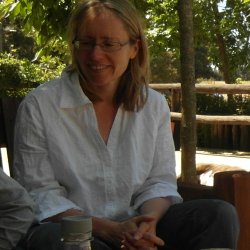
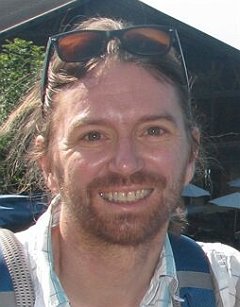
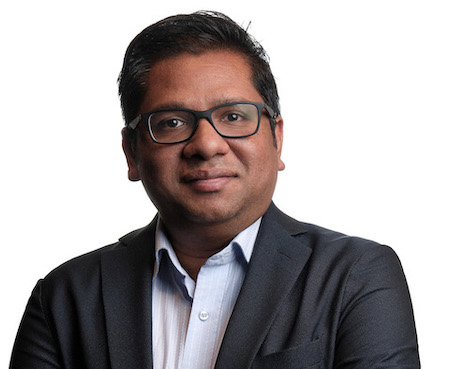
Lauren Johnson serves as a Lecturer in the Department of Mathematics at Southeastern Louisiana University, where she contributes to undergraduate education through course instruction and academic support services. Her scholarly focus spans core mathematical disciplines including Pure Mathematics (algebra, analysis, topology) and Applied Mathematics (modeling, computational methods), with emphasis on effective pedagogical approaches for foundational mathematics education. This work supports student development across calculus, linear algebra, and statistics curricula. Her professional activities center on classroom instruction within the university's mathematics framework, maintaining active engagement through departmental channels as indicated by her direct contact pathways.
Dr. Catherine Wilkins serves as a Departmental Lecturer at the University of Oxford's Mathematical Institute and holds a Stipendiary Lecturer position at Exeter College, delivering core undergraduate mathematics instruction across multiple academic levels. Her educational qualifications include: BSc (Open University) MA MSc D.Phil Her academic focus centers on applied mathematical disciplines, with significant emphasis on biological modeling applications, differential equations theory, and computational methodologies. This expertise manifests in her teaching of specialized courses spanning calculus of variations, integral transforms, and mathematical biology, demonstrating consistent integration of theoretical frameworks with real-world problem-solving scenarios. Her pedagogical excellence has been formally recognized through: Open University Building Excellence Teaching Award (2020) MPLS Division, University of Oxford Individual Award for Excellence in Teaching (2015) University of Oxford Teaching Award Project Grant (2009) Open University Teaching Award (2007) Dr. Wilkins actively supervises BSP Structured Projects in Mathematical Modelling and Scientific Computation, guiding student research initiatives while maintaining her comprehensive teaching portfolio across preliminary and advanced undergraduate curricula. Her sustained receipt of teaching grants and awards underscores a dedicated career focused on advancing mathematical education through innovative project-based learning approaches.
Erkan Günerhan is a full-time Lecturer in the Department of Computer Technologies at Kağızman Vocational School, Kafkas University, Turkey, holding this position continuously since 2012. He has also served in significant administrative roles including Department Head (2017-2020) and Center Deputy Director (2013-2017) at the same institution. His academic credentials include: BSc in Computer Engineering from Pamukkale University (2003-2009) MSc in Computer Engineering from Atatürk University (2009) Master's Degree in Computer Engineering (Thesis) from Karadeniz Technical University (2019) Günerhan's research spans computational mathematics and artificial intelligence, with early work on numerical methods for differential equations and fractional calculus evolving toward machine learning applications. His expertise demonstrates a clear transition from theoretical mathematical modeling to practical AI implementations, particularly in speech recognition systems. Publication trends reveal a methodological progression: initial focus (2014-2015) on differential transform methods for population models and fractional PDEs shifted toward deep learning techniques by 2022, evidenced by his LSTM-based speaker recognition research. This trajectory highlights his adaptation to emerging computational paradigms while maintaining strong mathematical foundations. He has not received any notable scientific awards. Günerhan has not supervised thesis students nor participated in research projects or intellectual property development. His collaborations include Khatereh Tabatabaei (4 joint publications), Cemal Köse (1 publication), and Ercan Çelik (1 publication), primarily focused on numerical analysis and AI applications.
Dr. Wanpeng Li is a Lecturer in Cyber Security within the Department of Computer Science at the University of Liverpool. Prior to this role, he held lecturer positions at the University of Aberdeen and Manchester Metropolitan University, and worked as a postdoctoral researcher at City, University of London. His research focuses on critical areas in cyber security including web security, identity management, authentication mechanisms, and malware detection using machine learning. Research Trends: His recent publications span both cyber security and mathematical modeling domains. Key security themes include automated vulnerability detection, federated learning attacks, and privacy-preserving protocols for vehicular networks and IIoT systems. Parallel studies in grey system models explore energy consumption forecasting and environmental impact analysis using fractional calculus and neural network integrations. Advising: Dr. Li actively accepts PhD students in cyber security-related fields.
Dr. Nadia Benakli is a Professor of Mathematics at New York City College of Technology (City Tech), part of the City University of New York system, within the School of Arts & Sciences. She coordinates the Computer Science and Applied Mathematics internship programs, bridging academic theory with industry practice. Her career spans decades of contributions to both pure mathematics and educational innovation. Her educational foundation includes a Ph.D. in Mathematics from Paris-Sud University, France. Research interests center on Geometric Group Theory (hyperbolic groups, Coxeter groups, polygonal complexes), Graph Theory , and Mathematics Education innovations. She integrates computational tools like R and Maple into calculus and data analysis instruction, emphasizing visualization and hands-on projects to enhance student comprehension in foundational mathematics courses. Publication trends reveal an evolution from theoretical work (1991-2002) on geometric structures to applied educational research (2011-2017). Early papers established frameworks for hyperbolic geometry and group boundaries, while recent work focuses on computational thinking, faculty mentoring models, and internship program design—demonstrating her commitment to translating abstract mathematics into practical educational strategies. As internship coordinator, she mentors students through industry placements and co-developed SIAM News-published frameworks for applied mathematics internships. Her teaching portfolio spans foundational courses (MAT065, MAT1175) to advanced topics (MAT440, MAT4901), reflecting deep engagement with curriculum development across all undergraduate levels.
Andreas Abel is a Senior Lecturer at the Department of Computer Science, Gothenburg University, with a focus on Programming Languages, Logic, and Type Theory. His work includes contributions to dependently typed programming, functional programming, lambda calculus, and formal verification. Research Interests Programming Languages Logic Types Projects Principal Investigator for Modal Dependent Type Theory (Vetenskapsrådet grant 2020-2024) Editor of the Theoretical Pearls column in the Journal of Functional Programming Senior developer of the dependently-typed language Agda His recent publications span graded type theory, normalization by evaluation, strong normalization, and formal verification using Agda. Key collaborations include Jean-Philippe Bernardy and Thierry Coquand. Scientific Awards Vetenskapsrådet grant 2020-2024 VR Grant 2014-04864 He has supervised numerous projects, developed software tools like the Backus Naur Form Compiler (BNFC), and contributed to international conferences as a PC member and author.
Leon Bungert is a Professor of Mathematics of Machine Learning at the University of Würzburg, working in applied analysis and numerics with a particular focus on data science and machine learning. His research investigates PDEs and variational models on graphs, adversarial robustness of machine learning, variational regularization, and nonlinear optimization. Dr. Bungert serves as a guest editor for the European Journal of Applied Mathematics, an associate editor for Advances in Continuous and Discrete Models: Theory and Applications, and is a member of the program committee at SSVM 2025. He is also an ELLIS member and actively organizes conferences and workshops, including "MIA'25" at IHP in Paris (January 13-15, 2025), "Synergies of Machine Learning and Numerics" in Osaka (March 11-13, 2025), and "Mathematical Analysis of Adversarial Machine Learning" in Oaxaca (August 17-22, 2025). Research Interests Dr. Bungert's primary research areas include: PDEs on graphs Adversarial robustness in machine learning Inverse problems Optimization Variational problems in L-infinity Nonlinear eigenvalue problems Image reconstruction with structural priors His work bridges theoretical mathematics with practical applications in machine learning, particularly focusing on the mathematical foundations of deep learning and developing robust algorithms that can withstand adversarial attacks. He has made significant contributions to understanding the connections between partial differential equations and machine learning algorithms. Research Trends Analysis of Dr. Bungert's recent publications reveals a strong focus on the intersection of machine learning and mathematical analysis. A key theme is the application of variational methods and partial differential equations to machine learning problems, particularly in understanding and improving the robustness of neural networks against adversarial examples. His work on Lipschitz learning on graphs has established important theoretical foundations for graph-based semi-supervised learning. Additionally, his research on the infinity Laplacian and p-Laplacian equations provides deep insights into the mathematical structure of machine learning algorithms. The development of Bregman learning frameworks for sparse neural networks represents a significant contribution to efficient deep learning model training. Professional Activities Dr. Bungert is actively involved in the academic community through editorial roles and conference organization. His current professional activities include: Guest editor for the European Journal of Applied Mathematics Associate editor for Advances in Continuous and Discrete Models: Theory and Applications Member of the program committee at SSVM 2025 ELLIS member Co-organizer of multiple international conferences and workshops Technical Contributions Dr. Bungert has developed several open-source software packages that implement his theoretical contributions, including: Code for convergence rates of Lipschitz learning on graphs A Bregman training framework for sparse neural networks CLIP: Cheap Lipschitz Training of Neural Networks Nonlinear Power Method for Proximal Operators and Neural Networks Robust Image Reconstruction with Misaligned Structural Information These implementations are primarily in Python and MATLAB, demonstrating his commitment to making theoretical advances accessible for practical applications.
Daniel Cameron Campbell is a Researcher at the Department of Mathematical Analysis , Faculty of Mathematics and Physics , Charles University , Prague. He teaches advanced courses on Sobolev spaces and calculus, focusing on nonlinear elasticity and geometric function theory. Research Interests: Ball-Evan's approximation, mappings of finite distortion, nonlinear elasticity, Sobolev embeddings Teaching: Derivatives and Integrals for Advanced Levels (NMMA437), Mathematical Analysis I (NOFY151) Research Trends: His recent work addresses approximation of Sobolev and BV homeomorphisms, focusing on diffeomorphic and piecewise affine methods. He explores topological constraints, Jacobian sign preservation, and applications to nonlinear elasticity and metric measure spaces. Scientific Contributions: Principal Investigator for GAČR grant 20-19018Y (2020–2022) on analytical tools for variational problems. Organized workshops: GeoCa 20 (2020), Per Partes (2021), GeoCa 22 (2022). Contact: Email daniel.campbell@mff.cuni.cz or campbell@karlin.mff.cuni.cz .
Prof. Ing. Tomáš Roubíček, DrSc., is a faculty member at the Department of Mathematics, Faculty of Mathematics and Physics, Charles University in Prague. His academic career is centered on mathematical research and education. Contact details: E-mail Tomas.Roubicek@mff.cuni.cz . Office located in room 392 (building K, 3rd floor, Karlín campus, Sokolovská 49/83, Prague 8). Research interests inferred from his departmental affiliation include: Mathematics Applied Mathematics Partial Differential Equations Calculus of Variations Continuum Mechanics
Elvise Berchio is a Full Professor in the Department of Mathematical Sciences (DISMA) at Politecnico di Torino, where she also serves as Deputy Coordinator of the Doctoral College of Mathematical Sciences. Her academic career spans theoretical and applied mathematics with a focus on partial differential equations and their applications in engineering contexts. Her research interests include: Functional inequalities (Sobolev, Hardy, Rellich) Partial differential equations (elliptic, parabolic, higher-order) Variational methods Mathematical models for bridges and plates Professor Berchio's work demonstrates a consistent focus on geometric-analytic methods for PDEs, with particular attention to inequalities on Riemannian manifolds and mathematical models for engineering structures. Her recent publications show a progression from theoretical analysis of PDEs to increasingly sophisticated applications in fluid-structure interaction and geometric contexts. She has established herself as a leading researcher in the analysis of higher-order partial differential equations with applications to engineering problems. She is actively involved in the mathematical community through: European Women in Mathematics (2015-present) Italian Mathematical Union (UMI) (2005-present) National Group for Mathematical Analysis (GNAMPA) (2004-present) Editorial board of RENDICONTI DEL SEMINARIO MATEMATICO (2019-present) Professor Berchio has directed multiple significant research projects including GAMPA (2023-2026), Direct and inverse problems for partial differential equations (2019-2022), and ASPETTI GEOMETRICI E QUALITATIVI DI EDP (2014-2017). She teaches Mathematical Analysis I and Mathematical Methods for Engineering across various engineering programs at Politecnico di Torino and supervises doctoral students in the Mathematical Sciences program.
Juan Abelló is an Associate Professor of Teaching in the Department of Mechanical Engineering at the University of British Columbia's Faculty of Applied Science. He serves as Program Chair for the Applied Science stream at Vantage College, UBC's first-year program integrating English language support with engineering content. With industry experience and a Cornell PhD, he brings practical applications to student learning through active methodologies. His educational background includes: B.S. from Cornell University M.S. from Cornell University Ph.D. from Cornell University He is a Professional Engineer (P.Eng.) and member of CEEA and Tau Beta Pi (TBP). Dr. Abelló's research centers on engineering education innovation, with emphasis on systemic functional linguistics in design pedagogy, academic buoyancy, and student wellness. His work investigates motivation in engineering career choice and integrates mental health literacy into technical curricula. Earlier research focused on rotorcraft aerodynamics and aeroacoustics, particularly blade-vortex interaction noise reduction through wake displacement modifications. Analysis of his 15 most recent publications (2018-2024) reveals a decisive shift from aerospace engineering to educational scholarship. Recent work dominates in engineering education (93% of publications), with concentrated focus on student wellness interventions, academic buoyancy metrics, and active learning techniques like self-paced modules and role-playing exercises. Only historical publications (pre-2018) address rotorcraft noise reduction. His scientific recognition includes: Killam Teaching Prize, University of British Columbia (2022) As Educational Leadership team member, Dr. Abelló transformed second-year engineering software instruction into self-paced modules with classroom support, enabling personalized learning while maintaining instructor accessibility. He pioneered embedding mental health literacy components into Mech 2 and Vantage College courses, conducting longitudinal studies on academic buoyancy. His grant-supported work focuses on evidence-based curriculum development, student wellness integration, and open educational resources, with findings presented at CEEA and ASEE conferences. He collaborates with the Mechanical Engineering Educational Leadership team and Vantage College faculty on initiatives including the Applied Science stream curriculum, wellness-integrated pedagogy, and mental health literacy frameworks for engineering students.
Abhishek Halder is an Associate Professor in the Department of Aerospace Engineering at Iowa State University and an Associate Adjunct Professor in the Department of Applied Mathematics at the University of California, Santa Cruz. He is also a member of the Translational AI Center at Iowa State University. His academic journey includes joining Iowa State University as an Assistant Professor in July 2023 and previously serving as faculty at UC Santa Cruz starting from October 2017. Dr. Halder's educational background includes studies at IIT Kharagpur and Texas A&M University, where he developed expertise in systems and control theory with applications to matrix analysis, probability, and optimization. His research has been recognized with prestigious awards including the O. Hugo Schuck Best Application Paper Award from the American Automatic Control Council, Applied Mathematics Research Award from UC Santa Cruz, Outstanding Doctoral Student Award from Texas A&M, and Best Dual Degree Thesis Award from IIT Kharagpur. His research focuses on stochastic systems, control and optimization with applications to large scale cyber-physical systems. Dr. Halder has made significant contributions to the fields of optimal transport, Schrödinger Bridge theory, distributional control, and uncertainty propagation in dynamical systems. His work bridges theoretical developments with practical applications in power systems, aerospace engineering, and machine learning. He has secured multiple research grants from NSF, including a CPS Frontier project on Computation-Aware Algorithmic Design for Cyber-Physical Systems. Dr. Halder has demonstrated leadership in the control systems community through editorial roles including Associate Editor for IEEE Transactions on Automatic Control (2025-present), ASME Journal of Dynamic Systems, Measurement, and Control (2025-present), Systems & Control Letters (2022-present), and previously for IEEE Control Systems Society Conference Editorial Board (2019-2025) and IEEE Transactions on Aerospace and Electronic Systems (2019-2022). He is a Senior Member of IEEE and a member of IFAC, SIAM and ASME. His research group has produced numerous publications in top-tier journals and conferences, with recent work focusing on connections between optimal transport theory, stochastic control, and machine learning. The publication trends show increasing integration of Schrödinger Bridge formulations with machine learning techniques for distributional control problems across various domains including power systems, aerospace applications, and resource allocation. O. Hugo Schuck Best Application Paper Award (2024) Applied Mathematics Research Award from UC Santa Cruz (2022) IEEE Senior Member (2021) Outstanding Doctoral Student Award from Texas A&M Best Dual Degree Thesis Award from IIT Kharagpur Dr. Halder has mentored numerous PhD students including Alexis, Georgiy, Iman, Shadi, and Kenneth, many of whom have received prestigious fellowships. His research group maintains strong collaborations with national laboratories including Lawrence Livermore National Lab and Los Alamos National Lab, as well as industry partners. Dr. Halder is also committed to education and outreach, having created and taught the 'Feedback Control' course for high school students in the California State Summer School for Mathematics and Science (COSMOS), introducing complex control theory concepts without calculus or linear algebra.
Nick Wright is an Associate Professor of Pure Mathematics at the University of Southampton , where he also serves as the Undergraduate Admissions Tutor for Mathematical Sciences. His research spans geometric and noncommutative frameworks, with a focus on coarse geometry and the Baum-Connes conjecture. Education: PhD in Mathematics from Penn State University, USA; BA/Part III/MA from the University of Cambridge. Research Interests: Nick investigates coarse geometry, non-commutative geometry, and geometric group theory. His work includes projects on metric geometry and analysis, Yu's Property A, amenable groups, and K-theory of affine Weyl groups. He collaborates with researchers like Graham Niblo and Roger Plymen. Recent Publications highlight trends in coarse median spaces, property A, and duality theorems. These works bridge abstract algebra with geometric structures, emphasizing infinite-dimensional analysis and topological classifications. Scientific Awards: Vice Chancellor's Award for Teaching (2013). Teaching: He currently teaches Hilbert Spaces and Harmonic Analysis modules, extending algebraic concepts to infinite-dimensional settings. Formerly taught Calculus and Analysis. Supervision: Currently supervises PhD students Dominic Charles Majda, Jane Toni Joy Turner, and Max Clarke in the Mathematical Sciences department. Grants: Funded by EPSRC and the Leverhulme Trust for projects including the Baum-Connes Conjecture and interdisciplinary work on preventing wide-area blackouts.
Professor İsmail Serdar Özoğuz is a distinguished academic at Istanbul Technical University , affiliated with the Department of Electronics and Communication Engineering . Holding the title of Professor since 2009, he has contributed extensively to analog circuit design, neural network applications, and wireless communication systems. Ph.D. in Electronics and Communications Engineering (1995) Department Head (2020-present) Vice Dean (2017-2020) Research Interests: His work spans Electronics , Analog Design , Circuits and Systems Theory , with recent focus on: Neural network-based filter optimization Memristor emulator circuits Spintronic devices for wireless and memory applications Intelligent optimization in RF designs Article Trends: Recent publications highlight AI integration in engineering challenges, power efficiency in wireless systems, and hardware-software co-optimization . His work bridges theoretical models (e.g., fractional-order neural networks) with practical implementations (e.g., GaN amplifiers). Scientific Awards: GEBIP Award (TUBA), 2002 Mustafa Parlar Foundation Research Incentive, 2003 TUBITAK Incentive Award, 2004 Grants & Projects: As Principal Investigator, he has led initiatives on: Spintronic devices for wireless/memory/analog uses Passive combiners in HF transmitters High-power GaN amplifier development Fractional-order neural network models
Dr Donna Mary Salopek is a Senior Lecturer at the University of New South Wales , affiliated with the Department of Statistics within the School of Mathematics and Statistics. Her research focuses on stochastic analysis and financial modeling, particularly applications of fractional Brownian motion and arbitrage theory. Current Teaching: MATH 5816 (Continuous Time Financial Modelling), MATH 5985 (Term Structure Modelling) Administrative Role: Postgraduate Coursework Coordinator Her work includes stochastic integration in UMD spaces and saddlepoint approximations in option pricing. She received a Faculty Research Grant in 2011 for her study on cylindrical fractional Brownian motion. Contact: dm.salopek@unsw.edu.au , Room RC-2054, Red Centre, Kensington Campus.