Kasper Sandal is an Assistant Professor at the University of Agder , affiliated with the Faculty of Technology and Science . His email contact is kasper.sandal@uia.no . Academic Rank: Assistant Professor Faculty: Faculty of Technology and Science University: University of Agder Research Interests : Focuses on pedagogical innovation through digital education , social robots , and transnational family communication , with particular attention to sensory engagement and material-semiotic interactions. His work explores how digitalization impacts teacher training, literacy education, and family dynamics. Scientific Contributions : Recent publications examine reading motivation in Nordic children, physical activity's impact on learning , and digital competence frameworks in post-pandemic education. Collaborative studies with Martín Bylund et al. investigate social robots in primary education, while work with Stenliden et al. analyzes sensory presence in online teacher training. Key Themes : Emergency remote teaching Posthumanist educational theory Material agency in learning Teacher-student relationships Family mealtime dynamics Transnational communication
Sébastien Dubreil is a Teaching Professor at Carnegie Mellon University's Dietrich College of Humanities and Social Sciences , specializing in French & Francophone Studies, Second Language Acquisition, and Technology-Enhanced Learning. He holds a Ph.D. in French and Educational Studies from Emory University and an M.A. in Economics and Business Administration from Université de Nantes. Education : Ph.D. (French and Educational Studies, Emory University); M.A. (Economics and Business Administration, Université de Nantes) His research focuses on designing technology-rich learning environments that extend beyond the classroom, utilizing tools such as games, multimedia, telecollaboration, and generative AI to promote active and collaborative language learning. He explores social pedagogies, linguistic landscapes, and ludic approaches through gameplay and game design, including projects like a board game archive and the online game Bonne Chance . His publications in journals like The Modern Language Journal and CALICO Journal emphasize innovative pedagogical practices. Recent projects highlight trends in place-based mobile learning , maker culture , and interdisciplinary collaboration . Scientific Awards : Generative AI in Teaching as Research (GAITAR) Fellow (2023-2024) Kenner Room Grant for 'Culture of Games and Gaming Culture' (2023) Kenner Room Grant for 'Interactive Webdocumentaries' (2023) Andrew W. Mellon Seed Grant (2016) Dubreil leads the LCAL Studio and Humanities Commons , serves on the Language Online Courses Advisory Board and the Applied Linguistics Press Editorial Board, and advocates for hands-on, community-connected language learning experiences.
Attia Youseif is a Senior Lecturer in the Department of Middle Eastern Languages and Cultures at Indiana University, Bloomington, affiliated with the Hamilton Lugar School of Global and International Studies. He serves as Director of the Tutoring in Arabic Flagship Program, contributing to advanced Arabic language education. His academic base is in linguistics, with a strong focus on pedagogical innovation and cultural integration in language learning. Dr. Youseif earned his Ph.D. in Linguistics from Alexandria University. His scholarly background reflects deep engagement with both theoretical and applied aspects of language. His research interests span a broad spectrum of linguistic disciplines, including Sociolinguistics, Semantics, Dialectology, Discourse Analysis, Phonetics, Applied Linguistics, and Second Language Acquisition . He emphasizes the interplay between language, culture, and identity, advocating for modern pedagogical methods that reflect this relationship. His work often bridges academic research and practical teaching applications, particularly in the context of Arabic as a foreign language. The recent publications reflect a consistent trajectory in linguistic research with applications in education. Themes include cross-linguistic comparison (Arabic-Georgian, Arabic-Berber), semantic analysis in poetry and religious texts, Arabic phonological heritage, and innovative methods in teaching Arabic using literature and technology. These works demonstrate a commitment to both scholarly rigor and practical impact in language education. While no formal scientific awards are listed in the provided text, Dr. Youseif's extensive publication record and leadership in the Arabic Flagship Program underscore his contributions to the field. He has advised or mentored students in linguistics and Arabic studies, though specific names are not listed. There is no mention of external grants, but his role as Director of a Flagship Program suggests involvement in federally funded or institutional initiatives. His work likely involves collaboration with language educators, curriculum developers, and international academic partners. Although specific lab affiliations are not mentioned, his leadership in the Tutoring in Arabic Flagship Program indicates active involvement in a structured, high-level language training initiative that likely includes tutoring teams, instructional designers, and assessment specialists.
André Leal Santos is an Assistant Professor at ISCTE - Instituto Universitário de Lisboa, affiliated with the Department of Information Science and Technology (ISTA) and the ISTAR-Iscte research center. He holds a PhD in Computing from the University of Lisbon (2009), co-supervised with Tampere University of Technology, and a Bachelor's degree in Computing from the same institution. His research focuses on the human aspects of software development, particularly in programming education and API usability. Key areas include pedagogical tools, automatic assessment systems, projectional editors, domain-specific languages, and software maintenance. He has developed tools like PandionJ, a pedagogical debugger for Java, and authored a digital book on Kotlin programming. His recent publications reflect a consistent focus on improving developer and learner experiences through innovative software tools and educational methodologies. Themes include API learning support, automated component integration, programming pedagogy, and empirical studies on software development practices. Scientific engagement highlights: Visiting researcher at Carnegie Mellon University (2014) under CMU-Portugal program with Brad Myers Visiting researcher at Aalto University (2020) with Lauri Malmi in LeTech Organizer of ICPEC’24 Program Committee member for ITiCSE, Koli Calling (2017–2023), SPLASH-E’24 Member of the International Committee of the SIGSCE Technical Symposium Participant in the Dagstuhl Seminar on Notional Machines He advises PhD students Afonso Caniço and Ricardo Miranda, and has supervised MSc students. His work bridges academic research and practical applications in both educational and professional software development contexts. He is actively involved in open-source development, with projects hosted on GitHub, and maintains a strong presence in the computing education research community.
Maryam Barghamadi serves as a Casual Academic Researcher at the College of Nursing and Health Sciences, Caring Futures Institute, while concurrently pursuing student status within the same college. Her academic role focuses on interdisciplinary research bridging health sciences and language education. Her research expertise spans Corpus linguistics, Discourse Analysis, and Computer-Assisted Language Learning (CALL), with significant contributions to UN Sustainable Development Goals related to quality education. She specializes in multi-word units, semantic transparency, and L1-L2 congruency in second language acquisition contexts. Analysis of her 2020-2024 publications reveals consistent focus on multi-word unit acquisition, examining technological interventions like flashcard applications and data-driven learning approaches. Her work demonstrates strong connections between linguistic theory and practical language teaching methodologies, particularly in English proficiency development.
Professor Ahmet Karadoğan is affiliated with the Faculty of Humanities and Social Sciences , specializing in Turkish language and literature. His academic career spans over two decades, with a focus on Turkish linguistics, historical syntax, and orthography studies. Research Themes : Turkish verb aspect, alphabet transitions, sociolinguistics, and computational modeling of social networks. Key Contributions : Bibliometric analysis of technology in language teaching, structural studies on Turkish suffixes, and historical Turkish manuscript analysis. Methodology Trends : Combines computational approaches (e.g., Petri nets) with traditional linguistic analysis, emphasizing interdisciplinary applications.
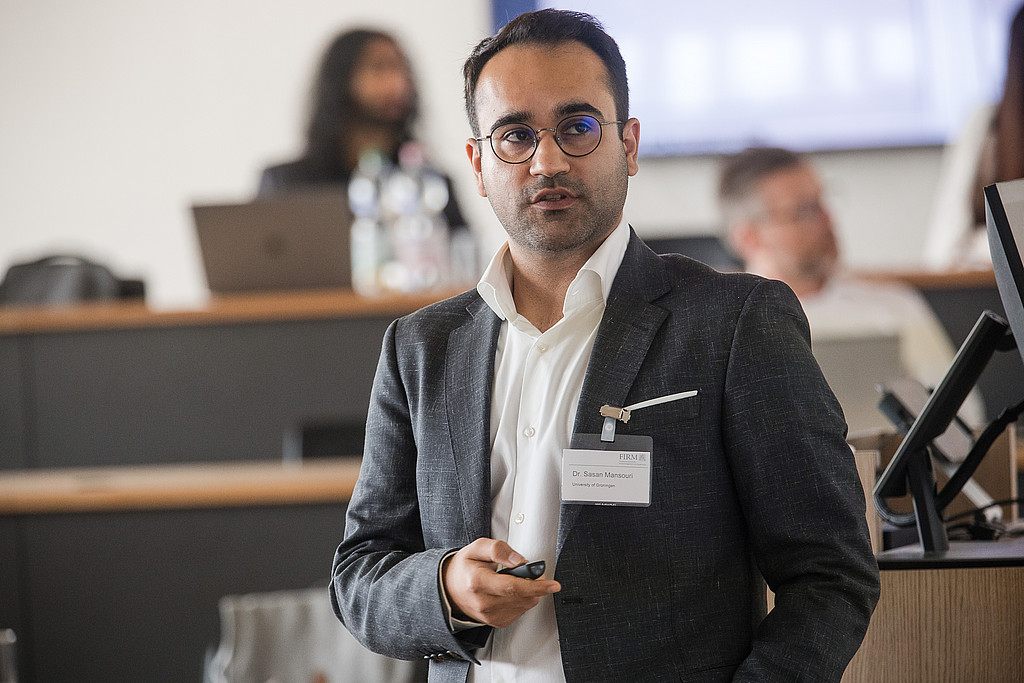
Sasan Mansouri is an Assistant Professor of Digitalization and AI at the Faculty of Economics and Business, University of Groningen , and a Junior Research Affiliate at the Leibniz Institute for Economic Research Halle (IWH) since February 2023. He is also an Affiliated Researcher at the Chair of Banking and Finance, Goethe University Frankfurt . His work integrates financial data science , natural language processing , and entrepreneurial finance to study information transmission dynamics in financial markets. Research Focus : Financial jargon's role in market efficiency, ESG metrics in sustainable entrepreneurship, AI-driven analysis of corporate disclosures, and regulatory impacts on banking. Teaching : Offers courses in Master Data Analytics , Natural Language Processing , and Mergers & Acquisitions , emphasizing AI applications in economics and finance. Entrepreneurial Ventures : Co-founded Very Bad Report (AI financial reporting) and Essence Scholar (AI academic research platform), and previously served as AI Advisor at Dealcode AI (2021-2022). His publications span journals like Management Science , Journal of Business Venturing , and Journal of Economic Behavior & Organization , along with working papers at SSRN and IWH . Current research explores AI's role in reducing information asymmetries and policy impacts on financial markets.
Martin Herles is an Assistant Professor at the Institute for English Business Communication within Vienna University of Economics and Business . Born in 19965, he has been an academic staff member since 1991 after completing his Mag.rer.soc.oec. , Dr.rer.soc.oec. (WU), and Mag.phil. in English and Linguistics (University of Vienna). His educational qualifications include degrees from Vienna University of Economics and Business Administration and University of Vienna. Research interests focus on text linguistics , sociolinguistics , language change , social security , and British cultural studies . He has also explored business communication and academic writing through publications and lectures. Publications trend shows sustained contributions across disciplines: Business communication (2012 monograph on financial terminology) Academic writing (1995-1996 works on language foundations) Educational technology (2001 CALL software analysis) Sociolinguistic analysis (2001 study on language attitudes) Cross-cultural studies (1998 economic hub analysis) Language testing methodologies (1998 translation-based assessment research) Herles actively engages with professional networks and international resources , recommending tools like ForBetterEnglish.com for collocation studies and ICONS Project for British cultural insights. His work spans both theoretical linguistics and practical business applications .
Atsushi Fukada is a Professor at Purdue University, affiliated with the School of Languages and Cultures and the School of Integrative Studies . Holding a Ph.D. in Japanese Linguistics from the University of Illinois at Urbana-Champaign, he specializes in pragmatics, computer-assisted language learning (CALL), and foreign language education. University: Purdue University School: School of Languages and Cultures; School of Integrative Studies Research Focus: Oral fluency assessment tools, CALL curricula, Japanese language pedagogy Research Interests center on applying technology to language education, analyzing speech patterns in L2 learners, and developing standardized oral proficiency metrics. His work explores virtual instructors, timed dictation methods, and longitudinal fluency studies. Recent Publication Trends highlight Computer-Assisted Language Learning innovations, oral fluency analytics via software tools, gamification in language acquisition , and online curriculum frameworks for Japanese and Chinese instruction. Articles span 2013–2023, emphasizing CALL integration and multimodal language practice . Contact: Office at SC G020, email afukada@purdue.edu
Geoffrey G. Pinchbeck is a faculty member at Carleton University’s School of Linguistics and Language Studies. He holds PhDs in Education (Languages and Literacy) and Medical Biochemistry from the University of Calgary, along with an M.Ed in TESL. His career spans teaching, research, and service in applied linguistics and language pedagogy. His research focuses on corpus linguistics , second language acquisition , and academic English . He explores the operationalization of academic English , computer-assisted language learning (CALL) , and content and language integrated learning (CLIL) . His work has implications for vocabulary diagnostic tools and text readability metrics. His refereed publications and conference presentations examine lexical and derivational morphology , word list validation , and mathematics education pedagogy . Recent collaborations highlight interdisciplinary approaches to language assessment and curricular design . Excellence in Graduate Teaching Award, Western University (2017) EuroSLA Doctoral Student Travel Grant (2017) AAAL ‘Educational Testing Services Graduate Student Award’ (2016) Pinchbeck has served as Strand Coordinator for Vocabulary and Lexical Studies at AAAL annual meetings (2020–2021) and contributed to graduate student award committees. His work bridges language research and mathematical pedagogy , emphasizing accessibility and student engagement.
Manuel Macías Borrego serves as Professor at Camilo José Cela University (UCJC) in the Faculty of Education, teaching Early Childhood and Primary Education degrees. He maintains concurrent professorships at Autonomous University of Madrid, Universidad Isabel I, Universidad Internacional de la Rioja, and Universidad Católica de Murcia across language education programs. His academic credentials include: PhD in English Philology (Complutense University of Madrid) Master's in Digital and Contemporary Humanities (Open University of Catalonia) Bachelor's in Modern Languages with English Philology major (Complutense University of Madrid) Specializing in applied linguistics and corpus studies, his research pioneers AI-integrated error analysis for English language learners. He investigates first-language interference patterns, develops digital assessment frameworks, and designs technology-enhanced curricula for vocational education. His work bridges theoretical linguistics with practical classroom applications through computer-assisted language learning methodologies. Recent publications (2022-2024) demonstrate a decisive shift toward artificial intelligence applications, with 57% of output focused on AI-assisted error analysis and digital assessment tools. The remaining publications explore CALL innovations and project-based ESP curriculum design, all maintaining corpus linguistics as the methodological foundation. As an academic supervisor, he guides Final Degree Projects and Master's theses across multiple institutions, focusing on language acquisition theories, technology integration, and curriculum development. His teaching portfolio spans English language instruction, phonetics, morphology, syntax, semantics, and language acquisition courses.
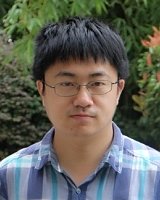
Jifeng Xuan is a Professor and Deputy Dean at the School of Computer Science, Wuhan University, China. He leads the CSTAR (Centre of Software Testing, Analysis and Reliability) research group and has made significant contributions to software engineering, particularly in software testing, debugging, and analysis. Dr. Xuan completed his bachelor's degree and PhD at OSCAR Lab, School of Software, Dalian University of Technology, China, under the supervision of Prof. He Jiang. He also conducted postdoctoral research at SPIRALS Team in INRIA Lille - Nord Europe, France, working with Dr. Martin Monperrus and Prof. Lionel Seinturier. His research focuses on Software Analysis and Testing , with specific interests in software testing and debugging, software data analysis, and search-based software engineering. Dr. Xuan's work bridges theoretical foundations with practical applications, addressing real-world challenges in software quality assurance. His research has led to numerous publications in top-tier software engineering venues and has influenced both academic research and industrial practices. Dr. Xuan's recent publications demonstrate a strong focus on innovative approaches to software testing, debugging, and analysis. His work spans multiple subfields including log analysis, fuzz testing, bug triage, and automated program repair. He has made significant contributions to understanding software crashes, improving bug report quality, and developing techniques for more effective software testing and analysis. 2025 ACM SIGSOFT Distinguished Paper Award 2025 IEEE TCSE Distinguished Paper Award 2024 CCF NASAC Youth Software Innovation Award 2018 ACM SIGSOFT Distinguished Paper Award 2015 Young Talent Development Program of CAST and CCF 2015 Luojia Young Scholar Program of Wuhan University 2014 Outstanding Doctoral Dissertation of CCF Dr. Xuan actively mentors PhD and master's students through his CSTAR research group at Wuhan University. He has served on numerous program committees for major software engineering conferences including ICSE, FSE, ASE, and ISSTA. His editorial service includes roles on the editorial boards of Empirical Software Engineering (EMSE), PLOS One, and Frontiers of Computer Science. Dr. Xuan has also organized several workshops and conferences, demonstrating his leadership in the software engineering community. As founder of CSTAR (Centre of Software Testing, Analysis and Reliability), Dr. Xuan leads a research team focused on advancing the state of the art in software quality assurance. The group's work spans theoretical foundations and practical applications, with strong connections to industry challenges. CSTAR has established collaborations with both domestic and international research institutions, contributing to a vibrant research ecosystem in software engineering.
Tanyasha Yearwood is a Professor in the Department of English Philology at the University of Göttingen's Faculty of Humanities. She holds an active teaching position with responsibilities spanning both the Department of English Philology and the Department of Romance Philology, teaching courses related to language teaching methodology, intercultural learning, and critical cultural awareness. Her primary research interests focus on Computer-Assisted Language Learning (CALL), Blended Learning approaches, and practical implementation of production-oriented learning and teaching methodologies. Yearwood's work particularly emphasizes the integration of technology in language classrooms, with special attention to creating learner-centered environments rather than technology-focused ones. She has extensively explored Activity Theory as a framework for understanding classroom dynamics in technology-enhanced language learning. Her publication record reveals a consistent trajectory in CALL research, with particular focus on how technology can be normalized in classroom settings to serve as complementary rather than central elements in language learning. Her work spans theoretical frameworks like Activity Theory to practical classroom implementations, especially in resource-constrained environments like single-computer classrooms. The evolution of her research shows increasing attention to cultural dimensions of language learning, particularly intercultural competence and critical cultural awareness. Yearwood maintains an active presence in international academic conferences, regularly presenting at major venues including EUROCALL, IATEFL, and specialized CALL conferences. Her teaching portfolio demonstrates comprehensive coverage of language teacher education across multiple semesters, with consistent offerings in research methods for language teaching and practical application of theoretical concepts.
Carrie Demmans Epp is an Assistant Professor in the Department of Computing Science at the University of Alberta, leading the EdTeKLA research group. Her career spans postdoctoral work at the University of Pittsburgh (Learning Research & Development Center and University Center for Teaching and Learning, 2015-2017), assistant director roles at the University of Toronto's TAGlab (2013-2015), and visiting researcher positions at Kwansei Gakuin University and the University of Birmingham (2014). Education: PhD in Computer Science (2016, University of Toronto), MSc in Computer Science (2010, University of Saskatchewan), BSc in Computer Science and Russian (2007, University of Saskatchewan) Research Focus: Educational Technology, Human-Computer Interaction, Artificial Intelligence, and Language Learning (CALL/MALL), with emphasis on learner modeling, open learner models, learning dashboards, and mobile-assisted language learning (MALL) Her research explores adaptive systems like VocabNomad for language learners, PsychOut for nursing education, and PeppeR for collaborative learning environments. She has contributed to understanding student behaviors in MOOCs, discourse health in online courses, and uncertainty visualization in educational data. Scientific Awards include the Walter C. Sumner Memorial Fellowship (2013-2014), Ontario Graduate Scholarship (2012, 2014), W. Garfield Weston Fellowship (2013), and Google Canada Anita Borg Scholarship (2008). 2019: Why and How Think-Alouds with Older Adults Fail (usability testing, aging populations) 2018: PsychOut! - A Mobile App (medical education tools) 2017: Talk with Me (discourse analysis in online courses) Teaching & Projects : She developed iHelp Discussions for linguistic analysis, Recollect for lecture capture, and ProTutor for Russian pronunciation support. Her work bridges formal and informal learning environments, addressing barriers in migrant education (2017) and synchronized swimming coaching (non-academic engagement).
Dr. Md Shahinur Alam is an Assistant Professor in the Department of Computer Science & Information Technology at Hood College, where he teaches both undergraduate and graduate courses. Previously, he served as a Postdoctoral Researcher at the VL2 Center at Gallaudet University and in the Optical Information Lab at Chungbuk National University in South Korea. Dr. Alam's educational background includes: Ph.D. in Information & Communication Engineering from Chungbuk National University, South Korea B.Sc. in Computer Science & Engineering from Jashore University of Science & Technology, Bangladesh His research focuses on innovative applications at the intersection of human-computer interaction, artificial intelligence, and virtual reality. Dr. Alam has pioneered several groundbreaking technologies including air-writing systems that replace traditional pen-and-paper input, a VR-based ASL learning platform called ASL Champ!, and image super-resolution techniques that advance optical microscopy eightfold beyond conventional physical limits. His work bridges theoretical advancements with practical applications in education, accessibility, and scientific visualization. Dr. Alam has received multiple prestigious awards for his research contributions: Best Demo Award at XR ACCESS 2024 Best Paper Award at COOC 2021 Best Paper Award at CRC 2019 As an active member of the academic community, Dr. Alam has served as a reviewer for over 30 academic journals, evaluating more than 150 research papers. He leads the NSF-funded Signing Avatars & Immersive Learning (SAIL 2.0) project, which develops innovative VR technology for American Sign Language education. His research has resulted in over 40 peer-reviewed publications and has accumulated more than 150 citations. Dr. Alam's work spans multiple interdisciplinary research areas, with particular emphasis on developing accessible technologies. His ASL Champ! project combines 3D avatar design, motion capture, and AI model development to create an immersive learning environment. His air-writing technology offers touchless input methods applicable in augmented reality, virtual reality, and healthcare settings. The research team he leads continues to push boundaries in gesture recognition, virtual reality interfaces, and image enhancement technologies.