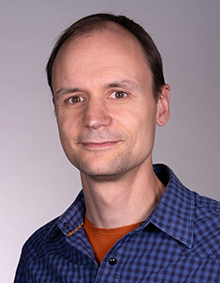
Stéphane Danjou is a Professor in Mechanical and Plant Engineering at the Faculty of Technology and Bionics, Rhine-Waal University of Applied Sciences, Kleve Campus. His research focuses on computer-integrated product development, additive manufacturing (3D printing), and interdisciplinary cross-company methodologies. Education: Technical draftsman apprenticeship at Siemens AG Power Generation; Mechanical Engineering degree with specialization in design engineering from University of Duisburg-Essen (formerly Gerhard Mercator University of Duisburg). Research: Develops methods for integrating product- and process-specific knowledge into development cycles, collaborating with industry partners and faculty members from other disciplines. Key Responsibilities: Teaches and conducts application-oriented research in 3D CAD, product/service development, and fundamentals of process engineering since 2015.
Prof. Dr.-Ing. Andreas Fritz is a faculty member at Esslingen University of Applied Sciences , affiliated with the School of Mechanical and Systems Engineering. His expertise spans multiple domains, including Engineering Mechanics, Computer-Aided Design (CAD), Applied Computer Science, and Reliability Engineering. Research Interests: His work focuses on technical drawing methodologies, mechanical design optimization, and the integration of CAD systems in engineering education. He contributes to interdisciplinary studies at the intersection of systems engineering and applied computing. Publications: A co-author of the 38th edition of Technisches Zeichnen (Technical Drawing, 2022), a foundational resource in engineering graphics and design principles. Contact: Email: andreas.fritz@hs-esslingen.de Office: Room S 05.104, Campus Esslingen Stadtmitte Address: Kanalstraße 33, 73728 Esslingen, Germany
Evelyn Bass is a Professor at the Hamburg University of Applied Sciences, affiliated with the Faculty of Design, Media and Information. She specializes in CAD pattern design and 3D simulation for fashion, with a focus on integrating digital tools into traditional garment modeling techniques. Teaching areas: CAD pattern design, 3D garment simulation Committee membership: MoKoTex Examination Committee Her research interests center on digital transformation in fashion design, leveraging software like CLO 3D to bridge classical pattern development with virtual prototyping.
Prof. Dr. Michael Wendland is a faculty member in the Department of Mechanical Engineering at the Westphalian University of Applied Sciences since March 2020. His research focuses on methodical product development, AI-based CAD design, additive manufacturing, and dependability engineering. Education: Research in digital teaching methods, modern collaboration forms, and AI applications in product development. His teaching areas include Computer-Aided Design , Product Development , Reliability of Technical Products , and Technical Project Management . He has led research on structural optimization for mechanical components, rapid prototyping, and sustainable product development. Recent publications highlight trends in AI-driven CAD design, blended learning assessment methods, and gamification in engineering education. His work also explores inverse functional modeling for reliability and heterogeneous modeling for product concepts. Prof. Wendland serves as PAV deputy, responsible for recognition and university transfers, emphasizing digital workflows via PDF submissions.
Dr.-Ing. Sebastian Bosse heads the Interactive & Cognitive Systems research group at Fraunhofer HHI in Berlin, Germany. His work integrates computational perception and cognition with machine learning and human-machine interaction , addressing applications in multimedia , augmented reality , medicine , agriculture , and industrial production . Research Interests include: Computational Perception & Cognition Machine Learning for Computer Vision Human-Machine Interaction in immersive environments AI-Driven Quality Assessment Neurophysiological Response Analysis Multi-View Gesture Recognition Recent Articles focus on multi-view coding , VR/AR applications , deepfake detection , agricultural AI , and neural quality metrics . Key collaborations span surgical robotics , explosive ordnance exploration , and agricultural phenotyping . Labs & Teams : Leads the Interactive & Cognitive Systems group at Fraunhofer HHI, specializing in pose/gesture analysis , contact-free interaction , and image quality estimation using subjective testing and neurophysiological data .
Lisa Anthony is a Professor affiliated with the University of Florida, specializing in Human-Computer Interaction (HCI) with a strong focus on gesture recognition, touchscreen interfaces, and child-computer interaction. Her research emphasizes the design of user-centered technologies for diverse populations, including children, older adults, and individuals with disabilities. Key contributions include studies on children's touchscreen interaction patterns, multimodal authentication systems, and mHealth applications for behavior change. Her work spans over two decades, with publications in top-tier venues such as CHI, ICMI, and IEEE Transactions. Notable projects include the MTAGIC initiative exploring child motion characteristics, the design of MyTrack+ for weight management, and studies on spherical interfaces. She collaborates extensively with researchers in computer science, education, and healthcare to address real-world challenges in technology accessibility and usability. Lisa's research has implications for improving educational tools, healthcare apps, and collaborative learning environments. While no grants or awards are explicitly listed, her prolific publication record underscores her sustained contributions to HCI and related fields.
Matthew Campbell is a Professor at the School of Mechanical, Industrial, and Manufacturing Engineering at Oregon State University. He holds the title of Hans Fischer Senior Fellow at the Technical University of Munich (TUM) Institute for Advanced Study (TUM-IAS). His academic journey includes a PhD from Carnegie Mellon University (2000) and prior roles as an Associate Professor at the University of Texas at Austin. Education: BSc and MSc in Mechanical Engineering from Carnegie Mellon (1995-1997), PhD in Mechanical Engineering (2000). He founded the Automated Design Lab at UT Austin and specializes in computational design tools that integrate engineering, computer science, and cognitive psychology to enhance design efficiency and quality. Research focuses on automated design synthesis, topology optimization, and human-computer collaborative systems. His work bridges algorithmic innovation with practical engineering applications, emphasizing multi-physics computational platforms and generative design methods. Awards include the NSF CAREER Award (2005) and multiple best paper awards in engineering design and computational methods. His publications span design automation, optimization, and interdisciplinary methodologies. Key contributions include the CDS platform for multi-physics design synthesis and foundational work on automated concept generation. Current projects involve integrating qualitative/quantitative data in experimental design and advancing fluid channel topology optimization.
Sofiène Tahar is a Professor at Concordia University's Department of Electrical and Computer Engineering, affiliated with the Faculty of Engineering and Computer Science. His research focuses on formal verification, theorem proving, and their applications in cyber-physical systems, circuit design, and reliability engineering. He has authored over 300 publications in top-tier conferences and journals, including DATE, ICFEM, and FMCAD. Key research areas include formal methods for analog/digital circuits, approximate computing, stochastic systems, and safety-critical systems. His work bridges theoretical foundations (e.g., theorem proving in HOL) with practical engineering problems like circuit reliability and autonomous systems verification. Recent projects involve formal analysis of vehicular systems, energy-efficient approximators, and machine learning integration with formal verification frameworks. Tahar collaborates extensively with industry partners and holds leadership roles in international conferences, including co-chairing ICFEM 2023.
Dr. Robert Fischbach is a researcher at the Institute of Micro and Electronic Systems (FET) at Dresden University of Technology. His work focuses on 3D integration, heterogeneous system design, layout verification, and thermal analysis of advanced electronic packaging solutions. Key research areas: 3D Integrated Circuits Thermal and Reliability Engineering Design Automation & Optimization Interposer-Based Systems He has contributed extensively to co-design methodologies, micro-transfer printing assembly, and XML/XSLT-based simulation frameworks. Collaborative work includes automotive mission profiles and standardized formats for electronics reliability. Notable publications span topics in layout verification, thermal modeling, and heterogeneous packaging. His collaborations include researchers like J. Lienig, A. Krinke, and T. Horst.
Simon Gehring is an Academic Staff Member for 3D – CAD at the Central Facilities of Karlsruhe University of Arts and Design (HfG Karlsruhe). His role focuses on supporting academic activities related to computer-aided design and digital production tools. Institution: Karlsruhe University of Arts and Design (HfG Karlsruhe) Department: Central Facilities Role: Academic Staff Member for 3D – CAD Contact: sgehring@hfg-karlsruhe.de His research interests include Computer-Aided Design , 3D Modeling , and Digital Design Tools , aligning with the institution's mission to integrate traditional arts with media technology. No specific scientific awards, publications, or student advising details were mentioned in the provided texts.
Raquele Giovana Conti serves as a Lecturer in the Department of Civil Engineering at Stuttgart University of Applied Sciences, specializing in instructional delivery for Technical Drawing and CAD coursework. Her academic focus centers on applied engineering disciplines with emphasis on Computer-Aided Design methodologies and precision technical drafting within civil infrastructure contexts. These competencies form the core of her pedagogical contributions to engineering education. No scientific awards or honors are documented in the available institutional records. Information regarding graduate student mentorship, research funding allocations, or grant administration responsibilities remains unspecified in current faculty profiles. The institutional documentation provides no details about laboratory facilities, research consortia, or collaborative project teams associated with her academic activities.
Prof. Dr.-Ing. Thomas Rauscher is a Professor in the Department of Engineering Mathematics and Construction Informatics at Bremen University of Applied Sciences. He serves as speaker of the committee for the Fachbereichstag Bau- und Umweltingenieurwesen (FBT-BaU), representing 44 civil and environmental engineering faculties across German universities of applied sciences with approximately 900 professors and 47,000 students. His work focuses on integrating mathematical and computational methods into civil engineering education through module-structured, problem-oriented teaching approaches. His research spans construction informatics—an interdisciplinary field examining construction information's nature, functionality, and data representation—with emphasis on visualization, calculation, and simulation systems. Key focus areas include: Engineering Mathematics Construction Informatics Numerical Methods in Civil Engineering Building Information Modeling (BIM) Computer-Aided Design (CAD) Civil Engineering Software Prof. Rauscher pioneered a virtual computer pool enabling location- and time-independent access to construction software for students and faculty. He teaches core courses including Engineering Mathematics and Construction Informatics (IMBI), Numerical Methods in Civil Engineering (NUMB), and Experiment, Model and Simulation (EMSI), covering linear algebra, differential equations, finite element methods, and technical infrastructure simulation.
Prof. Dr.-Ing. Stephan Eder holds the position of Professor of Engineering Mechanics and Design (CAD/CAE) at the Technische Hochschule Bingen, affiliated with Department 1. His expertise centers on advanced design methodologies, computational engineering tools, and mechanical systems analysis. Research interests include the integration of CAD/CAE technologies in engineering education and industry applications, with a focus on optimizing design processes through computational methods. He contributes to the Hermann Hoepke Institute's collaborative projects, advancing engineering innovation. No specific academic awards or grants are explicitly listed in the text. His involvement in curriculum development is implied through his association with programs like Mechanical Engineering B.Eng. and Green Engineering. Currently active in teaching and research, Prof. Eder's role emphasizes bridging theoretical engineering principles with practical design applications through modern software tools.
Wolfgang Oertel serves as Professor of Computer Graphics at Dresden University of Applied Sciences (HTW Dresden) within the Faculty of Informatics and Mathematics. He has held significant leadership roles including Dean of Studies (2009-2012) and Dean (2012-2015) for his faculty, and coordinated international university partnerships (2007-2011). His academic career spans over four decades with appointments at TU Dresden (1984-1998), FhG/IVI Dresden (1999-2004), and TUBA Freiberg (visiting positions in 1998-1999 and 2004-2005). Professor Oertel's research spans computer graphics, computer vision, virtual reality, and artificial intelligence with emphasis on practical applications. His work integrates knowledge representation with visual systems, focusing on spatiotemporal modeling, scientific-technological visualization, and CAD-oriented IT systems. Current projects include the Saxony5 Co-Creation Lab for Artificial Intelligence (2021) and systems for image data processing in scientific infrastructure (SEVVBWG series 2020-2023). His publication trends reveal consistent evolution from database/knowledge processing (1980s-1990s) to computer vision applications (2000s) and sophisticated AI-integrated visualization systems (2010s-present). Recent work focuses on heterogeneous traffic data visualization, knowledge-based graphic object synthesis, and conceptual frameworks bridging AI with virtual reality. Key technical domains include VRML/X3D, OpenCV, VTK, and specialized hardware integration. Award for integrated data processing (Integrata AG Tübingen, 1995) Oertel actively supervises graduate works and leads multiple research projects including Saxony5CCLKI (2021), SEVVBWG2 (2023), and GWMSV traffic simulation (2021). His laboratory maintains extensive equipment including stereo displays, 3D cameras, microscopes, VR headsets, and robotic platforms supporting research in virtual intelligent environments. Current teaching includes Computer Graphics I/II, CAD systems, and Computer Vision courses across multiple informatics programs.
Prof. Dr. Marcel Sebastian Seiler is affiliated with the Westfälische Hochschule , serving as Head of the Mechatronics and Mechanical Engineering departments at the College of Engineering. He has been at the university since March 2020, following a career in academia and industry. Research Focus : Structural optimization, CAD/FEM/CFD modeling, steam turbines, and lightweight construction. Education : Thesis on geometric constraints in structural optimization of machine components (RWTH Aachen, 2013). Teaching : Courses include Machine Elements (MEL), Mechanical Drives (MEA), Nonlinear FEM (NFE), and Additive Manufacturing (GAF). Publications : Recent work explores surrogate modeling for turbine casing analysis and additive manufacturing in energy technology.