Dr. Damiano Varagnolo is a Senior Lecturer at the Control Engineering Group, Luleå University of Technology, Sweden. His research focuses on distributed optimization, control systems for data centers and HVAC, and biomedical engineering applications. Current affiliation: Luleå University of Technology Primary research areas: Distributed optimization, Newton-Raphson Consensus methods, networked systems, energy-efficient control Selected applications: Smart building systems, biomedical modeling of pain responses, data center thermal management His work on distributed optimization explores asynchronous protocols and robustness in networked systems. Recent publications demonstrate applications in peer-to-peer networks, biomedical engineering, and energy-efficient computing infrastructure. Key collaborative projects include IEEE Transactions publications on data center cooling, European Control Conference contributions on sensor calibration, and IFAC symposium presentations on biomedical modeling. His distributed Gaussian regression methods appear in TPAMI publications.
Gillian Isoardi is a researcher affiliated with the School of Architecture and Built Environment at Queensland University of Technology (QUT) . Her work focuses on daylighting systems , lighting design , and visual comfort analysis in architectural environments. Her research spans energy-efficient lighting strategies , discomfort glare prediction , and dynamic luminance modeling , particularly in tropical and subtropical climates. She has developed innovative frameworks for post-occupancy lighting evaluation and multi-region contrast analysis using high dynamic range imaging. Recent publications highlight her contributions to complex fenestration systems , public stairway illumination , and LED integration with daylight for office comfort. Collaborative projects with Veronica Garcia Hansen and Michael Hirning demonstrate her interdisciplinary approach to building performance simulation.
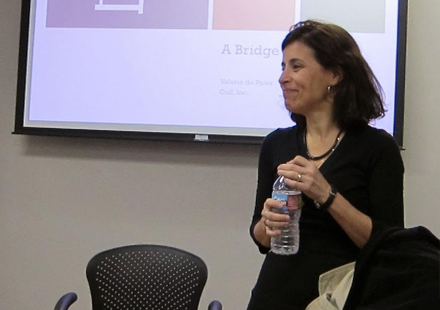
Valeria de Paiva is a mathematician and AI research scientist, currently serving as Founder of the Topos Institute in Berkeley where she explores the deep connections between mathematics, logic, and computation. She earned her PhD under the supervision of Martin Hyland, working on Dialectica categories, which established her foundational work connecting linear logic with Gödel's Dialectica interpretation. Dr. de Paiva's research spans category theory, programming languages, type theories, and logic in computer science, with special emphasis on the semantics of natural language and lexical semantics. She has pioneered work in linear and modal logics and their applications to mathematics, particularly in building tools to extract, structure, and reason about mathematical knowledge. Her research bridges symbolic/structural and distributional meaning representations through knowledge graphs, ontologies, and computational frameworks. Her recent publications reveal a strong trend toward mathematical concept extraction and natural language processing for mathematical texts. She has developed innovative approaches like MathGloss for building mathematical glossaries and Parmesan for educational concept extraction, demonstrating how theoretical foundations in category theory can solve practical problems in knowledge representation and education. Among her notable recognitions is the unofficial title of 'Ambassador of Logic,' awarded after she was invited by the Division of Logic, Methodology, and Philosophy of Science and Technology to record a video on logic. She has served as council member of this division from 2020-2023. Dr. de Paiva is deeply committed to mentoring and supporting women in logic and computer science. She has mentored 12 PhD students and postdocs at the Applied Category Theory MRC 2022. She co-founded and maintains the Women in Logic website, blog, and Facebook group, serves on the steering committee for Women in Logic, and helps organize the Workshop on Women in Logic, which has held nine editions as of the latest information. She also contributes to the ACM-W Scholarship Program supporting women students in computing worldwide. She is actively involved in numerous academic initiatives including serving as co-chair for CICM 2025 and MFPS 2024, and as scientific committee member for CT2025. She co-founded groups including Women in Logic, Lógicas Brasileiras, and the Women in Logic Workshop, and has organized numerous international conferences and workshops focused on logic, category theory, and computational semantics.
Dr. Kereshmeh Afsari is an Assistant Professor of Construction Engineering and Management at Virginia Tech's Myers-Lawson School of Construction (College of Engineering). She leads the ARCADE Lab, focusing on automation, robotics, and emerging technologies in construction. Her research emphasizes human-robot collaboration, inspection automation, and BIM integration. Prior to Virginia Tech, she held a joint appointment at Purdue University in Construction Management Technology and Computer Graphics Technology. Education: Ph.D. in Architecture (Design Computation), Georgia Institute of Technology M.S. in Digital Architectural Design, Salford University, UK B.S./M.S. in Architectural Engineering, Iran University of Science and Technology Research Interests: Dr. Afsari pioneers innovations in construction robotics, IoT, 3D printing, and BIM interoperability. She explores how autonomous systems can enhance safety, efficiency, and decision-making in construction through projects like quadruped robots for inspection and cloud-based BIM collaboration. Labs & Projects: As founder of the ARCADE Lab, she oversees interdisciplinary projects in next-gen construction tech, including cyber-physical systems for progress monitoring and human-robot teaming solutions.
Kazimierz Butelski is an Associate Professor at the Department of Workplace Architecture, Sport and Services within the Faculty of Architecture at Cracow University of Technology. His work spans architecture, urban planning, and sustainable design, with a focus on public spaces, cultural architecture, and extreme environments. He has contributed extensively to research on historical preservation, computer modeling in architecture, and international collaborations in design. Primary Affiliation: Cracow University of Technology Research Themes: Sustainable neighborhoods, cultural buildings, desert architecture, and urban development under historical constraints. International Scope: Comparative studies between Polish and Chilean architectural practices, Lebanese contemporary architecture, and global design trends. His publications highlight a commitment to integrating technology (virtual reality, computer modeling) with traditional architectural principles. Collaborations with researchers like Marta Łukasik, Janusz Purski, and Stanisław Jan Butelski demonstrate interdisciplinary and cross-border academic engagement.
John P. Shewchuk is an Associate Professor and Associate Department Head in the Grado Department of Industrial and Systems Engineering at Virginia Tech. His research focuses on manufacturing systems engineering, including green production systems, lean manufacturing, and circular manufacturing. He holds a B.Sc. in Mechanical Engineering from the University of Manitoba (1984) and a Ph.D. in Industrial Engineering from Purdue University (1995). Shewchuk has received notable awards such as the 2011 Lean Teaching Award from the Institute of Industrial Engineers and recognition for his doctoral dissertation. His work emphasizes integrating environmental considerations into manufacturing processes and improving production efficiency through lean methodologies. He teaches courses like ISE 4214 (Lean Manufacturing) and ISE 3024 (Data Management for Industrial Engineers). Research Highlights: Green Production Systems, Hybrid Manufacturing, Circular Supply Chains Professional Service: Reviewer for International Journal of Production Research , Production Planning and Control , and others Key Contributions: Development of ergonomics-focused decision support systems for residential construction Shewchuk's career includes industry experience as a manufacturing engineer before academia and has maintained collaborations on occupational safety research with the CDC.
Darcy Copeland serves as Professor and PhD in Nursing Education Program Coordinator at the School of Nursing, College of Natural and Health Sciences, University of Northern Colorado. Her role encompasses academic leadership in nursing education and research focused on critical healthcare challenges. Her educational foundation includes: PhD in Nursing, University of California, Los Angeles MS in Forensic Nursing, Fitchburg State College BSN/BA in Psychology, University of Northern Colorado Dr. Copeland's research examines families impacted by mental health and violence, academic-clinical partnerships, nursing workforce dynamics, and healthcare-law intersections. Her work addresses systemic issues like workplace violence against nurses, ethical dilemmas in high-stress environments, and vulnerability of marginalized populations including transgender elders and mentally ill individuals. She investigates stigmatization mechanisms and historical ethical failures to inform contemporary nursing practice. Analysis of her 2021-2025 publications reveals three dominant trajectories: 1) Workplace violence prevention through linguistic analysis and risk tolerance frameworks, 2) Ethical evolution studies connecting historical atrocities to modern nursing accountability, and 3) Vulnerability modeling for populations at intersectional risk. Her scholarship consistently bridges forensic nursing, mental health, and ethical decision-making with practical interventions like Code Lavender emotional support systems. While specific awards aren't documented in source materials, her research directly informs nursing safety protocols, ethics education, and trauma-informed care models. Dr. Copeland's program coordination role indicates significant mentorship responsibilities for graduate nursing students, though specific advisees aren't listed. Her work demonstrates strong clinical-academic partnerships addressing workforce retention and psychological safety.
Marlene Dixon is a Professor and Department Head of the Department of Kinesiology and Sport Management at Texas A&M University's College of Education and Human Development. Her research focuses on work-life balance in sport professions, gender equity in coaching, and sport-for-development initiatives. She has led numerous funded research projects including the Highway of Hope Basketball Program (2018-2019) and a study on role management among student-athletes (2018-2019). Her academic contributions include over 50 peer-reviewed publications addressing topics such as women's empowerment through sport participation, organizational capacity in NCAA athletics, and the interface between sport and community development. Dr. Dixon served as President of the National Association of Sports Management (2014) and currently holds an associate editorship at the Journal of Sport Management. Her teaching portfolio includes courses like FINC SPORT OPERATIONS, PERSONNEL MGMT IN SPORT, and DIRECTED STUDIES. She has advised two doctoral students and contributed to curriculum development emphasizing sport industry leadership and ethical management practices. Notable research initiatives include the AMOS Sport Business School-funded US Sport and Culture Program (2017-2018) and a $30k Catapult-funded study on Sport-For-Development in developing nations (2016-2018). Her work often bridges theoretical frameworks with practical applications in sport governance and community engagement.
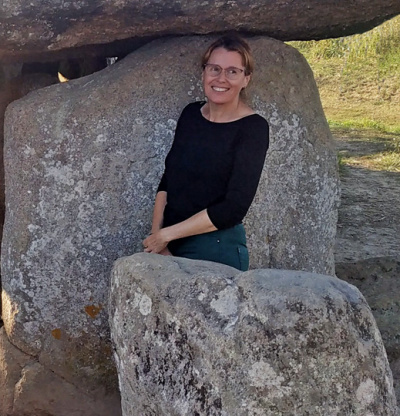
Dr. Tara Steimer is a Lecturer and researcher in Prehistoric Archaeology at the University of Geneva's Laboratory of Prehistoric Archaeology and Anthropology. Her work focuses on megalithic societies in the Near East (-3600 to -2000 BCE) and Asia, applying ethnographic models from Indonesian megalithic cultures to prehistoric studies. She has directed projects in Lebanon (MEG-A Mission), Jordan (Dolmen Project in Irbid), and Indonesia, emphasizing the social structures and cultural landscapes of ancient and modern megalithic communities. Key roles include Co-Director of the MEG-A Mission (2022-2025) and Director of the Wadi Fazaa Mission (2021-2023), funded by Swiss and international institutions. Her research spans archaeology, ethnoarchaeology, and cultural heritage preservation. Notable activities include curating the exhibition Mégalithes d'ici, Mégalithes d'ailleurs (2020) and developing tourist circuits in Menjez, Lebanon. She has secured grants from the Swiss National Science Foundation, the University of Geneva, and the Kuwaiti Department of Museums. Current projects include investigating the mechanisms behind megalithic monument appearance/disappearance and Levantine megalithic building techniques using photogrammetry. Steimer collaborates with global institutions like the Polish Academy of Sciences and the University of Edinburgh. Her work bridges prehistoric and modern contexts, emphasizing interdisciplinary approaches to understanding monumentality's role in societal memory and identity.
Glenn Morrison, PhD, is a Professor in the Department of Environmental Sciences and Engineering at the University of North Carolina's Gillings School of Global Public Health. His research focuses on chemical and transport phenomena in indoor environments, particularly regarding human exposure to pollutants and ozone surface chemistry. He has led studies on dermal uptake of indoor pollutants, sensor development, and pollutant movement in buildings. Education: PhD in Environmental Engineering from UC Berkeley (1999), MS from UC Berkeley (1995), and BS in Chemical Engineering from UC San Diego (1988). Research Interests: Morrison investigates indoor air quality, including SVOCs, ozone reactions with human surfaces, and exposure implications of indoor chemistry. His work emphasizes practical interventions like clothing interventions to reduce transdermal uptake of pollutants. Awarded the National Academies' Indoor Chemistry report contribution (2022). Served as ISIAQ President (2014-2016) and holds a 2011 ISIAQ Fellowship. Recipient of teaching awards from Missouri University of Science & Technology (2016). Key Projects: Includes the CASA study on indoor chemical processes and IPA campaign assessing PFAS in homes.
Athanasiou Tzempelikos is a Professor of Civil Engineering and holds a courtesy appointment as Professor of Mechanical Engineering at Purdue University's College of Engineering. His research focuses on high-performance building design, daylighting systems, thermal comfort, and energy efficiency. He leads studies on dynamic facade systems, indoor environmental quality, and building simulation methodologies. His work integrates advanced technologies like deep learning and Bayesian methods to optimize building performance. Key areas include glare control, occupant preference modeling, and energy-saving strategies for commercial and educational buildings. He has developed novel tools for luminance mapping, thermal preference inference, and smart control frameworks. Research interests also encompass material science for building components and sustainable design. His publications span over a decade of innovation in building energy systems, shading technologies, and occupant-centric design principles. Collaborations bridge engineering, architecture, and data science to address global challenges in energy efficiency and indoor environmental quality.
Dr Tehyun Ma is a Lecturer in International History at the University of Sheffield's School of History, Philosophy and Digital Humanities. Holding a BA from the University of Pennsylvania and a PhD from the University of Bristol, they completed postdoctoral research at Oxford's 'China's War with Japan' project. Their research focuses on 20th-century Chinese and Taiwanese state-building, particularly under the Guomindang regime, and explores transnational social policy influences during wartime. Key research areas include Cold War-era Taiwan's nation-building under American sponsorship, the intersection of propaganda and state legitimacy, and the adaptation of international social welfare models like the Beveridge Report in Republican China. They also investigate imperial governance legacies in China up to 1949. Teaching includes undergraduate courses on 20th-century global history, China's modern trajectory, and comparative revolutions, as well as postgraduate modules on the Japanese Empire. Professional activities include radio appearances, Chinese TV contributions, and public engagement projects in Chongqing and the UK.
Prof. Theo A. Arentze is Full Professor of Real Estate and Urban Systems at Eindhoven University of Technology, where he chairs the Real Estate Management and Development group. His research develops models of spatial choice behavior and decision support systems for urban environments. Research focuses on: Urban systems modeling and simulation Spatial choice behavior analysis Real estate management strategies Circular economy transitions Hybrid work environment design Recent publications examine: Hybrid workplace preferences and decisions Health impacts of energy-efficient housing Knowledge transfer in service organizations Stakeholder engagement in circular economy Urban restructuring through digital twins Honors include the EuroFM Best Paper Award (2017), Healthy Buildings Europe Long Paper of Distinction (2021), and Pyke Johnson Award (2016). He leads projects on energy transition in built environments and circular business ecosystems. Prof. Arentze's team develops computational models to analyze how built environments influence human behavior and wellbeing.
Allison Jean Carnegie is a Professor of Political Science at Columbia University, serving as Director of Graduate Studies and Director of the PaGE Lab. With a joint PhD from Yale University (2014) in political science and economics, her research focuses on international relations, political economy, and global governance. Co-authored Secrets in Global Governance (2020) with Austin Carson Authored Power Plays (2015) on coercive diplomacy Published in top journals including American Political Science Review and Foreign Affairs Her work examines populism's impact on international institutions, trade dynamics under authoritarian regimes, and the strategic use of secrecy in global governance. Key findings include: Information suppression challenges institutional effectiveness Populist governments reshape multilateral engagement Secrecy can enhance cooperation in sensitive domains Scientific Awards: David A. Lake Award (2019) Robert O. Keohane Award (2018) Next Horizons Essay Contest Winner (2014) Current research explores AI governance frameworks, with grants from the Bill & Melinda Gates Foundation and ongoing projects about economic sanctions and geopolitical stability.
Rishee Jain is Associate Professor of Civil and Environmental Engineering at Stanford University. His research develops data-driven solutions for urban sustainability challenges at the intersection of civil engineering, data science, and social science. The Stanford Urban Informatics Lab focuses on: (1) Socio-spatial dynamics of commercial building energy use, (2) Data-driven urban building benchmarking, (3) Sustainability planning in built environments, (4) Coupled urban system dynamics using machine learning. Recent projects analyze agricultural expansion impacts on biodiversity and economic valuation in forest-agriculture landscapes. Publications demonstrate a strong focus on urban building energy modeling (UBEM), machine learning applications for sustainability, occupant behavior analytics, and equity dimensions of energy systems. Recent work increasingly incorporates generative AI, wearable sensors, and spatial justice frameworks.