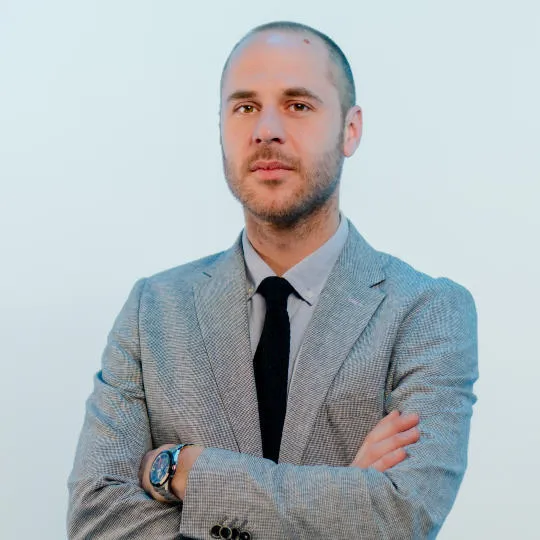
Deian Stefan is an Associate Professor at the University of California San Diego (UCSD) in the Department of Computer Science and Engineering . His research spans security , programming languages , and systems , with a focus on building principled and practical secure systems. He has served as a co-founder and Chief Scientist at Intrinsic (acquired by VMWare) and contributed to standards bodies like the W3C WebAppSec and Node.js Security Working Groups . His research interests include: Secure Systems : Web frameworks, browser designs, sandboxing, runtime systems Language-Based Security : Constant-time programming, memory safety, information flow control Verification : Security verification, static/symbolic analysis tools WebAssembly and JavaScript JITs security Deian Stefan has received multiple scientific awards , including several Distinguished Paper Awards at venues like POPL, ICFP, and USENIX Security, as well as the IEEE Cybersecurity Award for Practice (2022) and CSAW 2020 First Place for Applied Research. He has taught courses on Computer Security (CSE 127, CSE 227) and advanced topics in Building Secure Systems (CSE 291) using Rust, WebAssembly, and blockchain security. His work has been supported by collaborations with industry and academia, including projects like RLBox and COWL .
Sean Foley is a Professor of Applied Finance at Macquarie University, specializing in Fintech, Cryptocurrencies, Trading, and Market Design. He leads the Decentralized Assets division at the Digital Finance Cooperative Research Centre (DFCRC), bridging academia, industry, and government. His research focuses on blockchain applications like automated market makers, DeFi protocols, and stablecoins. Education: PhD in Finance from the University of Sydney (2014), focusing on 'The Impact of Regulation on Market Quality'. Research Interests: Decentralized finance (DeFi) systems Cryptocurrency market dynamics and regulation Market microstructure and liquidity provision Energy market crises and policy Regulatory frameworks for financial markets Key Projects: Leading the DFCRC's Industrial PhD Scholarships (2021–2031), mentoring students like Arvind Rangarajan and Juuso Artturi Itkonen. Research on Australia's National Electricity Market (NEM) suspension and energy policy. Awards: Best Paper Award at the Cryptocurrency Conference (2019) Philip Brown Prize for Best Australian Paper (2021) Exceptional Research Prize (2019) Advising & Grants: Supervised over 10 PhD students through DFCRC scholarships. Secured $181 million for the Digital Finance CRC. Lead applicant in the Gunns Ltd shareholder class action. Labs/Teams: Head of Decentralized Assets at DFCRC, collaborating on policy and technology. Co-researcher on 'Electricity Markets in Crisis' and cryptocurrency illicit use studies.
Noorbakhsh Amiri Golilarz is an Assistant Professor in the Department of Computer Science at The University of Alabama, College of Engineering. He has established himself as a prominent researcher in artificial intelligence, particularly in computer vision, deep learning, and image processing. His educational background includes: Postdoctoral Research Fellow, Computer Science, Boston College (2023) Ph.D., Electrical and Computer Engineering, Southern Illinois University Carbondale (2023) D. Eng., Computer Science and Technology, University of Electronic Science and Technology of China (2021) M.S., Electrical and Electronic Engineering, Eastern Mediterranean University (2017) B.S., Electrical Engineering, University of Guilan (2012) Dr. Golilarz's research spans multiple domains of artificial intelligence with a particular focus on computer vision, deep learning, and image processing applications. His work addresses challenges in medical imaging, satellite imagery, and cognitive neuroscience. He has made significant contributions to image denoising techniques, control chart pattern recognition, and AI applications in healthcare. His recent work has expanded into generative AI, large language models, and secure machine learning operations. His publication portfolio demonstrates consistent productivity with over 2500 citations and an h-index of 25. His most impactful work includes applications of blockchain and federated learning for COVID-19 detection, optimized support vector machines for medical diagnosis, and innovative image denoising techniques using metaheuristic optimization algorithms. Among his professional achievements: Co-founded AI Letters journal in 2024, serving as Associate Editor-in-Chief Served as Lead Guest Editor and Topic Editor for several SCI-indexed journals Held the role of Conference Program Chair Dr. Golilarz has supervised numerous graduate students and research projects, with his work spanning theoretical advancements in AI algorithms to practical applications in healthcare, energy systems, and cybersecurity. His research group has established collaborations with institutions including Boston College and Mississippi State University.
Ben Fisch is an Assistant Professor of Computer Science at Yale University's School of Engineering & Applied Science. He is also the co-founder of Espresso Systems, a company focused on blockchain infrastructure. His research focuses on privacy and verifiability in decentralized systems like Bitcoin and Ethereum, with applications in digital finance and healthcare. Dr. Fisch received his B.A. from the University of Pennsylvania and completed his Ph.D. at Stanford University, where he worked with Dan Boneh in the applied cryptography research group. His educational background provided the foundation for his work at the intersection of cryptography, distributed systems, and economics. His research centers on leveraging cryptographic tools such as succinct non-interactive zero-knowledge proofs (zk-SNARKs), private information retrieval, and homomorphic encryption to address challenges in verifiable computation, verifiable storage, and verifiable fairness. He has made significant contributions to verifiable delay functions (VDFs) and proofs of replication, which have been adopted by major blockchain projects including Ethereum 2.0, Chia, and Filecoin. His work on Filecoin's Proofs of Replication has helped the network reach over 1.5 exabytes of storage capacity. His publication record shows a clear trend toward increasingly sophisticated cryptographic protocols for blockchain applications, with recent work focusing on data availability for Bitcoin rollups, efficient folding schemes for pairing-based arguments, and privacy pools with proof-carrying disclosures. His research bridges theoretical cryptography with practical implementations that have real-world impact in decentralized systems. His notable recognition includes: Best Paper Finalist at ACM CCS 2017 for 'Iron: Functional Encryption using Intel SGX' Dr. Fisch's research has led to significant technology transfer, most notably with his work on Verifiable Delay Functions (VDFs) sparking a multimillion dollar industry initiative through the VDF Alliance. His research on Proofs of Replication forms the basis of Filecoin's incentive layer and consensus protocol. His newer SNARK system Basefold is being used by several commercial products. He maintains active collaborations across academia and industry, with publications spanning top conferences in cryptography and security. As co-founder of Espresso Systems, Dr. Fisch leads a team developing next-generation blockchain infrastructure, particularly focusing on sequencing layers for rollups. His work bridges academic research with practical implementation, ensuring that theoretical advances in cryptography find real-world applications in decentralized systems.
Professor Rainer Böhme is a prominent academic in the field of IT security and privacy at the University of Münster's School of Business and Economics, Department of Information Systems. He also holds a professorship for Security and Privacy at the University of Innsbruck's Institute of Computer Science. His research spans multiple dimensions of digital security, with particular expertise in steganography, digital forensics, privacy-enhancing technologies, and the economic aspects of cybersecurity. Dr. Böhme earned his Doctoral Degree from TU Dresden's Faculty of Computer Science in 2008, following studies in Communications, Economics and Computer Science at Technische Universität Dresden and Université Paris XII. His academic journey includes positions as Assistant Professor at the University of Münster (2010-2015), Postdoctoral Fellow at the International Computer Science Institute in Berkeley (2009-2010), and Scientific Staff at TU Dresden's Chair of Privacy and Data Security. His research interests focus on steganography and steganalysis, digital forensics, privacy-enhancing technologies, security and usability, economic and behavioral aspects of information privacy, virtual currencies, and the economics of information security. His work bridges technical security mechanisms with economic and behavioral considerations, creating a unique interdisciplinary approach to cybersecurity challenges. Analysis of his recent publications reveals a strong trend toward the economics of security, particularly regarding blockchain technologies, cryptocurrency, and privacy valuation. His work increasingly examines the intersection of technical security mechanisms with market dynamics, regulatory frameworks, and user behavior. The research spans theoretical game-theoretic models, empirical studies of user behavior, and practical applications in digital forensics and privacy protection. Program Co-Chair, Financial Cryptography and Data Security (2015) Program Co-Chair, New Security Paradigms Workshop (NSPW) (2015) General Chair, 8th International Conference on IT Security Incident Management & IT Forensics (2014) Organizer and Program Co-Chair, 1st Workshop on Bitcoin Research (2014) Associate Editor, Electronic Commerce Research (since 2013) Associate Editor, EURASIP Journal on Information Security (since 2013) Professor Böhme has supervised multiple Master's theses in Information Systems, including work on static code analysis for smart contracts, remote maintenance protocol security, and application protection requirements in retail banking. His research is supported by significant grants from the German Federal Ministry of Research, Technology and Space, the DFG, and the EU FP7 program, with projects focusing on digital forensics, privacy-enhancing technologies, and cryptocurrency crime prevention. He leads the IT Security Research Group at the University of Münster, which investigates theoretical and applied aspects of information security with particular emphasis on the economic dimensions of security decisions.
Elaine Shi is a Professor with a joint appointment in the Department of Computer Science (CSD) and the Department of Electrical and Computer Engineering (ECE) at Carnegie Mellon University (CMU). She is also an Adjunct Professor of Computer Science at the University of Maryland. Her research focuses on cryptography, security, mechanism design, algorithms, blockchains, and programming languages. Shi co-founded Oblivious Labs, Inc., and her work on Oblivious RAM and differentially private algorithms has been adopted by major companies like Signal, Meta, and Google. Affiliations: CMU’s Crypto Group CMU’s Cylab Crypto Seminar Series (co-founder) Research Interests: Cryptography and Security: Focused on oblivious computation, private information retrieval, and secure protocols. Blockchain Technology: Including consensus mechanisms, transaction fee design, and decentralized systems. Privacy-Preserving Algorithms: Such as differential privacy and secure multi-party computation. Algorithm Design: With applications to parallel computing and efficient data structures. Awards: Packard Fellow Sloan Fellow ACM Fellow IACR Fellow Advising & Grants: Current advisees include PhD students like Benjamin Chan, Yanyi Liu, Mingxun Zhou, and Nikhil Vanjani. Past students have taken academic roles at institutions like UVA, University of Michigan, and Duke University. Grants supported research in secure computation, blockchain mechanisms, and privacy-preserving technologies. Labs & Teams: Co-founder of Oblivious Labs, Inc. Leading CMU’s Crypto Group and Cylab Crypto Seminar Series.
Dr Zeno Leoni is a Lecturer in the Defence Studies Department at King’s College London, based at the Joint Services and Staff College (JSCSC) of the Defence Academy of the UK. He is also an affiliate of the Lau China Institute, co-convening their policy brief series. His research focuses on US and Chinese grand strategies, US-China relations, AUKUS, and world order, with recent publications including a forthcoming book on the new Cold War. He leads a research group studying middle-power diplomacy in the Indo-Pacific and has advised Italian and UK government bodies on geopolitical trends. Teaching: Delivers courses on China for the Higher Command and Staff Course (HCSC) at the JSCSC, and lectures on International Security Studies, Airpower, and International Political Economy. Additionally teaches at Italy’s IASD defence institute. Key Research Areas: Specializes in US-China competition, AUKUS dynamics, and the evolving Indo-Pacific order. His work bridges academia and policy, with contributions to UK Parliament hearings on AUKUS and US defense policies. Leads research on middle powers’ strategies amid great power competition. Professional Activities: Executive Director of ITSS Verona, a non-profit focused on international security. Active in King’s research groups including Contemporary Marxism, Environmental Security, and Economic Conflict & Competition. Frequently contributes to media analyses for outlets like the Financial Times and BBC. Awards: While no specific prizes are listed, his extensive policy engagement and academic output reflect recognition in strategic studies circles. Collaborations include work with the EU, UAE, and other middle powers on geopolitical strategy.
Alessandro Chiesa is an Associate Professor at École Polytechnique Fédérale de Lausanne (EPFL) in the School of Computer and Communication Sciences, holding positions across multiple departments including Computer Security (COMPSEC), SSC, SIN, and EDIC. His office is located at BC 245 in Building BC, Station 14, Lausanne, Switzerland. Chiesa's research spans cryptography, complexity theory, and computer security, with particular focus on the theoretical foundations and practical implementations of cryptographic proofs that are short and easy to verify. His work bridges theoretical computer science with real-world applications, especially in blockchain technology and privacy-preserving systems. He has made significant contributions to zero-knowledge proof systems, including zkSNARKs, and their applications in cryptocurrency. His publications reveal a strong focus on cryptographic protocols, with particular emphasis on privacy-preserving technologies. The analysis of his articles shows consistent work in applying mathematical foundations to practical security problems, especially in the domain of blockchain and digital currencies. His research demonstrates expertise in both theoretical aspects of cryptography and their implementation in real systems. IEEE SP Test-of-Time Award (2024) Sloan Research Fellowship (2021) Okawa Foundation Research Grant (2020) Google Faculty Research Awards (2018 and 2017) MIT Technology Review's 35 Innovators Under 35 list (2018) Chiesa has supervised multiple PhD students including Di Zijing, Fenzi Giacomo, Guan Ziyi, Knabenhans Christian Louis, Manzur Ignacio, Weissenberg Guy, and Zheng Yuxi. His teaching includes Algorithms I, Foundations of Probabilistic Proofs, and Lattice-based Cryptography. He co-founded Zcash and StarkWare Industries, translating his theoretical research into practical applications that have significantly impacted the cryptocurrency space.
Maria Apostolaki is an Assistant Professor of Electrical and Computer Engineering at Princeton University. Her research focuses on designing secure, reliable, and high-performance networked systems, integrating expertise in networking, security, blockchain, and machine learning. She holds a Ph.D. from ETH Zurich (2021) and an M.Eng. from the National Technical University of Athens (2015). Education: Ph.D., ETH Zurich 2021 | M.Eng., NTUA 2015 Her work investigates challenges in network security, distributed systems, and adversarial resilience. Notable contributions include SABRE (protecting Bitcoin from routing attacks) and TANGO (collaborative route control). She has advised multiple graduate students in computer science and engineering. Key honors include the NSF CAREER Award and the IRTF/IETF Applied Networking Research Prize (2018). Her lab explores cutting-edge topics like contextual robustness in ML-driven network functions and formal methods for secure systems. Advising: 6 advisees in COS/ECE domains Grants: NSF CAREER Award, innovation grants for AI/robotics Her TANGO framework enables secure cross-domain routing, while recent work addresses vulnerabilities in Ethereum PoS and BGP routing protocols.
Andrew Miller is an Associate Professor in the Electrical and Computer Engineering department at the University of Illinois, specializing in Programming Languages, Formal Methods, Software Engineering, Security and Privacy, and Systems and Networking. His research focuses on blockchain technologies, cryptography, and secure systems. Professor Miller's research spans multiple critical areas in modern computer security. His work primarily focuses on blockchain technologies , where he has made significant contributions to understanding and improving the security, privacy, and performance of systems like Bitcoin and Ethereum. He has conducted empirical analyses of privacy in the Lightning Network and developed protocols for confidential smart contracts. His work in cryptography includes research on multiparty computation, zero-knowledge proofs, and formal methods for cryptographic protocol design. Miller also investigates security vulnerabilities in proof-of-stake systems and resource exhaustion attacks, contributing to the robustness of decentralized systems. His applied security research extends to privacy-preserving health applications, as evidenced by his work on the Safer Illinois platform for COVID-19 contact tracing. Miller's publication record demonstrates consistent contributions to top security and systems venues including IEEE Security & Privacy, ACM CCS, Financial Cryptography, and USENIX Security. His research shows a clear trajectory from foundational work in blockchain security to more applied systems addressing real-world privacy and security challenges. Recent work focuses on making multiparty computation services publicly auditable and developing decentralized identity solutions that maintain compatibility with existing systems. Distinguished Reviewer Award, IEEE Security & Privacy 2018 Professor Miller has advised students including Vivek Nair, who joined the prestigious Hertz Fellows program in 2022. He has taught various courses including Introduction to Algorithms & Models of Computation, Advanced Computer Security, Cryptography, Applied Cryptography, and Ideal Functionality in Cryptography. His research has received support through grants including the SaTC: CORE: Medium project on "Automated Support for Writing High-Assurance Smart Contracts" in 2018. Miller is actively involved in research groups focusing on blockchain security, cryptographic protocols, and privacy-preserving systems. His lab appears to collaborate extensively with researchers across multiple institutions, as evidenced by the diverse author lists on his publications. Current work seems to be focused on making decentralized systems more secure, privacy-preserving, and accessible for real-world applications.
Peter Pietzuch is a Professor in the Department of Computing at Imperial College London, where he leads the Large-Scale Data & Systems (LSDS) group. He also serves as the Director of Research and is a Visiting Researcher at Microsoft Research Cambridge. Pietzuch holds a Ph.D. from the University of Cambridge and a B.A. from Girton College. His research spans distributed systems, cloud computing, big data processing, and systems security. Key interests include: Scalable architectures for cloud-native applications Efficient stream processing and machine learning systems Trusted execution environments and secure cloud infrastructure Optimization of serverless computing and distributed databases His recent publications focus on adaptive machine learning frameworks, secure cloud resource management, and high-performance stream processing systems. Trends show strong emphasis on hardware-software co-design, confidential computing, and fault-tolerant architectures. Awards include: Best Paper Award at Middleware'03 He actively advises PhD students and secures grants for projects like Faasm (serverless computing) and Teechain (blockchain security). His LSDS group collaborates with industry partners including Microsoft Research. Pietzuch teaches undergraduate and graduate courses including Scalable Systems for the Cloud and Operating Systems . He co-founded the ACM DEBS conference and serves on steering committees for EuroSys and Middleware.
Benedikt Bünz is an Assistant Professor of Computer Science at New York University's Courant Institute of Mathematical Sciences. He is also a co-founder and chief scientist of Espresso Systems, where he applies his research expertise to real-world blockchain solutions. His academic work bridges theoretical cryptography with practical blockchain implementations, focusing on enhancing privacy, security, and usability of decentralized systems. Dr. Bünz's research centers around applied cryptography, consensus mechanisms, and game theory as they relate to cryptocurrencies. His work spans zero-knowledge proofs, verifiable delay functions, secure multi-party computation, and privacy-preserving protocols. He has made significant contributions to Bulletproofs, a zero-knowledge proof system deployed on blockchains like Monero, and pioneered research in verifiable delay functions which are now part of Ethereum 2.0's design. His recent work focuses on recursive proof systems, accumulation schemes, and efficient verification techniques for blockchain scalability. His publication record shows a consistent progression from foundational cryptographic primitives to practical blockchain implementations. Recent work demonstrates increasing sophistication in recursive proof systems (ProtoStar, HyperPlonk), novel accumulation techniques (ARC, DewTwo), and foundational work on randomness generation (VDFs). His research consistently bridges theoretical cryptography with real-world blockchain applications, resulting in protocols that are both theoretically sound and practically implementable across multiple blockchain platforms. Dr. Bünz actively contributes to the academic community through teaching and mentorship. He teaches courses on cryptography of blockchains and computer security at NYU, providing students with hands-on experience in blockchain security and cryptographic protocols. His industry engagement through Espresso Systems demonstrates his commitment to translating academic research into practical solutions for the blockchain ecosystem.
Professor Michael C.L. CHAU serves as Professor and Deputy Area Head of Innovation and Information Management at The University of Hong Kong's Faculty of Business and Economics. He also holds the position of Associate Director at the HKU HKJC Centre for Suicide Research and Prevention, and serves on the HKU Senate and Court. His academic journey includes a Ph.D. in Management Information Systems from the University of Arizona and a B.Sc. in Computer Science (Information Systems) from the University of Hong Kong. Dr. Chau's research spans business analytics, artificial intelligence, web mining, fintech, smart health, and security informatics. His work focuses on applying data/text/web mining techniques to business, education, and social domains. He leads the Artificial Intelligence Research Group at HKU Business School, which has secured significant funding from the Hong Kong Research Grants Council, Food and Health Bureau, and other agencies for projects including 'The Invisible Hand in Crowdfunding' and 'Factors Moderating the Predictive Power of Social Media Sentiment on Stock Returns'. His publication portfolio includes over 150 articles in premier journals like MIS Quarterly, JMIS, and IEEE Transactions, with recent work exploring large language models, hate speech detection, and disaster-related social media analysis. His research demonstrates strong interdisciplinary connections across computer science, information systems, and business applications. INFORMS ISS Design Science Award (2020) IEEE ITSS Leadership Award in Intelligence and Security Informatics (2020) AIS Sandra Slaughter Service Award (2016) HKU Outstanding Young Researcher Award (2014) Faculty Research Postgraduate Supervision Award (2020 & 2025) Cited over 9,400 times (h-index = 47) Dr. Chau actively mentors doctoral students and has supervised numerous PhD graduates who now hold academic positions at institutions including Fudan University, Xi'an Jiaotong-Liverpool University, and the University of Maryland. His research grants portfolio demonstrates sustained funding success across diverse areas including blockchain, mental health applications, and social media analytics. The Artificial Intelligence Research Group he leads maintains strong industry connections through projects with Hong Kong Red Cross and the Hospital Authority.
Assoc Prof Ying Chen is an Associate Professor at the National University of Singapore , affiliated with the Department of Mathematics, Asian Institute of Digital Finance (as Academic Director of PhD Program in Digital FinTech 2022–2024), Risk Management Institute (2019–2023), Department of Statistics and Data Science (2019–2023), and Department of Economics (2018–2023). She also contributes to NUS Graduate School for Integrative Sciences and Engineering since 2016. Research Interests include: AI forecasting and quantum computing for finance Nonstationary time series and functional data analysis Energy data analytics and precision medicine Network autoregression and spatial-temporal modeling Explainable AI and citation metrics Portfolio liquidation and market-making algorithms Article Trends demonstrate expertise in: Adaptive forecasting for gas flows and electricity prices Blockchain network influence detection Quantum computing applications in finance Functional autoregression with mixed predictors Credit rating fairness and explainability High-resolution implied volatility modeling Scientific Awards include: ISI Elected Member (2016–) International Statistical Institute Council (2023–2027) IASC Scientific Secretary (2017–2019, 2023–2025) Advisory roles for EU FIN-TECH and xAIM projects
Ian Miers serves as an Assistant Professor in the Department of Computer Science at the University of Maryland, holding a joint appointment with the University of Maryland Institute for Advanced Computer Studies (UMIACS) and serving as a core faculty member of the Maryland Cybersecurity Center (MC2). His academic home resides within the Department of Computer Science, though the overarching college/school structure is not explicitly stated in available materials. His research program centers on applied cryptography with a context-driven methodology: starting from real-world security challenges to develop deployable cryptographic protocols. Key focus areas include blockchain privacy (notably Zerocoin/Zerocash), zero-knowledge proofs, anonymous credentials, and secure messaging systems. Miers emphasizes practical implementations that address subtle security requirements in production environments, bridging theoretical cryptography with tangible system security. Analysis of his 15 most recent publications reveals dominant trends in zero-knowledge proof scalability (zkSNARKs), privacy-preserving infrastructure for blockchains, and cryptographic solutions for content moderation in encrypted messaging. His work consistently targets deployable systems, with increasing focus on balancing privacy guarantees with accountability requirements in real-world applications. Miers actively recruits PhD students for hands-on research in his small lab, emphasizing direct collaboration on applied security and blockchain problems. As a founding scientist of Aleo, Bolt Labs, and Zcash, he translates academic research into commercial products, with his work receiving coverage from major media outlets including The Washington Post, The New York Times, and Wired.