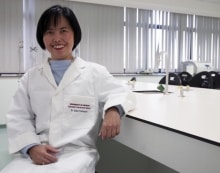
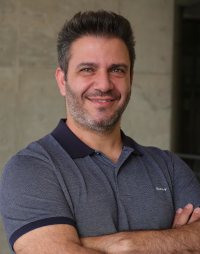
Prof. Dr. Gülsüm AŞIKSOY serves as the Head of the Artificial Intelligence Engineering Department at Near East University. She has held prior roles as a Lecturer in the Department of Computers and Instructional Technology (2012–2018) and Biomedical Engineering (2018–present), as well as coordinating flipped learning and educational technology initiatives. Her research bridges pedagogy and technology, focusing on gamification, digital simulations, and neural networks in education. Education: B.Sc. in Physics Engineering (Ankara University), M.Sc. in Electrical and Electronic Engineering, Ph.D. in Computers and Instructional Technology Research Interests: Flipped learning, gamification, physics education simulations, and artificial neural networks are central to her work. Roles: Currently leads the Artificial Intelligence Engineering Department and coordinates physics education and flipped learning programs.
Christodoulou Chris is a Professor at the Department of Computer Science, University of Cyprus. He joined in 2005 and holds a Visiting Research Fellowship at Birkbeck College, University of London. His educational background includes a BEng in Electronic Engineering from Queen Mary and Westfield College (1991), a PhD in Neural Networks from King's College London (1997), and a BA in German from Birkbeck College (2008). His research focuses on Computational Neuroscience, Neural Networks, and Machine Learning, with specific interests in neural coding, self-control modeling, computational neuronal modeling, multi-agent reinforcement learning, and practical machine learning applications. Recent publications (2013-2025) demonstrate interdisciplinary approaches combining neuroscience, computer science, and optimization techniques, with emerging emphasis on protein structure prediction and biomedical applications. Scientific awards include: Best Paper Award, ICSR 2015 Best Paper Award, MODELS 2008 Doctoral Symposium He leads the Computational Intelligence and Neuroscience (CIN) research group and has secured funding from European projects (SocioCoast, CYberSafety, TAMIT). He mentors students through Google Summer of Code and collaborates internationally.
Valeria Filippou is a Researcher at the Computation-based Science & Technology Research Center (CaSToRC) within The Cyprus Institute. She holds an MEng in Medical Engineering, an MSc in Tissue Engineering and Regenerative Medicine, and a PhD in Medical Engineering with a focus on Machine Learning, Signal Processing, and Wearable Technologies from the University of Leeds. Her research spans interdisciplinary applications of AI in healthcare, financial services, and environmental monitoring. Key areas include developing credit risk models, medical diagnostics algorithms, AI-driven data privacy solutions, and consulting on large language models (LLMs) and retrieval-augmented generation (RAG) systems. Her recent publications focus on wearable sensor data analysis for activity recognition, multimodal prediction of psychological conditions like alexithymia, and advancements in medical imaging phantoms via 3D printing. These works bridge computational methods with practical healthcare and environmental monitoring challenges. No scientific awards or grant details are explicitly stated in the provided information.
Professor Edna Yamasaki is the Head of the Department of Life and Health Sciences at the University of Nicosia's School of Sciences and Engineering, and serves as Vice Rector for Academic Affairs. Her career spans roles in academia, research, and administrative leadership. She holds a Medicine degree from Federal Fluminense University (Brazil), followed by MSc/PhD in Biophysics (Neurobiology) from Federal University of Rio de Janeiro, and postdoctoral training at institutions including Harvard Medical School (USA) and the University of Cyprus. Her research focuses on nervous system development/degeneration, public health implications of climate change, and biomedical materials. Notable projects include the CYPHEW initiative (identifying Cyprus's heat-related health risks), polymer development for biological applications, and Erasmus+ programs promoting health-enhanced physical activity. She has contributed to environmental hydrodynamic modeling, health information systems evaluation (DIPSA framework), and disaster risk assessments for oil spills. Her work bridges neuroscience, environmental science, and public policy. Recent studies highlight aging populations' health challenges and the impact of extreme weather on mortality and hospital admissions in Cyprus. She actively collaborates on EU-funded projects addressing work safety, healthcare informatics, and climate adaptation. Professional milestones include coordinating interdisciplinary teams across multiple continents and transitioning between laboratory research to institutional leadership roles. Her leadership emphasizes fostering curiosity-driven research while addressing societal health challenges.
Vasilios Zerris is a Professor of Neurosurgery at the European University Cyprus, affiliated with the School of Medicine. He concurrently holds leadership roles as Chairman of Neurosurgery at Hygeia Hospital (Athens) and Chairman of Pediatric Neurosurgery at Iaso Children Hospital (Athens). His academic qualifications include Diplomate of the American Board of Neurological Surgery, with advanced fellowship training from Harvard University Medical School and Brown University Medical School. Dr. Zerris specializes in complex neurosurgical procedures including spinal reconstruction, functional neurosurgery, and pain management. His research focuses on spinal biomechanics, dural substitute materials, and oncologic neurosurgery. Notable projects include a $450,000 grant investigating bacterial carriers for targeted cancer therapy and clinical trials on spinal cord stimulation technologies. He has authored over 15 peer-reviewed publications across high-impact journals like New England Journal of Medicine and Journal of Neurosurgery . Awardees include the Oliver Smith Award (2003), Stanley Aronson Prize (2000), and academic distinction at Brown University (M.D. 2000). He serves on SOLAS and holds multiple philanthropic roles. His clinical work emphasizes minimally invasive techniques and translational research, with active participation in medical device trials through collaborations with Medtronic and Advanced Bionics.
Assoc. Prof. Dr. Adnan Acan is a faculty member in the Department of Computer Engineering at Eastern Mediterranean University (EMU). He holds a PhD from Middle East Technical University, specializing in Electrical Engineering. His academic roles include teaching and supervising numerous graduate students in areas such as optimization algorithms, computer vision, and biomedical signal processing. Education: PhD, Electrical Engineering, Middle East Technical University (1992) MS, Electrical Engineering, Middle East Technical University (1985) BS, Electrical Engineering, Middle East Technical University (1983) Research Interests: His research focuses on optimization algorithms, machine learning, pattern recognition, and biomedical applications. Notable areas include metaheuristic algorithms (e.g., particle filters, great deluge), multi-agent systems, and ECG/heartbeat classification. He has contributed to advancements in computational intelligence, evolutionary algorithms, and medical diagnostics. Advising & Students: He has supervised over 30 graduate students, including PhDs such as JAMSHID TAMOUK (2021) and ZAHRA GOLRIZ KHATAMI (2019), and master’s students like MILAD ROSTAMPOUR (2023). His work spans applications in robotics, face recognition, and numerical optimization. Labs & Collaboration: His teaching and research involve courses in artificial intelligence, algorithms, and computer engineering. He actively contributes to academic service, including roles as a session chair and reviewer in conferences. His lab focuses on developing innovative solutions to complex computational and biomedical challenges.
Assoc. Prof. Dr. Rasime Uyguroğlu is an academic at Eastern Mediterranean University, specializing in antenna engineering and biomedical applications. She holds the rank of Associate Professor and has contributed to research in electromagnetic systems, medical imaging, and health monitoring technologies. Her work focuses on antenna design for cancer detection, wireless body channel communication, and advanced microwave systems. Her research interests include the development of antennas for biomedical diagnostics, optimization of antenna arrays, and application of metamaterials in antenna systems. She has served as an associate editor and reviewer for academic journals, demonstrating her active role in the scientific community. Prof. Uyguroğlu's publications span topics such as breast cancer detection using patch antennas, fracture healing monitoring via implanted antennas, and millimeter-wave massive MIMO systems. Her work bridges engineering and medicine, with a focus on practical solutions for healthcare challenges. She actively supervises master's and PhD students in thesis projects related to antenna design and biomedical applications. Her contributions reflect a commitment to advancing both theoretical and applied aspects of electromagnetic engineering in health-related contexts.
Constantinos S. Pattichis is a Professor of Computer Science and Director of the Biomedical Engineering Research Centre at the University of Cyprus. He also leads the HealthXR Group at CYENS Centre of Excellence and serves as a technical leader on high-impact EU-funded projects, including the EU Digital Covid Certificate Platform and the national eHealth4U initiative. His research focuses on eHealth, mHealth, medical imaging, and AI-driven healthcare solutions. **Education**: Ph.D., Electronic Engineering, University of London (1992) MSc, Neurology, University of Newcastle Upon Tyne (1991) MSc, Biomedical Engineering, University of Texas at Austin (1984) BSc, Electrical Engineering, University of New Brunswick (1983) Technician Engineer, Higher Technical Institute, Cyprus (1979) **Research Interests**: eHealth systems, mHealth interventions using Extended Reality (XR), medical image analysis (MRI, ultrasound), biosignal analysis, and explainable AI for clinical decision support. His work addresses challenges in stroke risk assessment, multiple sclerosis progression, and telemedicine accessibility. **Awards & Roles**: Fellow of IEEE, IET, IAMBE, and EAMBES. He has managed over €20M in EU grants, edited multiple books on mHealth and biomedical imaging, and serves on editorial boards of journals like IEEE Journal of Biomedical and Health Informatics. He has published ~409 peer-reviewed works (150 journals, 259 conferences) with an h-index of 54. **Grants & Projects**: Led projects such as the EU Digital Covid Certificate Platform, eHealth4U (national eHealth ecosystem), and the IPMT Excellence Centre. Active in standardizing cross-border eHealth services via EU CEF programs. **Labs & Teams**: Directs the eHealth Lab at the University of Cyprus and collaborates with CYENS on HealthXR innovations. His work includes developing VR tools for dementia care, teleconsultation apps, and AI-driven diagnostic systems.
Michalis Michaelides is an Assistant Professor at the Department of Electrical Engineering, Computer Engineering and Informatics at the Cyprus University of Technology , where he has held a tenure-track position since 2012. He holds a PhD in Electrical Engineering from the University of Cyprus (2009), and earlier degrees from Purdue University (MSEE, 1998; BSEE, 1997). His research focuses on communication systems, wireless sensor networks, environmental monitoring, and computational intelligence applications in maritime logistics and smart infrastructure. He received the Elsevier Building and Environment Journal Best Paper Award in 2014. His work spans smart port operations , IoT integration , and data-driven environmental modeling . Recent publications address berth allocation optimization, vessel arrival prediction, CO2-based virus transmission risk analysis, and AI-driven maritime terminal management. His interdisciplinary approach combines signal processing, optimization algorithms, and sensor networks to solve challenges in transportation, environmental sustainability, and public health. Education: PhD in Electrical Engineering, University of Cyprus (2009) MSEE, Purdue University (1998) BSEE, Purdue University (1997) Awards: Elsevier Building and Environment Journal Best Paper Award (2014) His research group collaborates on projects like intelligent irrigation systems and coastal eutrophication analysis , leveraging computational intelligence for real-world applications. Ongoing work emphasizes port efficiency, sensor network reliability, and decision support systems for maritime logistics.
Agapiou Agapios is an Associate Professor in the Department of Chemistry at the University of Cyprus, affiliated with the School of Natural and Applied Sciences. He holds a Ph.D. in Chemical Engineering from the National Technical University of Athens (2006) and a Diploma in Chemical Engineering from the same institution (2001). His research focuses on analytical methods for VOCs, environmental monitoring, biomedical diagnostics, and sustainable materials. He has held academic positions including Lecturer (2014), Assistant Professor (2019), and his current role since 2024. Research interests include VOC analysis in breath, environmental samples, and food products; development of biochar for pollution remediation; and electrochemical treatments for wastewater. His work bridges environmental science, biomedical applications, and sustainable technology. Over 50 publications span topics like VOC biomarkers for disease diagnosis, air quality assessment, and waste valorization. Key contributions include studies on breath analysis for smoking/e-cigarette effects, VOC mapping in soils, and biochar applications for VOC adsorption. His research emphasizes interdisciplinary approaches, integrating analytical chemistry with environmental and biomedical challenges.
Panoraia Siafaka is an Assistant Professor in the Department of Life Sciences at European University Cyprus. She holds a PhD in Chemistry from Aristotle University of Thessaloniki (2016), with research focused on polymeric drug delivery systems via electrospinning and phase separation. Her roles include Assistant Professor (2022–present), Scientific Collaborator (2022), and Senior Lecturer (2021–2022). She has contributed to over 50 national and international conferences, including invited lectures on drug delivery systems. Education : PhD (2016): Aristotle University, Chemistry (Polymeric Drug Delivery) MSc (2012): Aristotle University, Chemistry (Polymerization Kinetics) BSc (2010): Aristotle University, Chemistry (Nanocomposite Materials) Research Interests : Her work centers on advanced drug delivery systems using nanotechnology, polymers, and biomaterials for applications in wound healing, ocular drug delivery, neurodegenerative disorders, and cancer therapy. She has pioneered studies on electrospun nanofibers, chitosan-based carriers, and targeted drug delivery platforms. Awards & Recognition : Featured in Stanford’s 2% top global scientists (2021) Outstanding Reviewer, International Journal of Pharmaceutics (2018) Research Excellence Scholarship (2014–2015) Grants & Projects : She has led projects such as Evaluation of Venus Rose Eye Cream Effectiveness (2021–2022) and collaborated on nanotheranostics and localized tumor drug delivery systems. She supervises undergraduate and postgraduate theses in Pharmaceutical Technology and drug formulation design. Labs & Teams : Her research integrates interdisciplinary collaborations, including work at Istanbul Medipol University and EU-funded projects on biocomposites and nanomedicine.
Prof. Hakan Altınçay is a Full Professor in the Department of Computer Engineering at Eastern Mediterranean University (EMU). He holds a PhD from Middle East Technical University (METU), Turkey (2000), and has been at EMU since 2000, progressing from Assistant Professor (2000–2005) to Full Professor (2012–present). His research focuses on machine learning, including imbalance learning, feature selection, ensemble methods, and biomedical data analysis. He has supervised 10+ PhD and Master’s theses and authored over 50 journal and conference papers. Education: BEng in Electrical and Electronics Engineering (METU, 1993), MSc and PhD in Electrical Engineering (METU, 2000). Awards include the IEEE Third Best Paper Award (2003) and TÜBİTAK PhD Scholarship. He serves on editorial boards (e.g., Applied Intelligence Journal) and chairs academic committees at EMU. Key contributions include algorithms for imbalanced data classification (MaMiPot), feature selection techniques, and biomedical applications like diabetes prediction. His work addresses challenges in text categorization, speaker verification, and ensemble classifier design.
Aristidou Andreas is an Associate Professor at the Department of Informatics, University of Cyprus. His academic journey includes a BSc from National and Kapodistrian University of Athens (2005), MSc from King's College London (2006), and a PhD from the University of Cambridge (2011). He has held postdoctoral positions at multiple institutions and served as a visiting professor at the University of Nicosia. His research focuses on human motion analysis, computer graphics, cultural heritage digitization, and geometric algebra applications. He is a senior member of IEEE, ACM, and Eurographics, and serves on editorial boards for journals like The Visual Computer. Research highlights include the FABRIK algorithm (widely used in game engines) and motion capture innovations for cultural heritage preservation. Awards include the DIDAKTOR scholarship, Erasmus Mundus Grant, and NVIDIA GPU grant. He leads projects funded by EU initiatives (e.g., ITN-DCH, SCHEDAR) and collaborates internationally on digital twins, virtual museums, and AI-driven motion synthesis. Key contributions span 3D motion analysis, motion reconstruction from sparse data, and emotion recognition in theater performances. His work bridges computational methods with cultural preservation, biomedical applications, and interactive VR systems.
ERGÜL MUTLU ALTUNDAĞ serves as an Associate Professor at Eastern Mediterranean University's Faculty of Medicine, where she maintains an active research program focused on biomedical applications of advanced materials. Her office is located in Med 124 with contact number +90 392 630 3817. Dr. Altundağ completed her academic training with a BS in Chemistry from Karadeniz Technical University (2003), MS in Chemistry from Gaziosmanpasa University (2010), and PhD in Medical Biochemistry from Marmara University (2016). Her research interests center on biomedical applications of hydrogels and polymer-based drug delivery systems, with particular emphasis on 2-hydroxyethyl Methacrylate, N-(2-hydroxyethyl) acrylamide, poly(ethylene glycol) methacrylate, and Pol(N-vinyl imidazole) hydrogels. Her work bridges chemistry, materials science, and medical applications, focusing on creating innovative solutions for biomedical challenges. EMU Research Incentive Award (2021) EMU Research Incentive Award (2020) Dr. Altundağ has actively supervised graduate students, co-supervising PhD theses on hydrogel applications for biomedical uses. Her mentorship includes guiding research on quercetin-encapsulated alginate beads and advanced hydrogel formulations, demonstrating commitment to developing the next generation of researchers in biomedical materials science. While specific grant information isn't detailed in the available text, her consecutive research awards suggest successful grant acquisition and research project management.
Assist. Prof. Polyvios Eleftheriou holds a position at the Department of Mechanical Engineering and Materials Science and Engineering at Cyprus University of Technology since 2008. Previously, he served as Assistant Professor at Tennessee Tech University (1987-88) and lecturer at HTI-Nicosia (1988-2005). His academic journey includes roles in the Ministry of Interior (2005-2008). He holds a PhD (1987), MS (1984), and BSME (1982) from Tennessee Tech University, alongside a Diploma from HTI (1979). His research focuses on renewable energy systems, particularly solar technology, materials science, and nanotechnology applications. He pioneered work on perovskite solar cells, surface engineering for energy devices, and energy-efficient building design. His work also extends to biomedical engineering, including stent material analysis and inflammatory response studies. Prof. Eleftheriou has extensively contributed to educational technology, developing remote solar energy laboratories for e-learning. Notable projects include the Solar E-Lab platform enabling real-world experimentation over the internet. His publications span over three decades, addressing topics from HVAC fan optimization (1987) to cutting-edge nanomaterials (2021). His work emphasizes interdisciplinary approaches, blending engineering with environmental and biomedical applications. Current research trends include improving solar cell efficiency through novel materials and advancing sustainable building design in Mediterranean climates.