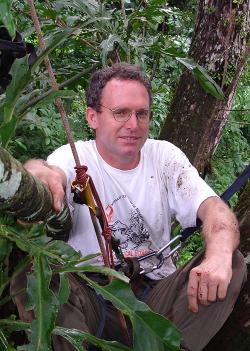
Robert Dudley is a Professor at the University of California, Berkeley, specializing in animal flight biomechanics, energetics, and evolutionary ecology. His research integrates laboratory experiments with global field studies, addressing topics such as hummingbird flight mechanics, stick insect gliding adaptations, and high-altitude bumblebee physiology. He leads the Berkeley Flight Lab, focusing on interdisciplinary approaches to understand flight evolution and ecological adaptations. Key research focuses include: Hummingbird kinematics and metabolic responses to turbulence Evolution of flight morphology in stick insects Ecophysiology of butterfly migrations in Panama High-altitude adaptations in Sichuan bumblebees Behavioral adaptations in wingless hexapods Publications highlight innovations in aerial performance, ethanol consumption in animals, and biomechanical studies of gliding and parachuting in reptiles and insects. Dudley’s work bridges evolutionary biology with applied robotics, as seen in studies of paravian-inspired flight models. His books, including *The Drunken Monkey*, explore human dietary ethanol consumption from an evolutionary perspective. Grants and collaborations support interdisciplinary projects, though specific grant details are not listed. His lab collaborates globally, with fieldwork in Peru, Southeast Asia, and the Neotropics.
Víctor Ortega Jiménez serves as an Assistant Professor at the University of California, Berkeley, where his research bridges biology, engineering, and fluid dynamics to investigate organismal responses to complex environmental forces. His work specifically examines animal locomotion through perturbed flows including rain, waterfalls, turbulent convection, and electrostatic fields, with implications spanning evolutionary biology to bio-inspired robotics. His core research interests focus on organismal dynamics under capillary forces, static electricity, and multicomponent fluid environments . This interdisciplinary program integrates physiological measurements, fluid dynamics modeling, and engineering principles to decode how small animals navigate unpredictable conditions—such as hummingbirds in precipitation or springtails at fluid interfaces—with direct applications for designing resilient bio-inspired robots. Key methodologies include high-speed videography, aerodynamic force measurements, and computational fluid dynamics simulations. Analysis of his 2012-2022 publications reveals a cohesive trajectory exploring size-dependent fluid-structure interactions across diverse taxa. His work systematically addresses how turbulence (von Kármán streets, whirlwinds), electrostatics (spiderweb deformation), and capillary phenomena (springtail adhesion) constrain animal movement, while identifying evolutionary adaptations for environmental challenges. The research consistently links fundamental biomechanics to ecological and engineering innovation. Dr. Ortega Jiménez directs the Ornithopterus Lab , which serves as the experimental hub for studying animal locomotion in complex flows through controlled environmental simulations and biomechanical analysis. The lab’s infrastructure supports high-precision fluid dynamics testing and bio-robotic prototyping for translating biological insights into technological solutions.
Yigit Yazicioglu is a Professor of Mechanical Engineering at Middle East Technical University (METU). He holds a Ph.D. from the University of Illinois at Chicago and has been affiliated with METU since 1997, progressing through roles including Lecturer, Assistant Professor, Associate Professor, and his current rank since 2021. His research focuses on solid acoustics in structural and bioacoustic applications, control systems, robotics, and automotive engineering. He has supervised numerous graduate students and led projects funded by TUBITAK, including work on legged robotics, fluid-structure interactions in biomedical contexts, and advanced control systems. Education: Ph.D. Mechanical Engineering (UIC, 2005), M.S. and B.S. from METU (1999, 1997). His teaching spans dynamics, control systems, and robotics courses. Recent research highlights include acoustic detection of vascular obstructions and compliant robotic leg design. He has contributed to over 30 peer-reviewed journal articles and supervised 20+ theses, with ongoing work in non-invasive medical diagnostics and advanced robotics. Key Projects: Low-power legged robot mobility (2018–2022) Acoustic-visual perception for legged robots (2010–2013) Electro-hydraulic control systems development (2007–2010) His academic contributions include pioneering work in bioacoustic signal analysis and robotic locomotion control, with applications in both engineering and biomedical fields. Current research emphasizes interdisciplinary approaches to solve complex problems in robotics and medical diagnostics.
Ariane Gayout is a Postdoctoral Researcher at the University of Groningen (Netherlands), affiliated with the Biomimetics group within the Faculty of Science and Engineering. Her research focuses on unraveling turbulence characteristics through the lens of animal flight adaptations, particularly insects and birds. She holds a PhD in Physics from the Laboratoire de Physique at École Normale Supérieure de Lyon (France), where her work centered on fluid-structure interactions in multi-stable pendular systems. She is a recipient of the NWO Veni Grant (2023) and the Amelia Earhart Fellowship (2021). Education: PhD in Physics, ENS de Lyon, France (2022) Master’s in Physics, ENS de Lyon, France Research Interests: Aerodynamics of biological systems (birds, insects) Turbulence and fluid instabilities Non-linear physics and bifurcation analysis Experimental and computational fluid dynamics Feather and wing morphological adaptations Notable Projects: PHOeBUS FLight OBSERVATION : Investigating butterfly flight under space-like gravity conditions. Biomimetics Group : Exploring animal-inspired solutions for fluid dynamics problems. Aurora Planeterrella : Public outreach on aurora physics simulations. Grants & Awards: NWO Veni Grant (2023): Funding her research on turbulence and insect flight. Amelia Earhart Fellowship (2021): Recognizing excellence in aerospace-related research. Labs & Teams: Biomimetics group at the University of Groningen Collaborations with institutions like CEA Saclay, ONERA, and Chiba University
Norman M. Wereley is the Minta Martin Professor of Aerospace Engineering at the University of Maryland's College of Engineering, directing the Composites Research Laboratory (CORE). He holds roles as InnoVital Systems Faculty Fellow and Keystone Professor. His research focuses on smart materials like magnetorheological fluids, active vibration control systems, and aerospace applications including helicopter dynamics and crashworthiness. He has authored over 300 publications and received numerous awards, including CAMX Technical Paper Awards and Fellowships from AIAA and ASME. Key affiliations include the Maryland Robotics Center and Alfred Gessow Rotorcraft Center. Education includes a Ph.D. (1990) and M.S. (1987) from MIT, and a B.Eng. from McGill University (1982). His work spans advanced materials, fluid dynamics, and robotics, with applications in biomedical devices and autonomous systems. Notable contributions include the first organ transplant flight via VTOL drone and pioneering studies on adaptive energy absorbers. Research interests emphasize magnetorheological fluids' rheology, structural health monitoring, and bio-inspired actuators. His lab develops materials for aerospace, medical, and robotic systems. Recent work includes tunable energy-absorbing foams and 3D-printed composites. Awards highlight his impact in materials science and engineering education. Lab activities include the Composites Research Laboratory (CORE) and collaborations with NASA and industry. He serves on editorial boards for journals like Smart Materials and Structures . His work bridges fundamental material science with applied engineering solutions.
Marcelo H. Kobayashi is a Professor in the Department of Mechanical Engineering at the University of Hawaii at Manoa . He holds dual PhDs in Mechanical Engineering (1994) and Mathematics (2003) from the Technical University of Lisbon/IST, Portugal. His research spans Computational Fluid Dynamics (CFD) , Fluid Mechanics , and Multidisciplinary Design Optimization (MDO) , integrating advanced numerical methods and genetic algorithms to solve complex engineering problems in aerospace, biomechanics, and defense applications. CFD: Stream function methods, finite volume schemes for Navier-Stokes equations, and Padé approximations. Fluid Mechanics: Stokes flows, particle dynamics in rotating systems, and acoustic wave propagation in shear layers. MDO: Hybrid genetic programming for metamaterials, cellular division optimization for control surfaces, and bio-inspired designs for micro aerial vehicles. His recent publications reflect the application of evolutionary algorithms , topological optimization , and aeroelastic modeling to challenges in air vehicle design , thermal management , and biological systems . He has led projects funded by AFOSR , NSF , and US Army , including grants for tsunami debris impact analysis and nanosat thermal control systems. As Director of the Hawaii Open Supercomputing Center , he contributes to computational research infrastructure. His teaching includes graduate courses in Computational Fluid Dynamics , Numerical Methods , and Advanced Aerodynamics .
Bingni Brunton is a Professor of Biology and the Richard & Joan Komen University Chair at the University of Washington , with affiliations in the Paul G. Allen School of Computer Science & Engineering , the Department of Applied Mathematics , and the UW eScience Institute as a Data Science Fellow. Ph.D. in Molecular Biology & Neuroscience, Princeton (2012) B.S. in Biology, Caltech (2006) Her research bridges computational neuroscience , neuroengineering , and data science , focusing on data-driven modeling of neural and behavioral dynamics, sparse sensing/control systems, and neural decoding for brain-computer interfaces. Recent publications emphasize 3D pose estimation ( Anipose ), neural decoders for transfer learning, and time-delay modeling in dynamical systems. These papers highlight her lab's expertise in machine learning for neuroscience and biological systems . Scientific recognition includes: Alfred P. Sloan Foundation Fellowship (2016) UW Innovation Award (2017) AFOSR Young Investigator Program (2018) Weill Neurohub Investigator (2020) Moore Distinguished Scholar (2021) She co-advises students across disciplines in Neuroscience , Computer Science & Engineering , and Applied Mathematics , including current advisees Michelle Hickner , Zoe Steine-Hanson , and Raveena Chhibber , as well as alumni like Nancy Wang (Amazon) and Satpreet Singh (Meta). Her lab receives funding from NIH/NIMH , NSF , Boeing , and the Weill Neurohub , among others.
Oscar Martínez Romero is a Research Professor at the School of Engineering and Science at Tecnológico de Monterrey, where he has been affiliated with the Department of Mechanical Engineering since January 2000. His academic journey began at the same institution, where he earned his Mechanical Electrical Engineering degree in 1996, followed by a Master of Science in Manufacturing Systems in 1999, and ultimately a Doctor of Engineering Sciences in 2011. His educational background includes: Mechanical Electrical Engineer, Tecnológico de Monterrey Master of Science with specialization in Manufacturing Systems, Tecnológico de Monterrey PhD in Engineering Sciences, Tecnológico de Monterrey Professor Martínez-Romero's research spans multiple cutting-edge domains in engineering, with particular emphasis on magnetorheological materials, fractal mechanics, and sustainable manufacturing processes. His work integrates theoretical modeling with practical applications, particularly in the development of smart materials and advanced manufacturing techniques. His publications consistently demonstrate innovative approaches to solving complex engineering problems through the application of fractal geometry and advanced mathematical modeling. Analysis of his recent publications (2021-2025) reveals a clear research trajectory focused on the intersection of smart materials, fractal-based modeling, and sustainable manufacturing. His work on magnetorheological elastomers, fractal mechanics, and additive manufacturing demonstrates exceptional technical depth and innovation. The consistent application of fractal concepts across diverse engineering problems highlights his unique research perspective and methodological contributions to the field. His scientific recognition includes: Mexican Researcher Certification - Level 1 Member of the National System of Researchers Level I With over 20 publications in refereed scientific journals and 23 articles in international congresses, Professor Martínez-Romero has established a robust research program. His grant portfolio includes 4 PEI projects with a total budget close to $600,000 USD with Acertek and Whirlpool companies, a basic science project, 2 postdoctoral fellowships, and a research stay. He has collaborated with global companies including Siemens, Whirlpool, Vitro, Prolec GE, Corporación Industrial de Moldeo SA de CV, Kubrelam, and Vidrios y Cristales Ontiveros, resulting in 12 technological developments. He is an active member of the Research Group on Nanotechnology and Device Design and the Thematic Network of Nanosciences and Nanotechnology since June 2016. His previous research stays at the University of Girona (Spain), Rice University, and the University of Houston have significantly contributed to his expertise in medical devices, nanostructured composites, and intelligent materials.