Sohmyung Ha is an Associate Professor of Electrical Engineering and Bioengineering at NYU Abu Dhabi and holds a Global Network position at NYU Tandon School of Engineering. He leads the Integrated BioElectronics Laboratory, focusing on advancing silicon integrated technologies for biomedical applications such as implantable devices and wearable sensors. His expertise spans biomedical circuits, neural interfaces, and wireless power systems. Education: MS (2004, KAIST), PhD (2016, UC San Diego) with a Best Thesis Award. Prior industry experience includes analog circuit design at Samsung Electronics (2006-2010). Academic affiliations include NYU Abu Dhabi, NYU Tandon, and global collaborations. Research interests include high-performance biomedical sensors, neural prosthetics, and energy-efficient bioelectronic systems. Notable achievements include a Best Paper Award (ISCAS 2024) and innovations in impedance spectroscopy and neural interface ICs. Current projects emphasize closed-loop neural interfaces, subcutaneous glucose monitoring, and retinal prostheses. His lab develops miniaturized, power-autonomous systems for healthcare applications.
Arnaud Bertsch is a Lecturer at the École Polytechnique Fédérale de Lausanne (EPFL) within the School of Engineering (STI) and the Department of Microengineering (IEM). He is affiliated with the Microsystems Laboratory 1 (LMIS1) and has been actively involved in teaching advanced microfabrication techniques and MEMS sensor/actuator practicals. His research spans microfluidics, nanofluidics, biomedical devices, and 3D microfabrication, with a focus on neural probes, drug delivery systems, and cell manipulation technologies. Microfluidic hydrodynamic and dielectrophoretic systems Nanovolcano microelectrode arrays for electrophysiology Thermal control of ionic transport in nanochannels 3D lipid microrobots for drug delivery MEMS-based intraocular pressure sensors Arnaud Bertsch has supervised PhD students including Torres Vila Pol, Zhang Tao, and past advisees like Clémentine Lipp, Nicolas Maïno, and Joan Teixidor. His work bridges fundamental research in nanofluidics with applied biomedical solutions, contributing to fields such as neuroscience, cancer therapy, and implantable medical devices. The articles listed demonstrate expertise in microsystem design, electrochemical sensing, and biofabrication technologies.
Megan Steele is an Honorary Senior Research Fellow at the University of Queensland's School of Public Health. Her research focuses on public health interventions, mental health in forensic settings, cancer survivorship, and Indigenous health equity. She contributes to initiatives like the Aboriginal and Torres Strait Islander Impact Strategy and collaborates with law enforcement and healthcare agencies to improve crisis response and patient outcomes. Key research areas include forensic mental health patients' physical activity, suicide crisis interventions, and substance use among justice-involved youth. Her work integrates data linkage studies and systematic reviews to address healthcare gaps in vulnerable populations. She has co-authored over 70 publications spanning oncology, neuroprotection, and public health policy. Her recent studies highlight innovative methods like bioimpedance spectroscopy for lymphedema diagnosis and explore exercise safety in cancer survivors. Collaborations with German oncology centers inform integrative therapy approaches. While no formal awards are listed, her extensive publication record demonstrates significant scholarly impact. Advising and grant details are not explicitly stated, but her involvement in multi-disciplinary projects suggests active team-based research. She contributes to initiatives like the Mental Health and Climate Change Research Network and Public Health Connect platform, fostering cross-sectoral partnerships.
Jan Olav Høgetveit is an Associate Professor in the Department of Physics at the University of Oslo (UiO), within the Faculty of Mathematics and Natural Sciences. He also serves as Head of Research & Development in the Department of Biomedical and Clinical Engineering at Rikshospitalet, Norway’s national hospital. His work bridges physics and clinical practice, focusing on medical instrumentation. Education: Bachelor of Electronic Engineering (Technical Cybernetics), Oslo University College, 1993 Master of Electronics, University of Oslo (Department of Physics), 1997 Ph.D. in Physics (Technology Applications for Medical Devices), University of Oslo, 2008 Research Interests: Høgetveit specializes in biomedical instrumentation and clinical engineering, particularly in surgical technology and wireless communication impacts on medical devices. His work addresses challenges like real-time physiological monitoring during heart-lung machine use, non-invasive blood glucose detection, and bioimpedance-based viability assessment of organs. He emphasizes interdisciplinary collaboration between engineering and medicine to enhance patient safety and surgical outcomes. Scientific Contributions: His research trends span bioimpedance applications in ischemia/reperfusion injury, machine learning for surgical decision support, and electrosurgery safety. He has explored ventilator optimization during pandemics and implant-related thermal risks. Contributions highlight both hardware development (e.g., optically isolated current sources) and software innovations (e.g., neural networks for viability prediction). Awards: No scientific awards explicitly mentioned in the text. Advising & Grants: Høgetveit received a 1998–2001 research council scholarship. As Head of R&D since 2001, he oversees translational projects. No formal advisees/students listed, though he collaborates extensively with teams on device development and clinical trials. Labs & Teams: Affiliated with UiO’s Department of Physics and Rikshospitalet’s Biomedical and Clinical Engineering department. Active in the Electronics research group at UiO. Engages with multidisciplinary teams addressing surgical instrumentation and physiological monitoring challenges.
Daniele Guido Allegri is a Professor at the University of Applied Sciences and Arts of Southern Switzerland (SUPSI), affiliated with the Department of Innovative Technologies (DTI) and the Institute of Systems and Applied Electronics (ISEA). He became a professor in 2021 and serves as the director of ISEA since August 2023. His roles include leading the "Digital Electronics, Microelectronics, and Bioelectronics" scientific area since 2019. Allegri's research spans biomedical electronics, microelectronics, and embedded systems. Key projects include the development of radiation-hardened PLL ASICs (Cadagno, Quarnei), a Cardio Pulmonary Rescue Support System, and signal processing solutions for myopathy diagnosis and renal dialysis monitoring. He teaches courses on machine learning, analog/digital electronics, and embedded systems design. His publications focus on CMOS multifrequency impedance analyzers for biomedical applications (2018), real-time hydration monitoring via bioimpedance (2016-2017), and the European Solar Telescope (2021), which integrates advanced technologies for solar physics. These works reflect interdisciplinary expertise in circuit design, medical devices, and astrophysical instrumentation. Allegri's current affiliations include the Department of Innovative Technologies and ISEA at SUPSI. He has worked extensively on integrated circuits for biomedical applications, signal processing, and radiation-hardened electronics for space systems.
Marco Farina is a Full Professor in Electromagnetics at the Department of Information Engineering, College of Engineering, Polytechnic University of Marche, Italy. His research spans electromagnetic modeling, scanning microwave microscopy, and nanotechnology, with applications in 2D materials, biosensors, and advanced measurement systems. He is a Senior Member of IEEE and actively contributes to Technical Committees on RF Nanotechnology. Laurea and Ph.D. in Electronic Engineering from University of Ancona Research interests focus on quantitative scanning microwave microscopy, electromagnetic analysis of active/passive components, and nanoscale characterization techniques. His work bridges theoretical modeling with practical implementation, including the development of the EM3DS software suite and novel inverted SMM systems. Recent publications highlight interdisciplinary applications in biomedical analysis and semiconductor physics. Scientific recognition includes the 3M-Nano Best Conference Paper Award and grants from US Army Research Laboratory and US Air Force Office of Scientific Research. He holds an ESA-funded patent for VNA calibration and has co-authored a book on planar structure analysis. Collaborative projects emphasize RF device optimization and biological imaging.
Ørjan Grøttem Martinsen is a Professor of Electronics at the Department of Physics, Faculty of Mathematics and Natural Sciences, University of Oslo. He also holds a temporary research position at the Medical Technology Business Area of Oslo University Hospital. With over three decades of experience, he has established himself as a leading expert in bioimpedance research and applications. Education: High-voltage engineer degree (1983) Cand. scient. in electronics/measurement technology (1990) Dr. scient. with thesis on skin's electrical properties (1995) Professor Martinsen's research centers on bioimpedance—the passive electrical properties of biological tissues that vary with anatomy and physiology. His work spans diverse applications including medical diagnostics (skin cancer detection), food quality assessment (fresh vs. thawed fish), skin condition monitoring (moisture levels), and stress level evaluation. His research bridges physics, engineering, and medical applications, creating practical diagnostic tools from fundamental electrical principles. He has pioneered methods to characterize tissue properties through impedance measurements, with particular focus on electrodermal activity and skin impedance. His recent publications (2022-2025) demonstrate a strong interdisciplinary approach combining bioimpedance with machine learning, robotics, and advanced signal processing. The work spans from fundamental biophysics (GABA detection, tissue characterization) to practical applications (dental anxiety assessment, ADHD treatment evaluation). Key trends include integration of AI with bioimpedance measurements, development of novel sensor systems, and expansion into new application areas like optogenetics and micro-robotics. Awards and Recognition: IEEE Senior Member (2006) CLABIO Award (2012) Fellow at Institute of Physics (FInstP) (2015) Dr. Honoris Causa, Tallinn University of Technology (2018) UiO Innovation Award (2019) Member of Norwegian Academy of Technical Sciences (2021) Professor Martinsen has served as Editor-in-Chief of the Journal of Electrical Bioimpedance since 2010 and was President of the International Society for Electrical Bioimpedance (2010-2016). His research has attracted significant funding, enabling collaborations across engineering, medical, and biological disciplines. He has supervised numerous students and researchers in the Bioimpedance Group at UiO, fostering a strong research environment that bridges theoretical and applied work. His work is conducted primarily through the Oslo Bioimpedance Group and Sensorama SmartSense research teams, which focus on developing innovative measurement techniques and applications of bioimpedance technology. These groups maintain strong collaborations with medical institutions and industry partners to translate research findings into practical healthcare solutions.
Professor Daniele Faccio is Professor of Quantum Technologies at the University of Glasgow's School of Physics & Astronomy since December 2017. He also serves as adjunct professor at the University of Arizona and was elected Fellow of the Royal Society of Edinburgh in 2017. Previously, he was at Heriot-Watt University (2010-2017) and has held visiting positions at MIT and ICFO, Barcelona. Professor Faccio leads the Extreme Light Group, focusing on quantum technologies applied to imaging and sensing. His research spans quantum-enhanced imaging through complex media, photon transport in biological tissues, and analogue gravity phenomena where intense laser pulses create artificial black holes and 'expanding universes' in laboratory settings. His work bridges fundamental physics with practical applications in biomedical imaging, security, and quantum information processing. Recent publications reveal a strong trend toward quantum-enhanced imaging techniques, machine learning applications in optical sensing, and biomedical applications of advanced optical technologies. His research integrates quantum optics, computational imaging, and photonics to develop novel sensing modalities with applications ranging from non-invasive medical diagnostics to quantum information processing. Professor Faccio has received numerous prestigious awards including the Philip Leverhulme Prize in Physics (2015) and the Royal Society of Edinburgh Senior Public Engagement Medal (2017). He was an ERC fellow from 2012-2017 and a Marie-Curie fellow at ICFO, Barcelona. As principal investigator, Professor Faccio has secured significant research funding supporting his interdisciplinary team. His work on quantum imaging, analogue gravity, and computational optics has attracted substantial grant support from major research councils. He actively mentors postdoctoral researchers and PhD students in the interdisciplinary field spanning physics, engineering, and computational science. The Extreme Light Group maintains state-of-the-art laser laboratories with capabilities in ultrafast optics, quantum optics, and computational imaging. Current projects focus on quantum-enhanced imaging for biomedical applications, non-line-of-sight imaging through scattering media, and exploring fundamental physics through optical analogues of gravitational phenomena.
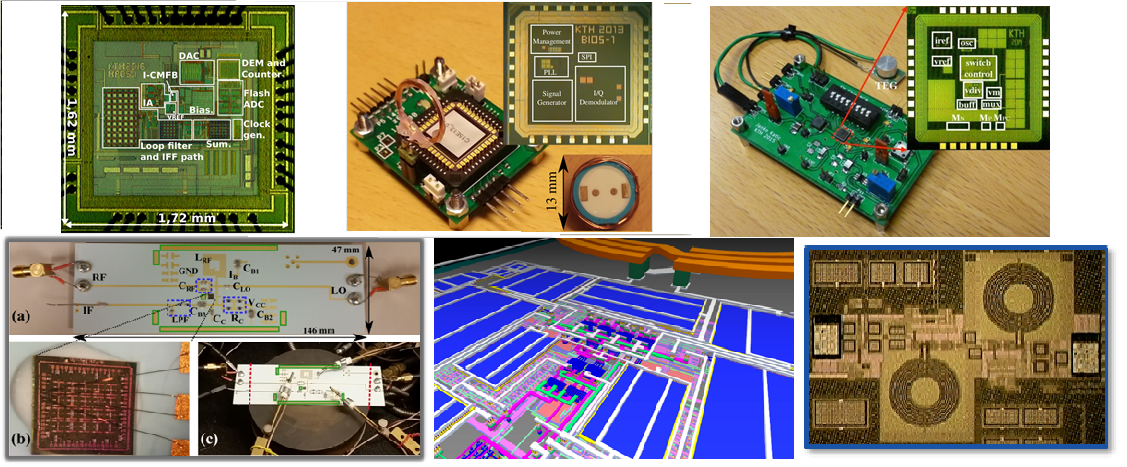
Saul Rodriguez Duenas is a Professor at the Division of Electronics and Embedded Systems, part of the School of Electrical Engineering and Computer Science (EECS) at KTH Royal Institute of Technology in Stockholm, Sweden. Previously, he held an Associate Professor position at KTH. He obtained his B.Sc. in Electrical Engineering from the Army Polytechnic School (ESPE) in Ecuador, followed by M.Sc. and Ph.D. degrees in System-on-Chip Design and Electronic and Computer Systems from KTH. He also holds a Docent title in Integrated Devices and Circuits from KTH. His research focuses on low-power RF, analog/mixed-signal ICs for wireless applications, biomedical systems, and energy harvesting. He is the founder of ElinTronics AB, a consulting firm specializing in embedded systems and mixed-signal ASICs. Rodriguez teaches multiple courses at KTH, including Analog Electronics, Analog Integrated Circuits, and RF Integrated Circuit Design. His work spans over 90 publications in peer-reviewed journals and conferences, with a strong emphasis on biomedical circuits, energy-efficient systems, and sensor technologies. He has contributed to patents in implantable sensors and health monitoring systems.
Dr. Graydon Raymer is a Professor and Dean of the Faculty of Education and Professional Studies at Nipissing University. He established the Bachelor of Physical and Health Education program in 2007 and leads the varsity Cross-Country Running Team. His research focuses on exercise physiology, mathematical modeling of physiological phenomena, and physical activity measurement. He has secured over $700k in Canadian Foundation for Innovation funding to equip his state-of-the-art research laboratory with advanced equipment like environmental chambers, metabolic carts, and motion capture systems. Education: BPHE, Queen's University BSc (Life Sciences), Queen's University MSc (Kinesiology), University of Western Ontario PhD (Medical Biophysics), University of Western Ontario His research areas include children's 24-hour movement patterns, high-performance sports physiology, and innovative dietary studies. He collaborates with institutions like the Children’s Hospital of Northeastern Ontario and Queen’s University. Recent projects explore low-cost school-based physical activity initiatives and physiological impacts of nose-breathing running programs. Awards & Grants: CIHR grants totaling $704,010 for children’s movement studies CFI funding ($700k) for laboratory equipment Dr. Raymer advises 1-2 graduate students annually in Nipissing’s Master of Science in Kinesiology program. He served on the College of Kinesiologists of Ontario Council (2017-2022) and currently oversees the $13M Centre for Physical and Health Education facility.
Ana Rusu is a Professor and leader of the Mixed-Signal Integrated Circuits and Systems Group at the Division of Electronics and Embedded Systems, Department of Electrical Engineering, KTH Royal Institute of Technology. She holds a Docent title from KTH and has been at the university since 2001. Her research focuses on energy-efficient circuits, biomedical applications, and emerging technologies like graphene and SiC. She has supervised numerous PhD students and led major projects such as AIsing (VR-funded) and Implantable Bioimpedance Spectrometer (SSF-funded). Education: Diploma Engineer (M.S.) from Technical University of Iasi (1983), PhD from Technical University of Cluj-Napoca (1998), Docent in Circuit Theory (KTH, 2006). She previously served as Director of Doctoral Education at the School of ICT (2013–2017) and Vice-Dean at EECS (2018–2022). Research interests include energy harvesting, spintronics-CMOS integration, and Ising Machines. Her work spans over 150 peer-reviewed publications and includes awards like the T-NANO Best Paper (2020) and ISCAS Best Paper (2023). She has advised 16+ PhD graduates and actively contributes to academic governance and education.
Daniele Allegri is a Professor of 'Programmable and Integrated Microelectronic Systems' at the University of Applied Sciences and Arts of Southern Switzerland (SUPSI), leading the Department of Innovative Technologies. He serves as Director of the Institute for Systems and Applied Electronics (ISEA) since 2023 and previously held roles including Head of the 'Digital Electronics, Microelectronics, and Bioelectronics' research area (since 2019). His professional career spans engineering roles at Mandozzi Elettronica SA (1998–2014) and academic research at SUPSI (2014–present). Education: Ing.-Dipl. in Electronic Engineering from ETH Zurich (1998), PhD in Microelectronics from the University of Pavia (2017). Research Focus: Development of integrated circuits and embedded systems for biomedical applications, mixed analog-digital circuits, FPGA systems, signal processing, imaging technologies, and Edge AI. His work addresses clinical needs like real-time hydration monitoring for dialysis patients and advanced solar telescope instrumentation. Key Projects: Probing semiconductor rad-hardness via ions/lasers Next-gen tunnel safety sensors High-precision 3D imaging systems Cardio Pulmonary Rescue Support System Wireless pulmonary edema sensing networks Publications emphasize biomedical instrumentation and astrophysical engineering. No scientific awards explicitly listed in text, but contributions suggest strong peer recognition. Advising activity details not provided in source text. Current affiliations include leadership roles at SUPSI's ISEA and teaching responsibilities in multiple electronics-related courses.
Lucas Lindeboom is a Researcher at Hanze University of Applied Sciences, Netherlands, affiliated with the Advance Care Planning Centre of Expertise and the Healthy Ageing Nursing Diagnostics group. His work focuses on metabolic and biomedical research, particularly in areas like bioimpedance technology, chronic kidney disease management, and mitochondrial metabolism. Research interests include medical imaging techniques (e.g., 31P MRI), wearable sensors for patient monitoring, and metabolic disorders such as non-alcoholic fatty liver disease. Lindeboom collaborates extensively with institutions in the Netherlands and internationally, contributing to peer-reviewed articles in journals like Nature Communications and Journal of Applied Physiology . His recent studies emphasize innovative diagnostic tools for hemodialysis patients, remote monitoring systems, and metabolic pathways during fasting. Lindeboom actively participates in interdisciplinary projects bridging clinical practice and technological innovation in healthcare.
Rasool Keshavarz is a Senior Research Fellow at the University of Technology Sydney (UTS), affiliated with the School of Electrical and Data Engineering within the Faculty of Engineering and Information Technology. He holds a Ph.D. in Telecommunications Engineering from Amirkabir University of Technology, Iran. His research focuses on RF/microwave/mm-wave systems, antennas, sensors, and electromagnetic compatibility (EMC), with a strong emphasis on applications in precision agriculture and IoT. He leads projects like 'Sustainable Sensing for Precision Agriculture' (funded by Food Agility-CRC and NTT) and collaborates with Zetifi Company on rural connectivity solutions. Education: Ph.D. in Telecommunications Engineering (Amirkabir University of Technology), M.Sc./B.Sc. details not specified. Professional roles at UTS include Senior Research Fellow (2023–present), Postdoctoral Research Fellow (2022–2023), and Visiting Fellow (2019–2021). He teaches courses such as 'Introduction to Satellite Communication and Sensing' and supervises graduate projects in 5G antennas, energy harvesting, and sensor design. Research interests span metamaterials, wireless power transfer, agricultural sensing systems, and antenna design for IoT. Key projects involve developing compact, low-cost RF systems for rural connectivity and sensor PCBs for soil quality analysis. His work integrates AI-driven data fusion strategies and advanced electromagnetic modeling. Recent publications highlight innovations in THz beamforming, soil permittivity spectroscopy, and reconfigurable antennas for smart agriculture. He is a technical leader in EMC compliance testing and contributes to industry partnerships for agricultural technology advancements.
David Naranjo Hernández is a Permanent Professor in the Signal Theory and Communications department at the University of Seville. His work focuses on biomedical engineering with emphasis on bioimpedance analysis, wireless body sensor networks, and e-health systems. Principal Investigator: Development and Clinical Validation of a Non-Invasive Glucometer for e-Health (P18-TPJ-3074) Researcher: e-EPOC (PI15/00306), e-Nefro (PI11/00111), Id3am (P10-TIC-6214), Pimetrans (P08-TIC-04069) Research interests span wearable technology for chronic disease management, including COPD and chronic kidney disease. He has developed smart sensors for respiratory rate monitoring, muscle function assessment, and glucose level estimation. His methodological contributions include distributed processing architectures and antenna design optimization. Patents include non-invasive glucose monitoring (2019), real-time body composition analysis (2017), and wireless sensor platforms (2013). Key publications address: Wireless body networks for frailty patient monitoring (2021) Smart bioimpedance devices (2020) Intrabody communication protocols (2018) Portable fall detection systems (2009)