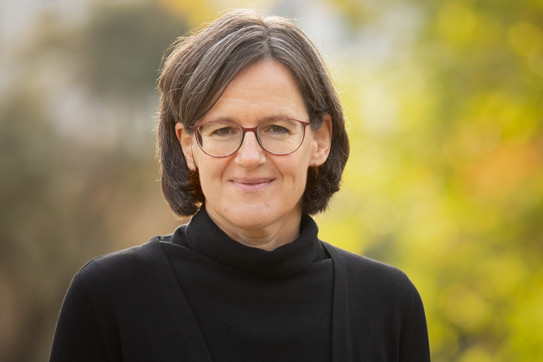
Prof. Dr. Bianca Burgfeld-Meise is a faculty member at the Department of Education and Social Sciences at South Westphalia University of Applied Sciences (FH-SWF). Her research focuses on media education, digitalization, and media socialization with a particular emphasis on media literacy, digital humanities, and social network sites. Key collaborations include TU Dresden (Digital@Humanities), HfM Detmold (digital music editions), and nationwide initiatives like Keine Bildung ohne Medien e.V. Research funded by DFG, BMBF, and institutional grants for projects on digital learning processes, MINT promotion, and digital edition methodologies. Her recent publications analyze lifelogging practices, digital memory, and interdisciplinary software development in educational contexts. She contributes to theoretical frameworks in media pedagogy and digital culture. She currently serves in the national steering committee of Keine Bildung ohne Medien e.V., advocating for systematic integration of media education across societal domains through workshops and policy discussions.
Prof. Dr. Andrea Dreyer is a full-time Professor of Art and its Didactics at the Bauhaus University Weimar , where she has served since 2013. She is Vice Dean for Strategic Development within the Faculty of Art and Design and actively participates in academic governance, including roles in graduation committees, teacher training advisory boards, and curriculum commissions. Her research focuses on teacher professionalization, architectural pedagogy, and digital art education, emphasizing interdisciplinary approaches and qualitative social research methodologies. First and Second State Examination for Teaching at Grammar Schools in Art Education and Social Studies (1994–2000, 2004–2006) Andrea Dreyer’s publications span topics such as Bauhaus-inspired pedagogy, urban-rural spatial education, and digital integration in art teaching. She has led initiatives like DigiProSMK and Denkraum.Bauhaus , and her work often bridges art, architecture, and societal transformation. She has served as Dean of Studies and Vice-Rector for Studies and Teaching at Bauhaus University, advocating for phase-transcendent teacher networks and reflective professional practices. Her recent articles address participatory architectural psychology, interdisciplinary curriculum design, and digitalization in art education. Despite extensive committee involvement and editorial contributions, no specific scientific awards are highlighted in the provided texts. She mentors students and collaborators within the kunst:pädagogik | netz:werk platform and maintains active partnerships with institutions like the Thuringian Ministry of Education and Friedrich-Schiller University Jena.
Maxim Romanov heads 'The Evolution of Islamic Societies' project at University of Hamburg's Asia-Africa-Institut, funded by DFG's Emmy Noether Program. Former positions include senior research fellow at KITAB Project and University of Vienna. Research reconstructs social history of Islamic world (c.600-1600 CE) through computational analysis of Arabic chronicles and biographical collections. Research Focus: Digital humanities approaches to premodern Islamic history including OCR development for Arabic manuscripts, corpus linguistics, and geospatial modeling of historical data. Technical Contributions: Developed OpenITI corpus infrastructure, al-Ṯurayyā gazetteer system, and computational methods for large-scale historical text analysis. Recent work enhances NLP for classical Arabic with OCR accuracy exceeding 90%.
Regula Forster is a Professor of Islamic History and Culture at the University of Tübingen, where she has served since 2020. She currently holds the position of Vice Dean for Research of the Faculty of Humanities. Previously, she was Professor of Arabic Studies at Freie Universität Berlin (2018-2020) and an SNSF professor at the University of Zürich (2016-2018). Her academic journey includes a junior professorship at Freie Universität Berlin (2008-2018) and post-doctoral research at the University of Oxford (2007-2008). PhD (Dr. phil.) from University of Zurich (2005) Habilitation from Freie Universität Berlin (2015) Studied German, Arabic, and Philosophy at Universities of Zürich, Tübingen and Birzeit (1994-2000) Professor Forster's research focuses on the intersection of literature, science, and religion in the Islamic world. Her primary areas include Arabic alchemy, particularly the works of Ibn Arfa' Ra's, knowledge transmission through literary forms, Quranic exegesis, and cultural exchanges between East and West. She examines how scientific knowledge was conveyed through dialogues, poetry, and other literary forms in medieval Arabic texts. Her publication record shows a strong focus on alchemy in the Islamic world, with numerous articles analyzing alchemical poetry, manuscripts, and the relationship between religious scholarship and scientific practice. She has also made significant contributions to understanding the transmission of Aristotelian knowledge through texts like the Sirr al-asrār/Secretum secretorum across cultural boundaries. Professor Forster has organized and participated in numerous international conferences and workshops on Islamic studies, alchemy, and manuscript culture. She serves as editor for the 'Islam' section of Orientalistische Literaturzeitung since 2009 and has edited special issues on alchemy in the Islamicate world. She leads a major research project on the Alchemist Ibn Arfa' Ra's and his poetry collection Šuḏūr aḏ-ḏahab ('The Gold Splinters'), examining how traditional religious scholarship in the Arab-Islamic world was reconciled with 'secret science' such as alchemy. This project involves extensive manuscript research across multiple institutions worldwide.
Jakob Schreiber is a researcher at the Institute of Sociology (Faculty of Philosophy I) at Martin Luther University Halle-Wittenberg. He has held various research and teaching roles since 2017, focusing on educational theory, transformation research, and discourse analysis. BA/MA in Educational Science (Martin Luther University Halle-Wittenberg; semester abroad at University of Vienna) Expertise in discourse analysis of educational practices, postdigital youth cultures, and crisis pedagogy Key projects: VR-based Va.Si.Li-Lab, BMBF project on curricula as knowledge transfer instruments His recent work analyzes educational responses to planetary crises through digital platforms (e.g., TikTok) and develops simulation-based learning systems. Collaborations include presentations at the American Educational Research Association and Austrian Youth Research Conferences. He has co-authored publications with Juliane Engel, Melanie Schmidt, and others, emphasizing pedagogical interventions, virtual reality applications, and critical practices in education.
Prof. Dr. Anke Wegner is a Professor of German Language Didactics with a focus on German as a Second and Foreign Language at the University of Trier , Germany. She leads the Didactics of the German Language department within the Faculty of German Studies, specializing in multilingualism, educational equity, and teacher professionalization. Her research spans citizenship education in multilingual contexts, historical development of language teaching, and digitalization in teacher training. Wegner's work emphasizes powerful knowledge and epistemic quality in language education, particularly in border regions and migrant integration. She co-edits the Multilingualism and Education book series and has spearheaded projects like Edu.GR (€860,000 BMBF funding) and Fit for the Job (€28,800 annually). She also collaborates internationally, including at the University of Vienna and Université de Bretagne Occidentale. Her recent publications analyze transnational teacher education, bilingual instruction in primary and secondary schools, and discrimination in academic discourse. She has been recognized with the Prize for International Engagement (Friends of the University of Trier, 2020) and contributes to edited volumes and comparative studies in language didactics. Wegner actively participates in ECER, EERA, and WERA conferences, focusing on equity, multilingualism, and pedagogical reform. Scientific Awards: Prize for International Engagement (2020), Friends of the University of Trier Grants & Projects: Edu.GR (2020–2023): €860,000 BMBF funding Teacher Training Digitalization Project (2020–2023): €1.7 million federal-state program INTERREG VA Multilingualism (2017–2022): Cross-border educational equity Leadership: Collegial management of the Center for Teacher Education, University of Trier Convenor, EERA/ECER Network 27 (2021–2025)
Christian Mauder is Professor of Islamic Studies at Freie Universität Berlin’s Institute of Islamic Studies, Department of History and Cultural Studies. His research focuses on premodern Islamic religious, intellectual, and social history, particularly the Mamluk Sultanate (1250–1517), Islamic court cultures, historical semantics, Arabophone Christianity, Christian-Muslim relations, and Quranic discourses. He has published extensively on Mamluk military education, legal riddles, Persian and Circassian ethnic identities, and Ottoman-Mamluk transitions, emphasizing transregional interconnectedness. PhD in Arabic and Islamic Studies, University of Göttingen (2017) Postdoctoral research at Yale, Princeton, NYU Abu Dhabi, and University of Bonn Associate Professor at University of Bergen (2018–2023) Mauder’s scholarly work bridges Islamic history and cultural studies, exploring how concepts like mujaddid (renewer) shaped religious authority. His publications include monographs on Mamluk court culture and edited volumes on Quran reception, legal knowledge transmission, and Islamic eschatology. Recent articles analyze Persian identity construction, Hanafi riddles, and Mamluk-Ottoman entanglements. His awards include the 2018 Malcolm H. Kerr Dissertation Award and Christian Gottlob Heyne Award. He supervises doctoral students and participates in international seminars, including the Balzan Seminar on Muslim state formation. His office hours (Tue 4:15–6:00 PM) are open for academic consultation at Fabeckstr. 23/25, Berlin.
Prof. Dr. Gabriele Weiß is a Professor of Educational Science specializing in General Pedagogy at the University of Siegen (Faculty II). Her work bridges educational theory, philosophy, and cultural studies, focusing on aesthetic education, museum pedagogy, and phenomenological analyses of pedagogical phenomena. Key research areas: Educational theory-practice transformation, subjectivity theories, ethics/aesthetics/politics intersections Teaching spans topics like social inequality theories, post-digital education, Foucauldian subjectivation, and Nietzsche's educational philosophy Collaborations include co-editing with Klaus Mollenhauer, Christian Thompson, and Jörg Zirfas Recent publications examine ludification/gamification, educational conscience, and participation in practice theory
Frank Schulz-Nieswandt is a Professor at the Department of Cooperative Studies within the Faculty of Management, Economics and Social Sciences at the University of Cologne, focusing on European Social Policy, Qualitative Social Research, and Co-operative Economics. He has held significant roles including Speaker of the Cologne Round Table of Scientific Institutions, Chief Editor of the Journal of Public and Non-Profit Enterprises (ZögU), and Professor of Honour at the Theological University of Vallendar. Key Affiliations: University of Cologne Theological University of Vallendar Research Interests include aging studies, social policy analysis, and existential philosophy applied to public services. His work explores the intersection of qualitative research and co-operative economic models. Scientific Contributions span publications on social exclusion, healthcare transformations, and EU regulatory systems. Notable awards and memberships involve leadership in the Cologne Networks of Public Services and advisory roles in major German public service organizations. He has contributed extensively to academic networks and journals while maintaining active research in aging-associated social challenges and qualitative methodologies.
Dr. Jana Mikota is a lecturer in the Department of German Studies – Literature Didactics at the University of Siegen, Faculty I. She is actively engaged in research and teaching, with a focus on children’s and young adult literature, literary didactics, and historical and ecological aspects of reading culture. Her work spans interdisciplinary fields including memory studies, gender, and exile literature. Her research interests include multilingualism in children’s literature, ecological themes in youth media, historical developments in children’s reading, and literary learning processes. She investigates how literature shapes identity, especially in contexts of exile, trauma, and gendered education. Her publications often explore the biographical dimension of reading and writing, particularly through the lens of transitional objects like dolls, as seen in her editorial work on the journal denkste: puppe / just a bit of: doll (de:do) . The most recent articles reflect a consistent engagement with historical children’s literature, especially during the Weimar Republic and exile periods. Themes include the representation of teachers, exile narratives, girlhood education, and the role of reading in personal and political development. Her work bridges literary analysis with pedagogical application, emphasizing the cultural and psychological significance of children’s media. Dr. Mikota has co-organized academic conferences, such as the 2011 event on vampires in children’s media, and frequently contributes to interdisciplinary discourse through edited volumes and journal publications. She has served on editorial boards and collaborative research projects focusing on war children, memory, and resistance. Although no specific grants are mentioned, her sustained scholarly output and editorial roles indicate active research engagement. She has supervised theses in the past but has announced she will not accept new BA or MA theses in 2025. She no longer provides second opinions starting winter semester 2023/24. She is associated with research teams and workshops on family history and memory, including collaborations with Imbke Behnken and Jürgen Zinnecker. Her work with the journal denkste continues to foster interdisciplinary dialogue on the symbolic and artistic roles of dolls in biography and literature.
Prof. Dr. Britta Frede is Acting Professor for the Chair of Islamic Studies at the University of Bayreuth since April 2022 and a Postdoctoral Researcher in the DFG Cluster of Excellence Africa Multiple. Her work focuses on translocal relations and global interconnections of Muslim Africa since 1800, Islamic education, manuscript culture, and popular Islamic movements like Sufism and the Muslim Brotherhood, with regional expertise in North Africa (Maghreb/Mauritania) and sub-Saharan Africa (East Africa/Kenya). Doctorate in Islamic Studies, Free University of Berlin (2012) Editor of the Africa section of the Orientalistische Literaturzeitung (2024–) Member of academic councils and editorial boards, including Islamic Africa (Brill) Her research explores Islamic education systems, Saharan manuscript traditions, and gender dynamics in Islamic authority. Recent publications analyze transcontinental manuscript collaboration, traditional female learning circles in Nouakchott, and postcolonial governance of Islamic heritage. She has received the Annemarie Schimmel Foundation Research Prize (2015) and Hedwig Hintze Women's Promotion Prize (2013). Her grants include Volkswagen Foundation and DFG funding for projects on Islamic reform, de-radicalization, and manuscript preservation.
Prof. Eveline Wuttke is a Professor of Business Education at the Goethe University Frankfurt am Main, leading the Chair of Business Education with a focus on empirical teaching and learning research. Since 2006, she has held this position, previously serving as an academic councillor at Johannes Gutenberg University Mainz and a research assistant at Justus Liebig University Giessen. Her work bridges empirical research on teaching practices, teacher competencies, and professional skills measurement. Key research areas include learning from mistakes, classroom communication dynamics, and vocational education system analysis. Her current DFG-funded project, the Action-based Financial Literacy Network (AFin), explores evidence-based interventions to enhance financial literacy. She leads a team including research associates like Luna Becker and Katharina Bushyla, focusing on topics such as digital assessment tools, workplace learning, and competency development. Recent publications emphasize vocational education systems, AI literacy training, and teacher professionalization programs. Prof. Wuttke’s research spans 4 decades, with over 50 peer-reviewed articles analyzing domains like apprenticeship outcomes, emotional intelligence in vocational training, and error-based learning strategies. Her work often integrates multidisciplinary approaches, combining educational psychology with organizational behavior insights.
Prof. Dr. Iris Clemens is a full Professor at the Chair of General Educational Science within the Faculty of Cultural Studies at the University of Bayreuth , where she has held a permanent position since 2014. She previously served as Acting Professor of Intercultural Education at Bundeswehr University Munich (2012-2013) and worked at Free University Berlin and German Institute for International Educational Research Frankfurt. Habilitation: General Educational Science as Cultural Science (2013) Doctorate: Education-Semantic-Culture (2005) Diploma: Media Discourse and Pedagogical Reflection in India (2000) Her research establishes relational educational frameworks through network theory applications, particularly focusing on knowledge transformations in globalized societies , postcolonial educational analysis , and non-Western learning processes . She has conducted sustained fieldwork in India since 1998 and Benin, examining global educational concept circulation , identity formation through networks , and epistemological decolonization . Her recent publications analyze networked livelihood creation in Africa, Bill & Melinda Gates Foundation influence on education, and spatial learning dynamics . She co-organizes Digital Workshop for Doctoral Candidates (DGNet) and serves as Deputy Chair of the German Society for Network Research. The 2025 articles in Springer and Palgrave Macmillan demonstrate her continued leadership in relational educational theory.
Dr. Johannes Weber is the Executive Scientific Coordinator at the Center for Teacher Education Bamberg (ZLB) since 2019. He holds a PhD in English Studies (summa cum laude) and focuses on teacher education structures, Victorian literature, Gothic film adaptations, and queer theory. Key roles: Managing coordinator of ZLB, WegE project coordinator (2016-2023) Research: Cultural education, film phenomenology, body theories His scientific work includes publications on Shakespearean film adaptations, Gothic monsters, and pedagogical innovation. Awards include the Görres Science Prize for his dissertation. Current teaching includes research seminars on teacher education reform. 2022: Co-edited Cultural Education in Schools and Classrooms 2018: Co-authored studies on curriculum development 2016: Analyses of Kurosawa's Shakespeare adaptations Contact: johannes.weber@uni-bamberg.de , Room LU19/01.09, Luitpoldstraße 19, Bamberg.
Prof. Dr. Susanne Ehrenreich holds the Chair for Applied Linguistics and English Language Education at the Technical University of Dortmund since 2010. Previously, she served as lecturer and assistant professor at LMU Munich (2002-2010) and held acting professorships at Catholic University of Eichstätt-Ingolstadt. A fully qualified teacher with secondary school experience in Germany, she specializes in English as a Lingua Franca (ELF) and its Business English variant (BELF), focusing on intercultural communication and language education . PhD summa cum laude (2004) on 'Residence Abroad and Teacher Education' Co-organized ELF/BELF research workshops (2012-2022) Editorial board member for Journal of English as a Lingua Franca (2012-present) Her research examines language use in German multinational corporations , communities of practice , and pedagogical implications of ELF/BELF . She has conducted extensive qualitative-ethnographic research in international business contexts, including landmark studies at Siemens and Daimler. Her work bridges language contact theory with corporate communication practices. Key publication themes include: Linguistic diversity in business Multilingual negotiation strategies Intercultural teacher education Study abroad impacts on language acquisition ELF/BELF in digital wilds She serves as an external examiner for PhDs in Japan, UK, and Austria, and mentors junior scholars through the Paderborn University program. Her courses at TU Dortmund focus on applied linguistics , pedagogical approaches , and pragmatic analysis of ELF .