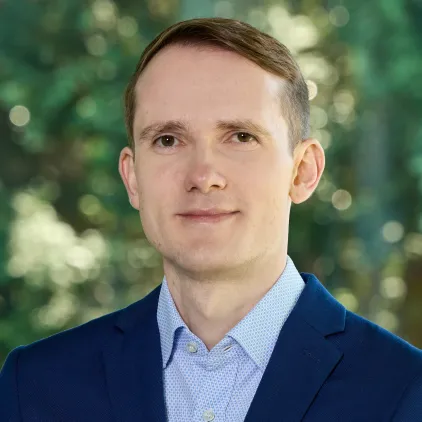
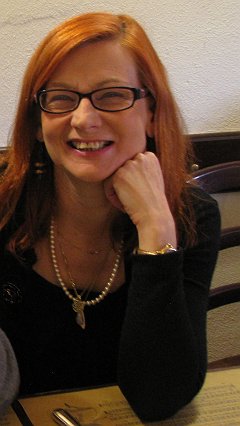
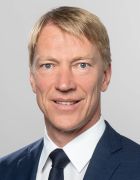
Torsten John is an Assistant Professor of Physical Chemistry at the School of Science, Constructor University Bremen gGmbH, Germany. His research bridges biophysical chemistry and computational chemistry to engineer biomolecular systems for biomedical applications. PhD in Chemistry (2020) from Leipzig University (summa cum laude) Postdoctoral experience at Max Planck Institute, MIT, and Leibniz Institute of Surface Engineering Research focuses on biomolecular self-assembly and membrane interactions , with implications for antimicrobial strategies , nanomedicine , and neurodegenerative diseases . Articles show interdisciplinary work combining experimental and theoretical approaches . Publications include high-impact journals like Advanced Functional Materials and Nucleic Acids Research . His group develops bionanomaterials using peptide nanofibrils and DNA origami, with applications in viral particle isolation and exciton transport . Collaborations span institutions in Germany, USA, and Australia. Teaching includes Physical Chemistry (CO-440) and Physical Chemistry Lab (CO-446-B) .
Prof. Dr. Simone Spuler is a leading researcher in muscle stem cell biology and gene therapy at the Experimental and Clinical Research Center (ECRC) in Berlin, jointly affiliated with Charité - Universitätsmedizin Berlin and the Max Delbrück Center for Molecular Medicine. She serves as Director of the University Outpatient Clinic for Muscle Diseases, focusing on translational approaches for genetic and age-related muscle disorders. Develops CRISPR/Cas9 and base editing therapies for muscular dystrophies (LGMD2A, Dysferlinopathy) Translates stem cell research into clinical trials like MuST and BASKet Validates GMP-compliant manufacturing of primary human satellite cells (PHSats) for ATMP applications Her research interests center on muscle stem cell heterogeneity, regenerative medicine, and epigenetic mechanisms in critical illness myopathy. Recent work explores: CRISPR editing of patient-derived stem cells Humanized mouse models for dystrophy validation Epigenetic reprogramming in ICU-acquired weakness Decellularization protocols for diaphragm repair She leads a multidisciplinary team working on: Genome editing of CAPN3, LMNA, and Dysferlin mutations Stem cell expansion using bacterial nanocellulose Development of regenerative therapies for urinary incontinence Scientific awards include: Science4Life Venture Cup 2019 (Pharma Category) NLSInvest Award 2022 Einstein Visiting Fellowship (2019-2022) Her clinical and entrepreneurial efforts involve founding the startup MyoPax , which develops stem cell therapies for incurable muscle diseases, supported by grants from the German Federal Ministry of Education and Research (BMBF) and Else Kröner-Fresenius Foundation (EKFS). The MuST clinical trial for epispadias patients is funded with €4.3M. Her team collaborates with patient organizations like Coalition to Cure Calpain 3 and Deutsche Gesellschaft für Muskelkranke .
Mirela Alistar is an Assistant Professor at the ATLAS Institute and the Department of Computer Science at the University of Colorado Boulder. She leads the Living Matter Lab , focusing on cyber-physical systems based on biochips to revolutionize healthcare diagnostics. Her interdisciplinary work bridges computer science, engineering, biotechnology, and bioart. Education : PhD in Embedded Systems Engineering (2010-2014, Technical University of Denmark), Postdoc in Human-Computer Interaction (2015-2018, Hasso Plattner Institute). Her research advances digital microfluidics and fault-tolerant biochips , enabling at-home diagnostic tools like OpenDrop . She also explores bioart through installations such as Semina Aeternitatis and Perfume Distillation Machine . She co-founded >top , a Berlin-based art & science project space, and advises startups digi.bio and bold.health . Her UIST'16 Honorable Mention Award highlights her innovative contributions. The Living Matter Lab under her leadership investigates interactive biodesign , combining technical precision with creative exploration of living systems.
Dr. Dietmar Schlosser is a Group Leader in Environmental Mycology at the Department of Applied Microbial Ecology within the Helmholtz Center for Environmental Research - UFZ since 2005. His research program focuses on fungal biodegradation of environmental pollutants, particularly synthetic polymers, micro-pollutants, and recalcitrant organic compounds. Education : Diploma in Biology (1990), Friedrich Schiller University Jena PhD in Technical Microbiology (1993), Friedrich Schiller University Jena His research integrates ecological principles with applied biotechnology , emphasizing fungal biochemistry, physiology, and enzymology. Key projects include: TapNature (2021-2027): Exploiting natural fungal systems for bioeconomy FINEST Microplastics (2022-2027): Sustainable materials management PUreValue (2024-2027): Polyurethane biodegradation for upcycling CLEANER (2023-2026): Water cycle resilience in cities Article trends reveal expertise in mycoremediation , lignocellulose valorization , and fungal attack on synthetic polymers , with recent work spanning environmental engineering, microbiology, and biochemical monitoring techniques. He maintains active collaborations with institutions across Europe and contributes to sustainable technology development through his leadership in Environmental Mycology .
Carlos Alberto Guzmán is a prominent researcher whose work spans immunology, virology, and biomedical research, with significant contributions to vaccine development and immune response modulation. His research focuses on innovative strategies for combating viral infections such as SARS-CoV-2 and influenza, leveraging computational modeling, adjuvant development, and RNA-based vaccine platforms. Editorial roles: Review Editor for Microbial Immunology (Frontiers in Immunology) and Guest Associate Editor for Virus and Host (Frontiers in Cellular and Infection Microbiology) His recent publications highlight interdisciplinary approaches integrating immunology, virology, and computational biology to address challenges in vaccine design and inflammatory response regulation. While his institutional affiliation is not explicitly stated, his collaborative work extends to fields like biobanking, radiation-induced viral inactivation, and neonatal immunization.
Quim Peña is a postdoctoral researcher at the Department of Experimental Molecular Imaging (RWTH Aachen University). He obtained his PhD in Chemistry from Universitat Autònoma de Barcelona (Spain) and Aix-Marseille Université (France) in 2019, focusing on metal-based chemotherapeutics. Current research focuses on nanomedicine for enhanced drug delivery in cancer therapies Specializes in polymeric micelles and prodrug synthesis Recent work involves RGD-coated microbubbles and ultrasound-mediated delivery Contributed to 89Zr-radiolabeled micelle development for personalized breast cancer treatment His publications (2021-2025) emphasize polymer-drug conjugates , multidrug delivery systems , and theranostic applications . Collaborative projects include collaborations with Twan Lammers, Fabian Kiessling, and Josbert Metselaar. 2025: Hydrophobic ion pairing for micelle drug co-loading 2025: Multidrug micelles for brain tumor treatment 2024: RGD-coated microbubbles for blood-brain barrier delivery 2023: Transformative materials for interfacial drug delivery Scientific recognition includes the 2025 CRS Award for best short talk . His work targets cancer nanomedicine with emphasis on side-effect reduction through advanced delivery systems.
Antje Kley is a Professor of North American Literary and Cultural Studies at the University of Erlangen-Nuremberg (FAU). Her academic leadership includes serving as Chair of American Studies (Literary Studies) since 2009 and roles such as Vice President for Teaching and Student Affairs. Education: University of Mannheim (English, American Studies, German Studies), Emory University (Women’s Studies), School of Criticism and Theory. Her research spans contemporary US-American novels, focusing on ethics , media theory , autobiographical writing , and the politics of death . She explores transculturality , gender studies , and literature's role in public debates . The articles highlight trends in death studies , science-literature intersections , and public humanities , with keywords like American Literature, Ethics, and Media History. Subfields include bio-objects, end-of-life narratives, and interdisciplinary knowledge production. Scientific awards: Fritz Thyssen Lesezeit Stipend (2020), Fellow of the German National Academic Foundation. She leads collaborative research groups such as GRK 2806 on Literature and the Public Sphere.
Ali Ertürk is a Professor at Helmholtz Zentrum München, serving as Director of the Institute for Tissue Engineering and Regenerative Medicine (iTERM). His work bridges cutting-edge technology and biomedical innovation, focusing on tissue clearing, spatial-omics, and AI-driven analysis to map biological systems at unprecedented resolution. His research spans three primary areas: Cellular & Systems Neuroscience Theoretical Neuroscience & Technical Applications Biomedical Neuroscience Keywords include tissue clearing, organoids, and neurodegeneration. Selected publications highlight advancements in vDISCO imaging, SHANEL protocols, and AI applications for cancer and neurodegenerative diseases. Graduated students include Dr. Chenchen Pan and Dr. Ruiyao Cai.
Claudia Johanna Gallert is a Professor in the Department of Technology at the University of Applied Sciences Emden/Leer, where she specializes in Microbiology and Biotechnology. She is actively involved in the Environmental Microbiology research group and contributes to key research areas such as renewable raw materials, fermentation, and biological waste treatment. Her research focuses on environmental microbiology and biotechnological applications, particularly in the context of sustainable waste management and resource recovery. She is a member of several professional bodies including the DWA Technical Committee KEK-4 "Mechanical and Biological Waste Treatment", DWA Working Group KEK-4.2 "Fermentation", and the VAAM (Society for General and Applied Microbiology), reflecting her strong engagement in the scientific community. Prof. Gallert has contributed to various research projects such as SUPER, Safe DIET, PIRAT-System, SchussenAktivplus, and studies on propionic acid metabolism. Although specific publications are not listed in the source text, her work spans applied microbiology, bioprocess engineering, and circular economy technologies. Her involvement in technical committees indicates peer recognition and leadership in her domain. ORCID: 0000-0002-8906-6756 Scopus ID: 6603577866 ResearchGate: Claudia Gallert She advises students and leads research initiatives in environmental biotechnology, though no named students are listed. Her work is supported by institutional laboratories and collaborative research frameworks. Prof. Gallert is also engaged in practical engineering applications through student projects and thesis supervision in biotechnological processes. The laboratories under her department include the Microbiology Laboratory and facilities related to bioengineering and analytical instrumentation. These support hands-on education and applied research in sustainable technologies.
Prof. Dr. Tsing Young Dora Tang is a Professor of Synthetic Biology at Saarland University's Faculty of Natural Sciences and Technology, with a dual appointment at the Max Planck Institute of Molecular Cell Biology and Genetics (MPI-CBG). She leads the interdisciplinary Tang Lab, which focuses on building minimal synthetic cellular systems through bottom-up approaches. Her research interests span synthetic biology, biochemistry, and biophysics, with particular emphasis on compartmentalization in biochemical processes , non-equilibrium behavior in synthetic cellular systems , and the physicochemical principles underlying modern biological systems . Her work bridges the gap between origin of life studies and artificial cell synthesis. Recent publications demonstrate her lab's expertise in lipid vesicle production, coacervate systems, and protometabolism. Her research employs innovative techniques including microfluidics, inverted emulsion methods, and cell-free expression systems to create and manipulate synthetic cellular components. Prof. Tang recently relocated her lab from Dresden to Saarland University, where they established new facilities in Building B2.2. The lab has been active in community events including the Cell Physics 2025 conference and regular Synbio Colloquia.
Elena Zucca is an Associate Professor in the Department of Computer Science, Bioengineering, Robotics and Systems Engineering (DIBRIS) at the University of Genoa, Italy. She has a strong research focus on programming languages, particularly in the areas of type systems, formal semantics, and coinduction. Her work bridges theoretical foundations with practical implementations, as evidenced by her publications on topics like Featherweight Java, corecursion, and soundness proofs for programming language features. Her research interests span the theoretical and practical aspects of programming languages. She investigates the formal semantics of programming constructs, particularly focusing on the boundaries between finite and infinite computations. Her work on coinduction and corecursion explores how to safely handle infinite data structures and computations. She has made significant contributions to understanding soundness in programming language features, especially in relation to resource-aware semantics. Her research often combines theoretical foundations with practical implementations, as seen in her work on Featherweight Java extensions and effect systems. Analysis of her recent publications reveals a consistent focus on advanced type systems and semantics. Her work explores the theoretical boundaries of programming language features while maintaining practical relevance. A recurring theme is the relationship between finite and infinite computations, with particular attention to soundness guarantees. Her research has evolved from foundational work on lambda calculus and object-oriented programming toward more specialized topics like graded types, coeffects, and resource-aware semantics. Elena Zucca has been actively involved in the programming languages research community, serving on program committees for major conferences including SPLASH, ECOOP, and POPL. She has mentored students through doctoral courses on Declarative Programming and (Co)Induction. Her research has been supported through participation in various academic programs, including the SEPL research program mentioned in her course materials. She teaches a diverse range of courses at the University of Genoa, from undergraduate to doctoral levels. Her teaching portfolio includes Automata Theory and Computability, Algorithms Analysis and Design, Principles and Paradigms of Programming Languages, and specialized doctoral courses on Declarative Programming and (Co)Induction. Her courses often reflect her research interests, covering theoretical foundations of programming languages, formal methods, and advanced programming paradigms.
Dr. Anna Taubenberger is a Research Group Leader at the Mildred-Scheel Nachwuchszentrum Dresden, affiliated with BIOTEC at Technische Universität Dresden. She leads the Oncomechanics research group focused on understanding the biomechanical properties of cancer cells and their microenvironment. Dr. Taubenberger received her PhD in Engineering from TU Dresden (2004-2009), studied at the University of Talca, Chile (2001-2002), and completed her Bioprocess Engineering degree at TU Dresden (1999-2004). She was a Postdoctoral Fellow at BIOTEC Dresden (2013-2020) in the Group of Cellular Machines under Prof. Jochen Guck, and previously at Queensland University of Technology (2009-2012) in the Group of Regenerative Medicine under Prof. Dietmar Hutmacher. Her research focuses on how mechanical properties of cancer cells and their surrounding tissue affect metastatic potential. The Taubenberger group employs a combination of atomic force microscopy and real time deformability cytometry to characterize cell mechanical properties. They develop physiologically relevant 3D in vitro models to study how cell and microenvironment stiffness influence tumor spheroid growth, invasion, drug resistance, and metastasis. Key research aims include investigating the link between microenvironment mechanics and spheroid behavior, testing the functional role of cell mechanics in cancer progression, and identifying clinical markers for individualized breast cancer therapy. Analysis of Dr. Taubenberger's recent publications reveals a consistent focus on the biomechanical aspects of cancer progression. Her work bridges engineering approaches with biological questions, particularly examining how physical properties of the tumor microenvironment influence cancer cell behavior. The research spans from single-cell mechanics to tissue-level organization, with a special emphasis on breast cancer models and the connection between mechanical stress and cellular responses. DFG postdoctorial fellowship Early career fellowship, QUT Australia Dr. Taubenberger's research is funded by various European and German institutions through the Mildred-Scheel Nachwuchszentrum Dresden. She actively recruits Master's and PhD students for her research group, indicating her commitment to mentoring the next generation of scientists. Her work combines expertise in bioengineering, cancer biology, and biophysics to address fundamental questions about cancer mechanics. The Oncomechanics lab utilizes advanced techniques including atomic force microscopy and real time deformability cytometry to characterize mechanical properties across scales, from single cells to complex tissues. The group collaborates with various institutions to develop innovative models for studying cancer progression and potential therapeutic approaches.
Andreas Fery is a Professor of Physical Chemistry of Polymeric Materials at the Technical University of Dresden and Head of the Institute of Physical Chemistry and Physics of Polymers at the Leibniz Institute of Polymer Research Dresden . His career spans leadership roles since 2015 at TU Dresden, prior professorship at the University of Bayreuth (2001-2015), and group leadership at the Max Planck Institute of Colloids and Interfaces (2001-2007). His research focuses on physical chemistry of polymers , nanofabrication , and nanophotonic materials . Recent work includes hybrid piezoelectric-trioboelectric tactile sensors , quantum dot metasurfaces , and structural analysis of metal-organic frameworks . Key subfields include nanoscale imaging , flexible electronics , and energy-efficient nanodevices . Recent publications highlight interdisciplinary advancements in nanomaterials and sensor technologies . Collaborations span institutions like Technische Universität Dresden , Leibniz Institute , and Max Planck Institute . He is affiliated with the Center for Regenerative Therapies Dresden and Center for Molecular and Cellular Bioengineering , though his core work remains in materials chemistry. Contact: andreas.fery@tu-dresden.de
Aniket Pal is a Junior Professor (Assistant Professor) at the Institute of Applied Mechanics (MIB) at the University of Stuttgart, where he leads the Soft Robot Mechanics Group. He holds affiliations with the International Max Planck Research School for Intelligent Systems (IMPRS-IS), Stuttgart Centre for Simulation Science (SimTech), and Centre for Bionic Intelligence Tübingen Stuttgart (BITS). His research focuses on soft robotics, mechanical metamaterials, and mechanical instabilities, with applications in bioengineering and wearable technologies. Education: PhD in Industrial Engineering from Purdue University (2015–2020) Bachelor of Engineering in Production Engineering from Jadavpur University (2010–2014) Dr. Pal's research interests bridge soft materials, robotics, and mechanical metamaterials, emphasizing applications in healthcare and autonomous systems. He explores omniphobic materials for smart bandages, magnetic putty for soft robotics, and hydrogel-based actuators. His work integrates mechanical computing and mechano-intelligence into functional materials. Notable contributions include waterproof electronic decals for biofluid monitoring, programmable magnetic devices, and low-cost smart bandage technologies. He is a recipient of the Humboldt Postdoctoral Fellowship (2020–2023) and has collaborated with the Max Planck Institute for Intelligent Systems. Labs/Teams: Soft Robot Mechanics Group at the University of Stuttgart Member of SimTech and BITS
Prof. Joachim Henkel is a Professor of Technology and Innovation Management at the Technical University of Munich (TUM), holding the Dr. Theo Schöller Endowed Chair. He specializes in patent management, standards, digitalization, and open innovation. Henkel earned his PhD in Economics from the University of Mannheim and habilitation in Business Administration from Ludwig Maximilian University of Munich. His research bridges strategic management, IP law, and innovation economics, with notable contributions to understanding patent ecosystems, open source development, and venture capital dynamics. He advises ICT firms on patent disputes and standards and has held visiting roles at MIT, Harvard, and Singapore Management University. Education: PhD in Economics (University of Mannheim, 1997), Habilitation in Business (LMU Munich, 2004), Physics Degree (University of Bonn, 1991). Research Focus: Standards essential patents (SEPs), innovation governance, and the strategic role of data in AI. Awards: Walter Rathenau Prize (2004), multiple paper awards, and recognition for contributions to open innovation and IP strategy. Grants & Collaborations: Editor of Academy of Management Discoveries , funded by DFG, Thyssen Foundation, and others. His work addresses blockchain-based trust systems, IoT licensing, and synthetic biology IP frameworks.