Christian Adam Olsen is a Professor at the Department of Drug Design and Pharmacology , University of Copenhagen. With a foundation in chemical synthesis, his research group develops peptidomimetic secondary structures and chemical tools to investigate human lysine deacylase enzymes, HDAC inhibitors, and quorum sensing modulators.
Esben Lorentzen is a Professor in the Department of Molecular Biology and Genetics at Aarhus University, Denmark, specializing in Protein Science. His research focuses on the molecular mechanisms of intracellular transport, particularly intraflagellar transport (IFT) in cilia. His research interests include: Intraflagellar Transport (IFT) and ciliary biogenesis Structure and assembly of IFT protein complexes Mechanisms of cargo recognition and transport in cilia Regulation of intracellular transport by small GTPases Structural biology of ciliary protein complexes Ciliopathies and disease mechanisms Professor Lorentzen's recent publications (2023-2025) show a strong focus on the structural organization of IFT complexes, particularly the role of RabL2-associated complexes at the ciliary base, mechanisms of cargo recognition (such as ODA16 release), and the regulation of intraflagellar transport. His work combines structural biology, biochemistry, and cell biology approaches to understand the molecular basis of ciliary function and dysfunction in disease. His scientific achievements have been recognized with several prestigious awards: EMBO Young Investigator (2012) Novo Nordisk Fonden Young Investigator Award (2016) F1000Research faculty member (2017) Professor Lorentzen has supervised multiple PhD students and has been involved in significant research collaborations internationally. His laboratory uses advanced techniques including protein co-expression, structural biology methods, and biochemical assays to study the molecular mechanisms of intraflagellar transport. His work has important implications for understanding ciliopathies - diseases resulting from ciliary dysfunction including blindness, obesity, mental disabilities, sterility, and cystic kidneys. His research group focuses on three main projects: 1) Assembly and structure of the IFT machinery, 2) Recognition of ciliary cargo by the IFT machinery, and 3) Regulation of intracellular transport by small GTPases.
Peter Arendt Jensen is a Senior Researcher at the Department of Chemical and Biochemical Engineering at the Technical University of Denmark (DTU). His work focuses on experimental and theoretical research in combustion, pyrolysis, and gasification of biomass and waste fuels, with expertise in ash deposit formation, emission abatement, and catalysis. He contributes to UN Sustainable Development Goals related to clean energy and sustainable infrastructure. Affiliations: CHEC Research Centre, DTU Key Research Areas: Biomass Conversion, Waste-to-Energy, Catalytic Processes His recent publications (2025) emphasize advancements in clay calcination methods, intumescent coatings, and pyrolysis integration in cement plants. He supervises multiple PhD projects on topics like oxyfuel combustion, catalytic hydrodeoxygenation, and cement carbonation. Collaborations span international institutions, with a focus on sustainable materials and energy systems. Notable projects include optimizing clay-based cement additives, developing fire-resistant coatings, and exploring alternative fuels for cement production. His work bridges laboratory-scale innovations with industrial-scale applications, addressing global challenges in resource efficiency and emissions reduction.
Jakob Kjøbsted Huusom is a Professor at the Department of Chemical and Biochemical Engineering, Technical University of Denmark (DTU). His research emphasizes advanced process control, model development for the process industry, and sustainable technologies. He is affiliated with the KT Consortium PROSYS and the Process and Systems Engineering Centre (PROSYS), contributing to UN Sustainable Development Goals related to affordable energy and climate action. His work spans hybrid modeling approaches integrating AI with first-principles methods, optimization of industrial processes, and real-time adaptive systems. Current projects include MPC tuning algorithms, enzymatic biodiesel production control, energy-efficient distillation technologies, and electrification of industrial processes using renewable energy. As a supervisor, he guides multiple PhD students in topics such as risk monitoring, model-based digitalization, and Power-to-X applications. His research tools and methodologies address challenges in process identification, state estimation, and controller design, with a focus on scalability and real-world implementation. Collaborations include international teams in Julia-based simulation tools and hybrid neural network modeling. His contributions advance both theoretical frameworks and practical solutions for sustainable industrial systems.
Pernille Rose Jensen is an Associate Professor and Group Leader at the Department of Health Technology, Technical University of Denmark (DTU). Her work focuses on advanced NMR spectroscopy and hyperpolarization techniques to study metabolic processes in living systems. She leads the Magnetic Resonance Hyperpolarization & Metabolism group within the DTU Microbes Initiative. Research interests include metabolic pathway analysis, antibiotic tolerance mechanisms, catalytic reaction mechanisms, and applications of hyperpolarized 13C NMR. Her interdisciplinary approach bridges chemistry, microbiology, and bioengineering to address challenges in metabolic monitoring and drug efficacy. Key recent projects involve metabolic adaptations in Salmonella typhimurium, acid-catalyzed furfural oxidation pathways, and metabolic comparisons across diverse organisms. She supervises multiple PhD students exploring topics like intracellular NMR, bio-sourced product synthesis, and bacterial metabolism as drug targets. Jensen collaborates internationally on metabolic monitoring technologies and contributes to DTU's initiatives in microbial systems biology. Her lab develops novel NMR-based methods to visualize transient biochemical species and metabolic dynamics in real-time.
Dr. Ahmad Salim Al-Sibahi is an Assistant Professor in the Programming Language and Theory of Computation Section at the University of Copenhagen's Department of Computer Science. He is a core member of the Aleatory Science Team, focusing on probabilistic programming applications in protein folding and inference algorithm optimization. His work combines formal methods with practical machine learning frameworks like Pyro. Educational Background: PhD in Computer Science (2014-2017), IT University of Copenhagen MSc in Computer Science (2014), IT University of Copenhagen Postdoctoral Researcher at University of Copenhagen (2017-2019) Research Interests: His primary focus lies at the intersection of probabilistic programming and computational biology. He develops efficient inference algorithms for probabilistic models, particularly in protein structure prediction and voucher scanning applications. His earlier work includes formal verification of program transformations using inductive refinement types and static analysis techniques. Awards: Best Paper Award at GPCE 2018 Contributions: He contributed to dependently-typed language Idris and co-developed family-based model checking techniques. His research bridges theoretical programming language constructs with applied problems in bioinformatics and software modernization.
Aurélien Desoeuvres is a Postdoctoral Researcher (Research Fellow) at the Department of Materials and Production within Aalborg University's Faculty of Engineering and Science. He conducts research in the Section of Applied Systems Research, specifically the Artificial Intelligence for Operations Research group, with an office at Fibigerstræde 16, 9220 Aalborg Øst, Denmark. His academic foundation includes a PhD in System Biology, transitioning from pure mathematics to applied mathematics with expertise in modeling and optimization methods. His research spans Artificial Intelligence, Operations Research, and Machine Learning, applied to System Biology and Chemical Reaction Networks. Key contributions include developing path planning algorithms, optimization techniques for dynamical systems, and AI-driven tools for scientific problem-solving. His work bridges theoretical mathematics with practical applications in healthcare and biochemical systems. Recent publications (2022-2024) demonstrate strong trends in AI/ML applications for oncology use cases and mathematical analysis of chemical reaction networks. He has pioneered semi-automated solution recommenders leveraging Scopus and OpenAI, alongside advanced methods for model reduction using conservation laws and tropical geometry. These works reflect interdisciplinary innovation at the intersection of computer science and life sciences. Desoeuvres actively collaborates internationally within the Artificial Intelligence for Operations Research group, focusing on applying AI to industrial optimization challenges and complex scientific modeling problems requiring novel computational approaches.
Dr. Jun Li is a Reader in the Department of Chemical and Process Engineering at the University of Strathclyde. He leads a bioenergy research group focused on decarbonizing energy systems through biomass and waste valorization, green hydrogen production, and advanced computational fluid dynamics (CFD) modeling. His work contributes to UN Sustainable Development Goals related to clean energy and climate action. Education: PhD from KTH Royal Institute of Technology (2014), MEng from North China Electric Power University (2010) Research interests span thermochemical processes, bioenergy technologies, hydrogen-rich syngas utilization, and techno-economic assessments. Key projects include biomass electrolysis for green hydrogen and leadership roles in the UK Supergen Bioenergy Impact Hub. Recent publications address hydrogen-LPG boiler performance, PEM fuel cell diagnostics, and lithium-ion battery health prediction. Awards include Best Presentation Prizes at ETP Annual Conferences (2022). Teaching modules include Clean Combustion Technologies and Chemical Engineering fundamentals. Supervised over 10 PhD students and research associates, with active roles in editorial and advisory boards.
Professor Birgitte Haahr Kallipolitis is affiliated with the University of Southern Denmark, where she serves in the Faculty of Science's Department of Biochemistry and Molecular Biology. Her research focuses on bacterial pathogenesis, RNA regulation, and antimicrobial resistance mechanisms. Research Pillars : Listeria monocytogenes virulence, RNA-mediated gene regulation, Staphylococcus aureus pathogenicity Key Projects : Investigation of fatty acid adaptations in Listeria (2024-2027), anti-virulence therapies (2021-2025) Collaborations : European PATHSENSE network, Newtec Engineering partnerships Recent publications highlight her work on RNA regulation of bacterial virulence factors, fatty acid impacts on pathogen invasion, and biofilm dynamics. Her research combines molecular biology with clinical microbiology perspectives. Scientific Recognition : Fyens Stiftstidende's Research Prize (2012) Active in academic service as peer reviewer and conference organizer, with media engagement on antimicrobial resistance topics. Maintains leadership role in Danish Ministry of Education-funded research initiatives.
Christian Damsgaard Jørgensen is an External Associate Professor at the Department of Mathematics and Computer Science, University of Southern Denmark. He holds a B.Sc. in Computer Science and an M.Sc. in Applied Mathematics. His interdisciplinary research bridges computational methods with biomedical applications. B.Sc.: Computer Science M.Sc.: Applied Mathematics Active in immunology and molecular medicine, his work focuses on autoimmune diseases like localized scleroderma and systemic lupus erythematosus, with a particular emphasis on nucleic acid antigens and autoantibody profiling. He also contributes to biochemical assay development for nucleic acid detection. Recent research trends include exploring the role of imprinted genes in metabolic disorders (e.g., Dlk1 in obesity/insulin resistance) and advancing tissue-engineered vascular grafts through meta-analytical techniques.
Jo Philips is an Associate Professor at Aarhus University's Department of Biological and Chemical Engineering. Her research specializes in microbial biotechnology for sustainable solutions, focusing on CO₂ conversion via electrosynthesis, gas fermentation, and microbial corrosion mechanisms. She integrates experimental work with mathematical modeling to optimize biotechnological processes. Research Focus Philips' work targets: Developing microbial systems for converting CO₂ into valuable products Investigating electron transfer in microbiological corrosion Optimizing gas fermentation through bioenergetic studies Engineering microbial electrosynthesis for renewable energy applications Awards and Grants Villum Young Investigator Grant (2023-2027) AUFF Starting Grant (2019-2023) European Union Doctoral Network funding (TRAMPOLINe, 2025-2028) Projects She leads initiatives including: MES-MODEL: Mathematical modeling for microbial electrosynthesis (2022-2025) Scaling CO₂-to-methane conversion via electrosynthesis (2023-2025) Biofilm adhesion engineering for electroactive bacteria (2020-2024)
Jens Lykkesfeldt is a Professor at the Department of Veterinary and Animal Sciences, Faculty of Health and Medical Sciences (SUND) at the University of Copenhagen. He leads the Lykkesfeldt Lab, which focuses on disease mechanisms and therapy of major lifestyle-associated human conditions through in vivo experimental models, methods, and clinical trials. Dr. Lykkesfeldt also serves as Director of the LIFEPHARM Centre for In Vivo Pharmacology and heads the In Vivo Pharmacology PhD program. Dr. Lykkesfeldt's research focuses on redox imbalance in development and disease, particularly studying how oxidative stress - an imbalance in cellular redox homeostasis - contributes to chronic diseases including atherosclerosis and cancer. His work spans from primary cells and tissue culture to animal models and clinical trials, with key projects examining vitamin C deficiency, non-alcoholic fatty liver disease, and cardiovascular disease. His laboratory trains highly qualified students and junior scientists within pharmacology, toxicology, and biomedicine. His extensive publication record (over 280 research outputs) demonstrates a consistent focus on oxidative stress mechanisms, vitamin C pharmacology, and metabolic diseases. Recent publications (2024-2025) show continued emphasis on vitamin C research, fatty liver disease models, oxidative stress biomarkers in psychiatric conditions, and hormonal regulation in metabolism. His work bridges basic science with clinical applications, particularly in understanding how redox imbalances contribute to disease development. Dr. Lykkesfeldt serves as Deputy Editor-in-Chief of 'Basic and Clinical Pharmacology and Toxicology' and on editorial boards of 'Antioxidants' and 'In Vivo'. He is an active member of several professional societies including the American Society of Nutrition, European Atherosclerosis Society, and the Society for Radical Biology and Medicine. As head of the In Vivo Pharmacology PhD program and Director of the LIFEPHARM Centre, Dr. Lykkesfeldt oversees significant research training and collaborative efforts. His laboratory receives funding from multiple sources including pharmaceutical companies like Novo Nordisk and H. Lundbeck, as well as research organizations like Nordic Bioscience and Chr. Hansen. The Lykkesfeldt Lab operates within the Department of Veterinary and Animal Sciences at the University of Copenhagen, utilizing specialized facilities for in vivo pharmacology research. The lab collaborates extensively with both national and international research groups, particularly in the areas of redox biology and metabolic disease research.
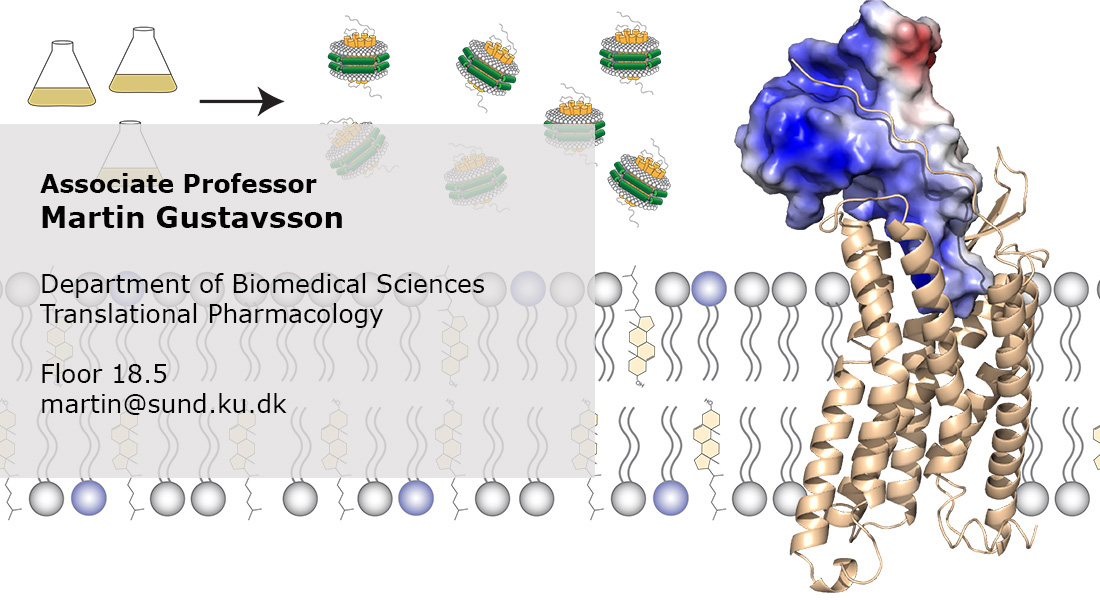
Martin Gustavsson is an Associate Professor in the Department of Biomedical Sciences at the University of Copenhagen's Faculty of Health and Medical Sciences. He leads the Gustavsson Group within the Molecular and Translational Pharmacology research theme, focusing on G protein-coupled receptor (GPCR) structure, dynamics, and function. His educational background includes: PhD in Biochemistry, Molecular Biology and Biophysics from the University of Minnesota (2007-2012) Master of Science in Chemical Biology from Linköping University, Sweden (2002-2007) Postdoctoral work at the University of California San Diego (2013-2019) Gustavsson's research focuses on understanding the molecular details of GPCR function and regulation, with particular emphasis on structural biology, receptor pharmacology, and chemokine receptor signaling. His work combines protein expression and purification techniques with functional characterization through binding and signaling assays (BRET, FRET, radioligand binding, SPR) and structural analysis (cryo-EM, NMR). GPCRs are important therapeutic targets, representing the focus of approximately 30% of approved drugs. His recent publications demonstrate a strong focus on chemokine receptor structure-function relationships, phosphorylation effects on receptor signaling, and the role of membrane environment in receptor function. The research shows progression from structural characterization to functional implications in cellular physiology, with particular attention to how post-translational modifications create molecular 'barcodes' that regulate receptor activity. Scientific recognition includes: Carlsberg Foundation Research Infrastructure grant for "Uncovering the structural basis for RAMP regulation of G protein-coupled receptors" VILLUM Young Investigator Grant (2019-2024) for "Allosteric control of G protein-coupled receptors" Robertson Foundation/Cancer Research Institute Irvington Postdoctoral Fellowship American Heart Association Predoctoral Fellowship Gustavsson mentors several Master's students and postdoctoral researchers working on various aspects of GPCR biology. His research is supported by multiple grants that enable cutting-edge structural and functional studies of membrane proteins, with applications for developing new therapeutic approaches targeting these critical cellular signaling molecules. The Gustavsson Group operates within the Department of Biomedical Sciences, utilizing advanced facilities for protein expression, structural biology, and functional characterization of membrane proteins. The group collaborates extensively with other research teams both within the University of Copenhagen and internationally, particularly with the Rosenkilde Group on chemokine receptor research.
Stig Jørring serves as an External Lecturer in the Department of Cellular and Molecular Medicine at the University of Copenhagen, specializing in orthopedic trauma and bone healing research. His clinical focus centers on wrist injuries and fracture repair mechanisms. His research portfolio spans collagen metabolism in fracture healing, biomarker development for monitoring bone repair, and advanced surgical techniques for scaphoid nonunions. Key investigations include serum analysis of procollagen peptides, CT-scan prediction models for surgical outcomes, and comparative studies of arthroscopic versus percutaneous fixation methods. This work bridges biochemical markers with clinical orthopedics to optimize trauma recovery protocols. Publication analysis reveals enduring expertise in orthopedic biomarkers since the 1990s, with recent (2020-2021) emphasis on wrist trauma innovations. His foundational collagen metabolism studies remain highly cited, while current work integrates imaging technology with surgical intervention strategies for improved union rates in complex fractures.
Cuiwei Wang is a Guest Researcher at the Department of Plant and Environmental Sciences, University of Copenhagen, specifically within the Section for Transport Biology. Wang has been affiliated with the DynaMo center since January 2016 as a PhD Fellow, conducting research in plant biochemistry and metabolic engineering. Wang's educational background includes: PhD Fellow at University of Copenhagen (2016-present) Master of Engineering in Biochemical Engineering from Shihezi University & Beijing Institute of Technology, China (2010-2013) Bachelor of Engineering in Chemical Engineering and Technology from Shihezi University, China (2006-2010) Research interests focus primarily on plant specialized metabolism, with particular expertise in glucosinolate biosynthesis pathways. Wang's work combines genetic engineering approaches in both microbial and plant systems to understand and manipulate metabolic pathways. The research spans fundamental plant biochemistry and applied biotechnology, with implications for understanding plant defense mechanisms and developing crops with enhanced properties. Wang's publication record demonstrates expertise in metabolic engineering, with first-author papers on glucosinolate pathway engineering in yeast and plants. The research shows progression from fundamental enzyme characterization to pathway optimization and heterologous expression systems. Recent work has expanded into related areas including plant stress tolerance mechanisms and evolutionary aspects of plant membrane transporters. Wang has established collaborations with multiple research groups across different institutions, as evidenced by co-authorship on diverse projects spanning plant physiology, evolutionary biology, and molecular engineering. As a researcher, Wang has demonstrated technical proficiency in molecular cloning techniques, metabolic engineering, and analytical methods for characterizing plant specialized metabolites. The research program bridges fundamental plant science with potential biotechnological applications.