Giorgio De Pasquale is an Associate Professor at the Department of Mechanical and Aerospace Engineering (DIMEAS) of Politecnico di Torino, where he heads the Smart Structures and Systems (S3) Laboratory. He serves on the Interdepartmental Center J-Tech@PoliTO and holds a national habilitation for Full Professorship (2018). His research spans additive manufacturing, smart structures, energy harvesting, and wearable systems. Additive Manufacturing: Design for AM, multi-material joints, lattice structures Smart Systems: Native sensors in metals, structural monitoring Human-Machine Interface: Wearable bio-mechanical sensors, GoldFinger glove MEMS: Dynamic response, fatigue modeling Recent projects include MIMOSA (multimaterial aircraft components) and STARDUST (wearable rehabilitation devices). He has received awards from ASME, MESAP, and Accademia del Premio Sapio. Teaching roles include PhD courses on lattice structure modeling and MSc/BSc lectures on structural mechanics. Over 60 students have been supervised in his lab.
Fatema Albalooshi is an Assistant Professor in the Computer Engineering department at the University of Bahrain since 2015. She holds a Ph.D. in Electrical and Computer Engineering from the University of Dayton (2015) and an MSc in Electrical Engineering from the University of Nottingham (2009). Education: PhD, Electrical and Computer Engineering, University of Dayton (2015) MSc, Electrical Engineering, University of Nottingham (2009) BSc, Electrical Engineering, University of Nottingham (2009) Research Interests: Deep Learning Image Processing Computer Vision Biometrics Machine Olfaction Environmental Remote Sensing Peer Review Contributions: Applied Intelligence (5 reviews) Signal, Image and Video Processing (16 reviews) Electronics (1 review) Computers in Biology and Medicine (1 review) Email: falbalooshi@uob.edu.bh
Dr. Jean-Stephane Jokeit is a researcher at the Institute of Neuroinformatics (INI) within the Faculty of Computer Science at Ruhr University Bochum, holding a Dr.-Ing. degree from the institution. He actively teaches courses including Autonomous Robotics and Computational Neuroscience, with recent instruction documented through Summer Term 2019. Education: Dr.-Ing. (Doctor of Engineering) from Ruhr University Bochum His research bridges robotics and cognitive neuroscience through interdisciplinary investigations of naturalistic arm movement generation, dynamical field theory, and biologically plausible neural models. Key focuses include mathematical characterization of human motor control for robotic implementation, attractor dynamics for robotic navigation, and modeling of neural oscillators and visual systems. He emphasizes translating neurophysiological insights into functional advantages for artificial systems, particularly exploring how biological mechanisms can overcome limitations in current AI abstractions. Publication trends from 2012-2014 reveal concentrated work on bio-inspired robotics navigation, comparing potential fields with attractor dynamics and developing Braitenberg vehicle frameworks for workspace coverage. These studies demonstrate consistent application of dynamical systems theory across robotic platforms including manipulators, drones, and mobile vehicles. Dr. Jokeit actively mentors students through project offerings in robotics and cognitive systems, encouraging integration of theoretical concepts into practical applications. He emphasizes the pedagogical value of synthesizing academic knowledge through hands-on implementation. As a core member of the Theory of Cognitive Systems research group at INI, he contributes to the institute's mission of understanding natural cognition through experimental psychology, neurophysiology, and machine learning to develop novel artificial cognitive solutions.
Sung-Min Sohn serves as Assistant Professor in the School of Biological and Health Systems Engineering within Arizona State University's Ira A. Fulton Schools of Engineering. His research pioneers RF/analog/digital circuit innovations for biomedical imaging systems, with particular focus on advancing magnetic resonance imaging (MRI) hardware capabilities. His academic foundation includes a Ph.D. in Electrical and Computer Engineering from the University of Minnesota-Minneapolis (2013), complemented by master's and bachelor's degrees from Korea University, Seoul (2004, 2002). Prior to academia, he gained industry experience as a circuit design engineer at LG Electronics (2004-2007). Dr. Sohn's research centers on bio-inspired electronics for medical applications, specializing in simultaneous transmit-receive (STAR) MRI systems, automatic RF tuning/matching mechanisms, and novel coil architectures. His work bridges electrical engineering principles with clinical imaging needs to develop more accessible and efficient diagnostic hardware. Publication analysis reveals an evolutionary trajectory from consumer electronics (2003-2006) to specialized MRI instrumentation (2011-2016), demonstrating consistent innovation in RF component design, field uniformity optimization, and high-power circuit integration for medical imaging systems. His scientific recognition includes the prestigious NIH Pathway to Independence Award (K99/R00) in 2016, one of only five awarded that year in biomedical imaging and bioengineering. As Principal Investigator, Dr. Sohn leads the NIH-funded Automatic RF Signal Tuning project (K99EB020058). He also contributes to major collaborative initiatives including portable MRI development (R24MH105998) and ultra-high-field (9.4T) human MRI systems (R01EB006835), working with researchers at the University of Minnesota and Columbia University. His teaching portfolio spans undergraduate and graduate biomedical instrumentation courses with honors thesis supervision.
Chenyu Wen is an Assistant Professor at the Department of Electrical Engineering; Solid State Electronics , Uppsala University . His research focuses on: Solid-State Nanopores DNA Sequencing Technologies Signal Processing Algorithms Wearable Electronic Sensors His recent work explores neuromimetic tactile systems and machine learning applications for nanopore sensing. Key collaborations include researchers like Shiyu Li , Zhen Zhang , and Shi-Li Zhang . Publications span high-impact journals including Science , Nature Nanotechnology , and ACS Nano .
Rajnish Kaur Calay is a Professor at the Department of Building, Energy and Material Technology, UiT The Arctic University of Norway, based in Narvik. His work spans research and teaching in renewable energy systems, environmental engineering, and sustainable technology development. Affiliation: UiT The Arctic University of Norway Department: Building, Energy and Material Technology Location: Narvik Campus Research interests include microbial fuel cells (MFCs), phase change materials (PCMs) for cold climates, bioelectrochemical wastewater treatment, AI-driven energy systems, sustainable construction, and computational fluid dynamics. His projects focus on integrating biological processes with energy generation, such as ethanol production from syngas and hydrogen safety innovations. Recent publications highlight trends in MFC optimization (electrode/membrane modification, substrate analysis), AI applications for infrastructure monitoring (S-BIRD dataset, blockage detection), and sustainable energy solutions for cold regions (PCM windows, photovoltaic systems). He investigates material properties, reactor design, and environmental impacts using experimental and computational methods. Rajnish contributes to interdisciplinary projects like SPRING, One Health, PEERS, ACE, BRIDGE, and ENFORCE, emphasizing collaboration across energy, environment, and health domains. His work addresses techno-economic models for biomass gasification, hybrid fuel cell systems, and sustainable urban/rural development.
Dr. Tabbasum Naz is a Research Fellow at the Strathclyde Institute of Pharmacy and Biomedical Sciences , University of Strathclyde, United Kingdom. Her work bridges Artificial Intelligence , Internet of Things , and Health Informatics to advance pharmaceutical and biomedical research. Expertise : Ontology engineering, AI/ML for healthcare, sustainable manufacturing Collaborations : International partnerships in pharmaceutical data analytics SDG Contributions : Focused on sustainable medicines (SDG 3, 12) Her research emphasizes digital design for pharmaceutical quality, bio-inspired optimization in energy systems, and semantic frameworks for maternal health diagnostics. Recent publications highlight applications of AI in drug interaction modeling and IoT-enabled diabetes prediction. Contact: tabbasum.naz@strath.ac.uk
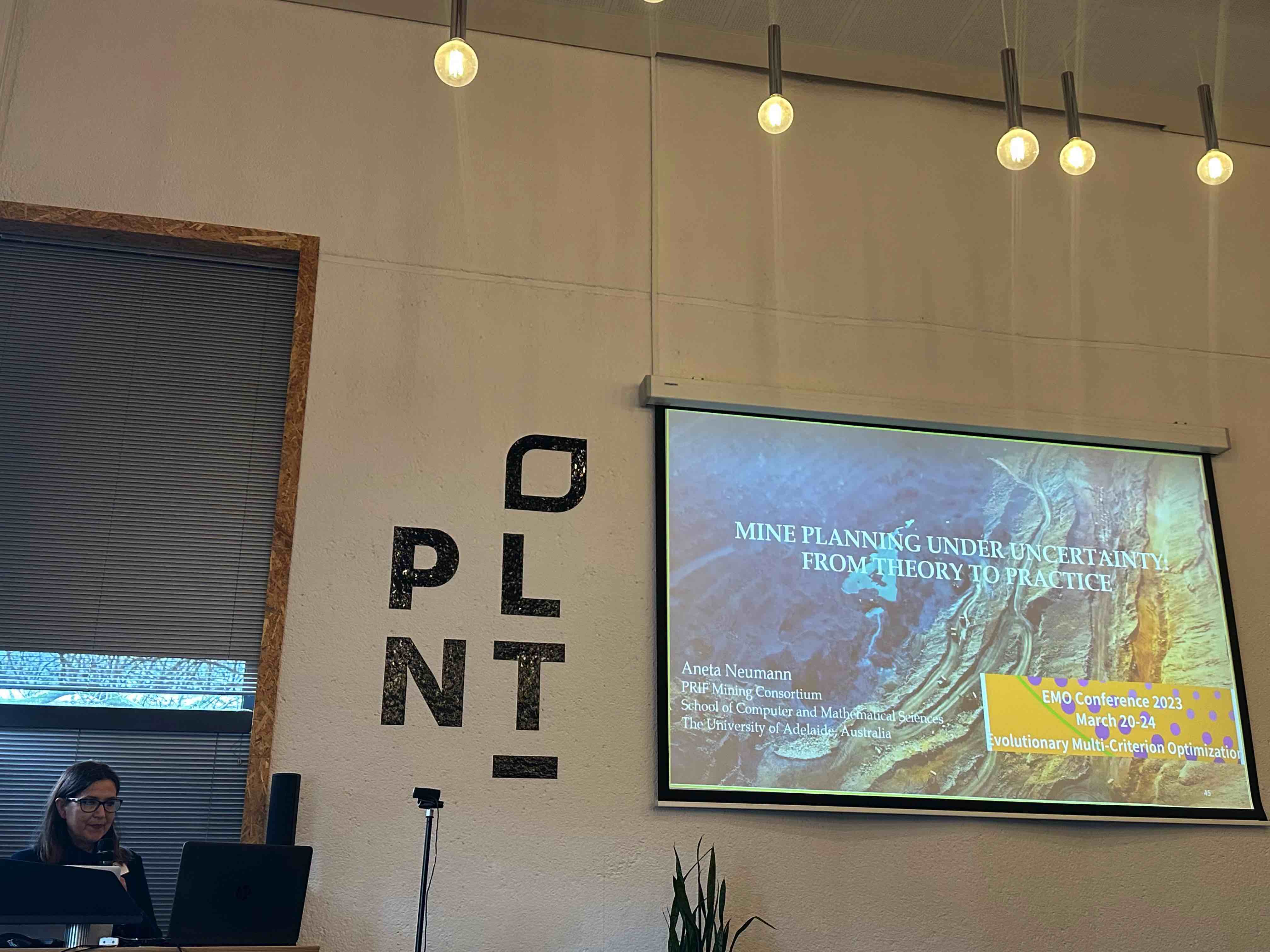
Aneta Neumann is a Researcher at the School of Computer and Mathematical Sciences within the University of Adelaide. Her work bridges bio-inspired computation with machine learning and computational creativity , focusing on dynamic and stochastic multi-objective optimization for real-world applications in mining, renewable energy, cybersecurity, and public health. Education : B.Sc. in Computer Science from Christian-Albrechts-University of Kiel, Germany; Ph.D. from University of Adelaide, Australia. Her research explores evolutionary diversity optimization to generate innovative solutions for complex problems like the Traveling Thief Problem , Chance-Constrained Knapsack , and Time-Use Planning . She investigates theoretical foundations through runtime analysis and applies these insights to industrial software integration in mining and energy sectors. Recent work emphasizes AI-based optimization trends , particularly in quantum computing benchmarks (e.g., Maximum Cut) and health outcomes via time-use scheduling. Her publications span top venues like GECCO , AAAI , NeurIPS , and Algorithmica . Scientific Awards : ACM-W Scholarship (2018), Hans-Juergen and Marianna Ohff Research Grant, Best Paper Award at GECCO 2024, multiple Best Paper Nominations at GECCO (2019, 2021, 2022). She co-organizes key conferences ( AI-OPT 2025 , EMO 2025 ) and serves as track co-chair for Genetic Algorithms at GECCO. Her teaching includes the Big Data Fundamentals course in the University of Adelaide's MicroMasters program.
Dr. A. Yousefzadeh is an Assistant Professor in Edge AI at the University of Twente (joined February 2024), affiliated with the Faculty of Electrical Engineering, Mathematics and Computer Science (EEMCS) within the Department of Computer Architecture Design and Test for Embedded Systems. He holds a Ph.D. in Neuromorphic Engineering from IMSE (Instituto de Microelectrónica de Sevilla), where his thesis focused on bio-inspired vision processing. His research specializes in neuromorphic computing systems, with emphasis on: Designing ultra-low-power AI processors and event-based vision systems Developing hardware accelerators for spiking neural networks (SNNs) Edge AI deployment for sensor-based applications Hardware-software co-design for energy-efficient computing His publication trends (2015-2025) reveal core foci on neuromorphic processor architectures (e.g., SENECA, NeuronFlow), event-based vision processing, hardware-aware neural network optimization, and 3D integration techniques. Recent work explores activation sparsification in transformers and hybrid analog-digital neuromorphic systems. Prior to academia, he contributed to industry neuromorphic projects: Architected the NeuronFlow processor at GrAI Matter Labs (acquired by Snap) Led SENECA processor development at imec's Hardware Efficient AI group He currently leads research on next-generation edge AI processors at UT's Embedded Systems lab.
Xiaoxuan Yang is an Assistant Professor in the Department of Electrical and Computer Engineering at the University of Virginia . Her research focuses on processing-in-memory-based system design , biologically plausible systems , and hardware accelerators for emerging applications. She has held postdoctoral positions at Stanford University's Robust Systems Group and served as a research scientist at the University of Virginia. Ph.D. : Electrical and Computer Engineering, Duke University M.S. : Electrical Engineering, University of California, Los Angeles B.S. : Electrical Engineering, Tsinghua University Her research integrates neuromorphic computing , LLM acceleration , and hardware-software co-design , with specific interests in ReRAM crossbars , photonic neural networks , and memristor synapses . Current projects address stochastic noise resilience , quantization optimization , and energy-efficient AI . The 15 most recent publications explore PIM architectures (38%), neuromorphic systems (30%), ML hardware (25%), and optical computing (7%). Key trends include large language model acceleration , hardware robustness , and emerging memory technologies . Third Place ACM Student Research Competition (ICCAD) Best Research Award ACM SIGDA Ph.D. Forum (DAC) Best Paper Award GLSVLSI 2025 Rising Star in EECS NSF iREDEFINE Fellow Machine Learning and Systems Rising Star Rising Scholars Postdoc Fellow
Timoteo Carletti is a Full Professor in the Department of Applied Mathematics at the University of Namur, Belgium, and a leading researcher at the Namur Institute for Complex Systems (naXys). He has been with the University of Namur since 2005, progressing from lecturer to professor in 2008 and Full Professor in 2011. Carletti co-founded the Namur Center for Complex Systems in 2010 and directed it until 2014. His academic journey includes postdoctoral research at Paris XI, IMPA in Rio de Janeiro, Scuola Normale Superiore in Pisa, and the University of Padova. Carletti earned his Master's degree in Physics from the University of Florence in 1995 and completed his Doctorate in Mathematics there in 2000 with a thesis on "Stability of orbits and Arithmetics for some discrete dynamical systems." His research spans diverse fields including biology, celestial mechanics, chaos detection, complex networks, control of systems, dynamic systems, economics, particle accelerators, and social dynamics. With over 150 publications and an h-index of 26 (2,450 citations), his work demonstrates significant impact in the field of complex systems. His research focuses on complex networks , synchronization phenomena , higher-order interactions , and pattern formation . Recent work explores synchronization in matrix-weighted networks, chimera states on directed hypergraphs, topological Dirac synchronization, and control strategies for desynchronizing Kuramoto oscillators. His publication record shows a clear evolution from traditional network analysis toward increasingly complex higher-order structures and topological approaches to understanding dynamical systems. Carletti has led numerous significant research projects including EMOTIONS (Emergent MOTifs in IntercONnected Systems), Be-neXst (Belgian advanced studies on compleX systems), and UNDER-NET (underground fungal networks). He served as President of the Graduate School FNRS "Non-linear phenomena, Complex Systems and Statistical Mechanics" from 2011-2017 and has organized major international conferences including ECCS12 in Brussels. As an educator, Carletti has supervised numerous PhD and Master's theses across mathematics, economics, biology, and computer science. His upcoming activities for 2025 include hosting researchers, delivering invited talks on global synchronization, and organizing the Perspectives in Nonlinear Dynamics conference and the International School and Conference on Network Science.
Prof. Thomas Ott is the Director of the Institute of Computational Life Sciences at the ZHAW School of Life Sciences and Facility Management. His research focuses on Bio-inspired Computing, Applied Neuroinformatics (including Pattern Recognition and Machine Learning), Modelling of Complex Systems, and Forecast Methodologies for Traffic/Logistics. He leads projects in AI-driven health systems, ecological sustainability, and industrial analytics. Ott has collaborated on over 50 peer-reviewed publications, with recent work emphasizing neuromorphic computing, predictive analytics in healthcare, and chaos-based network analysis. Education & Affiliations: His academic background includes prior roles at institutions like the University of Zurich and ETH Zurich. He serves on boards of Prognosix AG, Life Sciences Zurich Business Network, and Biotechnet Switzerland. Research Interests: Ott’s work bridges computational methods with real-world applications, such as AI for agriculture (fruit classification), predictive maintenance in healthcare systems, and traffic flow optimization. His team develops hybrid human-machine learning frameworks for complex decision-making processes. Projects & Grants: Key projects include 'Shapescience – AI for Morphologically-Based Fruit Recognition', 'Predictive Analytics for Hospital Supply Chains', and 'Smartstones - AI for Plant Breeding'. These reflect his focus on applied AI solutions for industry and public health. Labs & Teams: He oversees interdisciplinary teams at ZHAW’s Computational Life Sciences lab, integrating computer science, biology, and engineering for innovative problem-solving.
Dr. Alkiviadis Tsamis is an Assistant Professor in the Department of Mechanical Engineering at the University of Western Macedonia (Polytechnic School). His research focuses on the mechanics and engineering of soft biological materials, integrating multi-scale experimental and computational techniques. Key areas include ECM microenvironment characterization, fiber-reinforced biomaterials, and nanofabrication technologies. Educations: PhD in Biotechnology & Bioengineering (2010), École Polytechnique Fédérale de Lausanne (EPFL) Mechanical Engineering Diploma (2004), National Technical University of Athens (NTUA) Research Interests: Mechanical behavior of soft biological materials ECM microstructure analysis Fluorescence imaging techniques Bio-inspired material design Multi-scale modeling in biomechanics Notable Research Trends (2020–2025): Recent work emphasizes nanofiber-based drug delivery systems (e.g., PCL/PLGA/HA scaffolds), smart hydrogel materials with radiative cooling properties, and fibronectin-based biosensors for 3D strain mapping. Collaborations span biomechanical modeling of vascular systems and magnetoactive collagen hydrogels. Awards: Aging Cell’s Best Paper 2017 (2017) IEEE Award for Novel Scientific Project (2004) Teaching: Courses include Engineering Statics, Biomedical Engineering, and Tissue Biomechanics at postgraduate level. Active in curriculum development for additive manufacturing and mechanical design.
Chien-Chung Shen is a Professor and Associate Chair for Undergraduate Studies in the Department of Computer and Information Sciences at the University of Delaware. His expertise spans mobile ad hoc networks, sensor networks, blockchain technology, federated learning, and cybersecurity. He holds a PhD from UCLA and MS/BS degrees from National Chiao Tung University, Taiwan. Education: PhD in Computer Science, UCLA MS & BS in Computer Science, National Chiao Tung University, Taiwan Research Interests: Next-generation wireless networks (e.g., 5G/6G, underwater acoustic networks) Cybersecurity frameworks for autonomous systems and metaverse Blockchain-based distributed systems and trust management Federated learning for edge computing and traffic prediction Grants & Collaborations: National Science Foundation (NSF): Projects on federated learning, secure education, and network protocols Army Research Lab: Tactical network management and bio-inspired protocols Cisco, MITRE, NASA, and industry partnerships for applied research Advising & Education: Current PhD advisees: Ehsan Memary, Hang Chen, Syed Ali Asif Over 25 former students placed in academia (e.g., universities in China, Thailand, South Korea) and industry (Google, Meta, Amazon) Teaching courses on networks, cybersecurity, blockchain, and distributed systems Labs & Teams: Leading interdisciplinary research on edge computing, vehicular networks, and metaverse security Collaborations with international institutions like Korea Aerospace University and National Cheng Kung University
Arijit Banerjee is an Associate Professor in the Department of Electrical and Computer Engineering and Mechanical Science and Engineering at the University of Illinois at Urbana-Champaign, with a Grainger Associate appointment. His research focuses on advanced power electronics, electric drives, and renewable energy systems. Key areas include variable-pole induction machines, electromechanical actuators, and condition monitoring for power devices. He holds a Ph.D. in Electrical Engineering and has authored over 75 publications. His work bridges academic theory and industrial applications, addressing challenges in electric vehicle propulsion, offshore wind energy, and bio-inspired robotics. Research interests span: Electromechanical systems design High-efficiency power converters Reluctance machine optimization SiC MOSFET condition monitoring Recent articles emphasize variable-pole motor control, bioinspired actuators, and electro-thermal co-design. His NSF CAREER Award (2020) supports innovative electric propulsion research. Advising and grants include collaborations on EV drives, wind turbine systems, and fault detection algorithms. He leads interdisciplinary projects involving robotics and renewable energy integration.