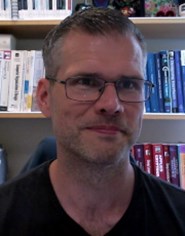
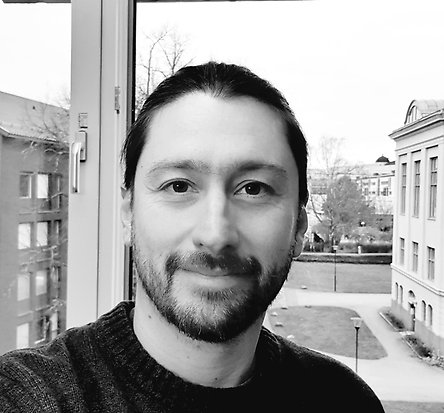
Tommy Löfstedt is an Associate Professor at Umeå University , affiliated with the Department of Computing Science and the Department of Mathematics and Mathematical Statistics. His research focuses on machine learning , computer vision , and medical image analysis , with applications in life sciences, radiation therapy, and biomedical imaging. He leads multiple research projects, including AI-driven delineation in radiation therapy, quantitative MRI for radiotherapy, and machine learning for plant nutrient uptake. Current research emphasizes structured regularization methods to improve model interpretability and robustness. Key applications include medical image segmentation , Alzheimer's classification , and uncertainty estimation in MRI . Recent publications highlight his work on morphological regularization , adversarial attack mitigation , and multi-task learning in medical imaging contexts. His projects span 2022–2026 with funding for pediatric oncology automation and gynecological cancer staging. Affiliated with both computing and mathematical departments, he bridges algorithm development with applied mathematical frameworks in medical and life science domains.
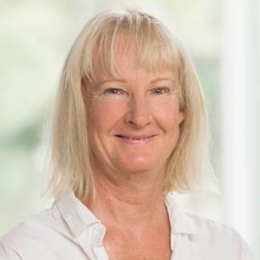
Annika Alexius is a Professor at the Department of Economics at Stockholm University, where she has been working since 2008. Prior to this, she held a research position at Uppsala University and completed her PhD at the Stockholm School of Economics in 1997, having done her internship at the Riksbank during her doctoral studies until 2001. Dr. Alexius earned her PhD from the Stockholm School of Economics in 1997. Her doctoral work included an internship at the Riksbank, Sweden's central bank, which she continued until 2001. She then held a research position at Uppsala University before joining Stockholm University in 2008. Professor Alexius specializes in empirical macroeconomics, monetary policy, and international finance. Her research examines the complex relationships between exchange rates and inflation, the dynamics of stock prices relative to GDP, and the mechanisms of monetary policy transmission. She employs sophisticated econometric techniques, including Bayesian VAR models with time-varying parameters and stochastic volatility, to analyze economic phenomena. Her work often focuses on how financial markets respond to economic shocks and policy interventions, with particular attention to the Swedish economy and its integration into the global financial system. Analysis of Professor Alexius's publication record reveals a consistent focus on the intersection of monetary policy and international finance. Her recent work (2023) examines exchange rate pass-through during periods of high inflation following the Covid-19 pandemic and Ukraine war, using advanced Bayesian VAR techniques. Earlier publications explore long-run relationships between stock prices and GDP (2018), interbank market dynamics during the financial crisis (2014), and the relationship between exchange rates and long-term bonds (2012). A recurring theme throughout her career has been understanding how policy decisions affect economic outcomes in open economies. Professor Alexius has made significant contributions to the field of economics through her rigorous empirical work. While specific awards are not listed on her profile, her publications in reputable journals such as the Review of World Economics, Journal of Applied Finance and Banking, and Journal of International Money and Finance demonstrate recognition of her scholarly contributions. Though specific information about her advising activities is not provided on her profile, Professor Alexius has maintained an active research program spanning over two decades. Her work has addressed evolving economic challenges, from the financial crisis of the late 2000s to the recent inflationary period following the pandemic. Her research has practical implications for central banks and policymakers navigating complex economic environments. While specific laboratory or research team information is not mentioned in the available profile, Professor Alexius appears to collaborate with various researchers across her publication history, including Mikaela Holmberg, Daniel Spång, Helene Birenstam, and Johanna Eklund, among others. Her work bridges theoretical economic models with empirical analysis of real-world data, contributing to both academic discourse and practical policy understanding.
Malin Göteman is an Associate Professor at the Department of Electrical Engineering, Uppsala University. Her research focuses on offshore renewable energy systems, particularly modeling and optimizing large-scale wave power farms and analyzing their resilience to extreme weather conditions. Deputy Director, Center for Natural Disaster Studies (CNDS), Sweden Specialized in wave energy converter dynamics and hybrid offshore energy systems Collaborates on SPH-based numerical wave-current tanks and CFD validation Research Interests: She investigates wave energy farm interactions, hydrodynamic performance of floating platforms, extreme wave load modeling, and survivability strategies using machine learning. Her work spans renewable energy integration, coastal protection, and power system stability under extreme conditions. Recent Publications: Her 2025 articles address resilience of offshore energy systems to metocean extremes and reduced-order modeling via Bayesian design. Earlier works (2023-2024) cover SPH validations for floating wind-wave systems, neural network survivability approaches, and hybrid energy-water supply solutions. Collaborations: She works with international teams on projects like Lysekil wave energy test sites and DeepCwind floating platforms. Key areas include grid-connected wave parks, multi-fidelity surrogate modeling, and comparative studies on offshore wind dependencies.
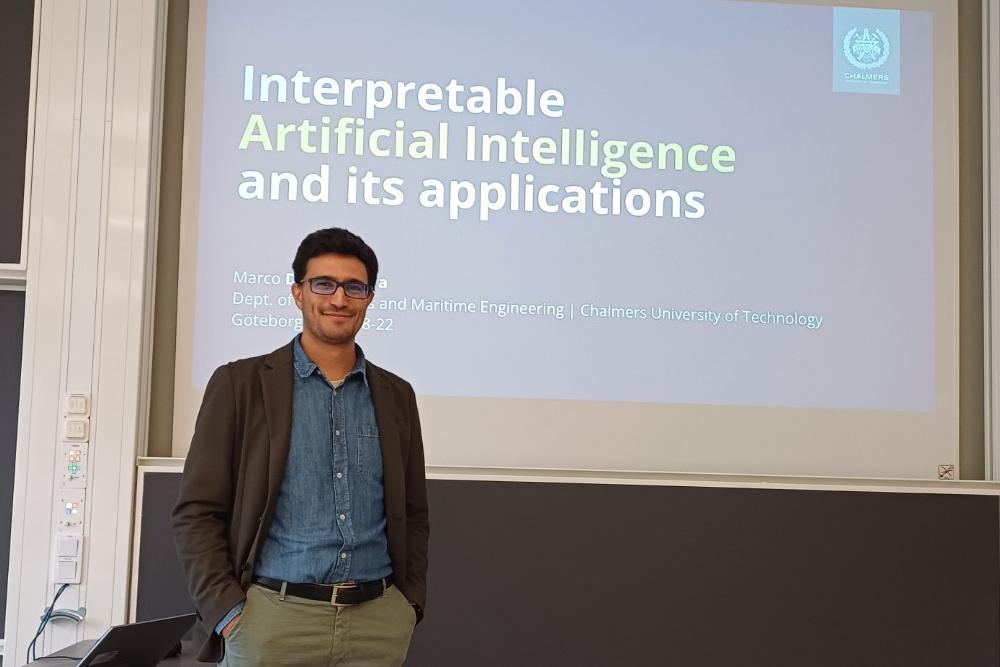
Marco L. Della Vedova is a Senior Lecturer in Applied Artificial Intelligence at Chalmers University of Technology, Sweden. He works in the Vehicle Engineering and Autonomous Systems division within the Department of Mechanics and Maritime Sciences, as part of Prof. Mattias Wahde's research group. Since 2025, he has served as Director of the Data Science and AI master's programme (MPDSC) at Chalmers, where he teaches courses including Introduction to Artificial Intelligence and Digitalization in Sports. Dr. Della Vedova earned his academic foundation at the University of Pavia, Italy, where he completed his BSc (2006), MSc (2009), and PhD (2013) in Computer Engineering. His doctoral research focused on "Real-Time Physical Systems and Electric Load Scheduling" under Prof. Tullio Facchinetti. During his PhD studies, he spent a year at U.C. Berkeley hosted by Prof. Francesco Borrelli at the Model Based Predictive and Distributed Control Lab. His research spans multiple AI domains with a strong emphasis on interpretability. Dr. Della Vedova develops interpretable methods for conversational AI, naturalness evaluation of forests using canopy height models, and geospatial applications. His work bridges theoretical AI with practical societal benefits, particularly in environmental monitoring, transportation systems, and orienteering. He has previously contributed to cloud computing, hate speech detection, and cyber-physical energy systems, demonstrating his interdisciplinary approach to AI research. Dr. Della Vedova's publication record reveals a consistent trajectory of impactful research across multiple domains of artificial intelligence. His recent work shows a strong focus on interpretability in AI systems, with significant contributions to natural language processing, geospatial analysis, and causal inference. The research demonstrates both theoretical depth and practical applications, particularly in environmental monitoring and social media analysis. His methodology often combines traditional machine learning approaches with novel interpretability techniques, creating bridges between complex AI systems and human understanding. Dr. Della Vedova has received several prestigious recognitions for his work: Best PhD thesis award from the Order of the Engineers of Bergamo (2013) Italian champion of Il Cervellone (2012) Top Italian performer in IEEEXtreme 6.0 programming competition (148th overall globally, 2012) Premio Arturo Schena award from Fondazione Credito Valtellinese (2010) With over 50 students supervised through bachelor's and master's theses, Dr. Della Vedova has established himself as a dedicated mentor in the AI community. His current PhD students include Minerva Suvanto working on interpretable NLP and Vivien Lacorre developing AI for railway infrastructure inspection. His supervision spans diverse topics from forest naturalness evaluation to hate speech detection and transportation optimization. Beyond formal supervision, he actively contributes to educational initiatives including serving as Director of Chalmers' Data Science and AI master's program and developing innovative teaching methods that connect theoretical concepts with real-world applications. Dr. Della Vedova is deeply embedded in both academic and professional communities. He leads the Applied Artificial Intelligence research group at Chalmers while maintaining strong connections with European research networks through projects like the ERASMUS+ EUrienteering initiative. His interdisciplinary approach is reflected in collaborations across computer science, environmental science, and social sciences. Notably, he applies his AI expertise to orienteering both as a researcher developing localization methods and as a licensed Event Advisor for the International Orienteering Federation, demonstrating how his professional and personal interests converge in innovative ways.
Summary Pawel Andrzej Herman is an Associate Professor at the Division of Computational Science and Technology within the School of Computer Science and Communication (CSC) at KTH Royal Institute of Technology. His research focuses on computational neuroscience, brain-inspired AI, and machine learning applications in healthcare and cognitive science. He teaches multiple courses including Artificial Neural Networks and Deep Architectures , supervises degree projects across computer engineering and electrical engineering disciplines, and actively contributes to interdisciplinary research initiatives. His work bridges theoretical neuroscience with practical AI solutions, emphasizing synaptic plasticity models, neuromorphic computing, and medical diagnostic systems. Key areas include olfactory perception modeling, working memory mechanisms, and FPGA-accelerated neural networks. He collaborates internationally on projects such as AI-driven medical imaging and cognitive neuroscience studies. Dr. Herman’s research has been published in high-impact journals and conferences, with recent contributions to understanding neural mechanisms of odor naming deficits, beta/alpha oscillations in working memory, and spiking neural network architectures. His technical leadership spans HPC frameworks like StreamBrain and interdisciplinary tools for scientific data storage (NoaSci).
Thomas Hellstrom is a Professor at the Department of Computer Science , Umeå University, Sweden. He leads the Intelligent Robotics group and is affiliated with the Center for Transdisciplinary AI . His research spans human-robot interaction (HRI) , deep learning applications , robot ethics , and field robotics for agricultural and forestry automation. Coordinated EU projects: INTRO (FP7/ITN), SOCRATES (H2020), CROPS, SWEEPER Developed intelligent walker for stroke patients with CMTS/MT-FoU/Umeå Stroke Center Key contributions in robot learning , causal reasoning , and natural language understanding Research Focus : His work emphasizes understandability in robot behavior, including causal modeling , multi-modal communication , and ethical frameworks for autonomous systems. Current project ROCC (Swedish Research Council) explores robot causality, while SOCRATES addressed social robotics in eldercare. Scientific Awards : • Erdös-Bacon-Sabbath number ≤ 13 Grants & Funding : • ROCC (2023, 3.7M SEK, Principal Investigator) • SCAI (2022, 3.7M SEK, Co-Applicant) • VINNOVA (2019, 3.47M SEK, Co-Applicant)
Mattias Villani is Professor of Statistics at Stockholm University, specializing in Bayesian statistics and machine learning. He obtained his PhD in Statistics from Stockholm University in 2000 and has held positions at Sveriges Riksbank and Linköping University. Villani develops computationally efficient Bayesian methods for inference, prediction and decision-making with flexible probabilistic models. Research Interests: His work spans Bayesian computation (MCMC, HMC, variational inference), machine learning (Gaussian processes, mixture models), and applications in neuroimaging, transportation, and econometrics. Research focuses on scalable Bayesian methods for large datasets and complex models. Publication Focus: Recent articles concentrate on Bayesian neuroimaging analysis, transportation network modeling, and efficient MCMC algorithms. Methodological innovations in subsampling techniques for large-scale Bayesian computation represent a significant research trend. Student Advising: Supervises PhD students in statistical methodology development and applications. Current research groups focus on spatiotemporal modeling, locally stationary processes, and neuroimaging statistics.
Tobias Andermann serves as an Assistant Professor at Uppsala University's Department of Organismal Biology, specializing in Systematic Biology. He leads the Biodiversity Data Lab, an interdisciplinary research group combining ecology, molecular biology, geomatics, and machine learning to address the biodiversity crisis through innovative computational approaches. His research focuses on quantifying biodiversity loss using AI-driven analysis of environmental DNA, remote sensing data, and fossil records. Key interests include modeling extinction rates across geological timescales, developing standardized biodiversity assessment methods, and predicting species distribution changes under anthropogenic pressures. His work demonstrates current extinction rates are 2000-10,000 times higher than natural background levels, comparable to historical mass extinction events. Methodologically, Andermann integrates machine learning with large-scale environmental DNA datasets and high-resolution remote sensing to develop predictive models of biodiversity distribution. His lab pioneers field sampling protocols for environmental DNA collection and AI frameworks that translate remote sensing data into biodiversity metrics for unsurveyed sites. The Biodiversity Data Lab maintains a dynamic, non-hierarchical research environment focused on high-impact solutions to the biodiversity crisis. Current projects include developing environmental DNA protocols for fungi and insects, analyzing land-use impacts on species communities, and creating neural network models for cross-scale biodiversity forecasting. The lab emphasizes practical applications for conservation policy, notably supporting the UN's 30% protected area target established at COP15.
Lennart Svensson is a Professor at Chalmers University of Technology in the Signal Processing research group. His work focuses on nonlinear filtering, multi-object tracking, Bayesian statistics, and deep machine learning with applications in autonomous systems and sensor fusion. Research Interests Nonlinear Filtering and Bayesian Inference Multi-Object Tracking and Sensor Fusion Deep Learning for Autonomous Systems Performance Metrics (GOSPA, T-GOSPA) Lidar-Camera Fusion and Radiance Fields 5G SLAM and mmWave Sensing Publications Trends Recent work emphasizes uncertainty-aware multi-object tracking metrics, trajectory estimation using Poisson Multi-Bernoulli Mixtures, and sensor fusion techniques for autonomous driving. His research integrates Bayesian methods with deep learning for applications in automotive radar, lidar, and 5G positioning systems. Contact Email: lennart.svensson@chalmers.se
Daniel Månsson is a Professor at the Department of Electrical Engineering, Royal Institute of Technology (KTH), specializing in smart electricity grids and power system components. His work spans electromagnetic compatibility (EMC) of large distributed systems, energy storage optimization, and privacy protection in smart metering. PhD in Engineering Physics (with specialization in Electromagnetism) Docent (Swedish Academic Title) in Electrical Engineering His research focuses on: Optimization of self-sufficient microgrids with energy hubs Smart meter privacy protection using energy storage EMC analysis of photovoltaic systems and UWB transients Hybrid energy storage system performance in renewable grids Recent publications indicate expertise in: Electromagnetic interference from solar PV systems Cyber-physical security in smart meters Conducted emission analysis Greenhouse gas reduction through optimized storage
Jonas Sjöberg is a Full Professor of Mechatronics at Chalmers University of Technology, where he leads the Mechatronic research group in the College of Engineering. His research spans multiple aspects of mechatronic systems with a strong focus on automotive applications. Sjöberg holds leadership roles in numerous research projects related to autonomous vehicles, vehicle control systems, and transportation safety. His research interests encompass a broad spectrum of mechatronics applications, with particular emphasis on model-based methods, signal processing, control systems, system identification, and optimization for design and product development of mechatronic systems. Sjöberg's work bridges theoretical control engineering with practical automotive applications, especially in the domains of Automotive Active Safety and Hybrid Electric Vehicles. Analysis of Sjöberg's recent publications reveals a strong research trajectory focused on autonomous vehicle technologies, with particular attention to vehicle dynamics control, intersection safety, road surface condition estimation, and optimization of vehicle maneuvers. His work demonstrates a consistent approach of applying advanced control theory to solve real-world transportation challenges, with increasing emphasis on machine learning techniques integrated with traditional control systems. Sjöberg actively supervises research and education at both undergraduate and graduate levels while leading multiple research projects funded by VINNOVA, the European Commission, and other organizations. His research group collaborates extensively with both academic institutions and industry partners in the automotive sector. His laboratory work focuses on mechatronic systems development, particularly for automotive applications including autonomous bicycles, bus docking systems, and vehicle control algorithms. The research group maintains strong connections with the automotive industry, particularly in Sweden's robust vehicle technology ecosystem.
Liqin Ding is a Research Fellow at the Department of Electrical Engineering at Chalmers University of Technology . She holds a Marie Skłodowska-Curie Fellowship and is actively involved in EU-funded projects like VoiiComm and Hi-Drive , focusing on vehicular communication systems and cellular positioning integrity. Previously, she was a postdoctoral researcher at Harbin Institute of Technology (Shenzhen) and a visiting researcher at Chalmers before transitioning to her current MSCA-IF position. Research Interests : Her work spans large antenna array-based communication , wireless propagation , vehicular networks , and cellular positioning . Key themes include 5G/6G protocols , channel modeling , and information theory for automated transportation systems. She specializes in Massive MIMO , DFT spreading , and integrity monitoring to enhance network reliability. Scientific Contributions : Recent publications address challenges in PAPR reduction for IoT, 3D antenna array bandwidth , UAV swarm communication , and Bayesian positioning algorithms . Her work bridges theoretical models (e.g., Shannon capacity) with practical applications in automotive connectivity and spaceborne antennas . Awards and Grants : European Union's H2020-MSCA-IF-2019 fellowship for VoiiComm project Funding from the European Commission (EC) for mobility research
Christian Müller is a Professor at Chalmers University of Technology since 2017, following roles as Assistant and Associate Professor there from 2012. He holds a Dr.Sc. in Materials Science from ETH Zurich (2008) and degrees from Cambridge University. His research focuses on physical chemistry of organic semiconductors, polymer blends, and composites, with applications in wearable electronics and energy technologies like organic solar cells and thermoelectrics. He leads a group developing novel materials for high-voltage insulation, plasmonic sensors, and sustainable energy solutions. Notable achievements include ERC Consolidator (2022) and Starting Grants (2014), SSF Future Research Leader (2016), and Wallenberg Scholar status (2021). Müller has authored over 180 papers and 3 book chapters, with 20+ patents. His work bridges fundamental material science and applied technologies, emphasizing conductivity, thermal stability, and functionalization. Recent articles highlight advances in organic solar cell stability, thermoelectric textiles, and high-voltage insulation materials. His research integrates computational methods (e.g., Bayesian modeling for glass formation) with experimental techniques (e.g., nanoindentation for elastic modulus analysis). Awards: ERC Grants, Wallenberg Scholar, SSF Leadership Patents: Over 20 inventions in polymer composites and energy materials Grants: Focus on sustainable energy systems and material innovation Labs/Teams: Active in Chalmers’ materials science groups, collaborating globally on organic electronics and thermoelectric textiles.
Carlos Guerrero Bosagna is a Senior Lecturer at Uppsala University's Department of Organismal Biology; Physiology and Environmental Toxicology. His research bridges evolutionary biology, epigenetics, and environmental science, focusing on how environmental exposures (e.g., toxins, stress) induce epigenetic modifications that influence developmental processes and transgenerational phenotypic variation. Role: Senior Lecturer, Uppsala University Department: Physiology and Environmental Toxicology Key Projects: Epigenetic stress response in chickens, metabolic/reproductive effects of environmental toxins, germline epigenetic variation in speciation His work has secured a FORMAS grant for modeling environmental toxicant impacts on chicken reproduction and metabolism. Recent publications analyze avian methylation patterns , mito-nuclear interactions , and Z-chromosome epigenetic regulation . Collaborations span poultry science, computational biology, and global environmental epigenetics research. Scientific awards include a FORMAS grant for environmental toxicology research His research emphasizes sustainability and evolutionary innovation, with lab projects tracking epigenetic changes across six generations to mimic early speciation events. Methodological contributions include protocols like GBS-MeDIP for concurrent genetic/epigenetic analysis.
Olle Häggström is a Professor of Mathematical Statistics at Chalmers University of Technology, specifically in the Department of Applied Mathematics and Statistics. His academic career spans several decades with a significant shift in research focus over time. Häggström's research interests have evolved from traditional probability theory to encompass broader future-oriented topics. Initially focused on mathematical statistics and probability theory, including percolation theory and stochastic processes, he has increasingly turned his attention to futurology, existential risk, and AI safety in recent years. His work demonstrates a unique interdisciplinary approach, bridging rigorous mathematical analysis with philosophical considerations about humanity's technological trajectory. The trends in Häggström's publications reveal a clear evolution from purely mathematical research toward interdisciplinary studies examining the societal implications of emerging technologies. His recent work focuses heavily on AI safety, existential risk assessment, and long-term futures thinking, while still maintaining connections to his mathematical foundations. This shift is evident in publications ranging from technical mathematical papers to broader philosophical discussions about technology's impact on civilization. Häggström has received research funding from notable sources including the FTX Foundation Future Fund for his project "Topics in the theory of xrisk and longtermism" (2022-2025), indicating recognition of the importance of his work in the existential risk community. His book "Here Be Dragons: Science, Technology and the Future of Humanity" (2016) represents a significant synthesis of his thinking on these topics. While specific details about his advising activities are not provided in the source material, his research projects suggest engagement with interdisciplinary teams working at the intersection of mathematics, computer science, and future studies. His work appears to influence both academic and policy discussions regarding technological risk and long-term planning.