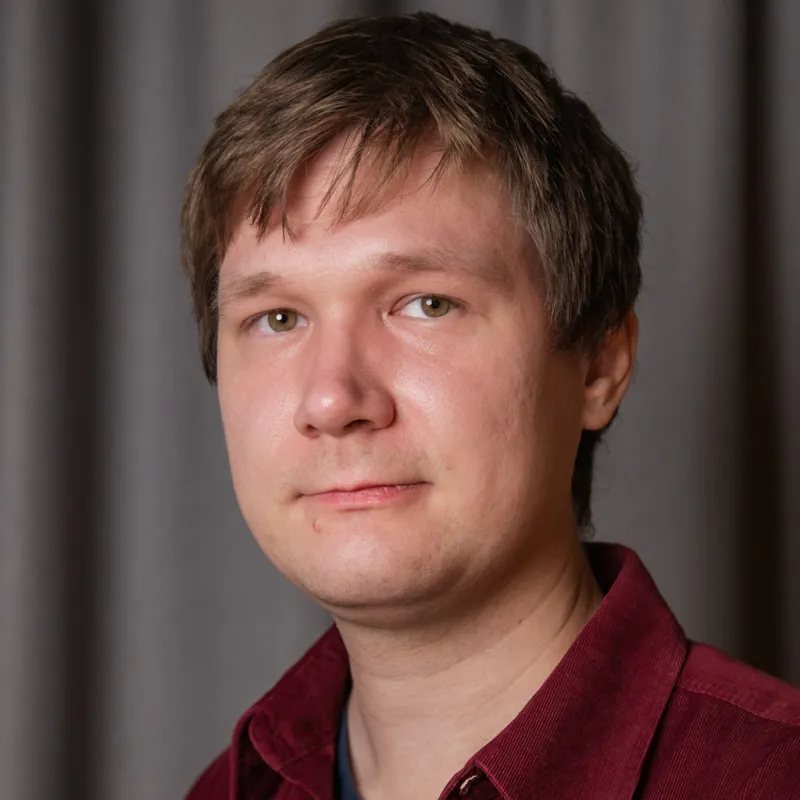
Eero Saksman is a Professor at the Department of Mathematics and Statistics , University of Helsinki . He is affiliated with the Faculty of Science and serves as a supervisor for the Doctoral Programme in Mathematics and Statistics . His research focuses on Mathematics , Statistics and probability , with specific expertise in Geometric Analysis , Partial Differential Equations , and Gaussian Multiplicative Chaos . Research Outputs : Active in 2025 with studies on stochastic pressure equations with log-correlated Gaussian coefficients, quasiconformal mappings in Triebel-Lizorkin spaces, Nevanlinna measures structure, and interdisciplinary projects like the Centre of Excellence in Randomness and Structures (FiRST) . Academic Collaborations : Involved in international collaborations with institutions such as Kings College London , EPFL , and University of Geneva . Scientific Awards : Recipient of the Lorenz Lindelöf Prize (2013) Magnus Ehrnrooth Prize (2018) Nevanlinna Prize for best dissertation (1995) Väisälä Prize for Mathematics (2007) Academic Activities : Regularly participates in conferences like the Barcelona Analysis Conference , Modern Aspects of Complex Analysis , and serves on doctoral evaluation committees.
Antti Honkela serves as a Visitor at Aalto University's Department of Computer Science and is deeply affiliated with the Helsinki Institute for Information Technology (HIIT), a joint research institute of Aalto University and the University of Helsinki. Within HIIT, he actively contributes to the Myllymäki Petri research group and leads the Probabilistic Machine Learning research group, focusing on advanced statistical methodologies. His research centers on machine learning with rigorous emphasis on differential privacy, Bayesian statistics, and probabilistic modeling. Honkela bridges theoretical innovation with biomedical applications, particularly in drug sensitivity prediction, genomic analysis, and privacy-preserving data sharing. His work addresses critical challenges in maintaining data utility while ensuring mathematical privacy guarantees for sensitive health information. Recent publications reveal a clear trajectory from foundational privacy mechanisms (e.g., FFT-based accounting) toward efficient biomedical implementations. His 10 publications between 2016-2021 demonstrate consistent output in top venues like Nature Communications and NeurIPS, with growing emphasis on transfer learning and distributed frameworks for real-world healthcare data. Scientific recognition includes: 2001 Year-End Thesis Award from CMCM, Center for Mathematical and Computational Modeling, University of Jyväskylä While specific student counts aren't public, his active research profile suggests ongoing supervision opportunities. Funding appears sustained through HIIT's infrastructure and competitive Nordic research grants, enabling work on privacy-preserving algorithms for genomic and clinical datasets. The Probabilistic Machine Learning group provides a collaborative environment leveraging Aalto University's computational resources and HIIT's interdisciplinary network. Lab activities focus on developing theoretically sound privacy mechanisms with practical biomedical impact, particularly in drug response modeling and genomic data analysis where privacy constraints are critical.
Jaakko Hollmen serves as a Senior University Lecturer in the Department of Computer Science at Aalto University, affiliated with the Helsinki Institute for Information Technology (HIIT) and the Computer Science Lecturers research group. His interdisciplinary work bridges machine learning with critical applications in healthcare, transportation systems, and environmental science. His research focuses on advanced machine learning methodologies including Bayesian optimization, random forests, and principal component analysis. Key application areas span neonatal healthcare (mortality prediction, brain injury analysis), transportation modeling (activity-based model calibration), and environmental data science (weather-crop relationships, drug-environment interactions). His approach emphasizes practical implementations of complex algorithms for real-world problems. Hollmen's recent publications (2018-2023) reveal a consistent trajectory in developing machine learning solutions for high-dimensional data challenges, with increasing emphasis on medical applications. His work demonstrates strong cross-domain collaboration, particularly with medical researchers at Helsinki University Hospital. His notable recognition includes: Best paper finalist and runner-up award (Computer Track) at the first IEEE Life Sciences Conference (LSC) for research on predicting complications in very low birth weight infants (2017) As a core member of HIIT, Hollmen contributes to Finland's national information technology research infrastructure while maintaining active collaborations with medical and agricultural research groups. His current projects focus on optimizing transportation models and advancing clinical prediction systems through novel machine learning techniques.
Toni Karvonen is an Assistant Professor of Applied Mathematics at LUT University's Computational Engineering Department, School of Engineering Sciences, since September 2024. His research focuses on statistics, applied mathematics, and computational methods with emphasis on Gaussian processes, uncertainty quantification, and kernel-based approximation. He has held postdoctoral positions at the Alan Turing Institute (2020–21) and the University of Helsinki (2021–24). Research Areas: Statistics and Probability, Applied Mathematics, Numerical Analysis, Gaussian Processes, Positive Definite Kernels Key Trends: His recent work explores probabilistic numerics, Bayesian quadrature, kernel methods for uncertainty quantification, and approximation theory in reproducing kernel Hilbert spaces. Email: Toni.Karvonen@lut.fi
Eero Hirvijoki is a Lecturer at Aalto University's Department of Energy and Mechanical Engineering within the School of Engineering. His research bridges plasma physics, fusion energy, and energy systems engineering. Research Interests: Plasma turbulence and confinement mechanisms in tokamaks Geometric numerical integration for Hamiltonian systems Hydrogen production and renewable energy integration Bayesian validation of plasma simulations Geothermal energy storage systems Recent Publications demonstrate expertise in computational methods for nuclear fusion, energy market analysis, and thermal engineering applications. No scientific awards were explicitly mentioned in the available data.
Indrė Žliobaitė is a Professor at the Department of Computer Science, Faculty of Science, University of Helsinki, and holds a Docent title in the same department. She maintains dual affiliations with the Department of Geosciences and Geography and serves as supervisor for both the Doctoral Programme in Geosciences and Doctoral Programme in Computer Science. Her research integrates data science and machine learning with earth sciences, focusing on evolutionary paleontology, macroecology, and macroevolution. She develops computational frameworks for analyzing fossil records, modeling species longevity, and reconstructing paleoenvironments, with specific applications in habitat suitability prediction and ecometric inference. Her work bridges algorithmic innovation with paleontological data interpretation. Recent publications reveal a cohesive trajectory where machine learning techniques—particularly probabilistic modeling and Bayesian approaches—are systematically applied to paleontological questions. This includes modeling fossil mammal community dynamics, inferring historical climate impacts on species distribution, and establishing quantitative laws for macroevolutionary processes, demonstrating how computational methods can unlock patterns in deep-time ecological data. Žliobaitė actively supervises doctoral candidates through two university programmes and leads the Academy of Finland project "Macroevolution of ecological relationships" (2023-2027). She collaborates internationally with the Turkana Basin Institute, Staatliches Museum Naturkunde Stuttgart, and Institut Catala de Paleontologia, and manages the New and Old Worlds Mammal Fossil Database (NOW), a critical infrastructure for paleontological research.
Markku Lanne is Professor of Economics at the University of Helsinki's Faculty of Social Sciences, where he has served since August 2010. He also holds the position of Vice-Dean for Academic Affairs of the Faculty of Social Sciences and leads the Financial and Macroeconometrics research group. His academic journey includes previous appointments as Professor of Empirical Macroeconomics at the University of Helsinki (2007-2010) and Professor of Economics and Finance at the University of Jyväskylä (2003-2007). He maintains adjunct professorships (docent) in econometrics at the University of Helsinki (since 2001) and in financial econometrics at Aalto University (since 2008). Professor Lanne's research focuses on advanced time series econometrics with applications in macroeconomics and finance. His work centers on structural vector autoregression models, non-Gaussian time series analysis, identification methods, and macroeconomic forecasting. His research has significant implications for understanding economic shocks, inflation dynamics, and the relationship between financial markets and the real economy. He has developed innovative approaches to identifying structural economic relationships using non-Gaussian features of economic data. Lanne's publication record shows a clear progression toward increasingly sophisticated methods for analyzing non-Gaussian economic time series. His recent work (2022-2024) demonstrates a strong focus on statistical identification of structural relationships using non-Gaussian features, particularly in the context of vector autoregressive models. This research has important applications for understanding macroeconomic shocks, weather impacts on economies, and improving economic forecasting methods. His scientific recognition includes: Alfred Kordelin Foundation encouragement prize (2011) Good Teaching Award (2014) Professor Lanne actively supervises doctoral students and serves as a pre-examiner for doctoral theses. He has secured significant research funding, most notably a major Academy of Finland project on structural analysis of non-Gaussian macroeconomic and financial time series (2022-2026). He regularly contributes to the academic community through peer review for top journals including Journal of Econometrics, Journal of Business and Economic Statistics, and Review of Economics and Statistics. He leads the Financial and Macroeconometrics research group at the University of Helsinki, which focuses on developing and applying advanced econometric methods to macroeconomic and financial problems. The group maintains active collaborations with researchers internationally and contributes to both theoretical advances in econometrics and practical applications in economic policy analysis.
Luigi Acerbi is an Associate Professor at the Department of Computer Science, University of Helsinki, leading the Machine and Human Intelligence research group. He is affiliated with the Finnish Center for Artificial Intelligence (FCAI) and ELLIS (European Laboratory for Learning and Intelligent Systems). His research focuses on probabilistic machine learning, statistical inference methods (e.g., amortized and surrogate-based approaches), and computational and cognitive neuroscience, including Bayesian models of perception and resource-constrained rationality. Previously, he held postdoctoral positions at the University of Geneva and New York University. He earned his PhD from the Doctoral Training Centre in Computational Neuroscience at the University of Edinburgh, working with Sethu Vijayakumar and Daniel Wolpert. His work includes developing open-source tools like BADS (Bayesian Adaptive Direct Search) and VBMC (Variational Bayesian Monte Carlo), widely used for optimization and Bayesian inference in MATLAB/Python. He actively contributes to the academic community through teaching (e.g., BAMB! 2022 summer school tutorials on model fitting) and software development (GitHub repositories for optimization, inference, and AI tools like Athanor). His research bridges machine learning, neuroscience, and cognitive science, emphasizing robust and efficient statistical methods.
Martino Ciaperoni is a Postdoctoral Researcher and Adjunct Professor in the Department of Computer Science at Aalto University. He is affiliated with the research group of Adj. Prof. Gionis Aris. His primary focus is on advancing interpretable machine learning, algorithm optimization, and data mining techniques. Ciaperoni holds a doctoral degree (Tekn. toht.) in Computer Science from Aalto University (2024) and a Doctoral degree in Engineering and Technology from Università degli Studi di Roma 'La Sapienza' (2019). His research emphasizes interpretability in AI, multi-label classification, and efficient algorithms for speech recognition and Bayesian networks. Recent work includes exploring the Rashomon set of rule-based models, developing low-memory Viterbi decoding algorithms (SIEVE), and solving the Hadamard decomposition problem. His research spans topics like core decomposition in temporal networks and low-rank matrix approximation. Collaborations include international projects in computational linguistics, knowledge discovery, and algorithm design. He has contributed to open-source software, such as the 'Efficient Exploration of the Rashomon Set' codebase (Zenodo). His work balances theoretical rigor with practical applications, aiming to bridge gaps between complex algorithms and real-world problem-solving.
Michael Mathioudakis serves as a Visiting Faculty member in the Department of Computer Science at Aalto University and is affiliated with the Adj. Prof. Gionis Aris research group and the Helsinki Institute for Information Technology (HIIT). His academic work spans multiple institutions and research collaborations focused on data-intensive computing and analysis. His educational background includes a Doctor of Philosophy from the University of Toronto, awarded on June 5, 2013. This foundation has enabled his research contributions across various domains of computer science and data analysis. Mathioudakis's research interests focus on Data Mining , Social Media Analysis , Text Mining , Social Network Analysis , and Bayesian Networks . His work explores the intersection of big data technologies with social phenomena, particularly examining how information flows through social networks and how probabilistic models can be optimized for real-world applications. His fingerprint analysis reveals significant contributions to Random Walk algorithms (100%), Social Network analysis (83%), Bayesian Networks (66%), and Big Data applications (33%). His publication record shows a consistent output from 2015-2022 with 22 total research outputs, including conference proceedings and journal articles. His work demonstrates a clear trajectory from foundational data mining research toward increasingly complex applications in social media analysis and urban informatics, with notable contributions to efficient algorithms for Bayesian network processing and social media content exposure systems. Mathioudakis has collaborated extensively with researchers across multiple institutions, as evidenced by his co-authorship on papers involving teams from various international organizations. His work contributes to UN Sustainable Development Goals, particularly in areas related to data-driven approaches to societal challenges.
Nguyen Tran is a Doctoral Researcher affiliated with the School of Business and the Department of Information and Service Management . Their work focuses on advancing robotic grasping and manipulation techniques through data-driven and physics-based approaches. Research Interests: Robotics, Soft Robotics, Machine Learning, Human-Robot Interaction, Haptics, and physical property modeling for robotic systems. Recent Work: Developments in deformable object manipulation, 6-DOF grasp sampling, and multi-fingered hand designs inspired by human anatomy. Technical Contributions: Novel algorithms like SPONGE for contact prediction, force control systems for safe grasping, and simulation-based quality metrics for deformable object interactions.
Petri Myllymäki is a Director at Helsinki Institute for Information Technology (HIIT) , Computer Science Adjunct Professors , and Finnish Center for Artificial Intelligence (FCAI) within Aalto University's School of Science, Department of Computer Science . His research focuses on Bayesian networks, information discovery, and interactive intent modeling . Active in ACM Transactions on Information Systems and SIGIR Conference publications Recipient of 2016 CPHC/BCS Academy of Computing Distinguished Dissertation runner-up and 2017 Kone Foundation Rajapinta award Collaborated with institutions like Stockholm University and researchers including Giulio Jacucci and Samuel Kaski His 15 most recent publications (2025-2015) span decision-making under conflicting objectives, machine learning applications in social science, Bayesian network structure learning algorithms , and cognitive modeling for exploratory search . Key technical subfields include hashing techniques, two-dimensional representation, computational efficiency, and user experience optimization . Scientific awards : 2016 CPHC/BCS Academy of Computing Distinguished Dissertation runner-up 2017 Kone Foundation Rajapinta award As an information discovery expert , he has contributed to open-access research through Interactive Visualization and Scinet frameworks, impacting Sustainable Development Goals related to digital innovation and knowledge dissemination.
Jouni Helske is an Academy Research Fellow in Statistics at the University of Turku, Finland, affiliated with the INVEST Research Flagship Centre. He leads the CAUSALTIME project and is a subconsortium-PI in the PREDLIFE consortium at the University of Jyväskylä. His work bridges statistical methodology and applied research in social sciences and epidemiology. Academy Research Fellow, University of Turku PI, CAUSALTIME Project Subconsortium-PI, PREDLIFE Consortium, University of Jyväskylä Associate Editor, The R Journal and rOpenSci Open Science Ambassador, Open Science Community Turku Education: PhD in Statistics, University of Jyväskylä, Finland (2015) Jouni Helske’s research centers on developing advanced Bayesian methods for causal inference, particularly using complex multivariate time series and panel data. His expertise includes state space models, hidden Markov models, computational statistics, and probabilistic programming. He is deeply involved in statistical software development, especially in the R ecosystem, contributing to open science and reproducible research. His applied work spans sociology, education, public health, and epidemiology, where he analyzes longitudinal and sequential data to understand causal mechanisms and life course trajectories. The recent publications highlight a strong trend in methodological innovation for causal analysis in panel data, spatio-temporal disease modeling, and R package development. His work integrates Bayesian computation with real-world applications, especially in social policy and health, using historical and contemporary data. The focus on dynamic multivariate models and sequence analysis underscores his leadership in modern statistical methodology for complex data. Scientific Awards and Recognition: Academy Research Fellow (prestigious research position funded competitively) Jouni Helske has led and contributed to major research projects such as CAUSALTIME and PREDLIFE, which aim to improve policy decisions through predictive modeling of life trajectories. He mentors and collaborates widely, evidenced by his numerous co-authored publications and software projects. While no formal students are listed, his role as a project leader and software maintainer suggests significant advisory and collaborative activity. He is a key contributor to the open-source statistical community, particularly through rOpenSci and Stan. Labs and Teams: He leads the CAUSALTIME project team and is part of the PREDLIFE research consortium. He is actively involved in the R and Stan developer communities, contributing to state-of-the-art Bayesian computational tools.