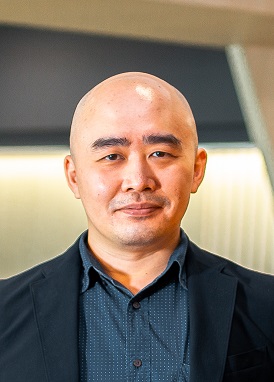
Amanda Parker is a Researcher in the School of Computing at the Australian National University (ANU). Her work focuses on applying machine learning to materials science and nanotechnology, with particular emphasis on nanoparticle design, multi-dimensional materials modeling, and computational chemistry. She has supervised research students and contributed to projects such as the 'Computing for Social Good Seed Grants 2023,' exploring efficient high-performance computing methods. Her research interests span machine learning algorithms, data-driven materials design, and the computational analysis of nanomaterials. Recent projects include developing graph-based representations for multi-dimensional materials and optimizing active learning strategies for scientific simulations. She has published extensively on topics like nanoparticle classification, interfacial informatics, and the prediction of material properties using Bayesian inference and neural networks. Her work bridges computational methods with experimental insights, aiming to accelerate the discovery of novel materials for energy, catalysis, and environmental applications. Current efforts emphasize minimizing experimental bias and enhancing computational efficiency through advanced machine learning techniques.
Scott McManus is a Lecturer in Spatial Science at Charles Sturt University, affiliated with the School of Agricultural, Environmental and Veterinary Sciences. He is an active academic researcher and educator, contributing to interdisciplinary studies that bridge data science, geostatistics, and Indigenous knowledge systems. PhD in Data Science, Charles Sturt University (2022) Graduate Certificate in Applied Statistics, CSU (2017) Graduate Diploma in Applied Science (Information Science), CSU (2005) Graduate Diploma in Archaeological Heritage, University of New England (2004) B.App.Sci in Applied Geology, CSU (1994) Scott's research focuses on the application of data science and machine learning in environmental and health contexts, with a strong emphasis on ethical AI, digital data sovereignty, and responsible use of data when working with First Nations communities. His work integrates Western scientific methods with Indigenous methodologies, particularly in conservation efforts such as koala habitat protection and mangrove ecosystem recovery. His recent publications and research outputs (23 total) demonstrate a consistent trend in merging geospatial analytics, Bayesian uncertainty modeling, and deep learning with ethical and cultural frameworks. Key areas include fire impact on coastal vegetation, river blockage detection in Southeast Asia, and reconciliation in science through collaborative Indigenous-Western research practices. Faculty Early Career Researcher (ECR) Scheme (2023) Open Access Publishing Scheme (2025) Conference Travel Grant (2018) CSU ILWS Category B Research Support Fund (2020) Executive Deans List (2017) Scott is a registered Professional Geologist (Australian Institute of Geoscientists), member of the International Association for Mathematical Geosciences, and the Aboriginal and Torres Strait Islander Mathematics Alliance. He serves as a Faculty representative on the Indigenous Board of Studies and is a registered supervisor. His work is supported by ongoing grants focused on AI, machine learning, and open-access research dissemination. He actively participates in academic workshops, particularly in digital learning platforms like Brightspace, and contributes to public engagement through media appearances on koala conservation and environmental stewardship. Scott is involved in the Data Science and Engineering Research Unit and the Data Mining Research Group (DaMRG) at CSU, where he contributes to projects on predictive analytics and responsible data use. His collaborative network includes researchers in environmental science, Indigenous studies, and conservation biology, reflecting his commitment to interdisciplinary and culturally responsive research.
Hannah Comiskey is a Research Fellow in the Department of Econometrics and Business Statistics at Monash University, within the Faculty of Business and Economics. Her research focuses on advanced statistical methods applied to global health and demographic data, particularly in reproductive health contexts. Her primary research interests lie in Bayesian hierarchical modeling, statistical demography, and public health analytics. She develops and applies sophisticated statistical models to estimate health indicators, especially related to contraceptive use and healthcare system contributions across countries. The recent publication in the Journal of the Royal Statistical Society Series A demonstrates a strong trend in using flexible Bayesian non-parametric models for health estimation, particularly in low-data settings. Her work integrates survey data from multiple sources to disentangle public and private sector roles in modern contraceptive supply. Hannah has actively contributed to academic discourse through presentations, including at the Annual Meeting of the Population Association of America (2022). While no formal advising or grant information is available, her collaborations with researchers like Leontine Alkema and Niamh Cahill suggest involvement in large-scale demographic estimation projects. She is part of an international research network focused on population health statistics, with external collaborations across multiple countries. Her work contributes to evidence-based policy in reproductive health through rigorous statistical inference.
Dr. Eric Howard is a Research Fellow at Macquarie University , affiliated with the School of Engineering , School of Mathematical and Physical Sciences , and School of Computing . His research spans interdisciplinary domains at the intersection of quantum physics, machine learning, and AI-driven systems. Key research themes include: Quantum cryptography for Industry 4.0 security Machine learning in IoT temperature sensing Adversarial AI in cybersecurity 6G wireless communication optimization Quantum information processing Deep learning for data imputation Recent publications demonstrate a focus on emerging technologies, with articles on quantum Bayesian inference , 6G signal processing , and smart city IoT systems . His collaborative work extends to blockchain-enabled supply chain visibility and generative AI applications in programming. Research collaborations span institutions in India (AIP Publishing) and Australia, with technical contributions to quantum dynamics, neural network applications, and nanosensor development.
Hasan Fallahgoul is currently a Senior Lecturer at the School of Mathematical Sciences, Monash University, and a member of the Monash Centre for Quantitative Finance. Prior to this, he held post-doctoral positions at the Swiss Finance Institute (EPFL) and the European Center for Advanced Research in Economics and Statistics (ECARES) at the Free University of Brussels, Belgium. Senior Lecturer, Monash University (2025–present) Post-Doctoral Researcher, Swiss Finance Institute (2024–2025) Post-Doctoral Researcher, ECARES (2023–2024) His research interests span Econometrics, Finance, Statistics, and Machine Learning, with a focus on Tail Risk, Neural Networks, and Fractional Calculus. Recent work integrates interpretable AI into asset pricing, develops significance tests for neural networks, and explores high-dimensional learning in finance. His recent article trends highlight applications of Machine Learning in financial econometrics, including state space models, Lévy processes, and tempered stable distributions. He has contributed to understanding complexity in financial models, significance testing frameworks, and the role of social signals in market dynamics. Hasan is supported by grants from the Australian Research Council (DP250100063) and the National Natural Science Foundation of China (72033002). He actively develops open-source tools like the SSMEfficientInference Python package for state space model analysis. He is affiliated with the Monash Centre for Quantitative Finance , where he collaborates on interdisciplinary projects involving econometrics, machine learning, and financial engineering.
Professor Taha Hossein Rashidi is a leading expert in Transport Engineering at the School of Civil and Environmental Engineering, University of New South Wales (UNSW), and a member of the Research Centre for Integrated Transport Innovation (rCITI). His work bridges disciplines like economics, statistics, urban design, and sustainability to advance smart-city solutions. Education : PhD, University of Illinois, Chicago (2011); MS Civil Engineering, Sharif University of Technology (2005); BS Civil Engineering, Sharif University of Technology (2003). His research focuses on travel behaviour analysis, activity-based travel demand modelling, integrated land use and transportation models, and autonomous driving technologies. He leads the rCITI Travel Behaviour Modelling Team, which includes 3 Post-docs, 7 PhD, and 3 MSc students. Recent work explores shared autonomous vehicles, social media data integration for transport models, and dynamic ride-sharing systems. His publications span topics like pedestrian demand modeling, residential relocation dynamics, and pandemic-related travel restrictions. Scientific Awards Fred Burggraf Award (TRB, 2008) Dwight Eisenhower Fellow (2008) ASCE Freeman Fellowship (2009) NSERC PDF Award (2012) Industrial RAND Fellowship (2012) Vice Chancellor’s Award for Teaching Excellence (2015, Team) Award for Engineering Education Engagement (2015, Team) Outstanding Paper (TRB Analytics Contest, 2017) He has secured over $1.2 million in research funding since 2007, including ARC DECRA and Linkage Grants. His teaching includes courses on geometric design, urban transport modeling, and transport econometrics.
Barry Drake serves as an Adjunct Professor in the School of Computer Science at the University of Technology Sydney (UTS), where he is also affiliated with the Faculty of Engineering and Information Technology and the Data Science Institute. Additionally, he holds the position of Co-Chief Scientist at the Digital Health Cooperative Research Centre and participates in government advisory committees. His career bridges academic research and industry application, with significant experience in translating research into practical technology solutions for business and government sectors. Drake earned his PhD in Computer Science from UNSW Australia (1998-2003) and a BSc with First Class Honors in Computer Science from UTS (1991-1996). His educational background is complemented by a Certificate of Proficiency for Radio Fitter/Mechanic Electronic Systems from the Royal Australian Navy. His research focuses on algorithms and software for practical smart systems, with particular expertise in applications of AI and machine learning, probabilistic inferencing and knowledge compilation, learning probabilistic models, and fast-efficient near-neighbor searching in ultra-high dimensional spaces. His work demonstrates a clear trajectory toward health informatics applications , especially in health systems and delivery of health services, where he has made significant contributions through projects like the Lumos statewide linkage programme. The analysis of his publication record reveals a consistent pattern of research bridging theoretical computer science with practical healthcare applications. His recent work shows increasing focus on health data integration, patient journey modeling, and privacy-preserving synthetic data generation for healthcare applications, while maintaining his foundational expertise in probabilistic models and efficient search algorithms. Inventor on 20 filed patents ORCID identifier: 0000-0003-0572-9936 Drake actively supervises Masters and PhD students according to his profile, and his funded research portfolio includes multiple grants from the Digital Health CRC and NSW Health. His industry experience, particularly his 13 years at Canon Information Systems Research Australia where he served as Senior Principal Engineer and lead researcher for machine learning, informs his approach to technology research methods from a commercial perspective. His current projects focus on the impact of integrated care in New South Wales, synthetic data generation, and patient journey modeling. As Co-Chief Scientist at the Digital Health CRC, Drake contributes to a major national initiative focused on digital health innovation. His work with the Lumos programme has created Australia's first statewide linked data asset across primary care and other health settings, providing unique insights about cross-setting healthcare utilization. This initiative represents a significant contribution to health data infrastructure in Australia.
Vahid Behbood is a Lecturer at the School of Computer Science within the Faculty of Engineering and Information Technology at the University of Technology Sydney (UTS). He belongs to the Decision Systems and e-Service Intelligence Research Laboratory in the Centre for Quantum Computation and Intelligent Systems. Ph.D. in Software Engineering from UTS (2014) His research spans machine learning , big data analytics , computational intelligence , and transfer learning , with a focus on addressing data shortage challenges through fuzzy systems and domain adaptation. His work includes: Advancing fuzzy regression domain adaptation for cross-domain prediction Developing granular computing techniques for financial failure prediction Exploring SQL query error patterns in computer science education Designing IoT architectural frameworks via systematic reviews Publications demonstrate expertise in neural networks , fuzzy logic , Bayesian methods , and financial data analytics . He applies these techniques to banking ecosystems, real estate valuation, and educational data mining.
Dr. Choo Chung Siung is a Senior Lecturer at Swinburne University of Technology Sarawak, Faculty of Engineering, Computing and Science, where he serves as Director of the Centre for Innovative Society. With 12 years of combined academic and industry experience, he teaches soil mechanics and geotechnical engineering to future civil engineers. Dr. Choo obtained his Bachelor of Engineering in Civil Engineering (1st Class Honours) in 2010 and completed his PhD at Swinburne University of Technology. His research focuses on tunnelling and trenchless technologies, numerical modeling of soil-structure interaction, machine learning applications in geotechnical engineering, upcycling industrial wastes for construction, and geoeducation innovations. Analyzing his recent publications reveals a strong emphasis on pipe jacking forces in weathered geological formations, with increasing integration of machine learning techniques in geotechnical analysis. His work bridges traditional geotechnical engineering with modern computational approaches, particularly in the context of Southeast Asian geological conditions. Vice-Chancellor's 2019 Industry Engagement Award (Highly Commended), Swinburne University of Technology International Convention Scholarship Award (ICSA) 2019/2020, Sarawak Convention Bureau Best Civil Engineering Graduate 2010, Cahya Mata Sarawak IEM Gold Medal Award 2009, Institution of Engineers Malaysia Dr. Choo actively supervises research students and has secured multiple research grants from both industrial sources and the Ministry of Higher Education's Fundamental Research Grant Scheme. His professional engagement extends to numerous industry organizations, where he serves as a committee member and technical expert. As Director of the Centre for Innovative Society, he leads interdisciplinary research initiatives that address regional engineering challenges.
Christopher Drovandi is a Professor at Queensland University of Technology and a Chief Investigator in the Australian Research Council Centre of Excellence for Mathematical and Statistical Frontiers (ACEMS). His research spans statistical methodology development and applications across diverse fields including ecology, biomedicine, and environmental science. Dr. Drovandi's primary research interests focus on advancing Bayesian statistical methods, particularly in the areas of: Approximate Bayesian Computation (ABC) and likelihood-free inference Synthetic likelihood methods Sequential Monte Carlo algorithms Bayesian experimental design Statistical computing for complex models His recent work demonstrates a strong emphasis on addressing model misspecification in Bayesian inference, developing robust computational methods for intractable likelihoods, and applying advanced statistical techniques to solve real-world problems in ecology, biomedicine, and environmental science. Drovandi has made significant contributions to both the theoretical foundations and practical applications of modern Bayesian statistics. Dr. Drovandi has received research funding through multiple Australian Research Council grants and collaborates extensively with researchers across disciplines. His work has been published in top-tier statistical and interdisciplinary journals including the Journal of the American Statistical Association, Bayesian Analysis, and PLOS Computational Biology.