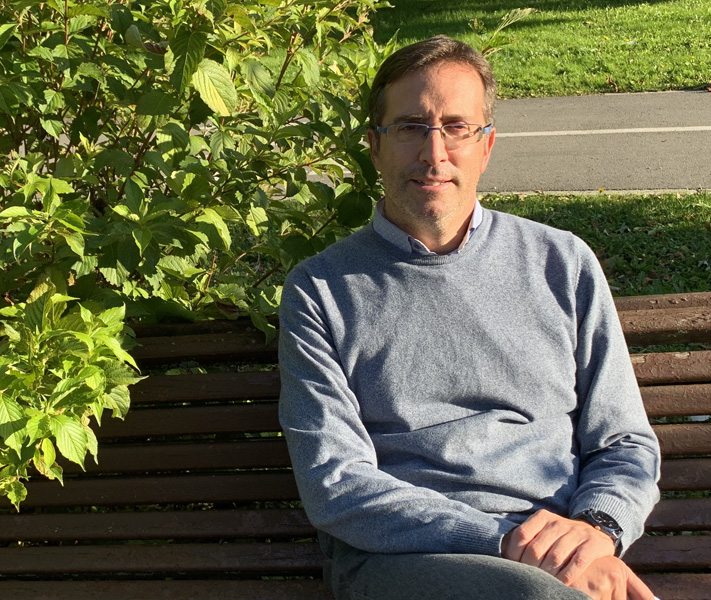
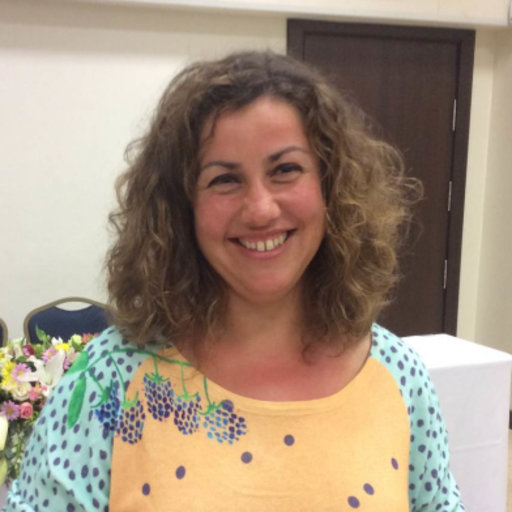
DAMȘESCU Adrian is a Lecturer at the Faculty of Letters , Transilvania University of Brașov , specializing in Theoretical and Applied Linguistics . His research focuses on Romanian-Spanish linguistic intersections, including orthographic challenges, cultural influences, and historical migrations. Contact: Room TP7, Building T, Eroilor Blvd. 25, Brașov, Romania. Email: adamsescu@yahoo.es His work explores the impact of the Spanish Golden Age on Romanian literature, Cervantine traditions, and linguistic evolution. Publications include poetry anthologies, linguistic analyses, and bilingual dictionaries. Key research areas: Spanish-Romanian linguistic parallels , magical realism , phonetic orthography , and Berber/Basque migration hypotheses .
Josu Mezo Arancibia is a faculty member at the University of Castilla-La Mancha , affiliated with the Department of Philosophy, Anthropology, Sociology and Aesthetics . His academic career spans political science, media criticism, and environmental policy. Academic Rank: Professor (Profesor Contratado Doctor) Key Research Areas: Political Geography, Language Policy, Environmental Governance, Media Studies, and Electoral Systems. His research focuses on regional governance in Spain , language policy in sociopolitical contexts (e.g., Basque Country and Ireland), and water policy dynamics with implications for democracy. A recurring theme in his work is the critical analysis of media representation of science, politics, and economic data. Analysis of his 15 most recent articles reveals a strong emphasis on interdisciplinary studies combining political science, environmental policy, and media literacy. His publications frequently address spatial electoral patterns , public participation in governance , and the methodological challenges of surveys and sampling .
Xosé Manuel Buxán Bran is a full-time Professor at the School of Fine Arts, University of Vigo, specializing in Sculpture within the Pontevedra campus. He holds a PhD from the University of the Basque Country (1996), with a thesis on Homoeroticism in the iconography of San Sebastián Mártir . PhD: University of the Basque Country (1996) His research intersects Contemporary Art , Gender Studies , and LGBT Activism , focusing on homoerotic iconography, queer theory, and the visual representation of sexual identity. He explores how religious symbols like Saint Sebastian are reinterpreted through modern lenses of hedonism, disease (e.g., AIDS), and cultural critique. His publications (1997–2003) span edited volumes and book chapters analyzing intersections of artistic innovation , sexual diversity , and cultural documentation . Key works include studies on surrealist spatial design, Lorca's visual legacy, and the role of non-verbal narratives in art. As a curator, he organized exhibitions like Malas Artes’03 and Radicais libres , emphasizing gay and lesbian experiences in Iberian art. He also contributes regularly to media outlets such as Faro de Vigo and A Nosa Terra , blending artistic analysis with socio-political commentary.
Iván Igartua is a Full Professor at the University of the Basque Country (UPV/EHU), where he has held a tenured position since 2009 and was accredited as Full Professor in 2016. He currently serves as Vice-rector of the Alava Campus (2017–present) and previously directed linguistic research for the Basque Government (2010–2013). His academic trajectory includes roles as Associate Professor (2008–2009), Assistant Lecturer (2001–2008), and Researcher (1996–2000) at UPV/EHU. Education: B.A. in Russian and Slavic Philology, Lomonosov State University (1991–1995) B.A. in Spanish Philology, UNED Madrid (1992–1997) Ph.D. in Classical Philology, University of the Basque Country (1997–2003) Research Focus: Igartua specializes in morphological and diachronic typology, Slavic historical linguistics (particularly nominal inflection), Indo-European reconstruction, and Basque language evolution. His work integrates comparative analysis of phonology, morphology, and lexicography across Basque, Slavic, and Indo-European languages. Awards & Honors: Corresponding member of Jakiunde (Basque Academy of Sciences, Arts & Humanities) since 2019 Member of the Basque Government's Advisory Committee for Basque Language (2016–present) Best Dissertation Award in Linguistics/Humanities, UPV/EHU (2005) Academic Leadership: He has supervised 5 PhD theses and 14 Master's theses, served on editorial boards ( Current Issues in Linguistic Theory , ASJU ), and held memberships in Societas Linguistica Europaea and Slavic Linguistics Society. His international engagements include research stays in Moscow, Paris, St. Petersburg, Tbilisi, and Leipzig.
Egoitz Laparra is a Researcher and Adjunct Instructor at the University of Arizona's College of Information Science since 2017. His work focuses on advancing natural language processing (NLP) methods for analyzing human language in medical and environmental domains. He specializes in machine/deep learning techniques for tasks like domain adaptation, information extraction, and semantic parsing. Research Interests: - Natural Language Processing (NLP) with emphasis on medical and environmental applications - Machine learning and deep learning methodologies - Domain adaptation and transfer learning in clinical and policy texts - Geographical ontology development and toponym resolution - Lexical resources like WordNet and predicate matrices Publications highlight innovations in NLP for environmental policy analysis, clinical text mining, and cross-lingual semantic interoperability. His recent work addresses challenges in metadata extraction from environmental impact statements and improving geolocation entity recognition through deep learning. Collaborations include the NewsReader project for cross-lingual news analysis. Laparra contributes to open-source projects like Eidos and INDRA, which transform free text into causal models. He maintains active involvement in international NLP competitions (e.g., SemEval tasks) and develops tools like Taxonomy Builder for knowledge organization.
Iraide Ibarretxe-Antuñano is a Full Professor in General Linguistics at the University of Zaragoza's Department of Linguistics and Hispanic Literatures, and a Researcher at the Institute of Heritage and Humanities (Excellency Research Group PSYLEX). She serves as Principal Investigator for the ICON research group and leads projects MultiMetAR (Government of Aragón) and MOTIV (Spanish Research Agency). Her educational background includes a degree in English Philology from Deusto University (1995) and a Ph.D. in Linguistics from the University of Edinburgh (2000). She completed post-doctoral research at UC Berkeley (1999-2001) and University of Deusto (2001-2003), with additional fellowships at Max Planck Institute, University of Concepción, and Lund University. Research Focus: Ibarretxe-Antuñano investigates the interplay between language, cognition, and communication through typological and psycholinguistic frameworks. Her work centers on semantic typology (lexicalization patterns and polysemy), iconicity phenomena (ideophones, phonic symbolism, gestures), and the cultural dimensions of metaphor and embodiment. She has pioneered research on Basque sound symbolism and cross-linguistic motion representation. With over 100 publications including 64 journal articles, 84 book chapters, and 11 authored/co-authored books, her work demonstrates significant scholarly impact reflected in an h-index of 33. Her publications span from foundational works like 'Sound Symbolism and Motion in Basque' (2006) to recent contributions including 'Lenguaje y cognición' (2021). Awards and Recognition: Rafael Monroy Research Award 2020 (Spanish Applied Linguistics Association) Scientific member of Spanish State Research Agency (2018-2021) Ranked among Spain's top 10% most cited researchers As an academic leader, she has served four terms as Secretary of the Spanish Cognitive Linguistics Association (2004-2008, 2012-2016), directed the Lexicography and Lexicology panel at AESLA (2013-2019), and consults for international research agencies including FONDECYT (Chile) and FWO (Flanders). She maintains editorial roles with Review of Cognitive Linguistics , Cognitive Linguistics , and other prominent journals. Her international collaborations span institutions across Europe and Latin America, including regular visiting professorships at universities in Chile, Estonia, Peru, Czech Republic, and Switzerland. Current research initiatives focus on multimodal metaphor in Aragonese languages and the cognitive processing of linguistic motivation.