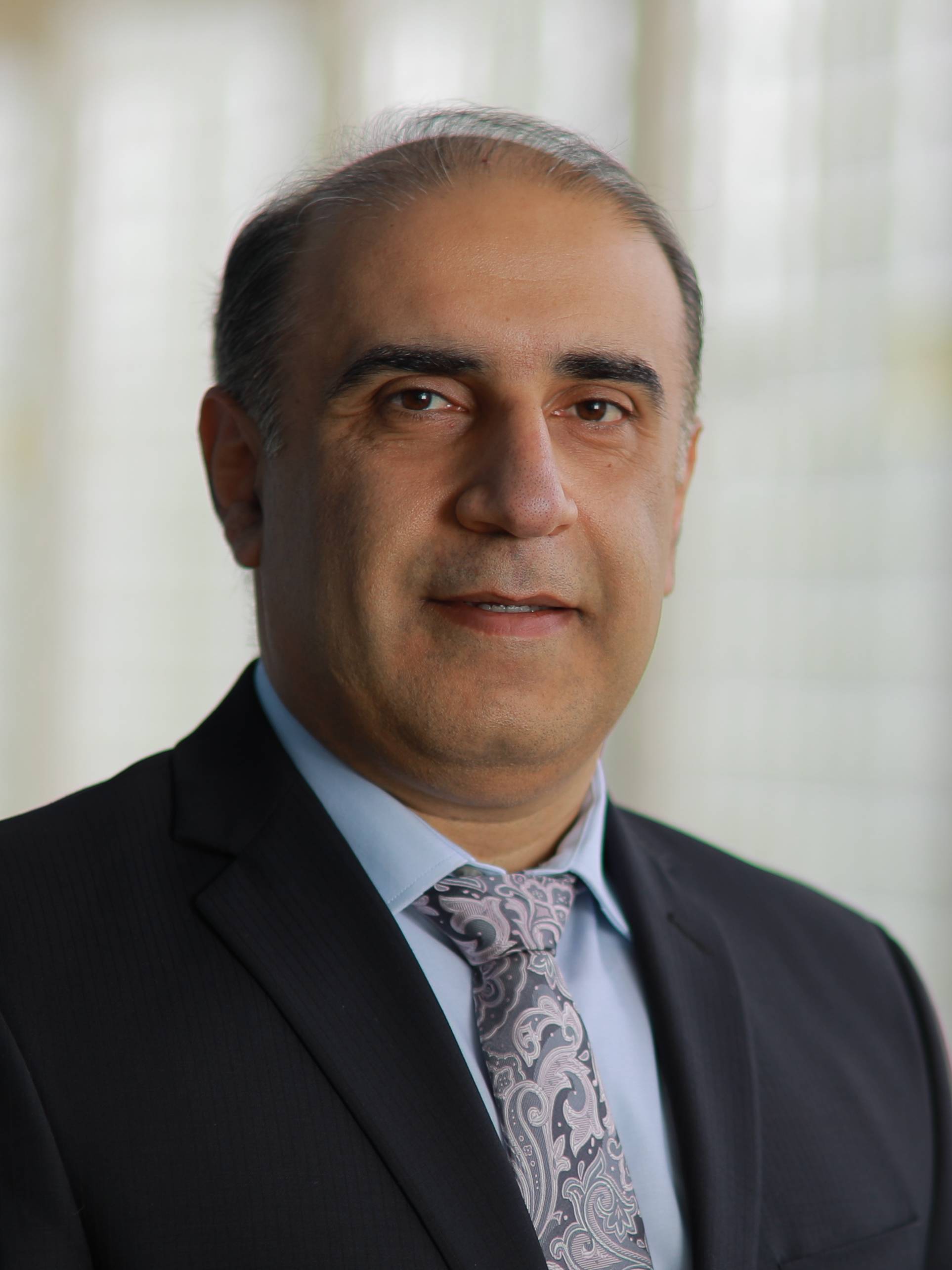
Abbas Semnani is an Associate Professor of Electrical Engineering and Director of the Adaptive Radiofrequency and Plasma Lab (ARPL) at the University of Toledo’s College of Engineering. He holds a faculty position in the Electrical Engineering and Computer Science department. Prior to joining the University of Toledo in 2019, he worked at Purdue University, focusing on plasma-electromagnetic interactions. Research Interests: His work centers on high-power microwaves, tunable antennas, reconfigurable RF electronics, and microwave plasma applications. Key areas include plasma-based impedance tuning, resonant plasma jets, and computational electromagnetics. Current projects emphasize energy-efficient plasma systems and adaptive radar technologies. High-Power Microwave Systems Low-Temperature Plasma Applications RF Nanotechnology Awards: 2019 IEEE MTT-S ‘Tatsuo Itoh’ Award 2022 NASA Glenn Faculty Fellowship 2024 NSF CAREER Award Labs & Teams: Leads the ARPL, advancing research in plasma-driven RF electronics and reconfigurable systems. Collaborates on projects involving plasma antennas and high-power protection mechanisms.
Prof. Dr.-Ing. Ingo Neumann is a Professor of Engineering Geodesy and Geodetic Analysis Methods at Leibniz University Hannover's Faculty of Civil Engineering and Geodetic Science. He serves as Executive Director of the Geodetic Institute and leads research in geodetic sensor systems, structural monitoring, and multi-sensor fusion. His work focuses on advancing terrestrial laser scanning (TLS), UAV-based calibration, and machine learning applications in civil infrastructure analysis. Research interests include deformation monitoring, sensor calibration, and geospatial data processing. Notable projects involve fusion of SAR/InSAR data with TLS for ground movement analysis, and development of automated damage detection algorithms for port and marine structures. He teaches courses on sensor technology, geodetic measurement methods, and industrial surveying. Publications span 2006–2025, with recent emphasis on robust outlier detection, Kalman filter applications, and B-spline modeling for structural analysis. His work integrates geodesy with computer vision and machine learning to enhance infrastructure monitoring precision.
Varun Shankar is an Assistant Professor (tenure-track) at the Kahlert School of Computing (KSoC), University of Utah, and currently serves as Associate Director of the Master of Software Development (MSD) program. His research focuses on developing efficient machine learning models for scientific applications, blending scientific computing, machine learning, and high-performance computing. Previously, he held a non-tenure-track role as an Assistant Professor Lecturer in KSoC, emphasizing teaching and curriculum development for the MSD program. Varun earned his PhD in Computing (Scientific Computing) from the University of Utah and completed a postdoctoral fellowship in the Math Biology group at the Department of Mathematics, University of Utah. His research interests span scientific machine learning, numerical analysis, and computational methods for complex systems. Recent work emphasizes physics-informed neural networks (PINNs), hybrid models for PDE solving, and meshless discretization techniques. His publications reflect contributions to operator learning, RBF-FD methods, and computational biomechanics. In teaching, Varun has instructed courses in software development, mobile programming, and numerical analysis, emphasizing practical skills for software professionals. He has co-advised MS and PhD students across KSoC and Mathematics departments.
Natalya Pya Arnqvist is an Associate Professor in Mathematical Statistics at Umeå University, Sweden. She is affiliated with the Department of Mathematics and Mathematical Statistics and has active roles in research groups focused on Functional Data Analysis, Semiparametric Regression, and Statistical Learning for Spatio-Temporal Data. Her career includes prior positions at Nazarbayev University (2015-2020), University of Bath (2011-2015), and KIMEP University (2000-2005). Education : PhD in Statistics (University of Bath, UK, 2007-2010), CSc in Physical and Mathematical Sciences (Institute for Mathematics, Kazakhstan, 2000-2005). Her research centers on statistical regression modelling and functional data analysis , with significant contributions to shape constrained additive models (SCAMs) and model-based functional clustering . She has developed R packages such as scam , fdaMocca , and nilde for these methodologies. Recent publications highlight applications in applied demography , defect detection , and nonlinear state space modeling , reflecting her focus on bridging statistical theory with industrial and ecological challenges. She teaches undergraduate and graduate courses in probability, regression, and statistical learning.
Luis Carlos Garcia Peraza Herrera is an Assistant Professor (Lecturer) in Computer Vision at King’s College London’s Department of Informatics, part of the Faculty of Natural, Mathematical & Engineering Sciences. He leads the Visual Understanding Research Group , focusing on healthcare applications of Computer Vision and Machine Learning, particularly visual understanding with limited supervision. His work spans surgical robotics, medical image segmentation, and AI-driven diagnostic tools. Affiliations : King’s College London (current), Siemens Healthineers (2018-2019), University College London (PhD), Imperial College London & University of La Laguna (undergraduate). Research Interests : Surgical phase recognition via transformers, robotic endoscope control, hyperspectral imaging for oral health, and interpretable neural networks for cancer detection. Recent publications include Medical Image Analysis (2025), Frontiers in Robotics and AI (2022), and Gastrointestinal Endoscopy (2021). He holds a US patent and has developed open-source tools like VideoSum. Collaborative projects include the EPSRC-funded Real-time panoptic segmentation of surgical instruments for autonomous endoscopy (2021-2022). Luis’s labs focus on algorithmic solutions for healthcare challenges, with active contributions to surgical video summarization and AI-driven medical diagnostics. His work aligns with UN SDG 3 (Good Health & Well-Being).
Cristina Stoica is a Professor at CentraleSupélec/L2S, Université Paris-Saclay, specializing in control systems and robotics. She leads the SYCOMORE research team (since 2020) and co-heads the 'Pedagogical Innovation and EdTech' projects cluster. Her research focuses on ensemble state estimation, robust control, multi-agent systems, and control education. She has received awards including the 2024 Bozenna Pasik-Duncan Award and the 2023 Best Paper Award in Control Engineering Practice. Education: PhD in Automatic Control (2008, Supélec/Paris Sud 11) and HDR (2014, Université Paris-Saclay). She holds a B.Sc. and M.Sc. in Electrical Engineering from the Polytechnic University of Bucharest. Teaching: Teaches core modules in Control Theory, Automatic Control, and Dynamical Multi-Agent Systems at CentraleSupélec. Develops innovative courses integrating robotics and hands-on projects. Research Highlights: Contributions to distributed estimation, fault-tolerant control, and UAV coordination. Notable projects include radar imaging applications and pedagogical tools like the DroPong game and Drone Arenas-based teaching. Administrative Roles: Head of SYCOMORE team, Deputy Head of Research Professional Track (2017–2022). Memberships: IEEE Senior Member, IFAC Technical Committees on Control Education and Societal Impact. Labs/Teams: Leads SYCOMORE (Robust Control of Complex Systems) and contributes to MODESTY and COMEDY research groups.
Soufia Benhida is a researcher specializing in optimization, operations research, and data approximation methods, with affiliations to both INSA Rouen Normandie and ENSA Agadir . Her doctoral work focused on decision support systems for logistics chains under uncertainty, combining theoretical and applied approaches to problems like the Probabilistic Traveling Salesman Problem (PTSP). She collaborated on the M2NUM project (Normandy and Europe region) and received joint supervision from Ahmed Mir (ENSA Agadir), Christian Gout, and Arnaud Knippel (INSA Rouen). Ph.D. Defense: December 12, 2018 Supervisors: Christian Gout, Ahmed Mir, Arnaud Knippel Projects: M2NUM, Logistics Optimization under Uncertainty Her research integrates optimization techniques for solving complex problems in logistics and industrial engineering, with a focus on exact methods for the Traveling Salesman Problem and data approximation using finite elements and splines. Current work involves probabilistic modeling for market uncertainty applications and wind field approximation considering topographic factors. Key publication trends include combinatorial optimization , subtour elimination constraints , and vector field approximation , reflecting interdisciplinary applications in logistics, environmental modeling, and industrial systems. Collaborations span institutions in Morocco and France. She has presented her work at major conferences including the International Symposium on Combinatorial Optimization (Marrakech) , CESCA Agadir , and LOGISTIQUA 2018 , showcasing methodological comparisons and novel formulations for the TSP.
Bjarne André Grimstad is an Associate Professor at the Norwegian University of Science and Technology (NTNU). His work focuses on optimization, surrogate modeling, and data-driven approaches for complex systems in chemical and petroleum engineering. Key contributions include advancements in B-spline models, hybrid gray-box systems, and neural network applications for virtual flow metering. Research interests span optimization algorithms, machine learning integration with physical models, and industrial process control. Notable publications address multi-task learning frameworks, identifiability in hybrid models, and the efficacy of gray-box modeling in nonstationary environments. Publications (2024–2015) highlight interdisciplinary work combining mathematical programming with real-world applications in oil & gas production and flow measurement. His 2015 doctoral dissertation explored daily production optimization using surrogate modeling techniques. Outreach activities include academic lectures at international conferences (e.g., IFAC OOGP 2015) and poster presentations on hybrid modeling at Geilo Winter School 2021. Collaborations with industry partners like SINTEF and TU Delft underscore his applied research focus.
Nico Pietroni is a Professor at the School of Computer Science at the University of Technology Sydney (UTS), where he conducts research at the intersection of geometry processing, digital fabrication, and architectural geometry. His work bridges theoretical foundations in computational geometry with practical applications in industrial production pipelines, and he is affiliated with the Visualisation Institute (VI) Research Network at UTS. His primary research interests include geometry processing, mesh parametrisation, digital fabrication, architectural geometry, and computational design. He has pioneered techniques such as FlexMaps for computational design of flat flexible shells and Metamolds for computational design of silicone molds. His research focuses on developing concepts and practical algorithms for the creation and manipulation of digital shape representations, with applications spanning entertainment industry, digital fabrication, and architectural geometry. His recent publications demonstrate a strong trend toward computational methods for digital fabrication and architectural applications. His work spans from garment design and alteration to architectural structures like grid shells and bending-reinforced structures. He has developed innovative approaches for surface approximation, mesh processing, and computational design that address practical challenges in manufacturing and construction, with particular emphasis on reducing manufacturing complexity while maintaining design integrity. Wynne Prize finalist for "Bending the Light" artwork, exhibited at the Art Gallery of New South Wales Professor Pietroni has supervised numerous research students working on projects related to geometry processing, digital fabrication, and computational design. His funded research includes projects such as "Digital Optimization of Personalised Spacesuit" and "CRC-P Shoulder Replacement Implant Design for Additive Manufacturing," demonstrating the practical applications of his work across diverse fields from space research to medical technology. He has secured multiple research grants totaling significant funding for computational design research. He has developed several influential software projects including MeshLab (an open-source system for 3D mesh processing that won the SGP Software Award in 2017), HexaLab (an online viewer for hexahedral meshes), and QuadMixer (for layout-preserving blending of quadrilateral meshes). His work has been widely adopted by both academic researchers and industry practitioners in fields ranging from entertainment to architecture to medical technology.
Professor Khan Wahid is a faculty member in the Department of Electrical and Computer Engineering at the University of Saskatchewan , affiliated with the Division of Biomedical Engineering . His research focuses on health informatics, IoT infrastructure, medical imaging, and wearable health monitoring , with notable contributions to wireless capsule endoscopy, smart-city applications, and sensor systems. He holds a GCC Stars in Global Health Award (2013) and has secured funding from multiple government and institutional grants. Education: BSc, MSc, PhD in relevant fields (details not specified in text). Research Interests : Health informatics & smart-health systems IoT design/deployment and drone infrastructure Medical imaging reconstruction (CT/MRI) Wireless sensor networks and body area networks Quantum-dot cellular automata (QCA) for nanoelectronics FPGA/ASIC-based embedded systems Funding & Recognition : Harper Government investment in medical imaging (2014) UofS GCC Stars in Global Health Award (2013) Advising & Grants : Supervises graduate students in interdisciplinary projects (specific names not listed). Active in securing grants for IoT-enabled healthcare and agricultural sensing systems. Collaborates on projects involving smart-pill devices, fluorometers for cancer detection, and LiDAR-based plant phenotyping. Labs & Teams : Leads projects integrating biomedical engineering, IoT, and nanotechnology within the College of Engineering. Collaborations span academic and industrial partners for medical device innovation.
Dr. Mehdi Dagdoug is an Assistant Professor in the Department of Mathematics and Statistics at McGill University, Montreal, Canada. His research focuses on the intersection of survey sampling, missing data treatment, and statistical learning. He holds a Ph.D. from the Université de Bourgogne Franche-Comté, supervised by Camelia Goga and David Haziza. Education: Ph.D. in Mathematics, 2022, Université de Bourgogne Franche-Comté Postdoctoral Fellow, 2022-2023, University of Ottawa Research Interests: Dr. Dagdoug develops rigorous inference methods for survey sampling, particularly addressing nonresponse challenges through statistical learning tools. His work emphasizes high-dimensional settings where auxiliary variables exceed sample sizes. Key areas include model-assisted estimation, variance estimation for imputed survey data, and random forest applications in finite population sampling. Teaching: Currently teaches MATH 533 (Linear Regression & ANOVA) and MATH 525 (Sampling Theory) at McGill. Previously instructed courses in survey sampling, statistical learning, and programming at undergraduate and graduate levels. Awards: 2022 Jean-Claude Deville Prize (French Statistical Society) Grants: NSERC Discovery Grant, Mitacs Accelerate Proposal. Previously supported by Region Franche-Comté and Médiamétrie. Administrative Roles: Committee Member, Student Travel Grants (Statistical Society of Canada) Organizer, McGill Statistics Seminar Series (2023-2025) Board Member, BFC-Maths Federation (2020-2022) Popularization: Engages in science outreach through workshops and conferences for high school students, including a popular 'Titanic and Random Forests' workshop.
Jaime Camelio is a Professor at the University of Georgia's School of Electrical & Computer Engineering, specializing in cyber-physical systems security, smart manufacturing, and statistical process control. His work integrates advanced technologies like machine learning, reinforcement learning, and Bayesian inference to enhance manufacturing resilience and safety. He focuses on vulnerabilities in production systems, digital twin applications, and data-driven quality control. His research spans aerospace composites, IIoT-enabled worker well-being monitoring, and synthetic data frameworks for manufacturing simulations. Research interests include cybersecurity in additive manufacturing, occupational safety monitoring via statistical control charts, and innovative approaches to fault detection in assembly systems. He leads projects funded by NSF CPS initiatives, such as collaborative research on manufacturing security and cyber-physical vulnerability assessments. His work bridges theoretical advancements with real-world applications in aerospace, automotive, and industrial IoT sectors. Scientific contributions include frameworks for digital thread integration in product lifecycle management and NURBS-based statistical monitoring of manufacturing surfaces. Publications emphasize both technical innovations and systemic risk mitigation strategies for modern manufacturing ecosystems. His lab explores cutting-edge topics like LLM applications in manufacturing workflows and random sampling strategies to counteract cyber-physical attacks.
Hanne Hardering is a postdoctoral researcher at the Institute of Numerical Mathematics, Dresden University of Technology, and a principal investigator in the DFG Research Unit 3013 Vector-and Tensor-Valued Surface PDEs . Her work bridges numerical analysis, differential geometry, and partial differential equations, focusing on finite element methods for surfaces and Riemannian manifolds. Education: Dr. rer. nat. in Mathematics, Freie Universität Berlin (2015) Dipl.-Math. in Mathematics, Freie Universität Berlin (2010) Her research emphasizes intrinsic discretization error bounds, symmetry constraints, and applications to tensor-valued surface PDEs. Recent publications highlight error analysis for surface Stokes equations, tangential constraints in finite elements, and geometric data approximation. Grants & Projects: Principal Investigator, DFG Research Unit 3013 (2023–present)
Francesca Mazzia is a Full Professor in the Department of Computer Science at the University of Bari (UniBA), Italy. She is a leading expert in numerical methods for differential equations and computational mathematics. Office: Campus - Via Orabona, 4 Bari, Department of Computer Science, fifth floor, room no. 565 Contact: +39 0805443291 | francesca.mazzia@uniba.it Personal website: http://archimede.uniba.it/~mazzia Research Interests: Numerical methods for Ordinary Differential Equations (IVP and BVP) Linear and nonlinear stability properties Parallel implementation techniques Saliency and change detection for hyperspectral images Quasi-interpolation methods Stability and conditioning of linear systems Parallel algorithms for large linear systems Notable Contributions: Co-author of the book Solving Differential Equations in R (Springer, 2012) Developer of the TOM MATLAB solver for boundary value problems Contributor to the QIBSH library and TestSets for IVP/BVP solvers Active participant in international conferences like SCICADE 03 Software Tools: TOM (Top Order Method) for ODE boundary value problems Integration with pde2path for optimal control problems Open-source contributions to MATLAB and R ecosystems
Professor Richard Mitchell is a Professor of Cybernetics at the University of Reading, affiliated with the Department of Computer Science. He serves as the Assessment Lead and School Director of Technology Enhanced Learning. He holds a BSc (Hons) and PhD from the University of Reading, becoming a professor in 2015. His research focuses on Cybernetics, Artificial Intelligence, Control Engineering, Robotics, and Technology-Enhanced Learning, with over £2m in research grants, including Knowledge Transfer Partnership (KTP) projects. Notably, he led a KTP project with Red-Whale awarded 'Best KTP in the UK' in 2021. Teaching includes courses on Cybernetics, AI, Robotics, Neural Networks, and Gaia Theory. He developed interactive web pages for the FutureLearn MOOC Begin Robotics , enhancing student engagement. Awards include a University Teaching Fellowship (2011) and Senior Fellow of the Higher Education Academy (2014). Administratively, he has held roles such as Head of Department and Examinations Officer. He contributes to professional societies like the Thames Valley IET and IEEE Systems, Man, and Cybernetics Society Chapter.