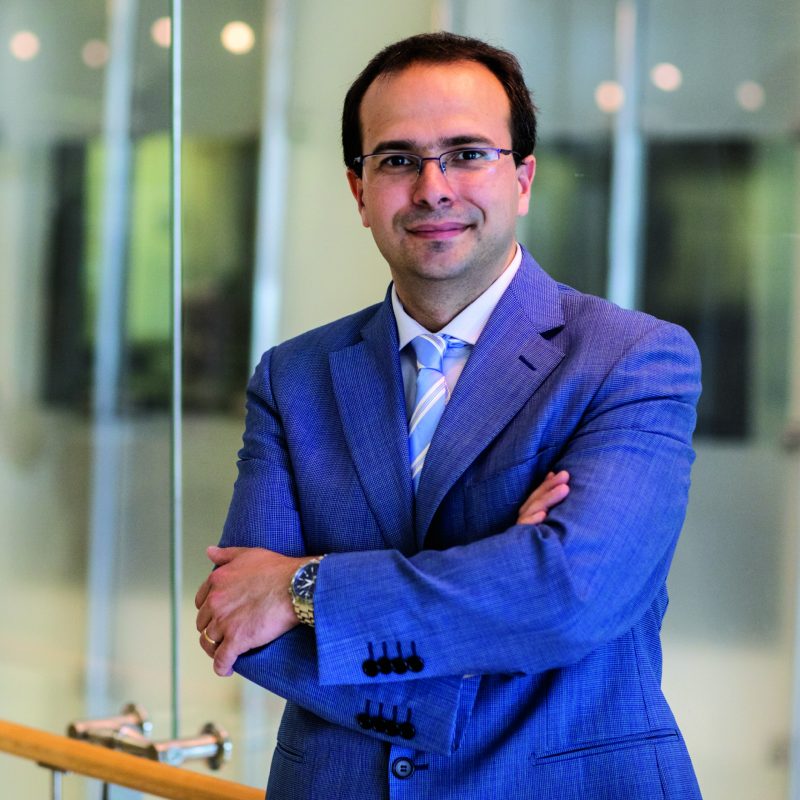
Calvin Coopmans is affiliated with Utah State University in the Department of Electrical and Computer Engineering , contributing to UAV technology and remote sensing. His work focuses on low-cost unmanned systems, flight control, and safety mechanisms. Key research themes include fractional order controllers for UAV stabilization, multi-sensor fusion for attitude estimation, and cost-effective remote sensing platforms . His publications emphasize open-source UAV development and heterogeneous system integration. Notable collaborations include work with YangQuan Chen and other researchers on AggieAir projects. While no explicit scientific awards are listed, his contributions to UAV flight control and radiation field mapping demonstrate technical expertise.
Victor Finomore Jr. serves as Executive Director of Research Operations and Data Analytics at the West Virginia University (WVU) Rockefeller Neuroscience Institute. He holds dual academic appointments as Assistant Professor in the Department of Neuroscience within the School of Medicine and Adjunct Professor in the Department of Chemical, Biomedical Engineering at the Statler College of Engineering and Mineral Resources. Dr. Finomore earned his Ph.D. in Experimental Psychology from the University of Cincinnati in 2008. Prior to joining WVU, he served as Technical Advisor for the Warfighter Effectiveness Research Center at the United States Air Force Academy, where he led research on human performance enhancement through multimodal displays, neuroergonomics, and human-machine teaming for military operators. His research program centers on Human Performance, Physiological Measurement and Assessment, and Cognitive Neuroscience. As director of the Human Performance and Applied Neuroscience (HPAN) research center, he conducts cutting-edge research on real-time neurophysiological assessment across diverse populations (Athletes, Military, Patients, and general Population - AMP 2 ). His work integrates advanced sensors with machine learning analytics to develop individualized augmentation strategies for optimizing brain health, human performance, recovery, and resilience. Cognitive testing in his lab focuses on workload, stress, fatigue, attention, decision-making, and multisensory integration. Analysis of Dr. Finomore's 15 most recent publications (2017-2021) reveals a strong interdisciplinary focus bridging psychology, neuroscience, and engineering. Key research themes include human-robot interaction dynamics (particularly robot authority and compliance), neurophysiological monitoring using wearable technology, deep brain stimulation applications for addiction treatment, and vigilance in automated systems. His work demonstrates consistent collaboration with military and clinical research partners, with significant emphasis on translating laboratory findings to real-world applications in healthcare and defense contexts. Dr. Finomore directs the Human Performance and Applied Neuroscience (HPAN) research center, which conducts both basic and applied research in controlled laboratory settings and naturalistic "in the wild" environments. The center specializes in developing and validating neurophysiological assessment protocols for diverse operational contexts, with particular expertise in translating cognitive neuroscience findings into practical human performance solutions.
Dr Edward Smart is a Principal Research Fellow at the University of Portsmouth, affiliated with the Faculty of Technology and School of Electrical and Mechanical Engineering. He is also part of the Centre of Excellence in Defence, Risk & Resilience, Portsmouth AI and Data Science Centre, and the Centre for Operational Research & Logistics. He holds a PhD from the University of Portsmouth (2011) and an MMath from the University of Reading (2005). Education: PhD in Engineering, University of Portsmouth, 2011 MMath in Mathematics, University of Reading, 2005 Research Interests: Dr Smart focuses on learning algorithms for detecting rare or abnormal events in industrial data, particularly in manufacturing, computing, agri-tech, and transport sectors. His work emphasizes anomaly detection, condition-based monitoring, and predictive maintenance, with applications in maritime, railway, aerospace, and high-performance computing industries. He has secured over £6.8M in grants from Innovate UK, STFC, and DASA, collaborating with institutions like Southampton, Nottingham, UCLAN, and Brunel. Grants & Collaborations: Lead or co-investigator on 20+ grants totaling £6.8M (over £3.4M for Portsmouth) Collaborations with industry partners in maritime, railway, aerospace, and agri-tech sectors Labs & Teams: Active in the Centre for Operational Research & Logistics and the Food Cultures in Transition research cluster. He contributes to researcher development through the Researcher Concordat implementation and previously chaired the Researchers' Network.
Markus Peer Rumpfkeil is a Full-Time Professor and the Hans von Ohain Endowed Chair in the School of Engineering's Department of Mechanical and Aerospace Engineering at the University of Dayton. As the aerospace program director, he specializes in computational fluid dynamics (CFD), uncertainty quantification, and multidisciplinary design optimization. He holds a Ph.D. from the University of Toronto and a Diplom (B.Sc./M.Sc.) in Physics from Humboldt University of Berlin, with research experience at the Max-Planck Institute. Education: Ph.D., University of Toronto Institute for Aerospace Studies (2008) Diplom Physik (M.S./B.Sc. Physics), Humboldt University of Berlin (2004) Research Focus: His work emphasizes uncertainty quantification applied to CFD problems, multi-fidelity surrogate modeling, and aeroelastic design optimization. Key areas include flutter analysis, robust optimization under mixed uncertainties, and hypersonic vehicle design. Publications: Over 80 peer-reviewed articles highlight his contributions to topics like multi-fidelity optimization frameworks, surrogate model construction (e.g., sparse polynomial chaos, kriging), and exergy-based analysis of hypersonic systems. Recent work extends to turbulence effects in turbine flows and robust control systems for missiles. Affiliations: He serves as an Associate Fellow of the AIAA and on the Scientific Committee for the International Conference on Computational Fluid Dynamics (ICCFD). He also contributes to educational initiatives like the Thrust Vectoring Design Project. Teaching: Courses include Fluid Mechanics, Computational Fluid Dynamics, and Introduction to Flight, reflecting his dedication to undergraduate and graduate education.
David Mindell is the Frances and David Dibner Professor of the History of Engineering and Manufacturing at MIT, with a joint appointment in the Department of Aeronautics and Astronautics. He holds dual roles as an academic and entrepreneur, combining historical scholarship with engineering practice. His primary affiliations include MIT’s Program in Science, Technology, and Society, and he has served in leadership roles such as Director of the STS Program and Chair of MIT’s 150th Anniversary Steering Committee. Education: B.S. Electrical Engineering, Yale University (1988) B.A. Literature, Yale University (1988) Ph.D. History of Technology, MIT (1996) Research Interests: Mindell’s work spans human-machine collaboration, deep ocean robotics, and the history of aviation/spaceflight. He emphasizes the social implications of engineering through projects like undersea archaeological expeditions and autonomous aircraft systems. His recent focus includes reimagining industrialism and the ethical integration of automation. Awards & Recognition: Associate Fellow, American Institute of Aeronautics and Astronautics Senior Member, IEEE Fellow, Explorers Club and Massachusetts Historical Society Labs & Ventures: He founded Humatics Corporation to advance transparent autonomy technologies and serves as an Operating Partner at Blackhorn Ventures. His research aligns with affiliations like the Woods Hole Oceanographic Institution and NASA Historical Advisory Committee.
Pavithra Prabhakar is a Professor of Computer Science and Peggy and Gary Edwards Chair in Engineering at Kansas State University (KSU). She holds a Ph.D. from the University of Illinois at Urbana-Champaign and has held roles including postdoctoral positions at Caltech and directorships at the IMDEA Software Institute. Her research focuses on formal analysis of autonomous and cyber-physical systems, with applications in aerospace, automotive, and agricultural automation. She has authored over 100 peer-reviewed articles and received prestigious awards such as the NSF CAREER Award and ONR Young Investigator Award. Education: Ph.D. in Computer Science, University of Illinois at Urbana-Champaign (2011) M.S. in Applied Mathematics, University of Illinois at Urbana-Champaign (2010) M.S. in Computer Science and Automation, Indian Institute of Science (2006) B.Tech. in Computer Science and Engineering, National Institute of Technology, Warangal (2004) Research Interests: Her work emphasizes formal verification and synthesis of autonomous systems, integrating ideas from control theory, formal methods, and AI. Key areas include stability analysis of hybrid systems, safety-critical AI components, and applications in robotics and CPS. Recent projects involve robust analysis of systems with machine learning components. Awards and Contributions: In addition to her academic roles, Dr. Prabhakar serves as a Program Director at the NSF CISE Directorate, managing over $100M in CPS and AI-related grants. Her leadership in conferences like HSCC and FORMATS reflects her influence in the field. Her work has been funded by NSF, ONR, NASA, USDA, and industry partners like Amazon. Advising and Grants: She advises PhD and postdoctoral researchers, with notable student achievements like Ratan Lal’s Excellence in Research Award. Her grants include NSF core programs on formal methods and CPS, as well as NASA projects on certifiable autopilots. Labs and Teams: Her research group focuses on formal methods for CPS, with collaborations in robotics, aerospace, and agricultural automation. She leads initiatives like the Center for Trustworthy AI-enabled Robotic and Autonomous Systems at KSU.
Giorgio Guglieri is a Full Professor of Flight Mechanics at Politecnico di Torino, where he serves as Head of the Department of Mechanical and Aerospace Engineering (DIMEAS). He is a member of the Academic Senate, the Executive Committee of Specialising Master's Programmes, and the steering board of the PhD Program in Aerospace Engineering. His work is centered at the intersection of flight mechanics, autonomous systems, and human-machine interfaces. Professor Guglieri's research spans multiple key areas in aerospace engineering. His primary interests include flight dynamics and control of both fixed-wing and rotary aircraft, flight simulation technologies, unmanned aerial systems for urban applications, and human factors in aviation. His work has significant applications in urban air mobility, precision agriculture using drones, and enhancing aviation safety through physiological monitoring of pilot workload. Analysis of his recent publications reveals strong trends toward integrating artificial intelligence with traditional aerospace engineering. His research group has produced significant work on UAV navigation in GNSS-denied environments, reinforcement learning for path planning, physiological monitoring for pilot stress assessment, and digital twin technologies for predictive maintenance. The research shows increasing focus on practical urban applications of drone technology, particularly in logistics, precision agriculture, and urban air mobility solutions. Professor Guglieri actively supervises numerous PhD students working on cutting-edge aerospace projects including drone navigation systems, pilot workload monitoring, urban air logistics, and advanced flight control systems. He leads multiple research projects funded by EU programs (including Horizon 2020), national research councils, and industry partners such as Leonardo, ENAC, and various agricultural technology companies. He heads the Flight Mechanics Research Team at Politecnico di Torino, which operates the STREAM Robotics Laboratory and collaborates extensively with international partners including ZHAW, University of Maryland, and multiple European research institutions. The team has developed patented technologies including an anti-sloshing tank for agricultural spraying drones and fixed-wing micro UAVs.
Dr. Andrea L'Afflitto is an Associate Professor in the Grado Department of Industrial and Systems Engineering at Virginia Tech. His primary research focuses on autonomous robots, unmanned systems, control theory, and lightweight robotics. He holds a Ph.D. in Aerospace Engineering from Georgia Tech and has held roles including Assistant Professor at the University of Oklahoma (2015–2019) and Summer Faculty Fellow at the Army Research Lab (since 2017). His work spans funded projects with ARL, DARPA, NSF, and ONR, emphasizing applications like autonomous aerial support for ground troops. Education B.S. & M.S. in Aerospace Engineering, University of Napoli 'Federico II' (2004, 2006) M.S. in Mathematics, Virginia Tech (2011) Ph.D. in Aerospace Engineering, Georgia Tech (2015) His research interests include robust adaptive control, model reference adaptive control (MRAC), barrier Lyapunov functions, and nonlinear systems. He has authored 1 monograph, 2 book chapters, and over 40 peer-reviewed publications. Notable awards include the 2018 DARPA Young Faculty Award and the Domenica Rea D'Onofrio Scholarship (2011–2015). Grants & Collaborations His projects are funded by Army Research Lab (ARL), DARPA, NSF, and ONR. He has developed an open-source framework for nonlinear control of UAVs and contributed to terrain-informed motion planning for tactical vehicles. His work integrates cutting-edge control theory with practical applications in autonomous systems. Labs & Teams Dr. L'Afflitto leads research in autonomous systems at Virginia Tech, focusing on UAV control and adaptive algorithms. He collaborates with Army Research Lab on tactical autonomous systems and has ties to institutions like FermiLab and Thales Alenia Space through prior industry experience.
Francesco Biondi is a Professor in the Department of Kinesiology at the University of Windsor's Faculty of Human Kinetics. His research focuses on driver behavior, automated vehicle systems, cognitive workload assessment, and workplace ergonomics. He leads the Human Systems Lab, collaborating with industry partners like Tesla and the Windsor Police Service on projects addressing driver distraction, semi-autonomous vehicle safety, and traffic zone analysis. Notable collaborations include studies on distracted driving in school zones and the effects of museum visits on mental clarity. Biondi has received federal research grants and contributed to over 50 peer-reviewed articles. His work emphasizes human-machine interaction challenges in automated systems, including legal liability implications and driver training requirements. Education and Training: Specialization in Human Factors Engineering Advanced training in Ergonomics and Biomechanics Research Interests: Automated vehicle human factors Cognitive workload measurement Driver distraction mitigation Workplace cognitive ergonomics Technology-assisted rehabilitation Recent Article Trends: Focus on real-world validation of automated driving systems, validation of cognitive workload metrics (e.g., pupil size tracking), and interdisciplinary approaches to vehicle automation safety. His team has pioneered camera-based monitoring systems for manufacturing environments and developed novel blink detection algorithms for driver monitoring. Labs/Teams: Leads the Human Systems Lab at UWindsor, collaborating with engineering faculty on cross-disciplinary projects through the WE-Spark Health Institute.
Michał Frant is an Assistant Professor at the Military University of Technology, specializing in aerodynamics and fluid mechanics. His research focuses on computational fluid dynamics (CFD), jet engine intake systems, and the aerodynamic characteristics of missiles, UAVs, and aircraft. He has authored 27 publications, supervised 13 promoted theses, and led 4 research projects. His work emphasizes turbulence modeling, ground effect analysis, and propulsion-aerodynamics integration in defense and aerospace applications. Research Interests: Dr. Frant’s expertise spans experimental and numerical studies in aerodynamics, including intake vortex dynamics, missile design optimization, and airborne launch platforms for space operations. His CFD-driven approaches address complex flow phenomena such as gust effects, blade cascade flows, and asymmetric/symmetric flow conditions. Key Achievements: With an h-index of 3 (Scopus/WoS), his work bridges theoretical fluid dynamics and practical applications in defense technology. Notable projects include analyzing intake system stability under flow throttling and investigating composite materials for aerial targets. He has also explored the repurposing of decommissioned fighters as space launch platforms. Advising & Grants: Having mentored 13 thesis students, his academic contributions extend to training future engineers in CFD and experimental aerodynamics. His 4 research projects likely involve collaborations with defense industries and military institutions, focusing on advanced propulsion systems and UAV design. Labs/Teams: While specific lab affiliations are not detailed, his work aligns with the university’s aerospace and mechanical engineering departments, leveraging wind tunnel facilities and computational resources for aerodynamic testing.
Afzal Suleman is a Professor of Mechanical Engineering at the University of Victoria. His research focuses on multidisciplinary design optimization, computational/experimental mechanics, and aerospace structures. He holds a BSc (Honours), MS from Imperial College, and a PhD from UBC, with professional engineer (P.Eng) certification. Education: BSc (Honours) MS (Imperial College) PhD (UBC) Research interests include active aeroelastic structures, morphing wing design for UAVs, fluid-structure interaction, topology optimization, and hybrid-electric propulsion systems. His work emphasizes smart materials, nonlinear aeroelasticity, and sustainable aviation solutions. Notable projects include developing a multidisciplinary design optimization (MDO) tool for morphing wings and pioneering studies on pH-responsive polymers. His articles span aeroelastic control strategies, topology optimization methodologies, and UAV propulsion systems. He collaborates with the University of Victoria's Centre for Aerospace Research (CfAR), advancing technologies like CubeSats and unmanned systems for commercial and defense applications. Academic contributions include flight-tested aircraft prototypes for active control strategies and innovations in SPH boundary treatments for fluid-structure interaction simulations. His research bridges theory and practice, addressing challenges in aerospace efficiency and sustainability.
Dr. Ramadan Janissary is an Assistant Professor at Istanbul Technical University's Department of Aeronautical Engineering, specializing in Unmanned Aerial Vehicles (UAVs) and Field Programmable Gate Array (FPGA) technologies. His research spans computational fluid dynamics, hardware acceleration, and multi-sensor tracking systems. Recent research trends focus on FPGA-based solutions for aerospace applications, including 6-DoF dynamical models, quaternion-Euler angle conversion, and formation flight systems for UAVs. His work addresses technical challenges in ad-hoc networks, time delay management, and nonlinear dynamics. Scientific awards include the BOEING Academic Study Incentive Award (2017) and Best Doctoral Theses Award (2015). Current projects involve UAV recording systems, FPGA-based accelerators, and aviation CNS technology development.
Timothy Sands is Professor of Practice in Space Systems at Cornell’s Sibley School of Mechanical and Aerospace Engineering. His research spans autonomous robotics, spacecraft control, and nonlinear systems, with applications in lunar exploration and defense technology. Dr. Sands served in the U.S. Air Force for 30 years, contributing to NASA and DoD space missions like the Solar Wind Interplanetary Measurement project. Decorated with three Air Medals and the von Kármán Award, he holds a PhD from the Naval Postgraduate School and multiple master’s degrees. He teaches astronautics optimization and adaptive systems, emphasizing real-world space industry challenges. His publications focus on sensor noise reduction and control algorithms for space robotics.
Dr. Iftekhar Ahmed is an Associate Professor in the Department of Informatics at the University of California, Irvine’s Donald Bren School of Information & Computer Sciences. His research focuses on software engineering methodologies, emphasizing software testing, analysis, and accessibility. He holds a Ph.D. in Computer Science from Oregon State University (2018) and a B.S. in Computer Science and Engineering from Shahjalal University of Science and Technology, Bangladesh (2007). Education: Ph.D., Computer Science, Oregon State University, 2018 B.S., Computer Science and Engineering, Shahjalal University of Science and Technology, Bangladesh, 2007 His research integrates artificial intelligence, data mining, and empirical software engineering to improve software quality and safety. Key areas include: Automated testing frameworks for large systems Bug prediction models for code vulnerabilities Accessibility testing tools (e.g., Ma11y mutation framework) Safety-critical systems like autonomous vehicles Recent work explores AI-driven code generation, prompt engineering, and mitigating biases in software tools. His team received a $1.2M grant in 2022 to enhance accessibility testing tools. Ahmed also investigates human factors in software development, including developer mental health and tool adoption challenges. His publications address critical issues like code smells in quantum computing, commit message quality, and Jupyter notebook bug patterns. He actively participates in industry-academia collaborations, such as the 2023 Southern California Software Engineering Symposium.
Georgios Ellinas is a Professor at the University of Cyprus, specializing in optical networking, machine learning for network management, and UAV swarm coordination. His research spans critical areas such as Elastic Optical Networks (EONs) , Physical Layer Security , and Multi-Agent Reinforcement Learning for autonomous systems. Recent work includes quantile regression models for handling uncertainty in network traffic, edge-assisted collision warning systems for urban mobility, and multi-task learning architectures for drone state identification. He applies distributed estimation techniques to jamming aerial targets and explores probabilistically robust trajectory planning for autonomous vehicles. His contributions extend to fair resource allocation in optical networks, UAV swarm coordination using ROS-LoRa integration, and quantum key distribution optimization. Collaborations with researchers like Tania Panayiotou and Panayiotis Kolios highlight his interdisciplinary approach.