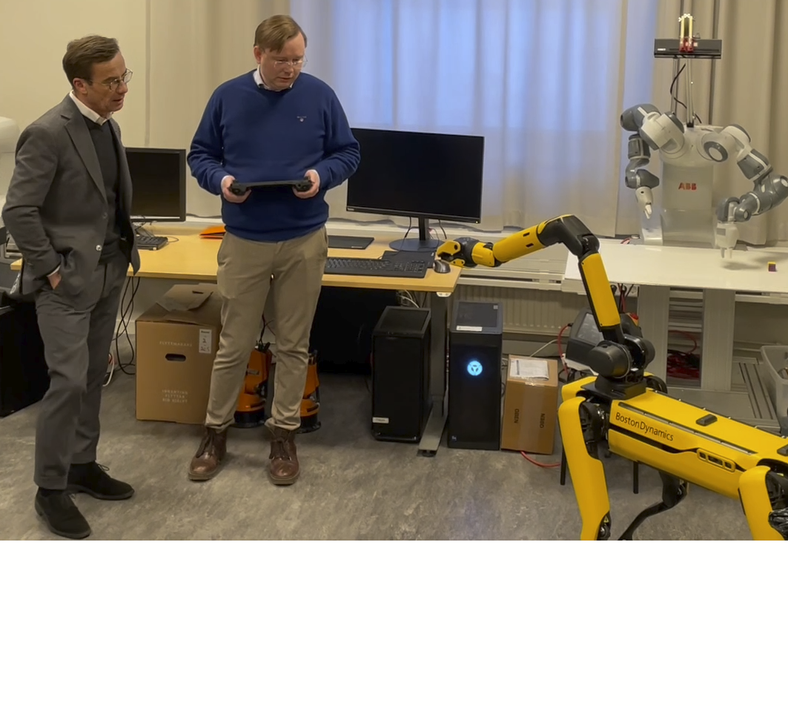
Olov Andersson is an Assistant Professor and WASP Fellow in AI for Autonomous Systems at KTH Royal Institute of Technology, leading the Division of Robotics, Perception and Learning. His research focuses on Embodied AI for autonomous robots and vehicles, combining advancements in Vision-Language Models (VLM), Large Language Models (LLM), and real-world navigation challenges. Key projects include the DARPA SubT Challenge-winning team CERBERUS and the EU H2020 Heron project for robotic road repair. He supervises multiple PhD students and postdocs, including Timon Homberger, Finn Lukas Busch, and Jesper Eriksson. Research interests emphasize full-stack autonomy in dynamic environments, including planning, mapping, and navigation. Notable contributions include the OneMap real-time open-vocabulary mapping system and self-supervised scene flow methods like Seflow. He has been recognized for technical leadership in autonomous systems through awards like the WASP Fellowship. Professional activities include co-chairing the 2024 IROS workshop on robot perception in dynamic environments and advising the Swedish Prime Minister’s AI initiative. Teaching roles span multiple graduate courses in machine learning, robotics, and systems engineering at KTH.
Géza Várady is an Associate Professor at the University of Pécs (PTE), holding roles such as Vice Dean for Scientific Affairs at the Faculty of Engineering and Information Technology. He has served as Head of the Department of Technical Informatics and has held various academic leadership positions. His career spans over two decades, with research focusing on computer vision, image processing, and lighting technology. He holds a PhD from the Doctoral School of Informatics at the University of Pannonia. Education includes a Master’s degree in Computer Engineering and a PhD in Informatics. He has also held research positions internationally, such as a Leonardo Fellowship at Schefenacker GmbH in Stuttgart, Germany. His research interests include mesopic vision models, color correction systems, 3D depth sensing using monocular cameras, and drone-based applications. He leads the drone research team and has supervised doctoral students in areas like image data correction and 3D modeling. Notable achievements include the 2024 Publication Excellence Award, IBM Faculty Awards for adaptive lighting systems, and the Walsh Weston Award for contributions to lighting science. He actively participates in academic governance, serving on national committees like the Hungarian Academy of Sciences’ Engineering Sciences Committee and the John von Neumann Computer Society. Publications span over 100 articles in journals like Lighting Research and Technology and Technical Gazette , focusing on topics ranging from photogrammetry to autonomous drone control. He has authored textbooks on MPI programming and computer architecture.
Dr. Sierra Young is an Assistant Professor in the Department of Civil and Environmental Engineering and the Utah Water Research Laboratory at Utah State University, where she leads the DAISy (Digital Agro-environment and Intelligent Systems) Lab. Her research integrates robotics, computer vision, and environmental sensing to advance monitoring in agriculture and hydrology. PhD, Civil and Environmental Engineering, University of Illinois at Urbana-Champaign, 2018 MS, Civil and Environmental Engineering, University of Illinois at Urbana-Champaign, 2015 BS, Civil and Environmental Engineering, Cornell University, 2014 Dr. Young's research focuses on field robotics, automation, and optical sensing systems for environmental and agricultural applications. She specializes in unmanned aerial systems (UAS), developing robotic payloads for tasks such as aerial pollination, soil moisture measurement, and water quality sampling. Her work also emphasizes hyperspectral imaging and machine learning for non-destructive evaluation of crops like industrial hemp and loblolly pine, enabling high-throughput phenotyping and disease detection. Her recent publications demonstrate a strong trend in intelligent robotics for agriculture, computer vision for environmental monitoring, and sensor fusion for hydrological applications. Key themes include autonomous decision-making in UAS, hyperspectral analysis for plant health, and real-time data processing for operational field deployment. NSF CAREER Award, 2024 Outstanding Reviewer, Journal of Sustainable Water in the Built Environment, 2024 Educational Aids Blue Ribbon Award, ASABE, 2024 ASABE Outstanding Reviewer, 2023 Dr. Young mentors graduate students in civil, environmental, and electrical engineering, guiding research in robotics, sensing, and data science. She has secured funding from agencies including the U.S. Geological Survey and the National Robotics Initiative to support projects on camera-based hydrologic monitoring and autonomous water sampling. Her teaching includes courses in computer programming and computer vision for engineers. The DAISy Lab fosters interdisciplinary collaboration, particularly with NC State University, focusing on scalable robotic solutions for agricultural and environmental challenges. The DAISy Lab is actively developing mobile sensor systems for applications in precision agriculture, hydrology, and aquaculture. Current projects include autonomous water quality monitoring using aerial and surface vehicles, hyperspectral imaging for crop breeding, and low-cost camera networks for operational hydrology.
Prof. Dr. Robert Wille is a Full Professor at the Technical University of Munich (TUM) in the School of Computation, Information and Technology and Chief Scientific Officer at the Software Competence Center Hagenberg GmbH . He leads the Chair for Design Automation , focusing on automatic methods for complex system design in conventional and future technologies. Studied Computer Science (Diploma) at the University of Bremen (2002-2006) Doctorate (summa cum laude) from the University of Bremen (2009) His research spans quantum computing , microfluidic biochips , field-coupled nanotechnologies , and reversible circuits , with applications in machine learning , artificial intelligence , and cyber-physical systems . Recent work includes quantum circuit verification, radar-camera fusion, and silicon dangling bond logic optimization. Robert Wille has received prestigious awards such as the ERC Consolidator Grant , Google Research Award , and Distinguished Professor appointment . He serves as Associate Editor for journals like IEEE TCAD and Springer LNCS, and has chaired conferences including DATE and ICCAD.
Dr. Victor O. K. Li is a Professor at the Faculty of Engineering, University of Hong Kong, with over three decades of academic leadership. His research spans Machine Learning , Artificial Intelligence , and Smart City Development , focusing on Environmental Monitoring , Intelligent Transportation Systems , and Neural Architecture design. He has co-authored over 550 publications since 1981, with recent work on Alzheimer's disease diagnosis, air pollution modeling, and autonomous vehicle systems.
Prof. Dr. Didier Stricker is a distinguished Professor of Computer Science at Rhineland-Palatinate University of Technology Kaiserslautern-Landau (RPTU) and serves as Scientific Director and Head of the Augmented Reality Research Department at the German Research Center for Artificial Intelligence (DFKI) in Kaiserslautern. He leads the Augmented Vision Group, which comprises approximately 30 researchers working across various domains of computer vision and augmented reality. His work bridges academic research with industrial applications through collaborations with major companies including Sony, Google, and John Deere. His educational background includes electrical engineering studies at the Polytechnic Institute of Grenoble and the Technical University of Karlsruhe. He earned his doctorate from the Technical University of Darmstadt in 2002 with a dissertation on "Computer Vision-Based Calibration and Tracking Methods for Augmented Reality Applications." Prof. Stricker's research spans virtual and augmented reality, computer vision, human-computer interaction, cognitive interfaces, and on-body sensor networks. His work focuses on developing practical applications that enhance human capabilities through advanced visual computing technologies. He has pioneered approaches in video and sensor analytics, particularly in creating cognitive interfaces that respond intelligently to user needs and environmental contexts. His recent publications reveal a strong emphasis on 3D scene understanding, real-time processing for augmented reality applications, and the integration of large language models with spatial reasoning capabilities. There's a clear trend toward more sophisticated multimodal approaches that combine vision, language, and spatial understanding to create more natural and intuitive human-computer interactions. Among his notable achievements: Innovation Prize of the German Society of Computer Science (2006) Organized the first IEEE & ACM International Symposium on Mixed and Augmented Reality (ISMAR) in 2002 Member of the ISMAR steering committee from 2000-2007 Multiple best paper and demonstration awards at major conferences Several registered patents in tracking and augmented reality technologies Prof. Stricker has supervised numerous PhD and Master's students through his leadership of the Augmented Vision Group. His research is supported by significant funding from both European and national research organizations, as well as through industrial partnerships. He serves as an expert reviewer for various research funding bodies and contributes to the academic community through editorial roles for journals and conferences in VR/AR and computer vision. The Augmented Vision Group under his direction maintains strong connections with industry partners and participates in numerous collaborative research projects including LUMINOUS, SHARESPACE, I-Nergy, BIONIC, and VIDETE. These projects span applications in language-augmented XR systems, social experiences in hybrid spaces, AI for energy systems, personalized body sensor networks, and 4D scene analysis.
Marian Łopatka is a Professor at the Military University of Technology, specializing in mechanical engineering and robotics. He leads research on unmanned ground vehicles (UGVs), hydraulic systems, and military robotics. His work focuses on vehicle mobility, obstacle negotiation, and control systems for high-mobility platforms. With over 100 publications and 30 promoted theses, he has contributed significantly to fields like terrain mobility analysis, hydrostatic drivetrains, and emergency response systems. Affiliations: Military University of Technology (Department of Mechanical Engineering) Research Highlights: UGV design, hydraulic manipulators, crisis management systems, and EOD (Explosive Ordnance Disposal) robotics. Key Projects: Development of aerial medical evacuation platforms, modular support robots, and hydrostatic drive efficiency studies. His research integrates mechanical engineering principles with advanced robotics, addressing challenges in military and humanitarian applications. Over 5 patents and 6 major projects underscore his contributions to practical engineering solutions. The articles emphasize interdisciplinary approaches, combining simulation, experimental validation, and real-world system integration. Notably, his work spans UGV suspension systems, teleoperation accuracy, and operator-human interaction in heavy manipulators. Collaborations include advancements in rubber track systems and crisis management strategies.
Francis Ogoke is an incoming Assistant Professor in the Department of Mechanical Engineering at Carnegie Mellon University, set to begin in Fall 2025. He is currently a postdoctoral associate at the Massachusetts Institute of Technology. His academic journey includes a Ph.D. in Mechanical Engineering from Carnegie Mellon University (2024) and a B.S.E. in Chemical and Biological Engineering from Princeton University (2019). His research lies at the intersection of artificial intelligence and engineering systems, with a focus on developing foundational AI methods for complex engineering problems. Key areas include: Physics-informed deep learning Uncertainty quantification and probabilistic modeling Representation learning for generalization Applications in additive manufacturing, digital twins, and cyber-physical systems The recent articles reflect a strong trend in leveraging deep learning—especially vision transformers, generative models, and reinforcement learning—for accelerating simulations, enhancing in-situ monitoring, and improving control in additive manufacturing. His work consistently bridges AI innovation with real-world engineering challenges, particularly in metal 3D printing and multiphysics modeling. Notable scientific awards include: Presidential Fellowship in the College of Engineering, Carnegie Mellon University G.E.M. Fellowship Francis Ogoke advises emerging researchers and is expected to lead a research group focused on AI-driven engineering systems. His lab will likely focus on developing intelligent frameworks for digital twins and autonomous manufacturing. He has not yet advised any students as per current records. He is actively involved in pioneering research that integrates AI into core engineering workflows, supported by advanced computational and experimental infrastructure. He is affiliated with the College of Engineering at Carnegie Mellon University and conducts research relevant to advanced manufacturing, sensing technologies, and intelligent systems.
Xin Zhang is a Lecturer in the School of Electrical and Mechanical Engineering at the University of Portsmouth, affiliated with the Portsmouth AI and Data Science Centre. Their research spans robotics, control systems, aerospace engineering, and artificial intelligence. Robotics and Autonomous Systems Control Systems and Dynamics Aerospace Engineering Applications Artificial Intelligence in Sensor Modeling Xin Zhang's recent work focuses on advanced robotics for space operations, precision control systems, and neural network modeling for piezoelectric sensors. They employ graph convolutional networks for pose estimation and explore human-robot interaction dynamics. Key trends in their publications include space robotics, neural network-based sensor modeling, and human-centric teleoperation systems. Their research contributes to sustainable technologies through the UN SDGs framework.
Antoni Grau Saldes is a Professor at the Department of Systems, Automation and Industrial Informatics at the Escola d'Enginyeria de Barcelona Est (EEBE), Universitat Politècnica de Catalunya (UPC). He is a member of the UPC VIS - Artificial Vision and Intelligent Systems research group, focusing on robotics, computer vision, and automation. His academic background includes a Licentiate and a Doctorate in Informatics. University: Universitat Politècnica de Catalunya School: Escola d'Enginyeria de Barcelona Est (EEBE) Department: Department of Systems, Automation and Industrial Informatics Research Group: UPC VIS - Artificial Vision and Intelligent Systems His research interests center on autonomous robotics, robot navigation, robotic sensing, and computer vision. He has extensively contributed to Simultaneous Localization and Mapping (SLAM), UAV navigation, industrial robotics, and environmental monitoring applications. His work integrates sensor fusion, real-time control, and deep learning techniques for robotic perception and decision-making. His recent publications show a strong trend in applying computer vision and robotics to environmental and urban challenges, such as autonomous last-mile delivery, wildfire smoke detection, underwater and aerial image enhancement, and robotic solutions for wastewater and urban infrastructure. The research spans from theoretical advancements in SLAM and sensor fusion to practical implementations in agriculture, urban logistics, and environmental protection. A significant portion of his work involves collaboration with other experts in autonomous systems and intelligent control. Premiada Index h 17.0 Antoni Grau Saldes has supervised several doctoral students and has been involved in numerous competitive R+D+i projects. His collaborations span across multiple research groups at UPC, including robotics, intelligent control, and environmental technologies. He has contributed to educational innovation in robotics engineering, developing simulators and pedagogical tools for higher education. He has also participated in scientific committees of international conferences, supporting academic dissemination in robotics and pattern recognition. He leads and participates in research labs and teams focused on intelligent systems and robotics, particularly the UPC VIS group, which works on vision-based robotic applications. His projects often involve multi-institutional and European collaborations, especially in the context of urban mobility, sustainable development, and industrial automation.
Prof. Dr. Alexander Schiendorfer is a faculty member at Technische Hochschule Ingolstadt within the Faculty of Industrial Engineering , focusing on AI-based Optimization in Automotive Production . His research bridges Artificial Intelligence with manufacturing and industrial engineering , particularly in constraint programming, self-organizing systems, and machine learning applications for composite materials. His work spans pedagogical innovation in machine learning education, real-time manufacturing analytics , and AI for energy systems . Recent publications highlight applications in gas grid management, synthetic data frameworks, and defect analysis in autonomous driving sensors. He leads teams at AImotion Bavaria , collaborating on projects like SmartManPy for synthetic manufacturing data and MORL agents for multi-objective energy optimization. His methodological contributions include certainty groups for neural network confidence estimation and hierarchical resource allocation algorithms.
Nasser Asgari is a Senior Lecturer in the College of Science and Engineering at Flinders University, Australia. He holds adjunct roles in the Medical Device Research Institute and serves as Teaching Program Director (TPD) for Engineering and Design. His key responsibilities include coordinating Electrical & Electronic Engineering and Robotics Engineering programs. Dr. Asgari's academic background includes a PhD in Computer Engineering from the University of Adelaide, an MSc in Communication Systems Engineering, and a BSc in Electronic Engineering. His research focuses on robotics, embedded systems, and computer vision applications in assistive technologies and disaster response. Specific interests include interprocessor communication, mobile robot navigation, and people detection using thermal/color cameras. His work spans multidisciplinary projects such as designing rescue robots with real-time vision systems and developing algorithms for thermal image analysis in disaster zones. He has published in journals like the International Journal of Mechanical Engineering and Robotics Research, and authored books on robotics applications. Teaching responsibilities include coordinating topics like ENGR2712 (Automation & Industrial Control), ENGR7851 (Advanced Electronic Design), and ENGR3771 (Robotic Systems). He actively contributes to curriculum development in cyber-physical systems, sensors/actuators, and advanced robotic systems.
Jan Swevers is a Full Professor at KU Leuven , affiliated with the MECO Research Team . His work focuses on predictive control, sensor-based robotics, and optimal motion planning, with applications in autonomous systems, industrial robotics, and aerospace engineering. Research Interests : Predictive control (Model Predictive Control, Iterative Learning Control), sensor-based robotics (surface following, cable shaping), optimal motion planning (Reeds-Shepp algorithms, time-optimal interception), and constraint handling in robotics. Publications : Recent work explores deformable object dynamics, autonomous surface vessel navigation, and computational efficiency in optimal control. Key trends include integrating predictive control with real-time estimation, simplifying complex environments via constraint reduction, and advancing human-like autonomous driving through imitation learning. Advising : Supervised PhD theses on topics like constraint-based robot programming, motion planning, and predictive control for sensor-based tasks. Labs : Leads the MECO Research Team at KU Leuven, focusing on control systems, robotics, and optimal planning.
Mehmet Kerem Turkcan is an Associate Research Scientist at Columbia University, affiliated with the Center for Smart Streetscapes (CS3) and the Department of Civil Engineering & Engineering Mechanics. He specializes in computer vision, deep learning, and their applications to urban streetscapes and robotic surgeries. Current Position: Associate Research Scientist at Columbia University (since Jul 2024) Previous Role: Postdoctoral Research Scientist in Electrical Engineering at Columbia Research Interests span real-world deployment of object detection/tracking systems, retrieval-augmented generation via large language models, and GPU-driven simulations of neural circuits. His work bridges computational neuroscience with urban informatics through platforms like FlyBrainLab and Fruit Fly Brain Observatory . Publication Trends show interdisciplinary focus: (1) Robotic surgery tracking (2025), (2) Cloud-edge vision-language processing (2025), (3) Urban navigation for accessibility (2024), and (4) Neurogenetic circuit modeling (2024). Earlier work includes Drosophila brain simulations and biomarker discovery for coronary disease.
SJ (Si Jung) Kim, Ph.D. is an Associate Professor in the Department of Entertainment Engineering and Design at the Howard R. Hughes College of Engineering, University of Nevada, Las Vegas (UNLV) , and serves as the founding director of the Digital Experience Lab (DEX Lab) . With more than 20 years of interdisciplinary experience spanning human-computer interaction, mechatronics, and intelligent systems, he leads cutting-edge research that bridges cyber-physical systems and interactive media to enhance user experiences. Education: Ph.D. in Human-Computer Interaction (HCI) M.S. in Robotics B.S. in Electronic/Mechatronics Engineering Research Interests: Dr. Kim’s work centers on intelligent interactive interfaces and technologies grounded in human-factors theory and HCI principles. Core areas include: Design and evaluation of immersive AR/VR systems Machine-learning-driven human augmentation Cyber-physical systems that seamlessly merge physical and digital worlds User-centered design of next-generation entertainment and educational technologies His research agenda emphasizes interdisciplinary collaboration to push technological boundaries while ensuring meaningful human benefit. Publication Landscape: Across 50+ peer-reviewed works from 1998 to 2024, Dr. Kim’s scholarship reveals three dominant trajectories: (1) convergence of mixed reality and IoT/digital-twin ecosystems, (2) empirical studies on user presence, cognition, and performance in virtual environments, and (3) development of novel hardware–software platforms for education, healthcare, and entertainment. These contributions collectively advance the theoretical and practical frameworks for intelligent interactive systems. Professional Appointments & Collaborations: Associate Professor, UNLV (current) Director, Digital Experience Lab (DEX Lab) Former roles: Samsung Electronics, Korea Institute of Science & Technology (KIST), Electronics and Telecommunications Research Institute (ETRI), and HP Labs, Palo Alto (intern) Labs & Teams: The DEX Lab under Dr. Kim’s direction is dedicated to exploring and advancing intelligent interactive media and systems. The lab fosters an environment of collaboration among graduate researchers and industry partners, focusing on projects that integrate AR/VR, AI, and IoT to create transformative user experiences.