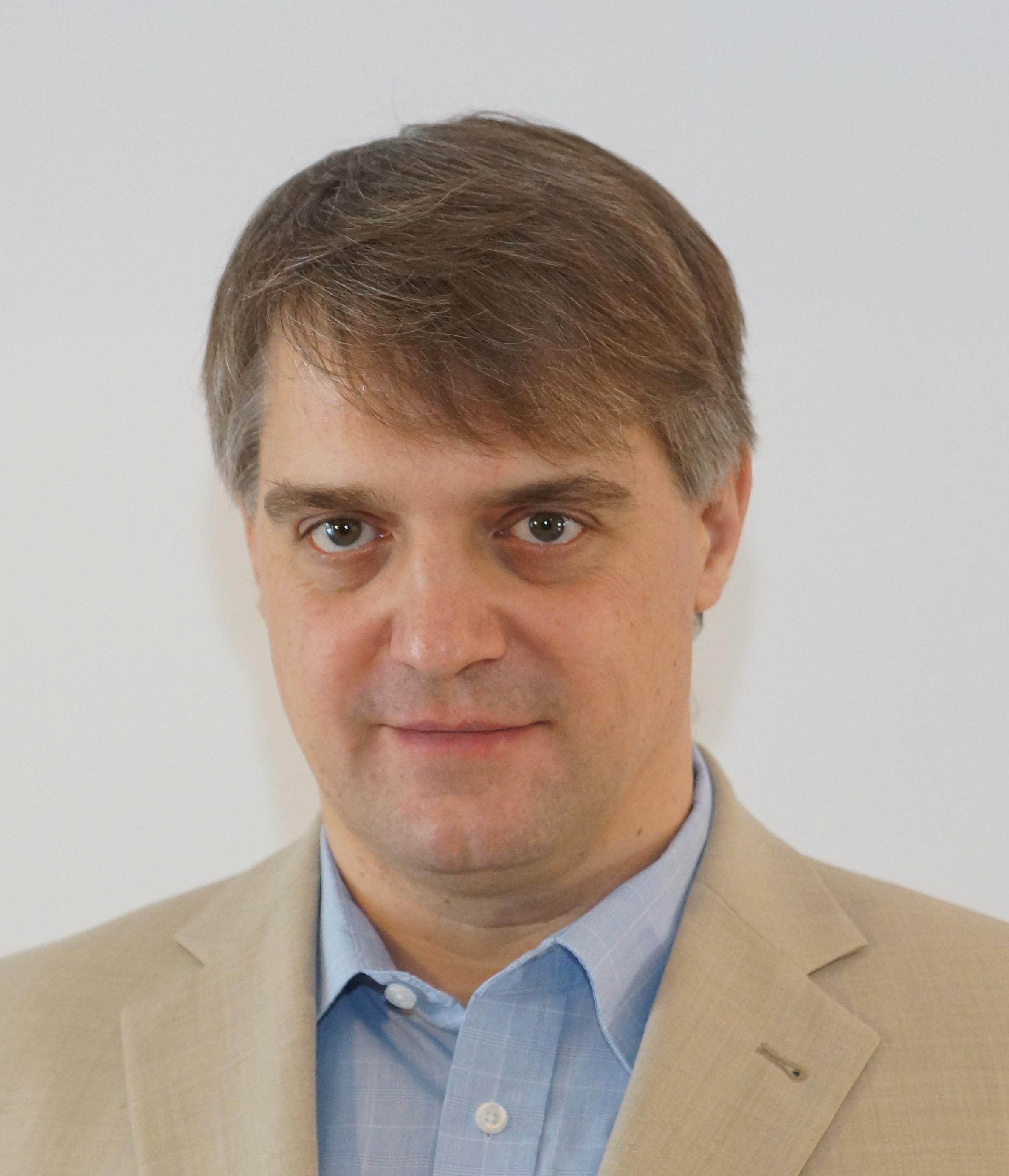
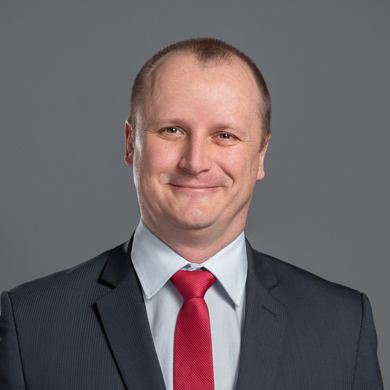
Vítězslav Beran is an Associate Professor at the Department of Computer Graphics and Multimedia (DCGM) within Brno University of Technology . His research focuses on Augmented Reality , Robotics , and Computer Vision . Role: Vice-dean for Marketing and External Relations Contact: beranv@fit.vut.cz, vicedean-foreign@fit.vut.cz Research interests include: Augmented Reality Applications Human-robot Interaction Image and Video Processing 3D User Interfaces His recent publications (2019-2024) explore: End-User Robot Programming Reachability Solutions in Industrial AR Drone Control Systems 3D Interaction Techniques Projects span both academic research and practical applications in: Embedded Systems Computer Vision Algorithms Collaborative Workspace Design Patents include: 2015: Multifunctional Camera System 2012: Data Distribution Method Teaching activities: Image Processing Computer Graphics User Interface Programming Advanced Computer Vision
Tomáš Bureš is a Professor at the Department of Distributed and Dependable Systems , Faculty of Mathematics and Physics , Charles University . His work focuses on adaptive software architectures for smart cyber-physical systems (CPS) and IoT, leveraging machine learning (neural networks) for self-adaptation, edge-cloud systems, and model-driven development. Research Groups: Leader of the SmartArch research group. Projects: Involved in ExtremeXP , ESTABLISH , AFarCloud , FitOptiVis , Trust 4.0 , ASCENS , RELATE ITN , Q-ImPrESS . Publications span topics like performance regression testing, ML workflow optimization, confidentiality analysis under uncertainty, and edge-cloud continuum modeling. Key subfields include self-adaptive architectures, adaptation rules, component ensembles, and statistical methods in software engineering. His work bridges theoretical models (e.g., DEECo, SOFA) with practical tools (e.g., ExpEngine, Robin) for CPS and cloud applications. Co-Authors include P. Hnětynka, M. Abdullah, R. Heinrich, and others. Publications appear in venues like IEEE Transactions on Autonomic Computing , ACM/SPEC ICPE , and ECSA Workshops .
Zdenek Hanzalek is a professor at the Czech Technical University in Prague, affiliated with the Industrial Informatics Department within the Czech Institute of Informatics, Robotics and Cybernetics (CIIRC). His research focuses on scheduling algorithms, real-time systems, robotics, optimization, embedded systems, and automation. He leads projects such as ROBOPROX and CERTICAR, addressing advanced industrial production and autonomous vehicle certification. Notable contributions include work on periodic scheduling for time-sensitive networks, energy-efficient robotic systems, and trajectory planning for autonomous vehicles. Research Interests : - Development of efficient scheduling algorithms for real-time and embedded systems. - Optimization techniques for manufacturing systems and robotic applications. - Autonomous driving technologies, including trajectory planning and control systems. - Energy consumption reduction in production and robotic processes. - Time-triggered communication protocols and network scheduling. Recent Trends in Articles : Recent publications emphasize integration of machine learning with scheduling, optimization of charging infrastructure for electrified transportation, and robust scheduling under uncertainty. Key areas include reconfigurable manufacturing systems, mixed-criticality scheduling, and pandemic-resilient workforce planning. Awards & Grants : - Best Student Paper Award (ICORES 2023) for work on analog circuit placement. - Best Paper Award (ICORES 2022) for incremental scheduling algorithms. - Multiple Grade 1 Application Results in national evaluations. - Supported by EU, TAČR, and industry grants (e.g., Horizon 2020, ECSEL). Advising & Teams : Supervised over 20 PhD and master’s students in scheduling, robotics, and embedded systems. Collaborates with industry partners like Porsche Engineering, Skoda Auto, and Honeywell. Leads the CERTICAR project for autonomous vehicle certification and the HERCULES project on many-core systems for autonomous driving. Labs & Infrastructure : - Develops tools like TORSCHE scheduling toolbox and autonomous driving demonstrators (e.g., Porsche Panamera Turbo). - Engages in hardware-software co-design for real-time embedded systems.
Professor Vladimír Vašek serves as faculty at Tomas Bata University in Zlín within the Institute of Automation and Control Engineering, Faculty of Technology. He maintains active teaching responsibilities with designated consultation hours. His research focuses on core engineering disciplines: Automation Control Engineering Robotics Systems Engineering Industrial Automation Contact details include email (vasek@utb.cz), mobile (+420 606 777 211), office phone (+420 576 035 254), and office location U51/A713. Consultation hours are held Tuesdays 4:00 PM - 5:00 PM.
Jakub Novák is a Researcher at the Faculty of Applied Informatics , Tomas Bata University in Zlín , with a focus on modeling and control of nonlinear systems, embedded systems, and predictive control. He works at the Regional Research Center CEBIA-Tech and previously at the Research Center for Applied Cybernetics. Education : Ph.D. in Applied Informatics (2007) and Master's degree in Technology (2002) from Tomas Bata University/Brno University of Technology International experience at Politecnico di Milano (2003) and Strathclyde University (2004) Research interests center on nonlinear system modeling , predictive control algorithms , and embedded control system implementation . His work includes applications in magnetic levitation, coupled drives, and chemical thermal processes. He has developed Simulink models for educational purposes and contributed to tools like LM Toolbox for local model networks. Publication trends show a strong emphasis on predictive control (14+ papers) and nonlinear system modeling across various platforms including magnetic levitation plants and twin rotor MIMO systems. He has contributed to real-time control solutions and mixed-integer programming implementations. Advising includes supervising 5 master's theses and 7 bachelor's theses since 2006. Collaborations with Petr Chalupa (55+ co-authored works) and Vladimír Bobál (33 co-authored works) indicate long-term research partnerships.
Pavel Pokorný serves as an Assistant Professor at Tomas Bata University in Zlín, specifically within the Faculty of Applied Informatics, Department of Computer and Communication Systems. He has held this position since 2010, following his previous role as Assistant Professor at the university's Institute of Applied Informatics from 2003-2009. Education: 1998-2003: Ph.D. in Automation and Control Engineering, TBU (Tomas Bata University), Faculty of Technology 1993-1998: Automation and Control Technology, BUT (Brno University of Technology), Faculty of Technology in Zlín 1998: Professional internship in Bonn, Germany Pavel Pokorný's research focuses predominantly on computer graphics and visualization technologies. His work spans multiple application domains including historical reconstruction, educational tools, and industrial applications. He demonstrates extensive expertise with major game engines such as Unreal Engine and Unity, as well as 3D modeling software like Blender. His research output reveals a consistent pattern of applying visualization techniques to solve practical problems across diverse fields from urban planning to biotechnology. The integration of virtual reality for educational purposes appears to be a recurring theme throughout his publication history. His scholarly contributions appear primarily in conference proceedings and book chapters, with notable publication venues including Advances in Intelligent Systems and Computing and Annals of DAAAM. His research demonstrates strong interdisciplinary connections, collaborating with experts in fields ranging from materials science to history. Pokorný maintains an active research profile with consistent publication output, particularly focusing on 3D visualization applications in historical contexts and educational settings. His work reflects both technical expertise in graphics programming and a creative approach to applying these technologies to real-world problems.
Martin Zálešák is an Assistant Professor at the Institute of Automation and Control Engineering , part of the Faculty of Applied Informatics at Tomas Bata University in Zlín. He leads the Environmental Technology Laboratory (CEBIA) and guarantees the study field Integrated Systems in Buildings . Education: Secondary Technical School of Civil Engineering in Valašské Meziříčí (1963–1967) Czech Technical University (CTU) Faculty of Mechanical Engineering in Prague (1967–1972) Scientific Postgraduate Course at CTU (1977–1981) His research focuses on building physics , environmental engineering systems , energy audits , and integrated building systems , with expertise in laboratory construction and industrial energy-saving measures. He has participated in international projects as a technical advisor and consultant. Professional Affiliations: ČSNI (Czech Standards Institute), Technical Committee 125 ČKAIT (Czech Chamber of Authorized Engineers and Technicians), Authorized Engineer in Building Physics STP (Society for Environmental Technology), Board Member of the Ventilation Section
Dr. Jakub Yaghob is a researcher at the Faculty of Mathematics and Physics , Charles University , specializing in computer science and parallel computing. He teaches advanced programming topics including Compiler Principles , Parallel Programming , and Cloud Computing . Research Interests : Parallel data stream processing, virtualization technologies, semantic web infrastructures, and performance optimization Teaching : Advanced C++ programming, virtualization administration, and computer systems architecture Technical Expertise : Design of parallelization frameworks, astrophysical data analysis, and hybrid CPU-GPU systems His publications focus on: Optimizing stream data processing across distributed architectures Developing domain-specific languages like Bobolang Performance evaluation in educational programming contexts Applications of parallel computing in astrophysics
Pavel Parízek is an Associate Professor at the Department of Distributed and Dependable Systems, Faculty of Mathematics and Physics, Charles University, Czech Republic. His research focuses on developing methods and tools for program analysis, verification, and debugging, particularly for large multi-threaded programs. He emphasizes techniques that efficiently detect bugs with minimal false positives. Research interests include static and dynamic analysis, concurrency bug detection, formal methods, and scalable verification. Key software tools developed include BUBEN (library abstractions for bug detection), JPF-Inspector (debugger for Java Pathfinder), and PANDA (predicate abstraction tool). Recent publications highlight advancements in partial order reduction, dynamic analysis frameworks for C#/.NET, and automated library abstractions. His work bridges theoretical formal methods with practical software engineering challenges. Teaching includes courses on program analysis, formal foundations of software engineering, and software development tools.
Lubomír Bulej serves as an Associate Professor at the Department of Distributed and Dependable Systems within the Faculty of Mathematics and Physics at Charles University, Prague. His office is located in room S 205 in the historic Lesser Town district, with contact details including email bulej@d3s.mff.cuni.cz and phone +420 951 554 189. He maintains an active research profile through platforms like Google Scholar, DBLP, and GitHub. His research centers on dynamic program analysis and software performance evaluation , with specific focus on analysis composition, program instrumentation, profiling accuracy, and observability in managed platforms. He develops methods for automatic performance evaluation during development, performance change detection, and testable documentation of performance assumptions. Additional interests span object-oriented programming, programming languages, operating systems, and computer architectures, reflected in his teaching of courses like Computer Architecture and Operating Systems. Analysis of his 2021-2025 publications reveals a consistent trajectory in performance-aware software development , with increasing emphasis on compiler technologies (particularly GraalVM), self-adaptive systems for cloud/edge environments, and cost-optimized performance testing methodologies. His work bridges theoretical program analysis with practical industrial applications, especially in avionics and distributed systems. Dr. Bulej actively contributes to major research projects including GraalVM compiler evaluation, FitOptiVis (avionics systems), ASHLEY (aircraft demonstrators), Ferdinand (model-driven design evaluation), Q-ImPrESS (service-oriented systems), and CoCoME (component modeling). He maintains critical software infrastructure such as the Renaissance Benchmark Suite, DiSL instrumentation framework, and Java Performance Measurement Framework.
Jan Kofroň is an Associate Professor in the Department of Distributed and Dependable Systems at the Faculty of Mathematics and Physics, Charles University in Prague, Czech Republic. His research focuses on program verification, static analysis, and software reliability. His educational background includes a Ph.D., as indicated by his title. He maintains an active research profile with numerous recent publications in top venues. Professor Kofroň's research interests span several key areas in software engineering and formal methods. He specializes in interpolation-based code model checking, static analysis of programs, system behavior models and verification, and programming language semantics. His work bridges theoretical foundations with practical applications in software development. His recent publications demonstrate strong focus on verification techniques for complex software systems, particularly in the areas of Horn clause solving, program comprehension using computational notebooks, and uncertainty-aware self-adaptive cyber-physical systems. His research shows consistent contributions to both theoretical foundations and practical applications of program analysis. Professor Kofroň actively leads and participates in multiple research projects including the current AIDE project (Advanced Analysis and Verification for Advanced Software) and past projects such as SNAPPY, ROBUST, Weverca, Q-ImPrESS, SOFA 2, and ASCENS. He teaches courses related to Java programming, Python programming, program semantics, and mobile devices programming. He maintains an open-door policy for student consultations, requesting students email him to arrange meetings rather than maintaining fixed office hours. His department maintains active GitHub presence, contributing to open-source projects related to software verification and analysis tools.
Martin Kruliš is an associate professor in the Department of Distributed and Dependable Systems at the Faculty of Mathematics and Physics, Charles University , Prague, Czech Republic. His primary roles include research, teaching, advising, and leading projects that bridge high-performance computing, GPU programming, and self-adaptive systems. Education: While exact details of his own degrees are not provided, Dr. Kruliš’s extensive publication record and faculty position at Charles University indicate advanced training in computer science with specialization in parallel and distributed computing. Research Interests: High-Performance GPU Computing: Deep investigation into CUDA kernel optimization, memory bandwidth utilization, and workload dispatching for massively parallel accelerators. Self-Adaptive & Self-Optimizing Systems: Designing ensemble-based abstractions that integrate machine-learning estimators to enable runtime adaptation in component architectures. Parallel Algorithms & Data Structures: Development of cache-friendly, SIMD-aware, and GPU-accelerated algorithms for clustering, dimensionality reduction, and similarity search. Software Engineering for Parallelism: Creation of C++ libraries, DSLs (e.g., Bobolang), and educational tools (ReCodEx) that simplify parallel programming and automated evaluation. Publication Trends: Across 2011–2025, Kruliš’s articles reveal a clear trajectory from foundational GPU-accelerated indexing and multimedia retrieval toward sophisticated self-adaptive systems that leverage machine learning. Recent works (2023–2025) increasingly focus on integrating LLMs and neural networks into compiler and runtime optimization loops, reflecting a convergence of AI and systems research. Scientific Awards & Recognition: No specific awards or fellowships are mentioned in the provided text; however, sustained publication in top-tier venues (JPDC, IPDPS, Euro-Par, SEAMS) and active involvement in program committees and tool development indicate strong peer recognition. Teaching & Student Supervision: Teaches Programming in Parallel Environment (NPRG042) , Advanced Programming in Parallel Environment (NPRG058) , Computer Systems (NSWI170) , and Software Projects . Supervises numerous bachelor’s and master’s theses; exact student names are not listed in the text. Labs, Projects & Tools: ReCodEx: A widely used platform for semi-automated evaluation of programming assignments at Charles University. Simdex: A modular simulator of the ReCodEx backend that enables realistic experimentation with self-adaptive job dispatching and machine-learning controllers. Active contributor to open-source repositories on GitHub, focusing on GPU kernels, benchmarking frameworks, and educational tooling.
Václav Hlaváč is a Professor of Engineering Cybernetics at the Czech Institute of Informatics, Robotics and Cybernetics (CIIRC), part of the Czech Technical University in Prague (CTU). He serves as Head of the Department of Robotics and Machine Perception, Deputy Director of CIIRC, and holds roles in university governance. His work bridges academic leadership with cutting-edge research. PhD in Control Engineering (CTU, 1987) Professor at CTU (1998–present) Founder of the Center for Machine Perception (1996) Research Interests Hlaváč specializes in: Computer Vision – 3D scene reconstruction, video sequence analysis, and image processing Pattern Recognition – Statistical and structural methods, ordinal classification Autonomous Robotics – Manipulation of soft materials and industrial applications His recent work focuses on robotic cable segmentation , digital twins for manufacturing, and event camera technology . Publications span journals like Information Sciences and IEEE Robotics and Automation Letters , with over 18,000 Google Scholar citations. Scientific Awards Research fellowship, Institute of Control Problems (Moscow, 1986) Research fellowship, University of Sussex (1989) Visiting professorships at TU Vienna (1993, 1995) Teaching & Publications He authored the textbook Image Processing, Analysis, and Machine Vision (4th ed, 2015) and maintains teaching resources in English and Czech . His Center for Machine Perception has been active since 1996.
Antonin Kucera is a Professor at the Faculty of Informatics , Masaryk University, Czech Republic. His work focuses on stochastic processes, probabilistic systems, Markov decision processes, stochastic games, infinite-state systems, and applications of game theory in security and operational research. He has led multiple research projects funded by institutions like the US Army Research Office and the Czech Science Foundation. Research Interests : Stochastic processes, probabilistic verification, infinite-state systems, multi-objective optimization, game theory, and security applications. Projects : Leading studies on adversarial security patrolling, probabilistic systems analysis, and game-theoretic verification. Past projects include European Network for Game Theory (COST) and Institute for Theoretical Computer Science. Advising : Mentored 13 PhD/Master's students, including Tomáš Brázdil, Petr Novotný, and Jan Křetínský. Teaching : Courses on Petri Nets, Semantics of Programming Languages, and Mathematical Logic.
Assoc. Prof. Jiří Vojtěšek, Ph.D. is an Associate Professor at the Institute of Process Management , Faculty of Applied Informatics, Tomas Bata University in Zlín. He serves as Dean of the Faculty since 2022 and held roles including Vice-Dean for Bachelor's and Master's Studies (2014-2022) and Assistant Professor (2007-2015). His work bridges automation, control systems, and applied informatics. Education : Habilitation in Machine and Process Control (2015), Ph.D. in Applied Informatics (2002-2007), Bc. in Automation and Control Technology (1997-2002). International Experience : 1-week teaching stays at Université D'Angers (France), University of Minho (Portugal), Universita di Cagliari (Italy), and others across Europe via Socrates/Erasmus. Research collaboration with Politecnico di Milano (Italy) and University of Applied Science Cologne (Germany). Academic Leadership : Chair of the Scholarship Committee, member of the Dean's College, and organizer of study programs like Engineering Informatics.