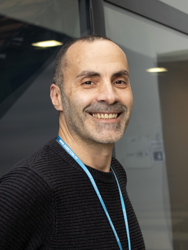
BEN AYED Safaمشاهده پروفایل
پژوهشگر
BEN AYED Safa is a Researcher-Lecturer at CESI, affiliated with the LINEACT research group and the Department of Engineering and Numerical Tools. Their work focuses on knowledge management, uncertainty modeling under belief function theory, decision support systems, and predictive maintenance. They hold dual PhDs in Computer and Automatic Engineering (Artois University, France, 2020) and Computer Science applied to Management (University of Tunis, Tunisia, 2020), along with advanced degrees in Business Intelligence and Data Mining. Currently collaborating on the ANR SCOPES project (2022-2025), they teach modules in computer science, networks, and electrical engineering at undergraduate levels. Their research emphasizes CBR systems maintenance, evidential fusion methods, and AI-driven predictive analytics. Recent work includes advancements in collaborative perception modeling and uncertainty quantification in industrial systems. Education : PhD in Computer and Automatic Engineering (LGI2A, Artois University, 2020) PhD in Computer Science applied to Management (LARODEC, University of Tunis, 2020) Master of Research in Business Intelligence (Institut Supérieur de Gestion, Tunisia, 2017) Master in Data Mining & Knowledge Management (Polytech'Nantes, France, 2017) Bachelor in Computer Science applied to Management (Institut Supérieur de Gestion, Tunisia, 2015) Research Interests : Belief Function Theory applications in CBR systems Evidential clustering and policy design Predictive maintenance frameworks Machine learning for uncertainty quantification Information fusion in autonomous systems Key Contributions : Recent work bridges belief function theory with industrial AI challenges, including energy forecasting, turbofan prognosis, and ITER divertor modeling. Their methods enhance case-base maintenance through evidential integration, addressing dynamic uncertainty in real-world systems. Grants & Supervision : Participating in the ANR SCOPES project (2022-2025) and planning thesis supervision by 2025. Their research spans academic-industrial collaboration in PHM frameworks and smart building analytics.