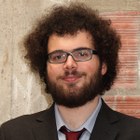
Malin Picha Edwardsson is a Senior Lecturer in Journalism at Södertörn University. She holds a PhD in Media Technology from KTH Royal Institute of Technology (2015) and an M.A. in Journalism from Stockholm University. Her research bridges journalism and media technology, focusing on digital storytelling, automated news processes, and blockchain applications in fact-checking. Education: M.A. in Journalism, Stockholm University PhD in Media Technology, KTH Royal Institute of Technology (2015) Research Collaborations: Bonnier News, Schibsted, Swedish Radio (2017) Sveriges Radio Östergötland, Norrköpings Tidningar Media (2017–2019) Storylab (blockchain in fact-checking, 2019–2020) Media & Democracy, Sydöstran (Blekinge local journalism, 2021) Teaching: Courses from A-level to Master's at Södertörn University since 2016. Her recent work explores blockchain's role in verifying data for journalism and fostering democratic discourse through collaborations with media companies and libraries in Sweden.
Professor Benoit Boulet is a Full Professor in the Department of Electrical & Computer Engineering at McGill University and serves as Director of the McGill Engine Centre for Technological Innovation and Entrepreneurship. His research focuses on systems and control, with applications in robotics, automation, smart grids, and electric vehicles. He is affiliated with the Systems and Control Unit and the CIM Research Group. His work spans reinforcement learning, time series forecasting, anomaly detection, and traffic signal control. Notable contributions include advancements in electric vehicle transmission systems, autonomous driving trajectory prediction, and energy management systems for smart grids. His research emphasizes practical applications in transportation, renewable energy, and industrial automation. Key technical areas include: Reinforcement learning frameworks for control systems Multi-agent systems and meta-learning Electric vehicle powertrain design Graph-based trajectory prediction Energy-efficient building systems His recent publications (2023-2025) highlight innovations in causal discovery algorithms, fault detection methodologies, and adaptive control strategies. Current initiatives focus on bridging AI advancements with real-world control engineering challenges.
Susana Pérez Soler is an Associate Lecturer at the Blanquerna School of Communication and International Relations, Ramon Llull University. Her research focuses on digital journalism, media literacy, European Union policy, and the impact of social networks on communication practices. She has contributed to projects like the STReaM initiative analyzing societal, technological, and media intersections. Roles: Researcher in 4 funded projects (2014-2025) Expertise areas: Social media strategies, misinformation combat, EU media governance Key projects: STReaM (2022-2025), Digilab (2014-2017) Her work bridges journalism ethics with digital innovation, addressing challenges like AI integration in newsrooms and podcasting evolution. She has published extensively on media history, paywall strategies, and professional development in journalism. Recent focus: Fact-checking platforms and digital media business models
Antoon Bronselaer is an Assistant Professor at Ghent University's Department of Telecommunications and Information Processing within the Faculty of Engineering and Architecture. He is an active member of the Database, Document and Content Management (DDCM) research group, focusing on advancing database theory and applications. His research centers on data quality (particularly measurement models and improvement techniques), temporal databases , data fusion , and uncertainty management in databases . Key contributions include measure-theoretic foundations for data quality assessment, dynamical order construction in data fusion, and predicate enrichment techniques for wrapper induction. Analysis of his recent publications reveals consistent innovation in data cleaning algorithms (e.g., Swipe framework), temporal data modeling, and orthographic similarity measures for graph-based text representations. His work increasingly bridges database theory with healthcare applications (e.g., statin-gait relationship studies) and digital humanities (Byzantine epigrams project). No scientific awards are mentioned in the source materials. Dr. Bronselaer's academic guidance includes formal advisees at Ghent University, though specific student names aren't documented in the provided texts. His research is supported through university positions and likely Belgian/Flemish research grants given his publication venues. Current projects involve automated news update analysis, persistent identifier validation, and syntactic interoperability frameworks. He leads research within the DDCM group, specializing in data quality measurement systems and temporal data management solutions. Recent work demonstrates expansion into healthcare data analytics and cultural heritage informatics while maintaining core expertise in database theory.
Anthony McCosker is a Professor of Media and Communication at Swinburne University of Technology, affiliated with the School of Social Sciences, Media, Film and Education. He holds dual roles as Director of the Social Innovation Research Institute and Chief Investigator in the ARC Centre of Excellence for Automated Decision-Making and Society (ADM+S). His research focuses on digital inclusion, technology adoption inequalities, health/wellbeing, automation, and AI ethics, with an emphasis on community-driven data practices. Research Projects: Includes the Impact Evaluation of Be Connected program, digital equity projects with Red Cross and Telstra, and initiatives addressing rural mental health service gaps. Publications: Over 160 outputs including books like Everyday Data Cultures and peer-reviewed articles on topics such as digital social ecosystems and AI literacy. Grants: Lead investigator on projects funded by ARC, Department of Education, and international collaborations (e.g., Australia-India Net Zero AI initiative). His work bridges academia and practice, collaborating with NGOs, governments, and tech firms to address digital divides and ethical AI applications. Supervises PhD/Master’s students in areas like AI ethics, social connection technologies, and digital health interventions.
Stefano Pedrazzi is an Assistant Professor and Senior Researcher in the Department of Communication and Media Sciences at the University of Fribourg, Switzerland, within the Faculty of Economics and Social Sciences and Management. He is also affiliated with the Institute for Digital Communication and Media Innovation. His work centers on the governance of digital media, algorithmic systems, and the societal implications of artificial intelligence. His research interests include: Digital Media Governance Algorithmic Decision-Making AI and Society Hate Speech and Visual Hate Content Misinformation and Disinformation Social Bots and Automated Accounts Media Policy and Public Service Media Digital Media Literacy and User Empowerment His recent publications and conference presentations focus on the potential of public service bots (PSBots) to correct misinformation, digital literacy as a governance tool, and the regulation of algorithmic content. His work employs content analysis, policy evaluation, and interdisciplinary approaches to address challenges in digital communication. He has presented his research at leading international conferences such as the International Communication Association (ICA), European Communication Conference (ECREA), and the German Communication Association (DGPuK). He has also co-organized workshops on platform regulation and digital copyright, bridging science and practice. Stefano Pedrazzi actively contributes to academic discourse through collaborative research, particularly with scholars like F. Oehmer-Pedrazzi and M. Puppis, and has been involved in policy-relevant studies for Swiss federal agencies.
JORGE VAZQUEZ HERRERO is a Full Professor in the Department of Communication Sciences at the University of Santiago de Compostela (Spain). He holds a PhD in Communication and Contemporary Information and has conducted visiting research at institutions such as the University of Leeds (UK) and Tampere University (Finland). His research focuses on digital journalism, interactive narratives, AI applications in media, and the ethical challenges posed by emerging technologies. Education: Doctorate in Communication Sciences (2019) from the University of Santiago de Compostela, with a thesis on interactive non-fiction narratives and user experience. Research Interests: Explores how technology transforms journalism, including AI-driven fact-checking, immersive storytelling, and the impact of social media platforms on news dissemination. He critically examines issues like misinformation, media ethics, and the evolving role of journalists in an algorithmic-driven landscape. His recent work highlights trends in AI ethics, disinformation mitigation, and the adaptation of journalism to platforms like Twitch. His studies on radon gas risk communication demonstrate cross-disciplinary approaches to environmental journalism. Awards: None explicitly listed in the provided texts. However, his extensive publications and international collaborations reflect significant academic recognition. Advising & Grants: No specific advisees listed, but he has directed research projects on interactive documentaries and digital native media. His work is supported by institutional research agendas and international collaborations. Affiliations: Member of the Institute of Studies and Development of Galicia (IDEGA), contributing to regional and national media studies initiatives.
Dr. Venelin Kovatchev is an Assistant Professor at the Institute for Interdisciplinary Data Science and AI , with a focus on Natural Language Processing , Computational Linguistics , and Cognitive Science . Their work intersects with educational and academic qualification themes in alignment with UN Sustainable Development Goals. Education : Doctor of Science in Computational Linguistics and Natural Language Processing from Universitat de Barcelona (2015); Master of Science in Cognitive Science and Language (2012); Bachelor of Literature in Bulgarian Philology from Sofia University St Kliment Ohridski (2010). Research spans large language models , named entity recognition , social adjustment analysis , and LLM instruction tuning . Recent work addresses fact-checking , automated scoring , and data disagreement resolution in NLP tasks. Active in interdisciplinary projects, including Natural language processing of electronic health records to improve empirical prescribing in acute admissions (2023-2027) as Co-Investigator with Shionogi B.V. funding. Contributions include datasets and methodological frameworks for NLP and cognitive science research.
Hongrae Lee is a researcher specializing in database systems, natural language processing, and data mining. His work bridges structured data management with language models, focusing on tasks like natural language to SQL translation, similarity joins, and efficient data processing. His research interests include: Database query optimization and similarity search Language model applications for text generation and hallucination correction Web data curation and structured data ecosystems Cloud storage optimization and distributed systems Hongrae Lee's recent publications (2022-2023) highlight trends in large language models (LLMs) for dialogue applications, attributed text generation, and acronym disambiguation with weak supervision. Earlier work (2016-2007) established foundational techniques in database scalability, LSH-based similarity estimation, and geographical data thinning. He has collaborated extensively with researchers at institutions like Google, Seoul National University, and University of British Columbia on projects such as WebTables, LaMDA, and Google Fusion Tables. His contributions span both theoretical advancements (e.g., variance-aware query optimization) and practical systems (e.g., CloudRAMSort, T5-based disambiguation).
Matthias C. Kettemann is a full-time Professor of Innovation, Theory and Philosophy of Law at the University of Innsbruck , where he leads the Department of Legal Theory and Future of Law . He also serves as a research programme leader at the Leibniz Institute for Media Research | Hans Bredow Institute in Hamburg, research group leader at the Alexander von Humboldt Institute for Internet and Society in Berlin, and as a research group leader at the Sustainable Computing Lab in Vienna. His academic affiliations extend to associated researcher roles at institutions in Hamburg, Frankfurt am Main, and Graz. Head of Department, University of Innsbruck Research Programme Leader, Leibniz Institute for Media Research Research Group Leader, Humboldt Institute for Internet and Society Board Member, Sustainable Computing Lab Associated Researcher, Research Institute for Social Cohesion Prof. Kettemann’s research focuses on internet law , AI governance , platform regulation , digital constitutionalism , and innovation law . His publications and projects explore normative orders , multinormativity , and cybersecurity in digital spaces. His recent articles address human-in-the-loop AI systems , consumer credit algorithms , and democratic resilience against disinformation . He also investigates legal frameworks for data sovereignty and platform accountability in crisis situations . He has received prestigious scholarships, including the Fulbright and Boas Scholarships , and contributes to academic discourse as Managing Editor of the Mohr/Siebeck series 'Internet und Gesellschaft' , editorial board member of journals like jusIT and Media and Communication Studies , and scientific advisory board member of the European Yearbook on Human Rights . He is actively involved in reviewing for international publishers and academic journals. Prof. Kettemann teaches in German, English, and French, with courses in internet law , innovation law , international law , and legal philosophy since 2008. He supervises theses at bachelor, diploma, doctoral, and post-doctoral levels, emphasizing digital law and innovation frameworks . His third-party funding includes grants from the European Union , Friedrich-Ebert-Stiftung , Google , and Deutsche Telekom .
Dr. Anna Kerkhof is a researcher at Ludwig Maximilian University of Munich specializing in the economics of social media, with primary focus on hate speech dynamics, political polarization, and misinformation spread. Her research employs dual-method approaches: large-scale observational analysis of 7 million German online forum comments to identify hate speech contagion patterns and topic vulnerabilities, coupled with field experiments on Twitter and Reddit testing interventions like automated counter-speech and cross-ideological encounters. She investigates how political events (notably the AfD party's emergence) reshape political discourse while developing media literacy training and fact-checking efficacy studies to combat misinformation.
Rui Cao is a Researcher at the Department of Computer Science and Technology at the University of Cambridge, located in the William Gates Building. Their work focuses on multimodal AI systems, particularly addressing challenges in misinformation detection, hate speech moderation, and the analysis of internet memes. Rui's research integrates computer vision, natural language processing, and large language models to tackle real-world societal issues such as online toxicity and factual verification. Key research emphases include: Multimodal fact-checking systems (e.g., AVerImaTeC dataset) LLM-based hallucination mitigation in vision-language models Automated hate speech detection in memes and live video streams Zero-shot and few-shot learning for visual question answering Tools for meme analysis (e.g., Matk Toolkit) Recent work has explored adversarial data augmentation (HateGAN), modular neural architectures for hateful meme detection (Pro-CAP), and frameworks for resolving conflicting evidence in automated fact-checking. Their contributions span both technical advancements and ethical considerations in AI deployment. Research has been published in top-tier venues, with a focus on applications to social media content moderation and misinformation mitigation. No awards or grants are explicitly listed in the provided materials.
Hana Habib is an Assistant Professor at Carnegie Mellon University's Software and Societal Systems Department in the School of Computer Science . She serves as Associate Director of the Master's in Privacy Engineering program and contributes to the Collaboratory Against Hate through human-centered design interventions. Ph.D. in Societal Computing (2021), Carnegie Mellon University MSIT in Information Security (2015), Carnegie Mellon University BS in Computer Science/ECE (2013), Cornell University Her research investigates privacy engineering challenges through human-computer interaction lenses, focusing on user behaviors in digital ecosystems, privacy choice interfaces , and hate speech mitigation strategies. Current work examines iconography effectiveness in privacy communication and regulatory compliance implementation. Recent publications analyze GDPR compliance mechanisms , CCPA implementation challenges, and behavioral advertising controls across platforms. Her empirical approach combines user studies with policy analysis to advance usable security frameworks. Scientific Recognition : Facebook Research Award recipient for advertising control usability Three-time CyLab Presidential Fellowship awardee Executive Women's Forum full-tuition scholarship Stokes Educational Scholarship Program participant Rising Stars Workshop invitee Habib previously served as a Program Committee member for EuroUSEC, USEC, and WAY conferences, and held leadership roles in CMU's OurCS Conference Committee and INI Alumni Leadership Council . Her work has been cited in CCPA rulemaking and influenced NIST Digital Identity Guidelines through password policy research.
Andrea Galassi is a Junior assistant professor (RTD-A) at the University of Bologna's Department of Computer Science and Engineering (DISI), part of the Language Technologies Lab led by Paolo Torroni. He holds a PhD in Computer Science and Engineering from the University of Bologna (2021), with a dissertation on integrating deep neural networks and symbolic knowledge. His postdoctoral research included roles at Stanford, Imperial College London, and the Humane-AI-Net European project on ethical AI. He also served as an Adjunct Professor at the University of Bologna. His research focuses on Machine Learning, Natural Language Processing (NLP), and neuro-symbolic techniques applied to argument mining, legal text analysis, and ethical AI. Notable projects include the FAIR initiative (developing scalable AI techniques), CLAUDETTE, PRIMA, and ADELE legal analytics projects, and StairwAI's horizontal matchmaking services. He is an expert in argument mining for judicial decisions and automated analysis of privacy policies. Galassi has taught over 300 hours of courses, ranging from foundational computer science to advanced NLP topics. He holds National Scientific Qualification for Associate Professor in Computer Engineering (ASN 2023-2025). His recent work emphasizes ethical AI applications, misinformation detection, and AI-driven legal systems, with publications in areas like cross-lingual legal benchmarking (LEXTREME) and subjectivity detection in news media. He leads projects on AI for social impact, including chatbots for asylum seekers and privacy-preserving dialogue systems. His lab participates in CLEF challenges on news credibility and legal argumentation analysis, demonstrating expertise in collaborative AI frameworks and real-world societal applications.
Mubashara Akhtar is a Research Fellow at ETH Zurich (ETH AI Center) and a visiting researcher at the University of Cambridge. She completed her PhD in Natural Language Processing at King's College London under Prof. Elena Simperl and Dr. Oana Cocarascu. Her research focuses on multimodal approaches for fact-checking, AI safety, and benchmarking for large language models. She has held internships at Google DeepMind and contributed to projects like the Croissant dataset documentation format. Education: PhD in Informatics (King's College London), MSc and BSc in Computer Science (TU Wien) Research Interests include multimodal machine learning, knowledge graphs, and ethical AI. Her work bridges NLP, computer vision, and data science to improve automated fact-checking systems and responsible AI practices. Key awards include the Best Short Paper Award at DEEM 2024 and King’s Research Impact Award for multimodal fact-checking. She actively contributes to conferences like NeurIPS, ACL, and EMNLP, co-leading initiatives such as the FEVER workshop and the Croissant project.