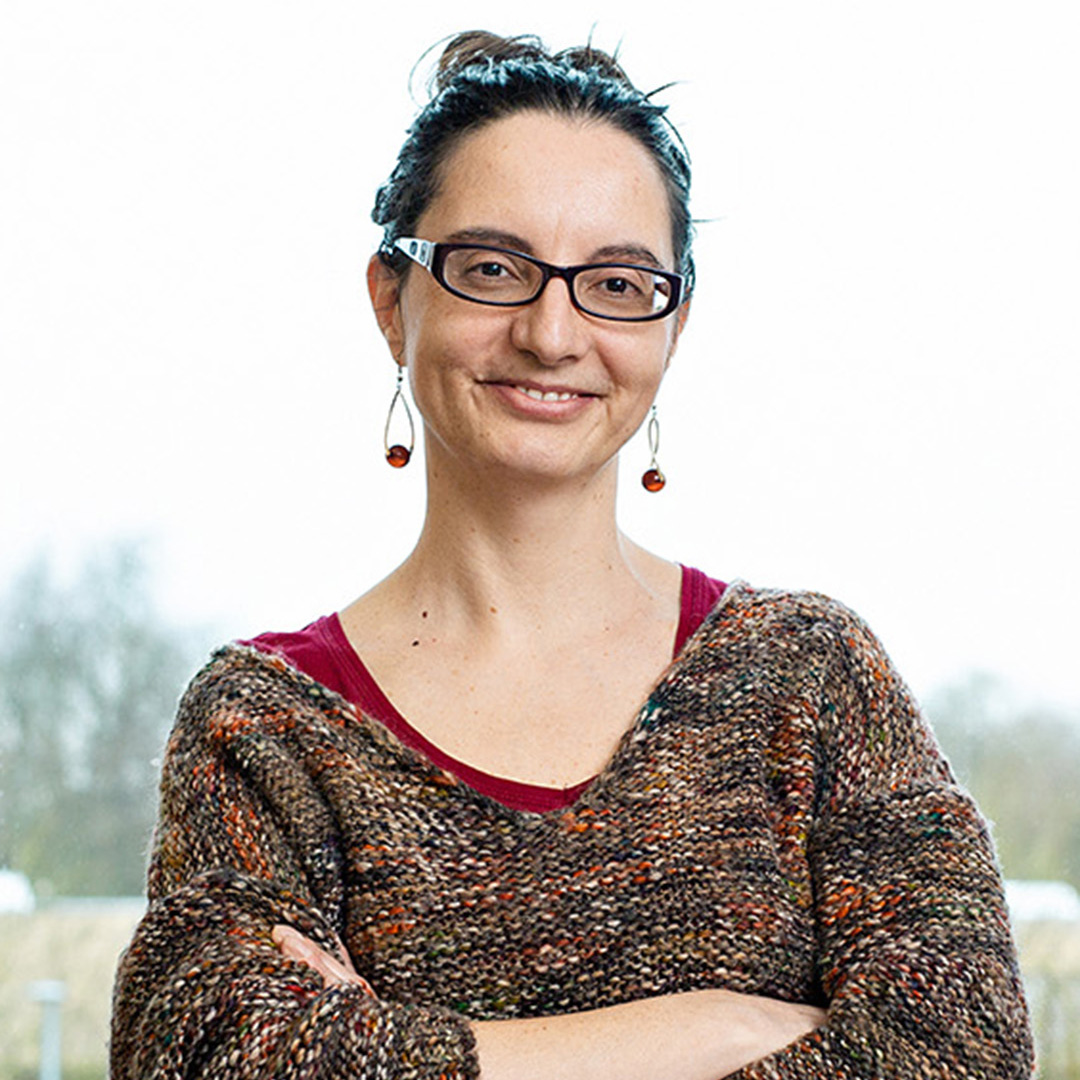
Dr. Hilde Kuehne is a Professor at the University of Tuebingen and a key researcher at the Tuebingen AI Center. She holds affiliations with MIT-IBM Watson AI Lab and Goethe University Frankfurt, with a focus on computer vision, multimodal learning, and explainable AI. Her work bridges vision-language models, audio-visual alignment, and self-supervised methods. Co-organizer of the New Frontiers in Associative Memories workshop @ ICLR 2025 Member of the Scientific Advisory Board of the Carl-Zeiss-Foundation Contributor to CVPR 2025's UTD dataset for unbiased video benchmarks Her research addresses critical challenges in: Explainability for Vision Transformers (LeGrad) Fine-grained audio-visual alignment (CAV-MAE Sync) Zero-shot visual recognition automation (Meta-Prompting) Spatio-temporal grounding without annotations Recent collaborative work spans 15+ publications across CVPR, NeurIPS, ICCV, and ICLR, with emphasis on multimodal foundation models, dataset bias mitigation, and differentiable logic networks. She actively contributes to workshop organization and peer review as evidenced by her involvement in CVPR 2025 and ICLR 2025 program committees.
Bryan Pardo is a Professor of Computer Science at Northwestern University and head of the Interactive Audio Lab. He co-directs the Northwestern Center for Human Computer Interaction + Design and chairs the Computer Science Diversity Committee. He teaches courses in Deep Learning, Machine Learning, Generative Modeling, and Digital Music Instrument Design. PhD in Computer Science and Engineering, University of Michigan MMus in Jazz and Improvisation, University of Michigan MS in Computer Science, Ohio State University BMus in Jazz Composition, Ohio State University His research focuses on machine understanding and manipulation of sound, particularly in music and speech domains. Key areas include Machine Learning (e.g., automated gradient clipping), Signal Processing (e.g., Multi-scale Common-fate Transform), and Human Computer Interaction. Applications involve inclusive audio interfaces, audio search engines, source separation, natural language-controlled audio effects, privacy-preserving adversarial attacks on voice recognition, and music co-creation tools. Recent publications highlight advancements in neural watermarking (MaskMark), masked acoustic modeling (VampNet), and real-time adversarial privacy systems for speech. His lab's work has been applied in Adobe's AI-powered audio editor and Lexie B2 hearing aids. Scientific Awards: $1.8 million NSF Future of Work award $440K NSF grant for accessible music programming $200K Toyota grant $100K Sony grant TorchCrepe pitch tracker: 20 million+ downloads Bryan Pardo advises PhD student Max Morrison and collaborates with researchers like Patrick O'Reilly, Zeyu Jin, and Prem Seetharaman. His lab develops technologies for blind and visually impaired audio creators, including HaptEQ and Eyes-free tools.
Fernando De la Torre is a Courtesy Professor in the Department of Electrical and Computer Engineering at Carnegie Mellon University, with an affiliation to the Robotics Institute where he has been a research faculty member since 2005. He holds a Ph.D. in Electronic Engineering from Ramon Llull University (2002). His research focuses on machine learning and computer vision, with applications in human health, augmented/virtual reality, generative models, and data-centric methodologies. He directs the Human Sensing Laboratory, which explores technologies for human behavior analysis and health monitoring. Notable contributions include founding FacioMetrics LLC (acquired by Meta), advancing facial recognition and 3D human digitization, and developing frameworks for robust visual models. His work bridges theory and practice, with over 225 peer-reviewed publications and editorial roles, including Associate Editor for IEEE Transactions on Pattern Analysis and Machine Intelligence. Recent research trends emphasize generative AI applications in satellite imagery analysis, VR/AR rendering optimizations (e.g., Gaussian splatting), and clinical motion recognition for healthcare. His projects often intersect with industry, addressing challenges in wearable health monitoring and immersive technologies. His lab collaborations span academia and industry, focusing on scalable solutions for 3D human modeling, adversarial robustness, and multimodal data fusion. Key achievements include pioneering work on 3D face animation from speech and garment reconstruction from single images.
Adriana I. Kovashka is an Associate Professor in the Department of Computer Science at the University of Pittsburgh's School of Computing and Information. She serves as Chair of the Department of Computer Science. Her research focuses on computer vision, machine learning, and their intersections with human-machine communication and visual rhetoric analysis. Kovashka earned her BA in Computer Science and Media Studies from Pomona College (2008) and her PhD in Computer Science from the University of Texas at Austin (2014). She joined Pitt in 2015. Her work emphasizes improving image retrieval systems through semantic attributes, human-in-the-loop feedback, and crowd-sourced data. Notable projects include analyzing advertisements' persuasive strategies, developing object detection models resilient to domain shifts, and exploring multimodal learning with linguistic and visual inputs. She has secured significant grants, including NSF awards for geographic diversity in object detection (2023), CAREER funding for weak supervision methods (2021), and multiple Google Faculty Research Awards. Kovashka advises PhD students on topics ranging from multimodal intent modeling to domain generalization. She has organized workshops on advertising understanding and subjective attributes in vision conferences. Her lab's datasets, such as the 64,832-image ad repository and video ad collections, are widely used in vision research. Recent efforts include quantifying perceptual diversity in multilingual systems and mitigating bias in CNNs through shape regularization. Awards and recognitions include the NSF CAREER Award, Pitt's CRDF grants, and leadership roles in CVPR and WACV conferences. Her research bridges technical innovation with societal impact, addressing challenges in visual communication, ethical AI, and educational robotics.
Cecilia Mascolo is a Professor of Mobile Systems at the University of Cambridge , specifically in the Department of Computer Science and Technology . She co-directs the Centre for Mobile, Wearable System and Augmented Intelligence and is a Fellow of Jesus College, Cambridge . Her research focuses on mobile systems , machine learning for mobile health , and earable technology . She has been awarded prestigious grants such as the ERC Advanced Research Grant (2019-2025) and the EPSRC Open Research Fellowship (2025-2030). Currently on sabbatical at Harvard University , her work bridges systems and machine learning for health applications. Education: PhD in Computer Science from the University of Bologna, Italy. Previous Affiliation: Faculty at University College London before 2008. Her research spans mobile and wearable systems for health and behavior monitoring, focusing on on-device machine learning , uncertainty-aware models , and audio-based diagnostics . Key areas include federated learning , edge computing , and respiratory disease progression analysis via wearables. She explores earable technology for physiological monitoring, gait analysis, and even toothbrushing tracking using in-ear sensors. Her recent publications highlight advancements in earable-based health monitoring , including heart rate estimation , respiratory rate detection , and ECG analysis using machine learning. She emphasizes longitudinal health data from consumer devices, advocating for scalable diagnostics beyond traditional clinical standards. Scientific Awards: ERC Advanced Research Grant EPSRC Open Research Fellowship Best Paper Award - IEEE Percom 10-Year Impact Award - ACM Ubicomp Computer Laboratory Ring Hall of Fame Best Paper Award Student: Andrea Ferlini - ACM SIGMOBILE Doctoral Dissertation Runner-up She leads the Mobile Systems Research Laboratory , mentoring a team of 15 researchers (postdocs and PhD students), and has graduated over 25 PhD students. Her teaching includes Mobile Health courses at the University of Cambridge, and she serves as Director of Studies for Computer Science at Jesus College.
David Lindlbauer is an Assistant Professor at Carnegie Mellon University's Human-Computer Interaction Institute (HCII), where he leads the Augmented Perception Lab and co-directs the CMU Extended Reality Technology Center. His research focuses on advancing Mixed Reality (MR) and Extended Reality (XR) interfaces through computational interaction methods that optimize spatial, temporal, and multimodal feedback.
Xiaohu Guo is a Professor of Computer Science at the University of Texas at Dallas specializing in computer graphics, computer vision, and geometric modeling. His research develops algorithms for 3D/4D reconstruction, virtual reality, medical imaging, and physics-based simulations. Professor Guo has received significant recognition including a Best Paper Award at SIGGRAPH (2023) and an NSF CAREER Award (2012). His current research focuses on dynamic human capture, deformable models, and medical image computation. Education: PhD, Stony Brook University MS, Stony Brook University BS, University of Science and Technology of China Research Funding: Recently secured a $500,000 NSF grant for developing open-source 4D reconstruction frameworks for real-time dynamic human capture (2021). Editorial Roles: Serves on editorial boards of Graphical Models , Computer Animation and Virtual Worlds , and IEEE Transactions on Visualization and Computer Graphics .
Florence d'Alché-Buc is a Professor at Télécom Paris (Institut Polytechnique de Paris), holding an Isaac Newton Institute Simons Chair (2025) and leading the Data Science and Artificial Intelligence for Digitalized Industry & Services (DSAI) Chair. She heads the Image, Data, and Signal Department and is part of the Signal, Statistics, and Learning (S2A) team at the LTCI laboratory. Her research focuses on machine learning, bioinformatics, and industrial applications, emphasizing kernel methods, structured prediction, and reliable AI. Education: Previously a professor at Université d’Evry and deputy director of the IBISC lab. Co-director of the Paris-Saclay Data Science Master and creator of specialized AI programs (e.g., Certificate of Specialized Studies in AI). Research highlights include contributions to operator-valued kernel methods, graph prediction, and frugal AI. She actively collaborates with institutions like Inria, École Polytechnique, and industry partners (Airbus, Engie, etc.). Notable roles: Scientific director of Digicosme Labex, Ellis Fellow, and board member of IVADO (Montreal). Her recent work addresses AI explainability, robustness, and sustainability, including projects on interpretable networks and energy-efficient models.
Dr. Changyou Chen is an Associate Professor in the Department of Computer Science and Engineering at the University at Buffalo, State University of New York. His research focuses on Multi-Modal Learning Foundation Models Deep Generative Models Large-scale Bayesian Sampling with applications in document understanding, music-AI integration, and molecular representation learning. Research Trends revealed through his recent publications include Optimizing Multimodal Large Language Models Developing Novel Retrieval-Augmented Generation Frameworks Creating Benchmark Datasets for Visual Text Understanding Advancing Diffusion Models with Domain-Specific Constraints across domains from music sheets to biomedical documents. Scientific Contributions : UB Young Investigator Award (2020) Architect of LoCAL Framework for Long Document Understanding Co-developer of MusiXQA Benchmark Pioneering Work in Probability Contrastive Learning Academic Leadership includes mentoring 10+ graduate students and serving as Area Chair for major AI conferences (ICML, NeurIPS, AAAI, IJCAI). His Labs develop scalable solutions for multimodal reasoning, with recent work demonstrating practical GPU memory optimization through LoRA adapter sharing.
Dr. Siwei Lyu is a SUNY Distinguished Professor and SUNY Empire Innovation Professor in the Department of Computer Science and Engineering at the University at Buffalo. He serves as Co-Director of the Center for Information Integrity (CII) and Director of the UB Media Forensic Lab (UB MDFL). His research focuses on digital media forensics, computer vision, and machine learning, with significant contributions to counter-deepfake technologies. Education includes a PhD in Computer Science from Dartmouth College (2005), MS from Peking University (2000), and BS in Information Science from Peking University (1997). He has held academic positions at the University at Albany and New York University. His work spans media forensics, adversarial machine learning, and AI security. Notable achievements include developing the Celeb-DF dataset, leading NSF-funded projects, and testifying before U.S. and NYS legislative bodies on disinformation threats. Over $11.3M in grants have supported his research on AI-generated media detection, including a $5M NSF Convergence Accelerator grant. Key awards include IEEE and IAPR Fellowships, Google Faculty Award, and SUNY Chancellor's Research Award. He has authored 230+ papers, 4 patents, and serves on editorial boards of top journals and conferences (e.g., CVPR, ICCV).
Professor Moncef Gabbouj is a distinguished academic and researcher currently serving as Professor of Signal Processing at the Department of Computing Sciences, Faculty of Information Technology and Communication Sciences, Tampere University, Finland. Previously, he held the same position at Tampere University of Technology before the merger in 2019. He has also held visiting professorships at prestigious institutions including Hong Kong University of Technology and Science, University of Southern California, and Purdue University. Ph.D. and MSc. in Electrical Engineering from Purdue University, USA (1989 and 1986) B.Sc. in Electrical Engineering from Oklahoma State University, USA (1985) Prof. Gabbouj's research spans multiple domains within signal and image processing, with a strong focus on machine learning applications. His primary research interests include artificial intelligence, machine learning, Big Data analytics, multimedia content-based analysis, indexing and retrieval, nonlinear signal and image processing, voice conversion, and video processing and coding. His work bridges theoretical advancements with practical applications across various industries, particularly in multimedia communications and biomedical applications. His extensive publication record demonstrates a clear evolution from traditional signal processing techniques toward more sophisticated machine learning and deep learning approaches. Recent work shows increasing focus on convolutional neural networks for various applications including ECG classification, video processing, financial time-series analysis, and image recognition tasks, reflecting the broader trend in the field toward deep learning methodologies while maintaining strong foundations in signal processing theory. IEEE Fellow (2011) Member, Finnish Academy of Science and Letters (2014) Knight, First Class, of the Order of the White Rose of Finland (2006) Nokia Foundation Recognition Award (2005) Nokia Foundation Visiting Professor Award (2012) Finnish Cultural Foundation for Art and Science Award (2017) TUT Foundation Grand Award (2015) Prof. Gabbouj has supervised 64 doctoral and 72 Master's theses, demonstrating his significant contribution to academic mentoring. His research has been supported by substantial funding, including research grants totaling 8.5 million Euro (2001-2015). He has served as Academy of Finland Professor during 2011-2015 and has been involved in numerous EU research projects including Horizon, ESPRIT, HCM, IST, COST, Tempus and Erasmus programs. As Editor, Guest Editor or member of the Editorial Board of 6 international scientific journals, he has significantly influenced the academic discourse in his field. He leads the Signal Analysis and Machine Intelligence (SAMI) research group at Tampere University and serves as the Finland Site Director of the NSF IUCRC funded Center for Visual and Decision Informatics. His research unit focuses on applying advanced machine learning techniques to solve complex problems in signal processing, computer vision, and multimedia analytics, with applications ranging from healthcare to multimedia communications and financial analysis.
Roberto Togneri is a Professor and Senior Honorary Research Fellow at the University of Western Australia's School of Electrical, Electronic and Computer Engineering. He has been affiliated with the university since 1988, following his PhD in 1989. His research focuses on signal processing, speech recognition, machine learning, and biometrics, with notable contributions to audio-visual recognition systems and fraud detection. Education: PhD in Electrical Engineering (University of Western Australia, 1989). Research interests include feature extraction for audio signals, neural network models for speech and speaker recognition, and applications of machine learning to fraud prevention. His work has been recognized with awards such as the Education Innovation Award (ICASSP 2019) and grants from the Australian Research Council (e.g., DP110103336 for a 3D Audio-Visual Speech Recognition System). Key projects include developing robust speech recognition systems in adverse environments and advancing graph-based fraudster group detection using spatio-temporal data. He has also contributed to editorial roles in IEEE Signal Processing Magazine and authored over 214 research outputs. Funding highlights include $279,000 for a 3D audio-visual speech recognition system (2011–2013) and $230,000 for robust speech recognition in hostile environments (2010–2012). His research aligns with UN SDGs related to innovation and infrastructure.
Lizi Liao is an Assistant Professor at the School of Computing and Information Systems , Singapore Management University (SMU) , specializing in Artificial Intelligence and Conversational AI . Her research bridges Machine Learning , Natural Language Processing , and Multimodal Systems , focusing on proactive dialogue systems, multimodal conversational search, and task-oriented interactions. Education : PhD in Computer Science (2019) from the National University of Singapore (NUS) , advised by Professor Tat-Seng Chua . Research Interests center on principles of human conversational understanding and machine implementation, particularly in proactive conversational agents , multimodal dialogue systems , and target-driven conversation planning . Key applications include emotional support systems , intelligent shopping assistants , and learning companions . Recent Publications (2024-2025) highlight her work on LLM-based proactive dialogue , multimodal emotion recognition , and dynamic graph modeling , often integrating NLP , Multimedia , and Knowledge Graphs . Collaborative projects with her CoAgent Lab team emphasize human-AI interaction and ethical response generation . Scientific Awards : Google South Asia & Southeast Asia Research Award 2023 Lee Kong Chian Fellow Teaching includes Visual Analytics for Business Intelligence (undergraduate) and Text Analytics and Application (graduate). She also serves as Associate Editor for TOIS and TOMM , and organizes tutorials at ACL , SIGIR , and WSDM .
Professor Gary Edmond is a law professor at the University of New South Wales School of Law, directing the Program in Expertise, Evidence and Law. Holding a BA(Hons) from the University of Wollongong, LLB(Hons) from the University of Sydney, and PhD from the University of Cambridge, he bridges legal scholarship with forensic science expertise through extensive research grants and international collaborations. Education: BA(Hons), LLB(Hons), PhD Institutions: University of New South Wales, Australian Academy of Forensic Sciences His research focuses on the intersection of law and forensic science, examining expert evidence reliability, forensic reporting practices, and the adversarial legal system's limitations. With over $1.4 million in research funding since 2007, he leads interdisciplinary projects involving policing agencies and forensic institutions across Australia and international partners. Recent publications analyze judicial handling of expert evidence, cognitive biases in courtroom identification, and forensic science reform. His work has shaped evidence law understanding through the 6th edition of 'Australian Evidence: A principled approach to the common law and the uniform acts' and advisory roles in high-profile inquiries like the Goudge Inquiry. Awards: Fellow of the Royal Society of New South Wales As Chair of the Evidence-based forensics initiative and member of Standards Australia’s forensic science committee, he continues to influence policy while teaching core legal subjects including Courts, Procedure, Evidence and Proof, and Introducing Law and Justice.
Jesper Rindom Jensen is an Associate Professor in the Department of Electronic Systems at Aalborg University, Denmark, under the Technical Faculty of IT and Design. He is the Head of the Audio Analysis Lab, a leading research group in audio signal processing, since 2023. His work bridges theoretical signal processing and practical applications in artificial intelligence and audio systems. Full Name: Jesper Rindom Jensen Institution: Aalborg University School: The Technical Faculty of IT and Design Department: Department of Electronic Systems Research Lab: Audio Analysis Lab Email: jrj@es.aau.dk Office: Fredrik Bajers Vej 7B, B5-206, 9220 Aalborg Øst, Denmark Education: M.Sc. in Electronic Systems, Aalborg University (cum laude, 2009) Ph.D. in Signal Processing, Aalborg University (2012) Research Interests: Jesper Rindom Jensen's research centers on audio signal processing, with a strong emphasis on artificial intelligence, speech enhancement, noise reduction, beamforming, and multichannel systems. His work applies to diverse domains including robot and drone audition, spatial audio, and active noise control. He develops novel filtering techniques, including variable span linear filters and harmonic beamformers, to improve speech quality and intelligibility in noisy and reverberant environments. Publication Trends: His recent publications (2023–2025) show a strong trend toward integrating deep learning with classical signal processing, particularly in direction-of-arrival estimation, underwater acoustics, and robust multichannel systems. There is a clear focus on real-world applications, including sound zone control, active noise control, and limited-data scenarios using knowledge distillation. His work consistently emphasizes robustness, efficiency, and practical deployment. Scientific Awards and Recognition: AAU Talent for emerging research leaders Recipient of a competitive postdoc grant from the Danish Independent Research Council Advising and Grants: Jesper has supervised multiple PhD and master’s students, including Nørholm, Karimian-Azari, Zhang, and Wang. He has led significant research projects such as 'Sound Processing for Robots and Drones' (2018–2020) and participated in others related to joint audio-visual tracking and speech enhancement. His research has been supported by national funding bodies, reflecting its innovation and impact. Labs and Teams: He is a founding and core member of the Audio Analysis Lab at Aalborg University, which focuses on cutting-edge audio signal processing and AI-driven solutions. The lab fosters interdisciplinary collaboration and has produced numerous publications, datasets, and real-world applications. Jensen’s leadership since 2023 underscores his pivotal role in shaping the lab’s research direction.