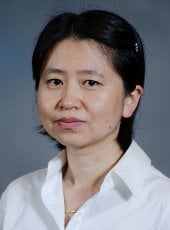
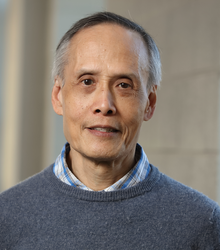
Yongmei M. Jin is a Professor in the Department of Materials Science and Engineering at Michigan Technological University (MTU), affiliated with the College of Engineering. She holds a PhD in Materials Science and Engineering from Rutgers University. Her research focuses on microstructure evolution in crystalline solids, solid-state phase transformations, magnetic domains, computational materials science, and single crystal diffraction techniques. Notable work includes studies on magnetic domain boundary dynamics in Fe-Ga alloys, electric field control of magnetism at material interfaces, and phase field modeling of microstructural evolution. Selected publications demonstrate expertise in modeling material behavior under external stimuli (e.g., electric fields, currents) and analyzing microstructural changes at atomic and macroscopic scales. Teaching responsibilities include courses on materials processing, mechanical behavior of materials, and transmission electron microscopy.
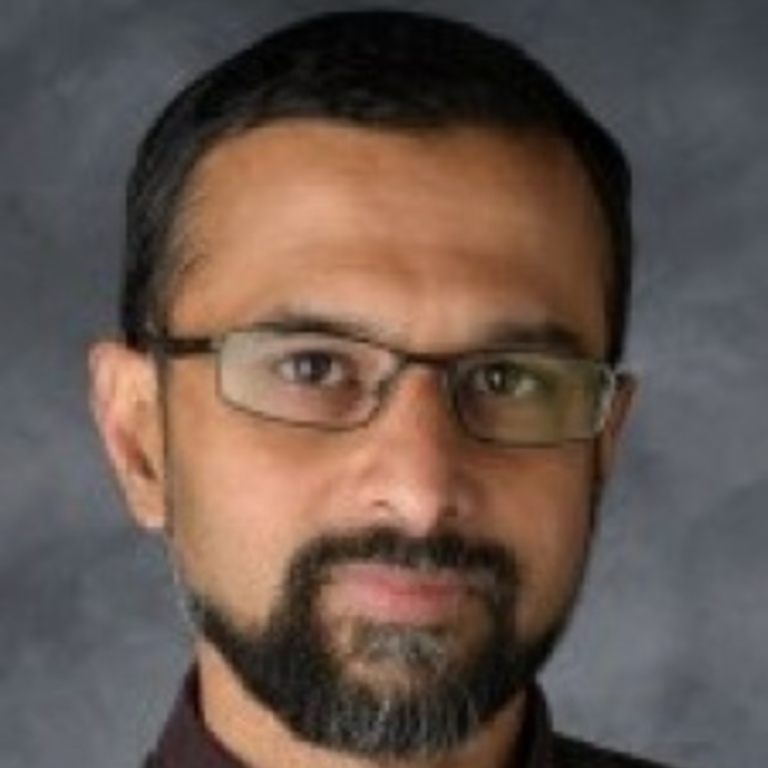
H.S. Udaykumar is the Associate Dean for Research and Faculty and Roy J. Carver Professor of Engineering in the University of Iowa's College of Engineering, with a primary appointment in Mechanical Engineering. He also serves as a Faculty Research Engineer at IIHR—Hydroscience and Engineering. He joined the university in 1999 and holds leadership roles in research administration and academic governance. Education: PhD in Mechanical Engineering, University of Florida, 1994 MS in Mechanical Engineering, University of Florida, 1990 Bachelor of Technology in Mechanical Engineering, Indian Institute of Technology Madras, 1988 Research Focus: Dr. Udaykumar specializes in computational fluid dynamics (CFD), biofluid mechanics, and multi-scale modeling of energetic materials. His work emphasizes developing numerical methods for simulating shock-induced phenomena in complex materials, including pore collapse dynamics, shear band formation, and hotspot ignition. He integrates machine learning and AI to bridge atomistic, meso-scale, and continuum models for predictive material behavior analysis. Key Contributions: His recent work explores AI-driven frameworks for synthetic microstructure design, physics-aware neural networks for multiphase flows, and high-fidelity simulations of shock initiation in materials like HMX and RDX. He also investigates the application of heat pumps in decarbonization strategies for building thermal control. Awards & Memberships: Active member of the American Society of Mechanical Engineers (ASME), American Institute of Aeronautics and Astronautics (AIAA), and Biomedical Engineering Society. His research has been published in over 200 peer-reviewed articles, with an h-index of 42 and 10,000+ citations (Google Scholar). Grants & Labs: Leads multi-million-dollar research projects funded by the U.S. Department of Energy, Defense Threat Reduction Agency, and Office of Naval Research. His lab focuses on computational methods, experimental validation, and AI integration in materials science and engineering.
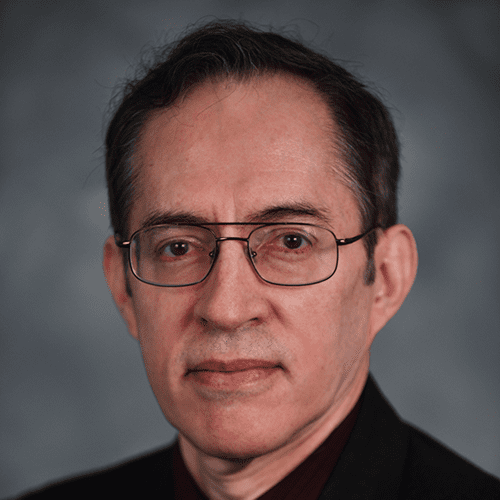
Ramon Ravelo is an Associate Professor in the Department of Physics at the University of Texas at El Paso (UTEP), with a strong focus on computational science and material behavior under extreme conditions. He is based in the College of Science and conducts research at the intersection of physics, materials science, and high-performance computing. His research interests lie in understanding material response to high pressures, temperatures, and strain rates, particularly those induced by shock waves. Employing advanced computational techniques, his work addresses: Shock-induced plasticity and material strength Stress-induced phase transformations and melting Development and validation of classical interatomic force-field models Large-scale atomistic simulations of extreme environments Applications of density functional theory and non-equilibrium statistical mechanics The body of work suggests a strong emphasis on predictive simulation methods in materials physics, leveraging advances in computational power to model complex physical phenomena. Although specific publications are not listed, the research keywords indicate active contributions in computational condensed matter physics and planetary science contexts. Scientific Awards: No awards listed in the provided text. Dr. Ravelo advises students in computational and materials physics, though specific advisees are not named. There is no mention of external grants or funding sources in the available content. He is involved in research networks related to planetary science and astrobiology, suggesting interdisciplinary collaborations. His work supports both fundamental science and potential applications in defense, geophysics, and space science.
Fernando A. Escobedo is a Professor in the Department of Chemical Engineering at Cornell University's College of Engineering, holding the Marjorie Hart Chair of Engineering since joining the faculty in 1998. His research pioneers computational methodologies for understanding entropy-driven self-assembly in complex soft matter systems, with applications spanning solar cells, battery electrodes, and advanced membranes. His educational background includes: B.S. in Chemical Engineering from Universidad de San Agustin, Peru (1986) M.S. in Chemical Engineering from University of Nebraska-Lincoln (1993) Ph.D. in Chemical Engineering from University of Wisconsin-Madison (1997) Professor Escobedo's work centers on molecular-level simulations of thermodynamic and kinetic properties, with particular emphasis on entropy's role in forming intermediate-ordered phases like liquid crystals and block copolymer mesophases. His group develops novel computational frameworks to establish structure-property relationships for nanoscale building blocks, enabling rational design of materials with tailored mechanical, optical, and transport properties. This research bridges statistical mechanics with practical engineering challenges in nanomaterials synthesis. Analysis of his 2023-2025 publications reveals three dominant trends: (1) machine learning integration for multiscale materials design, (2) entropy-controlled phase behavior in non-additive colloidal mixtures, and (3) molecular engineering of liquid crystalline oligomers for enhanced ion transport. Key advancements include heuristic rules for nanoparticle superlattice stability and diffusionless transition mechanisms in faceted colloids. His scientific recognition includes: Fellow, American Physical Society (2014) AIChE Computational Molecular Science & Engineering Impact Award (2012) Alfred P. Sloan Foundation Fellowship (2004) NSF CAREER Award (2001) Camille & Henry Dreyfus Foundation New Faculty Award (1999) College of Engineering Teaching Excellence Award (2003) Professor Escobedo has secured sustained funding through competitive grants including the NSF CAREER award and Sloan Fellowship, supporting his computational research group's high-impact publications in top journals. His mentorship focuses on training graduate students in advanced simulation techniques, with research outputs frequently appearing in Journal of Physical Chemistry and Macromolecules . While no dedicated lab name is specified, his work operates at the intersection of Cornell's Chemical Engineering department and nanomaterials research initiatives, emphasizing collaborative approaches to entropy-driven assembly problems.
Shuyin Jiao is an active Associate Teaching Professor in the Department of Computer Science at North Carolina State University's College of Engineering. She serves as course coordinator for CSC 111 Introduction to Computing: Python and teaches multiple core undergraduate courses including CSC 116 (Java) and CSC 246 (Operating Systems), with extensive teaching experience spanning over 9 years at both NC State and the College of William & Mary. Her educational background includes a Ph.D. from the University of Houston (2015), a Diplôme d'Ingénieur from Ecole Central de Lyon, France, and a B.S. from Beihang University, China. She previously held positions as Assistant Teaching Professor (2020-2025) and Lecturer at NCSU, and taught as Lecturer and Adjunct Lecturer at William & Mary from 2015-2020. Dr. Jiao's research focuses on computing education and program analysis, with particular emphasis on developing tools to enhance student learning in computer science. Her work explores pedagogical methods to address diverse learning styles in increasingly large CS classrooms and investigates code inefficiencies through memory profiling and performance analysis. She leads the CERES lab at NCSU and serves as Publications Co-Chair for SIGCSE TS 2026. Her publication record shows consistent output in top venues including SIGCSE, CGO, MobiCom, and ICSE, with recent work spanning from 2025 back to 2012. Her research trajectory demonstrates a clear evolution from materials science (early career) to software engineering and computer science education, with current work heavily focused on educational technology and program analysis tools. Dr. Jiao has secured significant funding including as PI for NSF Grant DUE-#2417469 (2024-2027), NCSU Data Science Academy Seed Grant (2023-2024) as Co-PI, and NCSU GEARS Grants (2023-2024) as PI. She also serves as Co-PI for NSF Grant OAC-#2411136 (2025-2028) focused on computer system research. She actively involves undergraduate students in research through COE REU and CSC 498/499 projects, recruiting at CSC Undergraduate Research Lightning Talks each semester. Her course redesign projects include enhancing operating systems education through multimedia and redesigning CSC 111 with DELTA funding to address challenges in large-class instruction.
Jaakko Akola is a Professor in the Department of Physics at the Norwegian University of Science and Technology (NTNU). His research focuses on computational materials science, particularly density functional theory (DFT) and atomistic simulations of materials, nanoparticles, molecules, and interfaces. He leads significant projects such as "SIDI" (inoculation in cast iron), "Infinity-RETIS" (chemical rare events), and "AllDesign" (rational alloy design), alongside coordinating EU-funded initiatives like "CritCat" for catalyst development. The Materials Theory group under Akola employs DFT, molecular mechanics, and Monte Carlo methods to explore atomic-scale structures and functions in technological applications. Key research areas include platinum-free catalysts for hydrogen energy, amorphous semiconductors for memory devices, noble metal nanoparticles in biological environments, and alloy design for cast iron and aluminum. Recent work integrates machine learning to advance theory-driven material design, reducing reliance on experimental trial-and-error. Akola's publications highlight advancements in hydrogen evolution catalysis, phase-change memory materials, and alloy precipitation. His projects often involve interdisciplinary collaborations with experimental teams. He teaches Quantum Physics 1 (FY2045) and Computational Physics (TFY4235) at NTNU, reflecting his commitment to education alongside research.
Dr. Matteo Degiacomi is a Visiting Associate Professor in the Department of Physics at Durham University. His research focuses on integrative computational methods combining machine learning and molecular dynamics simulations to model biomolecular systems at near-atomistic resolution. Education: MSc in Computer Science (2008), PhD in computational biophysics (2012) from EPFL. His work leverages ion mobility , cross-linking , SAXS , and electron microscopy data to study protein assembly mechanisms. Recent publications highlight applications in virology , nanomaterials , and membrane protein dynamics . He develops open-source tools like ClayCode and JabberDock . Scientific awards include a Swiss National Science Foundation Early Postdoc Mobility Fellowship (2013-2017) and an EPSRC Junior Research Fellowship (2017-2020). He supervises postgraduate researchers Ajeeth Kanagarajan , Breanna Voss , and Listra Ginting .
Celine Hin is an Associate Professor jointly appointed in the Department of Materials Science and Engineering and Mechanical Engineering at Virginia Tech. Her research focuses on advanced materials science with a particular emphasis on atomistic simulations and energy-related materials. Education: B.S. in Physics, University of Marne La Vallée, France M.S. in Materials Science and Engineering (MSE), University of Marne La Vallée, France Ph.D. in Materials Science and Engineering (MSE), Institut National Polytechnique de Grenoble, France Research Interests: Dr. Hin’s work spans nuclear materials, thermoelectric materials, Li-ion battery technologies, and materials behavior under extreme conditions. She employs theoretical and computational methods, including statistical physics and atomic-level modeling, to advance understanding of material properties and electrochemical systems. No academic articles or awards are listed in the provided text. Her professional affiliations include Sigma Xi, the Materials Research Society (MRS), and the American Nuclear Society (ANS).
Marco Molinari is an Associate Professor (Reader) at the University of Huddersfield, affiliated with the School of Applied Sciences and the Department of Physical and Life Sciences. He is a member of the Centre for Functional Materials and associate member of the Pharmaceutics and Drug Delivery Centre and Structural, Molecular and Dynamic Modelling Centre. His research focuses on computational chemistry and materials science, particularly energy and environmental materials, surface science, and nanomaterials. Education: BSc from the University of Pavia (Italy, 2006), PhD in computational chemistry (2009) through a collaboration between the University of Pavia and Bath (UK). Postdoctoral research at the University of Bath, funded by the EPSRC, focused on surface science and materials chemistry. Research interests include computational modeling of mineral and oxide materials, surface adsorption and reactivity, nanoparticle morphology, and catalytic properties. His work contributes to UN Sustainable Development Goals related to clean energy and environmental protection. He leads projects such as 'Computational Design and Engineering of Metal Oxide Nanozymes' (2018–2019) and 'NanoCeO2: Design of CeO2 Nanostructures with Enhanced Catalytic Properties' (2017–2017). Publications span over 100 peer-reviewed articles, with recent studies on cerium oxide nanoparticles, surface engineering, and computational methods like density functional theory. He actively participates in conferences and serves on committees like the EPSRC-funded Materials Chemistry Consortium and the RSC local section. Molinari supervises PhD students and collaborates on datasets and software tools like SurfinPy for phase diagram generation. His research bridges computational modeling, experimental validation, and real-world applications in energy storage, environmental remediation, and biomedical materials.
Prof. Robert Meißner is a Professor at the Department of Surface Physics and Technology at TUHH. His research focuses on molecular simulation techniques applied to corrosion processes, energy storage systems, and nanomaterials. He develops computational tools like ELECTRODE and i-PI for electrochemical and advanced molecular dynamics simulations. His work addresses challenges in magnesium battery performance, structural health monitoring of composite materials, and interfacial phenomena in nanoscale systems. Education details are not explicitly provided in the text, but his professional trajectory reflects extensive academic and industrial experience in materials science. Research interests span from fundamental studies (e.g., water imbibition in nanopores, magnetite oxidation dynamics) to applied innovations (e.g., corrosion protection via layered double hydroxides, data-driven electrolyte design). His recent publications highlight trends in data-driven materials discovery, structural health monitoring via vibro-acoustic methods, and computational prediction of corrosion inhibitors. He collaborates on projects involving graphene-based supercapacitors, epoxy resin curing dynamics, and peptide-surface interactions. Advising and grants: While student names are not listed, his research group actively explores corrosion engineering, battery technology, and nanomaterials. Projects include EU-funded initiatives and industry partnerships. Technical expertise includes ATR-FTIR spectroscopy, molecular dynamics, and machine learning for sparse data scenarios. He leads teams focused on surface science and energy storage, maintaining lab facilities for in situ electrochemical analysis and advanced computational modeling. His work bridges theoretical insights with practical applications in materials durability and energy systems.
Matthias Heyden is an Associate Professor at Arizona State University's School of Molecular Sciences and an affiliate of the Center for Biological Physics. He joined ASU in 2017 after prior roles as a research group leader at the Max-Planck-Institut für Kohlenforschung and the Cluster of Excellence RESOLV, and as a postdoctoral researcher at the University of California, Irvine. His research focuses on atomistic simulations of molecular systems to study solvation processes, vibrational dynamics in biomolecules, and novel computational methods for simulating crowded biomolecular environments. Education: Dr. rer. nat. (summa cum laude) in Chemistry from Ruhr-Universität Bochum (2010), B.Sc. in Biochemistry (2004). His work bridges computational chemistry and biophysics, with applications in protein-ligand interactions, enzyme catalysis, and cellular crowding effects. He leads the Heyden Lab and maintains a research website at CompMolSci.com . Research Interests: His group uses molecular dynamics simulations to explore solvation thermodynamics, correlated vibrational motion in biomolecules, and large-scale protein simulations. Key areas include understanding solvation's role in biomolecular processes, analyzing vibrational signatures for energy propagation, and modeling complex cellular environments. Techniques developed by his lab enable spatially resolved analysis of solvation free energy and entropy. Service & Professional Roles: Co-chair of the TSRC Workshop on Water Structure and Dynamics (2019), faculty advisor for Biophest (2019), and member of professional societies including the American Chemical Society and Biophysical Society. His research has been published in high-impact journals such as Journal of Physical Chemistry , Biophysical Journal , and Proceedings of the National Academy of Sciences .
Sourav Sahoo is a Research Assistant at the Department of Chemistry and Bioscience, Faculty of Engineering and Science, Aalborg University. His research focuses on materials science and tribology , particularly graphene-based coatings for enhancing glass scratch resistance. Sahoo holds a Ph.D. in Materials Science and Engineering (2019-2024) and a B.Tech in Ceramic Engineering from National Institute of Technology Rourkela (2015-2019). Education: Ph.D. in Materials Science and Engineering (Aalborg University, 2024) B.Tech in Ceramic Engineering (NIT Rourkela, 2019) Research interests span scratch resistance , graphene oxide , surface science , disordered materials , and tribological properties . His work combines experiments and simulations to study 2D material-protected silica glass. Recent publications (2021-2025) include studies on atomistic structural evolution , superlubricity , and oxide deposition techniques . Scientific awards include: Best Poster Award - 2nd place (2023) Research Excellence Travel Award (2023) "Significant Contribution to the Department" Award (2023) Prime Minister's Research Fellowship (2021) Institute Silver Medal (2019) Sahoo's research has gained significant media attention, including coverage by 9 news outlets and 18 Mendeley readers. His collaborations focus on graphene oxide , shear flow , and borosilicate glass studies.
Jouko Nieminen is a University Lecturer and Docent of computational materials physics at Tampere University, affiliated with the Faculty of Engineering and Natural Sciences and the Department of Physics. His research focuses on computational modeling of two-dimensional (2D) and layered materials, particularly their interfaces and electronic properties, with applications in quantum technologies and superconductivity. He leads the Computational Physics Laboratory and collaborates with groups such as BIO, EST, M&MM, QCAD, and SCM. Research interests include transition metal dichalcogenides (TMDs), high-temperature cuprate superconductors, and surface/interfaces analysis using techniques like scanning tunneling microscopy/spectroscopy (STM/STS). His work explores phenomena such as proximity-induced superconductivity, charge density waves, and topological states in materials like MoS2 and NbSe2. Key projects include modeling superconductivity in monolayer MoS2 on Pb (collaborating with Temple University) and edge states in silicene and Ag/Si(111) surfaces. Recent studies extend to strain effects in NbSe2, heterostructure design, and quantum device applications. No scientific awards are explicitly listed, but his contributions span over 50 peer-reviewed articles since 1992. Labs/Teams: Computational Physics Laboratory, Tampere University; affiliated with research groups BIO, EST, M&MM, QCAD, and SCM.
MP Gururajan is a Professor in the Department of Metallurgical Engineering and Materials Science at the Indian Institute of Technology Bombay (IIT Bombay), where he has been serving since May 2021. He previously held the positions of Associate Professor (2016–2021) and Assistant Professor (2009–2016), indicating a long-standing and active academic career at IIT Bombay. B.Sc (Physics), Madras University, 1994 M.Sc (Materials Science), Anna University, Madras, 1996 M.Sc. (by research), Indian Institute of Science, Bangalore, 1999 Ph.D., Indian Institute of Science, Bangalore, 2006 His research focuses on computational modeling of microstructural evolution, employing both atomistic (Monte Carlo, molecular dynamics) and continuum (phase field modeling) approaches. Key areas include phase transformations, deformation mechanisms, materials mechanics, and thermodynamics. His work bridges theoretical modeling with experimental validation in metallic systems. The selected publications reflect a consistent focus on phase field modeling, interfacial phenomena, and microstructure evolution under various thermomechanical conditions. Topics such as precipitate growth, grain boundary grooving, strain effects, and anisotropy are recurrent, demonstrating deep expertise in multiscale materials simulation. No scientific awards or fellowships are mentioned in the provided text. Prof. Gururajan leads an active research group (CMEGAT IITB) and has secured funding from national agencies including the Department of Science and Technology (DST), Defence Research and Development Organisation (DRDO-SASE), and industrial partners like Tata Steel and GE. Collaborative IMPRINT projects with TCS and GE Global Research highlight his engagement in indigenous software development and life prediction methodologies for advanced alloys. He maintains a research group website and is involved in both teaching and research supervision at IIT Bombay. His lab focuses on computational materials engineering, with emphasis on predictive modeling of microstructure and mechanical behavior.
S. Joseph Poon is the William Barton Rogers Professor of Physics at the University of Virginia in the Department of Physics, College of Arts and Sciences. He is an active experimental condensed matter physicist with a Ph.D. from the California Institute of Technology (1978). His research spans thermoelectric materials, magnetic skyrmions, and high-entropy alloys, combining experiment, computation, and data science. His research focuses on three main areas: (i) thermoelectric properties of narrow-gap semiconductors and topological semimetals, (ii) synthesis and computational modeling of ferrimagnetic and antiferromagnetic heterostructures exhibiting skyrmions and anomalous Hall effects for spintronics, and (iii) data-driven exploration of high-entropy alloys in high-dimensional composition space. These efforts aim to enable low-power, ultrafast computing and superior functional materials. The recent publications reflect a strong trend in topological magnetism and advanced materials design. His group leverages atomistic simulations, thin-film synthesis, and machine learning to uncover new physical phenomena and optimize material performance. Work on skyrmionics and high-entropy alloys demonstrates a forward-looking approach integrating physics with data science. Notable scientific recognition includes: 2020 Jesse W. Beams Research Award, American Physical Society (Southeastern Section) His research has attracted significant funding, including a $3.4 million DARPA grant for developing ultra-compact computing memory. He leads a vibrant research group and collaborates extensively with experts in spintronics and materials theory. He is also active in departmental governance, serving on key committees such as the APS/AAAS Fellowship Committee (Chair), Long Range Planning Committee, and Chair's Advisory Committee. His lab focuses on experimental and computational studies of quantum and emergent phenomena in complex materials.