Tatjana Pavlenko is a Professor in Statistics at Uppsala University, affiliated with the Department of Statistics. Her research bridges mathematical statistics, probability theory, and computational methods, focusing on high-dimensional data analysis in biomedical and machine learning contexts. Key research areas include: High-dimensional statistical inference and Bayesian graph structure learning Sparse signal detection and adaptive thresholding methods Statistical machine learning with applications to biomedical datasets Her recent publications demonstrate expertise in: Bayesian model averaging and junction tree sampling Asymptotic theory for high-dimensional classifiers Testing independence and covariance structures L2-type statistics and empirical process theory She supervises PhD students working on: High-dimensional causal inference in media Bayesian graphical models Sparse classification algorithms Currently active in Uppsala University's AI4Research initiative, Pavlenko develops adaptive data-driven procedures for statistical learning problems with complex sparsity patterns.
Ingeborg Waernbaum is a Professor at the Department of Statistics, Uppsala University, and a Researcher at the Institute for Evaluation of Labour Market and Education Policy (IFAU). Her work bridges biostatistics, causal inference, and epidemiology, with a focus on observational studies and methodological innovations. Primary Affiliation: Department of Statistics, Uppsala University Secondary Affiliation: IFAU (Institute for Evaluation of Labour Market and Education Policy) Her research centers on: Causal inference methodologies for observational data Propensity score modeling and doubly robust estimation Selection bias bounding and sensitivity analysis Applications to diabetes epidemiology and socioeconomic health disparities Recent publications (2023-2025) highlight her dual focus on theoretical advances in causal effect estimation (e.g., entropy balancing, mediation analysis) and applied biostatistical studies in diabetes and public health. She has developed R packages for selection bias bounding and covariate selection, emphasizing practical tools for researchers. Key methodological contributions include: Clarifying limitations of doubly robust estimators Advancing sensitivity analysis for unmeasured confounding Examining efficiency trade-offs in propensity score methods Applied work spans: Diabetes incidence trends and complications Socioeconomic determinants of health outcomes Fracture risk analysis in pediatric populations She actively engages in: Register data analysis Statistical software development (R packages) Methodological critiques and robustness studies
Katsuhiko Matsuzaki is a Professor at the Faculty of Education and Integrated Arts and Sciences , Waseda University, Tokyo. He holds a Ph.D. in Science from Kyoto University and has held academic positions at Okayama University, Ochanomizu University, and Tokyo Institute of Technology. His research spans geometric function theory, Teichmüller spaces, and quasiconformal mappings, with particular emphasis on symmetric structures and their applications to hyperbolic geometry. Education: Ph.D. (Science), Kyoto University (1992) Graduate School, Division of Natural Science, Kyoto University (1989) Faculty of Science, Kyoto University (1987) Professional Memberships: Mathematical Society of Japan Matsuzaki’s research explores the intersection of complex analysis and hyperbolic geometry , focusing on Teichmüller spaces of symmetric homeomorphisms, quasiconformal extensions, and the analytic structure of infinite-dimensional Teichmüller spaces. His work on p-Weil–Petersson curves , BMO embeddings , and vanishing Carleson measures has advanced the understanding of conformal invariants and their geometric implications. Recent publications analyze the complex Banach manifold structure of Teichmüller spaces and the rigidity of diffeomorphism groups under conjugation. Scientific Awards: Analysis Prize, Mathematical Society of Japan (2022) Takebe Katahiro Award, Mathematical Society of Japan (1996) His extensive research activity includes grants from the Japan Society for the Promotion of Science, such as projects on the Weil-Petersson metric , quasiconformal groups , and thermodynamic formalism for conformal semigroups. Matsuzaki’s contributions to the theory of infinite-dimensional Teichmüller spaces and modular groups reflect a deep interplay between geometric analysis, group theory, and dynamical systems.
Gustavo Benitez Alvarez is a Full Professor in the Department of Exact Sciences at Federal Fluminense University (Universidade Federal Fluminense) in Brazil. His academic profile demonstrates an active research career with numerous publications spanning computational mathematics, numerical analysis, and biomedical applications. His research interests focus primarily on Numerical Analysis , Finite Difference Methods , and Computational Mathematics , with significant applications in Mathematical Oncology and Thermal Physics . He has developed innovative approaches to solving partial differential equations, particularly the Helmholtz equation, where he has created methods that eliminate pollution error in one dimension and minimize dispersion in two dimensions. His publication record shows a strong trend toward interdisciplinary research, with approximately half of his recent work applying advanced numerical methods to biomedical problems, particularly glioma (brain tumor) modeling and treatment optimization. The other half focuses on fundamental numerical methods for PDEs, computational fluid dynamics, and thermal analysis. Gustavo Benitez Alvarez's work demonstrates a consistent pattern of high-quality publications in reputable journals such as Annals of the Brazilian Academy of Sciences , Mathematical Notes , and Semina: Ciências Exatas e Tecnológicas . His research has practical applications in medical treatment planning, engineering design, and computational physics. He collaborates with researchers across multiple institutions, including co-authorship with colleagues from UFF (Universidade Federal Fluminense) and other Brazilian universities. His work on glioma modeling shows particular promise for improving radiotherapy treatment planning through more accurate tumor growth prediction.
Zhou Fan is an Associate Professor in the Department of Statistics and Data Science at Yale University, specializing in mathematical statistics, probability theory, and computational algorithms with applications in statistical genetics and computational biology. Education: Ph.D. in Statistics, Stanford University, 2018 His research spans Random matrices and free probability , Statistical physics and inference , High-dimensional statistics and machine learning , and Applications in genetics and computational biology . He develops theoretical frameworks for complex data analysis, focusing on inferential problems in scientific contexts through advanced computational methods. Recent publications demonstrate leadership in Approximate Message Passing algorithms, empirical Bayes methods, and group orbit estimation, with significant contributions to high-dimensional statistics and biological applications. His work bridges statistical theory with practical computational solutions for modern data challenges. As Co-Director of Graduate Studies, Professor Fan provides academic leadership for the department's graduate program while teaching advanced courses in high-dimensional probability, statistical theory, and random matrix applications.
Devdatt Dubhashi is a Professor at the Data Science and AI 3 department at Chalmers University of Technology. His research spans multiple domains within computer science and data science, with a focus on theoretical foundations and practical applications of algorithms and machine learning. Professor Dubhashi's primary research interests include the design and analysis of randomized algorithms, machine learning for Big Data, and computational biology. His work demonstrates a strong interdisciplinary approach, connecting theoretical computer science with practical applications in diverse fields such as quantum computing, transportation modeling, genomics, and social sciences. His research often bridges the gap between theoretical foundations and real-world implementations, as evidenced by his numerous collaborations across different domains. Dubhashi's recent publications reveal a consistent research trajectory focusing on algorithmic foundations of machine learning, with increasing emphasis on interdisciplinary applications. His work shows significant contributions to bandit algorithms, kernel methods, graph-based learning, and the theoretical understanding of deep learning models. There's also a growing focus on societal implications of AI, as seen in his publications addressing responsible AI development and policy considerations. Among his notable scientific contributions are publications in prestigious venues including ACM, IEEE, and Nature journals, covering topics from fundamental algorithm design to applications in computational biology and social sciences. His work has been cited extensively across multiple disciplines, reflecting its broad impact. Professor Dubhashi actively supervises PhD students and collaborates with researchers across Chalmers and internationally. His research group appears to focus on the intersection of theoretical computer science and practical machine learning applications, with projects spanning quantum computing, transportation modeling, and biological applications.
Stefano Marmi is a Full Professor of Mathematical Physics at the Faculty of Sciences, Scuola Normale Superiore in Pisa, Italy. He joined the institution as a full professor of Dynamical Systems on November 1, 2003, after serving as an associate professor at the University of Udine and a researcher at the University of Florence. His academic journey began with Physics studies at the University of Bologna, where he graduated in June 1986 and later earned his PhD in Theoretical Physics (specializing in Mathematical Methods for Physics) in 1990. Professor Marmi's research primarily focuses on Dynamical Systems , with particular emphasis on quasiperiodic motions, KAM theory, and geometric renormalization in holomorphic and Hamiltonian dynamical systems. His work also extends to analytic number theory (including Lambert series and continued fractions), elliptic curves, and applications of mathematics to life sciences and medicine. His publication record demonstrates consistent contributions to the field since the early 1990s, with recent work concentrating on interval exchange maps, small divisor problems, and complex dynamics. His research trends show a consistent thread connecting dynamical systems theory with number theory, particularly through the study of continued fractions and their dynamical properties. The most recent publications (2010-2012) reveal an increasing focus on quantitative aspects of dynamical systems, including entropy calculations and numerical analysis of alpha-continued fractions. His work maintains strong connections with mathematical physics applications. ISAAC Prize winner in 1999 Invited speaker at Bourbaki Seminar (exposé 854, November 14, 1998) Professor Marmi has maintained significant international collaborations throughout his career, particularly with Jean-Christophe Yoccoz at the Collège de France in Paris, Pierre Moussa at SPhT, CEA in Saclay, France, and Carlo Carminati at the University of Pisa. His teaching portfolio includes courses on Dynamical Systems, Statistical Mechanics, Rational Mechanics, and specialized PhD courses on Holomorphic Dynamical Systems, Hamiltonian Systems, Small Divisors, and Analytic Number Theory. He has also developed courses connecting dynamical systems theory with financial time series analysis.
Sara Riva is an Associate Professor (Maître de Conférences) in Computer Science at Université de Lille, affiliated with the CRIStAL laboratory (UMR 9189). She is a member of the BioComputing research group and the MSV thematic group. Her academic journey includes a PhD jointly supervised by Université Côte d'Azur and Università degli Studi di Milano-Bicocca (2019-2022) and postdoctoral research at Université de Bordeaux (2022-2023). Her research explores Discrete Dynamical Systems , Cellular Automata , and Boolean Networks , with emphasis on equation solving, factorization methods, and dynamics modeling. She develops algorithmic approaches to analyze complex behaviors in computational and biological systems. Publications (2019-2023) demonstrate consistent focus on theoretical foundations of discrete systems, with applications in systems biology and complex modeling. Key themes include Boolean network dynamics, computational pipelines for equation solving, and sensitivity analysis in cellular automata. Awards: First prize for PhD students (Computer Science), STIC doctoral school Teaching: Extensive instructional experience at Université de Lille and Université Côte d'Azur covering: Algorithms & Programming (72+ lab hours) Databases (39+ lab hours) Logic, Graph Theory, Web Technologies (18+ lab hours each) IT Security and Information Coding (18 hours each) Academic Service: Member of CRIStAL's parity commission; Program Committee for AUTOMATA 2024; President of ADSTIC PhD association (2021-2022); Organized summer schools (EJCIM 2022).
Professor Valerie Pinfield is a distinguished academic at Loughborough University, where she serves as Professor of Ultrasonics and Complex Materials and Associate Pro-Vice-Chancellor for the Doctoral College. She has held several leadership positions including Head of the Department of Chemical Engineering (2017-2020), Director of Student Experience for the School of Aeronautical, Automotive, Chemical and Materials Engineering (2023-2024), and Acting Dean for the School (Sept 2024-Aug 2025). Her academic journey began with postdoctoral research at the Universities of Leeds and Nottingham before joining Loughborough University as a Lecturer in 2012, where she was awarded a personal chair in 2023. Professor Pinfield's educational background includes: MA in Natural Sciences from the University of Cambridge PhD in Food Science from the University of Leeds With a mathematical physics background, Professor Pinfield has developed a broad spectrum of research interests focused on the intersection of physical acoustics, materials science, and digital technologies. Her work spans from fundamental investigations of wave propagation through complex media to applied research in sustainable energy systems. She is particularly known for her contributions to understanding multiple wave scattering in soft complex materials, which has applications in material characterization and metamaterial design. Her recent research has expanded into machine learning and digitalization for material design and process optimization, with a strong emphasis on electrochemical technologies for sustainable energy. Professor Pinfield leads significant infrastructure and facilities projects in hydrogen technologies, spanning from sustainable propulsion for transport through materials development and testing to production and storage technologies. This work positions her at the forefront of research addressing global challenges in energy transition and sustainability. An analysis of Professor Pinfield's recent publications reveals a clear trajectory toward integrating advanced computational methods with traditional physics-based approaches. Her work increasingly combines machine learning with multi-physics modeling to address complex problems in energy systems and materials science. The focus on CO2 reduction and capture technologies demonstrates her commitment to addressing pressing environmental challenges through innovative engineering solutions. Her research bridges fundamental physics with practical applications in sustainable technologies. Professor Pinfield has received significant recognition for her contributions to academia and science: Fellow of the Institute of Physics (FInstP) Chartered Physicist (CPhys) Fellow of the Higher Education Academy (FHEA) As Associate Pro-Vice-Chancellor for the Doctoral College, Professor Pinfield plays a pivotal role in shaping the doctoral education experience at Loughborough University. She is deeply committed to developing future professionals in engineering and beyond through teaching, research mentorship, and academic leadership. Her industry experience at the Welding Institute and Cadbury Ltd provides valuable practical perspective to her academic work and student development initiatives. Professor Pinfield's research group contributes significantly to the university's strategic focus areas including Net Zero, Digital Engineering, and Sustainable Manufacturing and Circular Economy. Professor Pinfield leads research groups focused on ultrasonics, complex materials, and sustainable energy technologies. Her work connects with several research centers at Loughborough University that focus on hydrogen technologies, sustainable manufacturing, and digital engineering. These interdisciplinary teams bring together expertise from physics, engineering, computer science, and materials science to tackle complex challenges in energy and sustainability.
Minerva Mukhopadhyay is an Assistant Professor in the Department of Mathematics and Statistics at the Indian Institute of Technology Kanpur. She earned her PhD in Statistics from the Indian Statistical Institute (ISI), Kolkata, and completed postdoctoral work at Duke University under Professors David Dunson and Sandeep Dave. Her research focuses on Asymptotic Statistics, Bayesian Variable Selection, and Nonparametric Inference, with applications to high-dimensional data analysis. Her academic work includes developing distribution-free tests for high-dimensional data, consistency analysis of Bayesian variable selection methods, and novel approaches for sparse linear models. She has contributed to journals like Biometrika , Annals of the Institute of Statistical Mathematics , and Statistica Sinica , reflecting her expertise in theoretical and computational statistics. Research Trends: Her recent articles emphasize scalable Bayesian methods for ultra-high-dimensional data, random projections for predictive modeling, and nonparametric extensions using Gaussian processes. Scientific Awards: Best Student Paper Award (IISA 2015) Pillar Iglesias Travel Award (ISBA 2016) O’Bayes Travel Award (2017) Academic Roles: Previously taught at Bethune College (Kolkata) and Duke University, with experience in interdisciplinary statistical research at ISI. Skills: C, R, MATLAB, and journal reviewing for TEST , JSPI , Stat , and CSDA .
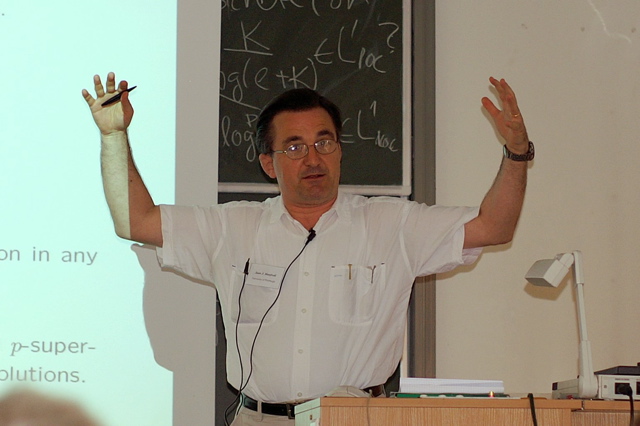
Juan J. Manfredi is a Professor of Mathematics at the University of Pittsburgh's Department of Mathematics, part of the Dietrich School of Arts and Sciences. He holds a PhD from Washington University in St. Louis, focusing on quasiregular mappings and partial differential equations. His research emphasizes elliptic and parabolic PDEs of p-Laplacian type, sub-Riemannian manifolds, and game-theoretic interpretations of equations like the infinity Laplacian. He explores regularity properties of p-harmonic functions and their applications in stochastic processes and signal processing. His work spans nonlinear potential theory, subelliptic equations, and geometric analysis. Notable contributions include studies on Monge-Ampère equations, viscosity solutions, and the interplay between stochastic games (e.g., tug-of-war) and PDEs. He has collaborated on topics like Carnot groups, Heisenberg group geometry, and Riemannian approximations in sub-Riemannian settings. Recent publications highlight advancements in asymptotic mean-value formulas, BMO estimates for solutions, and convergence principles for dynamic programming. His research bridges pure analysis and applied problems, including mass transport and optimal control. While no formal awards are listed, his extensive bibliography and academic roles reflect significant scholarly impact. Manfredi maintains an active online presence with resources like the QuasiWorld page, offering lecture notes and computational tools. His work often intersects with probability, geometric analysis, and numerical methods, positioning him at the forefront of modern nonlinear PDE research.
Nicholas McCleerey is an Assistant Professor in the Department of Mathematics at Purdue University, College of Science. He specializes in complex geometry, pluripotential theory, and Monge-Ampère equations. His research addresses singularities, geometric analysis, and non-Archimedean geometry. Education: Ph.D. in Mathematics (2020) from Northwestern University, supervised by Valentino Tosatti; B.Sc. in Mathematics (2015) from Rice University. His postdoctoral work was at the University of Michigan, Ann Arbor, under Mattias Jonsson. Research focuses on Kähler geometry, m-subharmonic functions, and the interplay between tropical and non-Archimedean geometry. Key topics include Monge-Ampère equations on Calabi-Yau manifolds, regularity theory, and geometric singularities. Recent work explores eigenvalue problems for complex Hessian operators and boundary regularity in real Monge-Ampère equations. Publications span advanced topics like plurisupported currents, Lelong numbers, and geometric envelopes, appearing in journals such as Advances in Mathematics , Journal of the Institute of Mathematics of Jussieu , and Indiana University Math Journal . His 2024 IMRN paper on simplex boundary regularity exemplifies his focus on geometric PDEs. Awards: 2020 Best Thesis Award from Northwestern University. He co-organizes Purdue’s Geometry and Geometric Analysis Seminar and mentors the Math Alliance. Teaching includes differential equations, topology, and calculus courses at Purdue and the University of Michigan. Labs/Teams: Leads the Purdue Experimental Math Lab (undergraduate research in Monge-Ampère eigenvalues) and mentored an REU program on planar Monge-Ampère singularities. Active in seminars and conferences globally, including at Columbia, Stony Brook, and Tsinghua University.
Dr. Min Ju Lee is an L. E. Dickson Instructor in Mathematics at the University of Chicago. Previously a postdoctoral fellow at the Institute for Advanced Study, she earned her PhD from Yale University under Hee Oh. Her research explores dynamical systems and geometric structures including hyperbolic geometry, homogeneous dynamics, ergodic theory, and higher Teichmüller theory. Lee's work primarily investigates Anosov groups, geometric invariants in hyperbolic manifolds, and measure rigidity in homogeneous spaces. Recent publications demonstrate deep exploration of limit sets in hyperbolic 3-manifolds, ergodic decompositions, and classification of invariant measures. Her mathematical approach integrates topological methods with geometric analysis to address problems in orbit closure theorems and spectral properties. Publication trends show consistent focus on the intersection of dynamical systems and geometric group theory, with increasing attention to measure-theoretic aspects of group actions and higher-rank generalizations of classical theorems. Her work frequently employs techniques from Lie theory, fractal geometry, and thermodynamic formalism. Lee maintains an active presentation schedule at international conferences including talks at IHES, ICERM, and Oberwolfach workshops. Her collaborative network spans institutions including Yale, ETH Zurich, and the Korean Institute for Advanced Study.
André Arroja Neves is a Professor of Mathematics at the University of Chicago's Department of Mathematics. He earned his PhD from Stanford University in 2005. His research focuses on geometric analysis, differential geometry, and minimal surfaces, particularly through variational methods and min-max theory. He has made significant contributions to the Willmore conjecture, scalar curvature, and mean curvature flow. Neves has been recognized with prestigious awards, including the Simons Investigator award (2018) and election to the American Academy of Arts and Sciences (2020). His work often involves collaboration, notably with Fernando Codá Marques. Recent research highlights include studies on minimal hypersurfaces, Weyl laws for volume spectra, and geometric flows in negatively curved manifolds. Education: PhD in Mathematics, Stanford University, 2005 Research Interests: Geometric Analysis Minimal Surfaces and Variational Problems Min-max Theory Mean Curvature Flow Scalar Curvature and Topology Mathematical Relativity Key Research Trends: Neves' publications span min-max theory applications, singularities in geometric flows, and geometric inequalities. His work bridges topology and geometry, with implications for understanding minimal surfaces in various ambient spaces. Recent articles explore the density of minimal hypersurfaces under generic metrics and equidistribution properties. Awards: Simons Investigator (2018) American Academy of Arts and Sciences Member (2020) Grants & Advising: While specific grants are not listed, Neves' sustained research output indicates significant funding. He has advised multiple doctoral students (not explicitly listed here), focusing on geometric analysis. His work often intersects with theoretical computer science and geometric topology. Labs/Teams: Collaborations include joint projects with leading mathematicians like Fernando Codá Marques, Daniel Ketover, and others, reflecting a networked approach to solving complex geometric problems.
Vadim Marmer is a Professor at the University of British Columbia (UBC) since 2005, affiliated with the Vancouver School of Economics . He earned his Ph.D. at Yale University. His research centers on Econometrics , with specific expertise in estimation and inference in auctions, weak identification, non-stationary time series, and network-dependent data analysis. Education : Ph.D., Yale University Institutional Affiliation : University of British Columbia Research Focus : Econometric theory, auction modeling, regime switching, and financial time series. His recent publications focus on stochastic cycles in macroeconomic data, treatment effect estimation in triangular models, and auction theory advancements. Collaborations include Jun Ma, Zhengfei Yu, and Artyom Shneyerov. Though no explicit awards are listed, his work appears in top journals like Journal of Econometrics and Quantitative Economics .