Marti Alcaraz is a Part-Time Lecturer at the Department of Statistics, Mathematics and Informatics within the Miguel Hernández University of Elche. Their professional profile focuses on computing languages and systems, with teaching responsibilities in Computer Engineering and Data Science & Artificial Intelligence programs. Marti teaches courses such as Mobile Device Application Development, Object-Oriented Programming, and Software Engineering Project Management, reflecting expertise in software development, programming methodologies, and project coordination. Their fields of interest align with core computing disciplines, emphasizing practical and theoretical aspects of software systems. Contact details include personal and departmental email addresses. Teaching activities span multiple academic years, with consistent involvement in core curriculum courses for bachelor's degrees.
Maria Halkidi is an Associate Professor in the Department of Digital Systems at the University of Piraeus, Greece, where she conducts cutting-edge research in data mining and machine learning with over two decades of academic experience. Her educational background includes: Bachelor's degree in Informatics from the University of Piraeus (1997) Master's degree from Athens University of Economics and Business (1999) Ph.D. from Athens University of Economics and Business (2003) Dr. Halkidi's research focuses on fundamental and applied aspects of data mining, particularly recommender systems, graph data mining, cluster validity assessment, and distributed data mining. Her work bridges theoretical frameworks with practical implementations in sensor networks, social media, and real-time analytics, contributing significantly to algorithmic development in these domains. Analysis of her recent publications reveals a strong trajectory toward fairness and diversity optimization in recommender systems, alongside innovative approaches to graph clustering quality assessment and scalable sentiment analysis. Her research consistently addresses real-world challenges in dynamic data environments, with increasing emphasis on multi-stakeholder optimization and privacy-aware recommendation frameworks. Scientific awards: No specific awards or honors were documented in the provided materials. Dr. Halkidi has participated extensively in National and European-funded research projects, including a prestigious Marie-Curie fellowship at the University of California, Riverside. She serves on program committees for major international conferences in data mining and machine learning, demonstrating active community engagement. While specific graduate students aren't listed in the source materials, her professorial role indicates ongoing mentorship of Master's and Ph.D. candidates. She maintains active research affiliations with the Network oriented systems & services lab and the DataStories research group at the University of Piraeus, where she collaborates on interdisciplinary projects involving big data analytics, social network analysis, and distributed systems.
Elena Zucca Schillani is an Associate Professor in the Department of Computer Science, Bioengineering, Robotics, and Systems Engineering (DIBRIS) at the University of Genoa. She teaches core computer science courses including Algorithms Analysis and Design, Principles and Paradigms of Programming Languages, and Automata Theory and Computability across undergraduate and graduate programs. Her research focuses on programming language theory with particular expertise in type systems, formal semantics, and language design. Dr. Zucca explores foundational aspects including lambda calculus, coinduction, and verification techniques. Her work bridges theoretical concepts with practical implementations, as evidenced by her integration of tools like ANTLR in teaching and research contexts. Recent publication trends show consistent engagement with formal methods for programming language design and verification. Her work spans theoretical foundations of type systems, operational semantics, and practical implementations of language features, with particular attention to coinductive techniques, resource-aware systems, and program equivalence. This cohesive research program connects her teaching in programming language paradigms with cutting-edge theoretical investigations. Dr. Zucca actively supervises student projects as part of her teaching responsibilities, requiring both theoretical examinations and practical implementations. Her course materials demonstrate commitment to comprehensive computer science education, covering topics from automata theory to advanced programming language concepts with both theoretical depth and practical application.
Professor Stefan Huber holds the Chair of Civil Law, Civil Procedure and Insolvency Law, European and International Private and Procedural Law at the University of Tübingen's Faculty of Law. His office is located in Room 229 of the New Auditorium at Geschwister-Scholl-Platz, Tübingen, with consultation hours available after lectures and by appointment. Professor Huber's research focuses on civil procedural law, private international law, and transnational uniform law, employing a comparative law approach. Current projects examine the use of digital technology, particularly artificial intelligence, in civil procedural contexts and the management of civil proceedings involving similar subject matters. His scholarly output demonstrates expertise across European civil procedure, international commercial arbitration, and the evolving landscape of digital justice. His extensive publication record includes recent works on AI in civil procedure, European private international law developments, and procedural rights frameworks. Professor Huber has contributed significantly to the field through monographs such as 'Erfüllungshaftung Vertragsfremder' (2017) and 'Entwicklung transnationaler Modellregeln für Zivilverfahren' (2008), which received the Serick Prize 2007. Professor Huber is actively involved in academic governance as coordinator of the 'Structure of Civil Litigation' research group within the 'Comparative Procedural Law and Justice' project, member of the German Council for International Private Law, and secretary of the Civil Law section of the Society for Comparative Law (2013-2022). He serves as co-editor of IPRax journal and several book series, and participates in international research collaborations focused on European civil procedure harmonization. In teaching, Professor Huber offers courses on civil law obligations, civil procedure, international private law, and co-directs the 'Law and Rhetoric' program with Professor Olaf Kramer. He also supervises student teams in the Willem C. Vis International Commercial Arbitration Moot and has led Tübingen teams to victory in competitions such as the Justus Liebig Moot Court.
Wing-Kwong Chan is an Associate Professor in the Department of Computer Science at City University of Hong Kong. With a background that includes industry experience as a software engineer, Dr. Chan returned to academia and has established himself as a leading researcher in software engineering with a focus on emerging technologies. Dr. Chan received his BEng, MPhil, and PhD all from The University of Hong Kong. His academic journey began with a hardware-oriented Computer Engineering degree before shifting to software engineering for his graduate studies. His research interests center on software engineering, particularly the technical aspects interfacing with machine learning, blockchain, and GPU technologies. He addresses challenges in program analysis and concurrency, with recent work focusing on deep learning model verification and robustness. His publications span top venues including TOSEM, TSE, ICSE, ESEC/FSE, and ASE. Dr. Chan's recent publications demonstrate a strong trend toward integrating software engineering principles with deep learning systems, particularly in verification, testing, and robustness of AI models. His work bridges theoretical software engineering concepts with practical applications in emerging technologies. Best Paper Award from COMPSAC'04 Best Paper Award from COMPSAC'08 Best Paper Award from COMPSAC'10 Best Paper Award from QSIC'11 Best Paper Award from QRS'16 Best Paper Award from ISET'18 CityU President's Award 2017 Dr. Chan has successfully advised numerous PhD and MPhil students, with alumni dating back to 2006. He has secured substantial research funding through multiple Hong Kong Research Grants Council projects, ITF grants, and international collaborations. His current research focuses on patch robustness certification for deep learning models, reflecting his ongoing commitment to advancing software engineering practices for emerging technologies. As Program Leader for the MSc in E-Commerce program from the CS Department, Dr. Chan also contributes significantly to academic administration and curriculum development at City University of Hong Kong.
Marianne Huchard is Full Professor of Computer Science at the University of Montpellier, Faculty of Sciences since 2004, serving as Director of LIRMM (Laboratory of Informatics, Robotics and Microelectronics at Montpellier) and head of its Computer Science Department. She also participates in the human resources committee of the MIPS scientific department. She earned her PhD in Computer Science in 1992 researching algorithmic aspects of multiple inheritance in object-oriented programming languages. Her primary research domains are Formal Concept Analysis (theoretical and applied, including Relational Concept Analysis) and Software Engineering (model-driven engineering, component-based development, and software product line migration), with recent work integrating Large Language Models for innovative solutions. Analysis of her 2024-2025 publications reveals a strong interdisciplinary trend: Relational Concept Analysis enhanced by LLMs is being applied to software engineering challenges like user-story generation, class model restructuring, and product line migration, demonstrating significant methodological innovation. Scientific awards: None documented in provided sources. She actively supervises doctoral research: Thomas Georges (defended January 2023): 'Agile Engineering of Software Product Lines for Agricultural Decision Support' Austin Waffo-Kouhoué (defended November 2024): 'Web Accessibility for People with Visual Impairments' Her research is supported by projects including RCAviz (funded by #DigitAg), FCA4J toolkit development, and Web Iris accessibility extension. As leader of the MAREL team (Models And Reuse Engineering, Languages) at LIRMM, she drives research at the formal methods/software engineering intersection and co-created Montpellier's Master's program in Software Engineering.
Dr. Racheal McInnis serves as Program Director and Assistant Professor in the Physician Assistant Program at Nova Southeastern University's Dr. Kiran C. Patel College of Allopathic Medicine in Jacksonville, a role she assumed in 2025 after eight years as Academic Director since joining NSU in October 2013. Her educational journey includes: Undergraduate Nursing degree (Florida Community College, Jacksonville) Physician Assistant degree (St. Louis University, 1994) MS in Physician Assistant Studies (University of Nebraska) Doctor of Health Science (Nova Southeastern University, 2018) MS in Nursing - Women's Health (University of South Alabama) Dr. McInnis specializes in Physician Assistant Studies pedagogy and Women's Health integration within medical education. Her unique dual-background as both nurse and clinician informs curriculum development emphasizing direct patient care impact and interdisciplinary teamwork . She bridges nursing and PA educational methodologies to prepare students for primary care challenges through experiential learning models. As Program Director, she oversees all aspects of student training and faculty development. Recognized by students for teaching excellence and peers for curriculum innovation, her leadership focuses on producing community-oriented clinicians who understand the PA profession's critical role in modern healthcare teams. Her Jacksonville-based program emphasizes practical application in underserved settings.
Dr. Berkan Sariaydin serves as Lecturer in the Department of Didactics of Ancient Languages within LMU Munich's Faculty of Languages and Literatures, while concurrently holding a Studienrat position at Wilhelmsgymnasium Munich. His dual academic-school roles focus on bridging classical philology with contemporary pedagogy through innovative multimedia approaches. His educational trajectory includes: MA-level studies in Latin, German and Philosophy at LMU Munich (2012-2018) First State Teaching Examination (2018) Doctoral degree from LMU Munich (2018-2024) Second State Teaching Examination (2024) Research centers on classical reception studies with emphasis on intermedial transformations of antiquity. His work analyzes how ancient narratives (particularly Virgil and Ovid) manifest in modern media like graphic novels and fantasy literature, while developing practical didactic frameworks for language instruction. Current projects explore mythological narratives as tools for addressing contemporary social challenges through the ERC-funded 'Modern Argonauts' initiative. His publication record shows consistent output since 2016, with increasing focus on methodological innovation in classical reception studies. Recent works demonstrate growing integration of multimedia analysis and pedagogical application, particularly in teacher training contexts. Award highlights include: Bavarian State Ministry award for exceptional teacher training (2024) German National Academic Foundation doctoral scholarship (2019) LMU's MZL Prize for academic excellence (2019) Germany Scholarship for undergraduate studies (2015) Grant involvement centers on the ERC Proof of Concept project 'The Modern Argonauts' at Warsaw University, where he develops multicultural educational programs using classical mythology. His teaching methodology emphasizes active student engagement with ancient texts through contemporary media adaptations. He actively contributes to academic discourse through LMU's 'Rejuvenated Antiquity' research seminar and international conferences, focusing on practical applications of classical studies in modern educational settings.
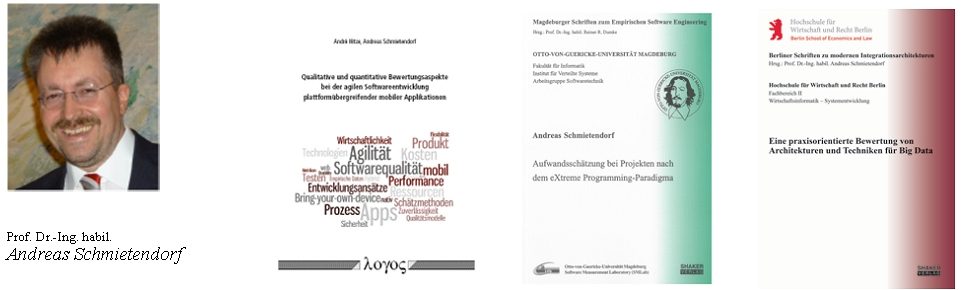
Prof. Dr. Andreas Schmietendorf is a Professor of Business Informatics – System Development at the Berlin School of Economics and Law (HWR Berlin) and holds a private lectureship in Software Engineering at the Otto von Guericke University Magdeburg. He leads the Business Informatics – System Development research group and is actively involved in the HWR doctoral college and Competence Center Digitization. His research focuses on the intersection of software engineering, business informatics, and artificial intelligence, with particular emphasis on: AI-driven changes in software engineering practices Trustworthy AI implementations in domain-specific contexts Web API security and management Digital transformation through low-code development approaches Requirements engineering for trustworthy digital services Prof. Schmietendorf's recent work has centered on the TAHAI (TrustAdHocAI) research project, which investigates trustworthy ad-hoc AI solutions across multiple domains including railway infrastructure, mediation research, and forestry. His research group regularly publishes on software engineering, AI applications, and digital transformation, with a strong focus on practical industry collaborations. The group has produced numerous workshops (ESAPI, KI4SE), conference proceedings, and practical implementations that bridge academic research and industry needs. He has successfully supervised multiple PhD students to completion and maintains an active doctoral supervision portfolio. His research group collaborates extensively with industry partners, particularly Deutsche Bahn, and regularly organizes events that foster academic-industry dialogue. Prof. Schmietendorf is also active in teaching, offering courses on Service Engineering at the University of Magdeburg and various business informatics topics at HWR Berlin. His teaching emphasizes practical applications of software engineering principles and the integration of emerging AI technologies through hands-on exercises and industry-relevant case studies.
Dr. Elise Sargeant is a Senior Lecturer at Griffith University's School of Criminology and Criminal Justice and a core member of the Griffith Criminology Institute. With appointments spanning from 2016 to present, she holds leadership roles including Higher Degree by Research Program Director (2023-present) and Equity, Diversity and Inclusion Coordinator (2023-present). Her academic foundation includes a PhD from the University of Queensland (2012) and First Class Honors in Arts (2007). Dr. Sargeant's research focuses on procedural justice dynamics within criminal justice institutions, examining both citizen perspectives and internal organizational processes. Her work spans three interconnected domains: Police-citizen interactions with ethnic minorities and immigrants Impact of police appearance (uniforms/accoutrements) on legitimacy perceptions Application of procedural justice principles in sexual violence response and corrections Recent publications demonstrate growing emphasis on officer wellbeing through organizational justice frameworks and innovative methodological approaches to measuring legitimacy. Her 63+ publications reveal significant scholarly impact, with multiple articles exceeding 20 citations including her 2021 COVID-19 policing study (64 citations). Current research trajectories show deepening specialization in visual aspects of policing authority and trauma-informed responses to sexual violence. Dr. Sargeant's recognition includes: Outstanding Collective Body of Research Award (2023) Paul Bourke Award for Early Career Research (2017) Queensland Police Service Leadership Award (2016) Highly Commended in Women in Policing Research (2017) As an active grant recipient, she currently leads projects evaluating prison procedural justice (NSW Corrective Services), driver-police interactions (Motor Accident Insurance Commission), and sexual violence response protocols. Her supervision approach emphasizes methodological rigor in justice studies, particularly survey design and mixed-methods approaches, while maintaining leadership in graduate research programs. Within the Griffith Criminology Institute, she contributes to advancing evidence-based policing practices through close collaboration with Australian law enforcement agencies. Her research group focuses on translating procedural justice theory into practical policing applications, with current projects examining uniform psychology, victim-centered sexual assault response, and organizational factors affecting officer wellbeing. This applied research orientation ensures direct impact on criminal justice practice while advancing theoretical understandings of legitimacy and justice.
陳恭 is a Professor at the Department of Information Management, College of Business, National Chengchi University. With expertise spanning blockchain technology, information security, and software engineering, he has established himself as a leading academic in Taiwan's fintech research community. His work bridges theoretical computer science with practical business applications, particularly in digital finance and secure information systems. Dr. 陳恭 earned his PhD in Computer Science from Yale University (1989-1994), following Bachelor's and Master's degrees from National Taiwan University. His academic journey at National Chengchi University spans over two decades, progressing from Associate Professor to his current position as Professor, with significant administrative roles including Department Chair and Director of the Computer Center. Professor 陳恭's research primarily focuses on blockchain and smart contracts, Open API technology and security, social big data analysis, and programming languages. His work demonstrates a clear evolution from foundational programming language research to cutting-edge blockchain applications. He has made significant contributions to secure multi-party computation, aspect-oriented programming, and blockchain-based systems, with publications in top journals and conferences across computer science, public administration, and business innovation. An analysis of Professor 陳恭's recent publications (2016-2024) reveals a strong concentration on blockchain technology and its financial applications, particularly in smart contracts, consensus algorithms, and secure data dissemination. His research increasingly integrates with IoT systems and demonstrates practical applications in financial technology, showing a clear trajectory from theoretical foundations to real-world business solutions. His notable achievements include: Senior Excellent Teacher (20 years) from National Chengchi University Multiple Distinguished Professor appointments Special Outstanding Talent Award from the National Science Council Multiple Internationalization Excellent Research Awards Professor 陳恭 has secured numerous research grants from both governmental agencies like the Ministry of Science and Technology and private sector organizations including financial institutions and technology companies. His projects often focus on blockchain applications, fintech innovation, and information security, demonstrating strong industry-academia collaboration. He is actively involved in establishing National Chengchi University as a leading center for blockchain research in Taiwan, contributing to research centers focused on fintech innovation and digital transformation. His work has fostered significant collaborations between academia and industry in the rapidly evolving field of digital finance.
Alexandra Silva is a Professor of Computer Science in the Department of Computer Science at Cornell University's College of Engineering. She joined Cornell as faculty in 2021 after previously serving as a Royal Society Wolfson Fellow and Professor of Algebra, Semantics, and Computation at University College London. Her research spans programming languages, formal verification, and theoretical computer science, with particular focus on Kleene Algebra with Tests (KAT), probabilistic programming, and automata theory. She has held numerous leadership roles in major programming languages conferences including POPL, PLDI, and ICFP. Dr. Silva completed her PhD at Centrum Wiskunde & Informatica (CWI) in Amsterdam under the supervision of Jan Rutten and Marcello Bonsangue, with her thesis entitled "Kleene coalgebra" defended in December 2010. Prior to her PhD, she was an undergraduate student at University of Minho in Portugal, where she completed a 5-year Mathematics and Computer Science degree in May 2006. Her research focuses on the modular development of specification languages and algorithms for models of computations, often from the unifying perspective offered by coalgebra. She has made significant contributions to Kleene Algebra with Tests, probabilistic programming semantics, network verification, and automata learning. Her work bridges theoretical foundations with practical verification tools, particularly in the domain of Software-Defined Networking where her NetKAT framework has gained significant attention. Analysis of her recent publications reveals a strong trend toward unifying frameworks for program verification, particularly through her development of Outcome Logic which provides foundations for both correctness and incorrectness reasoning. Her work increasingly integrates probabilistic and concurrent aspects of programming languages, with applications to network verification and security. The NetKAT ecosystem remains a central theme, with extensions to infinite state verification, symbolic execution, and learning-based approaches. Distinguished paper award for Guarded Kleene algebra with tests: verification of uninterpreted programs in nearly linear time (POPL 2020) Dr. Silva advises a large research group with numerous PhD students, postdocs, and undergraduate researchers. Her group has produced significant work in programming languages theory, verification, and applications to networking. She has secured substantial research funding through various grants that support her work on formal methods for network verification and probabilistic programming. Her mentoring approach emphasizes both theoretical depth and practical impact, with many of her students moving to prestigious academic and industry positions. Her research group, spanning both Cornell University and University College London, focuses on developing theoretical foundations for programming languages with practical applications in network verification, probabilistic systems, and program analysis. The group maintains active collaborations with researchers at CWI, University of Oxford, and other leading institutions in programming languages and formal methods.
Marcel den Dikken serves as Principal Researcher at the Centre of Linguistics of the University of Lisbon and Senior Researcher at the Hungarian Research Centre for Linguistics in Budapest. His academic profile reflects deep expertise in theoretical linguistics with particular emphasis on syntactic structures across diverse language families. Den Dikken's research program centers on syntax and its interfaces with morphology, semantics, and phonology. His work systematically investigates copular constructions , secondary predication , argument structure , and morphosyntactic phenomena across languages including Hungarian, Dutch, Russian, and various Uralic languages. He has developed influential analyses of depictive secondary predicates, Hungarian suffixation patterns, and information structure in syntax. Analysis of his recent publications reveals sustained scholarly productivity with consistent contributions to theoretical syntax. His work demonstrates particular strength in examining how syntactic structures interface with morphological and semantic properties, especially regarding predicate structures and argument realization. Den Dikken maintains strong research connections with Hungarian linguistics through his work on sociative/dissociative suffixes, verb morphology, and case marking systems.
Laurent Crouzeix is a Lecturer at the University Institute of Technology in Mechanical and Production Engineering of Toulouse (IUT GMP), part of the University of Toulouse. He is a member of the Composite Materials and Structures group (MSC) at the Clément Ader Institute, where he serves as Co-Animator of the Implementation, Processes and Properties (MaPP) axis. His academic position is firmly within the engineering faculty, focusing on practical and theoretical aspects of composite materials. Professor Crouzeix's research centers on the critical relationship between manufacturing processes of composite structures and their resulting mechanical properties. His work specifically addresses: Effects of defects and variabilities generated during production of composite parts from thermosetting prepregs Manual draping and autoclaving processes Abrasive water jet machining for composite structure repair Automatic production of thermoplastic composite parts by strip deposition Methods for repairing thermoset (TD) and thermoplastic (TP) composite structures His research approach combines rigorous experimental observations with sophisticated numerical simulations to predict mechanical behavior. This dual methodology has resulted in approximately 70 scientific contributions spanning from 2006 to 2022, demonstrating consistent productivity in high-impact journals such as Composites Part A, Composites Part B, and Composite Structures. His publication trend shows particular focus on abrasive water jet applications and composite repair methodologies in recent years. Professor Crouzeix plays a significant role in managing experimental facilities at ICA Toulouse, overseeing critical equipment including multiaxial test frames, polymerization autoclaves, and advanced machining systems for composite materials. His technical leadership extends to coordinating spaces and resources for the Jacqueline Auriol training center and participating in various institutional committees. As an educator, he coordinates solid mechanics courses, teaches composite materials manufacturing and repair, and covers Aeronautical Sciences for undergraduate students, while also contributing to Master's level education in mechanical testing and composite structure repair through the European Master Erasmus Mundus program.
Viorel Grigorcea is a Senior Lecturer at the Department of Computer Science within the Faculty of Mathematics and Informatics at the University of State of Moldova (USM). He has been with USM since 1997, becoming a senior lecturer by competition in 2002, and has served as Vice-Dean of the Faculty of Mathematics and Informatics since that same year. His academic journey began with a Bachelor's degree in Applied Mathematics from USM (1991-1996), followed by a Doctorate in Computer Programming from the Institute of Mathematics and Informatics of the Romanian Academy of Sciences (1996-1999). His teaching portfolio includes a comprehensive range of computer science courses: Artificial Intelligence Logic Programming Functional Programming Object-Oriented Programming Programming Fundamentals Programming Techniques Computer Architecture Operating Systems Expert Systems Grigorcea's research has evolved over time, with early work focusing on analogical reasoning, case-based reasoning, and attribute modeling in artificial intelligence systems. In recent years, his research has expanded to include educational assessment, particularly evaluating school results and basic skills of primary and secondary school graduates in Mathematics, Romanian, and Russian. His scientific activity includes continuous collaboration since 2001 on the institutional project 'Research and development of theoretical and practical aspects of modern programming technologies,' building on his earlier work in artificial intelligence systems. Grigorcea is associated with the Web Programming Section at USM, reflecting his engagement with practical programming technologies and applications.