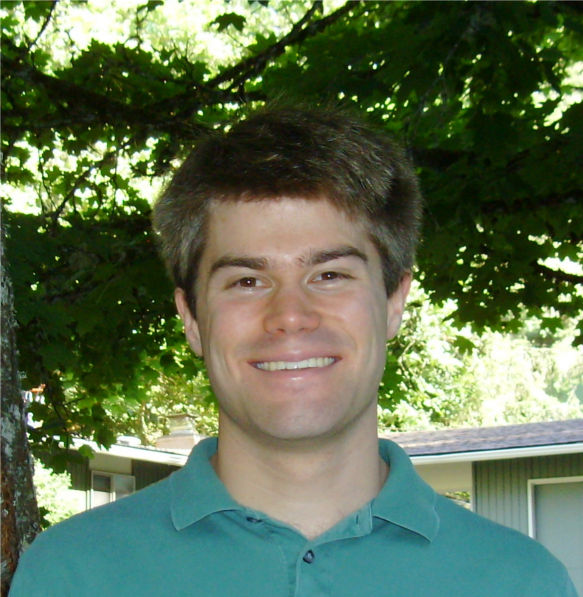
Eric Larson is an Associate Professor at Brown University's Department of Mathematics, specializing in algebraic geometry. His research focuses on moduli spaces, Brill-Noether theory, and algebraic curves. He collaborates with notable mathematicians such as Isabel Vogt and Izzet Coskun on topics like normal bundles, Chow rings, and stability conditions. Larson actively engages in academic outreach, organizing Putnam competition practices and undergraduate colloquia. He has developed computational tools for studying elliptic curves' Galois representations and contributed to expository works on interpolation problems and LaTeX accessibility.
Brian Lawrence is an Assistant Professor in the Department of Mathematics at the University of Wisconsin–Madison, currently on leave as of 2025. Previously, he held positions at UCLA, the University of Chicago, and Columbia University, following doctoral studies at Stanford University under Akshay Venkatesh. His educational background includes: PhD in Mathematics from Stanford University (advisor: Akshay Venkatesh) Lawrence's research centers on arithmetic geometry, specializing in Diophantine problems through p-adic methods. His work develops innovative approaches to Mordell's conjecture, Shafarevich-type results, and rational point distribution using p-adic Hodge theory, étale cohomology, and period mappings. He bridges theoretical number theory with computational frameworks, particularly in algorithmic solutions for Diophantine equations. His publication trends reveal sustained focus on foundational Diophantine geometry problems, with recent work emphasizing conditional algorithms for the Mordell problem and sparsity phenomena in integral points. Collaborations with leading mathematicians like Venkatesh and Sawin demonstrate interdisciplinary engagement across number theory and algebraic geometry. Lawrence actively mentors undergraduate researchers, supervising projects on resultants, Hodge theory, and symmetric polynomials by students including Pramana Saldin, Yuchen Chen, Anuj Sakarda, and Spencer Dembner. His organizational roles include founding the Crystalline Cohomology seminar at Columbia and co-organizing the University of Chicago Number Theory Seminar, fostering collaborative research environments. He contributes extensively through expository notes on schemes, polynomials on lattices, and Fibonacci numbers modulo p, reflecting commitment to mathematical education and knowledge dissemination across multiple institutions.
Sug Woo Shin is a Professor of Mathematics at the University of California, Berkeley ( Math Genealogy , MathSciNet Profile ). His research focuses on Number Theory and Automorphic Forms, with significant contributions to the Langlands Program, Shimura varieties, and cohomology of arithmetic spaces. Editorial roles: Astérisque , Manuscripta Mathematica , Journal of the Korean Mathematical Society Recent research explores cohomological properties of locally symmetric spaces, tempered A-packets for classical groups, and modularity of symplectic Galois representations Collaborators include Ana Caraiani, Mark Kisin, Arno Kret, and Peter Scholze He has supervised PhD theses on topics like affine Deligne-Lusztig varieties, specialization maps in Scholze's category of diamonds, and statistical properties of automorphic representations. Teaching includes graduate courses on Number Theory (254A/254B), undergraduate Linear Algebra (110), and Calculus (1A), as well as seminars on global Langlands reciprocity and p-adic cohomology theories. Co-organized conferences include the BIRS workshop on Langlands programs (2025), PRIMA algebraic number theory sessions (2022), and KAST Symposium on automorphic forms (2021). His work appears in journals like Annals of Mathematics, Duke Mathematical Journal, and Compositio Mathematica.
Tasho Kaletha is a Professor in the Department of Mathematics at the University of Michigan. His research focuses on the Langlands program, intersecting number theory, representation theory, algebraic geometry, and analysis. He holds a Ph.D. from the University of Chicago (2010). Key research interests include representation theory of reductive groups, harmonic analysis, Galois cohomology, and automorphic representations. Education: Ph.D., University of Chicago (2010). Research interests revolve around the Langlands conjectures, endoscopy, and the structure of reductive groups. His work addresses representation theory of real/p-adic groups, cohomology of Galois groups, and automorphic spectra. Recent publications explore Bruhat-Tits theory, discrete series L-packets, and global rigid inner forms. He has authored a monograph with Gopal Prasad and contributed to foundational papers in Duke Mathematical Journal and Inventiones Mathematicae . Notable contributions include studies on supercuspidal L-packets, endoscopic classification, and commensurability growth in algebraic groups. His work bridges abstract algebraic structures with analytic techniques, advancing the Langlands program's goals.
Professor Dinesh S. Thakur holds the position of Professor in the Department of Mathematics at the University of Rochester. He earned his PhD from Harvard University and has made significant contributions to number theory, arithmetic geometry, and function field arithmetic. His research focuses on developing theories related to zeta functions, Drinfeld modules, and p-adic analysis in finite characteristic environments. Education: PhD in Mathematics, Harvard University Research Interests: Thakur’s work integrates advanced topics such as elliptic curves, modular forms, Diophantine equations, and the arithmetic of function fields. He has pioneered studies on multizeta values, p-adic continued fractions, and the distribution of Diophantine exponents in finite characteristic. His research bridges classical number theory with modern algebraic geometry and p-adic analysis. Teaching & Mentorship: Thakur has taught a wide range of courses, including graduate-level topics in function field arithmetic, algebraic geometry, and number theory. He has advised 11 PhD students and several master’s students, whose theses span themes like elliptic Carmichael numbers, Drinfeld modular forms, and multizeta relations. Notable advisees include Javier Diaz-Vargas (1996), George Todd (2015), and Yao-Rui Yeo (2021). Outreach & Contributions: Thakur participates in initiatives like the Arizona Winter School and Olympiad training programs in India. He maintains an active seminar series at UR on topics such as L-values, Fermat’s Last Theorem, and automatic sequences. His work is accessible through his personal page and MathSciNet.
Aise Johan de Jong is a Professor in the Department of Mathematics at Columbia University, where he teaches courses including representations of finite groups and organizes the algebraic geometry seminar. He is a leading figure in algebraic geometry with a particular focus on stacks theory and arithmetic aspects of algebraic varieties. Institution: Columbia University, Department of Mathematics Research Focus: Algebraic stacks, arithmetic geometry, moduli spaces Major Project: The Stacks Project (open-source collaborative textbook) De Jong's research primarily centers on algebraic stacks, arithmetic geometry, and the foundations of algebraic geometry. His work bridges abstract theoretical frameworks with concrete computational aspects, particularly in positive characteristic. He has made significant contributions to understanding Brauer groups, period-index problems, and the geometry of moduli spaces. His research often connects number theory with geometric structures, exploring how arithmetic properties manifest in geometric settings. His publication record shows a consistent focus on fundamental structures in algebraic geometry, with particular emphasis on stacks theory (evident in The Stacks Project), Brauer groups, rational connectivity, and arithmetic properties of algebraic varieties. The trajectory of his work demonstrates increasing sophistication in handling complex geometric structures while maintaining connections to arithmetic questions. His most recent work continues to explore the interplay between algebraic geometry and number theory, particularly through the lens of stacks and moduli spaces. De Jong actively mentors graduate students, with numerous descendants listed in the Mathematics Genealogy Project. His academic lineage includes researchers working across various subfields of algebraic geometry. He has organized multiple conferences including "Moduli spaces and moduli stacks" (2012) and "Spaces of curves and their interaction with diophantine problems" (2009), demonstrating his leadership in the field. He leads The Stacks Project, a major collaborative open-source initiative that has become an essential reference for algebraic geometers worldwide. This project provides comprehensive foundations for algebraic stacks and related concepts, with regular updates and community contributions. De Jong also maintains the Stacks Project Blog where he discusses mathematical topics related to the project and shares updates.
Caterina Consani is a Professor of Mathematics at Johns Hopkins University's Krieger School of Arts & Sciences. She holds a PhD from the University of Chicago (1996) and a Dottore di Ricerca in Matematica from the Universities of Genoa and Turin (1993). Her research focuses on arithmetic geometry, non-commutative geometry, and the development of absolute geometry over the 'absolute point.' She has contributed to foundational work on the BC-system, the Arithmetic Site, and the Scaling Site, linking number theory with geometric frameworks. Education: PhD in Mathematics, University of Chicago (1996); Dottore di Ricerca in Matematica, Universities of Genoa & Turin (1993). Prior to Johns Hopkins, she taught at MIT (1996–1999) and the University of Toronto (1999–2005). Research Interests: Arithmetic geometry, non-commutative geometry, absolute geometry in characteristic one, connections to number theory and the Riemann Hypothesis. Collaborations include work with Alain Connes on adele class spaces and non-commutative algebraic geometry. Awards: Fellow of the American Mathematical Society (2024); 2025 Best Paper AOFA Award (Annals of Functional Analysis). Editorial roles include the Journal of Number Theory and Journal of Noncommutative Geometry. Teaching: Offers advanced courses in algebraic geometry and number theory, including topics like étale cohomology and the yoga of weights in 'Weil II.' Grants: Supported by the Simons Foundation. Organized major conferences such as the JAMI Conference on Riemann-Roch in Characteristic One (2019).
University of Illinois Urbana-ChampaignUnited States
Vesna Stojanoska is an Associate Professor in the Department of Mathematics at the University of Illinois, holding the Norman P. Jones Professorial Scholar title and serving as a Hamstrom Scholar. Her research focuses on stable homotopy theory, chromatic phenomena, and interactions with arithmetic. She earned her PhD in Mathematics from Northwestern University in 2011 and has been recognized with a Fellowship from the Center for Advanced Study (2018-2019). Key research areas include advanced topics in algebraic topology, such as Picard groups, Brauer groups, and topological modular forms. Her work frequently explores connections between homotopy theory and arithmetic structures. Recent contributions include studies on Morava stabilizer groups, determinant spheres, and collaborative efforts through initiatives like the Women in Topology IV workshop. Dr. Stojanoska has advised three graduate students, including Zachary Halladay (expected 2025), Venkata Sai Bavisetty (2024), and Elizabeth Tatum (2022). Her office is located at #307, 805 W Pennsylvania Ave, Urbana, Illinois.
Brian Conrad is a Professor of Mathematics at Stanford University, specializing in number theory and arithmetic geometry. He holds a position in the Department of Mathematics and has contributed extensively to algebraic geometry, algebraic number theory, and representation theory. His research encompasses foundational work on reductive groups, pseudo-reductive groups, and their applications in arithmetic contexts. Dr. Conrad is an editor for the Journal of the AMS, Algebra and Number Theory, and IMRN. He has organized numerous learning seminars, including those on étale cohomology and the BSD conjecture, and has taught advanced courses on algebraic geometry, class field theory, and modular forms. His work bridges classical algebraic geometry with modern arithmetic applications, emphasizing foundational proofs and geometric intuition. His editorial roles and seminar leadership reflect his commitment to advancing mathematical exposition and education. Education details are not explicitly provided in the texts, but his academic trajectory includes significant contributions to the field through publications and mentorship. Dr. Conrad's research has led to advancements in areas such as the classification of algebraic groups, étale cohomology, and the arithmetic of elliptic curves. His collaborative work with mathematicians like Chai, Oort, and Prasad has produced influential monographs, including Pseudo-reductive Groups and Complex Multiplication and Lifting Problems .
Kartik Prasanna is a Professor in the Department of Mathematics at the University of Michigan , affiliated with the College of Literature, Science and the Arts . He received his PhD from Princeton University in 2003 under the supervision of Andrew Wiles. Research Interests: His work lies at the intersection of number theory , algebraic cycles , and automorphic forms , focusing on the Langlands program , L-functions , algebraic cycles , and Iwasawa theory , particularly through the lens of the Bloch-Beilinson and Bloch-Kato conjectures . His recent publications explore periods of automorphic forms and the arithmetic of Shimura varieties. Grants & Awards: Simons Fellowship (2014-15) von Neumann Fellowship at the Institute for Advanced Study (2014-15) Current NSF Grants : DMS 2001293 and RTG DMS 1840234 Previous NSF grants: DMS 1600494, DMS 1160720, DMS 1015173, DMS 0801191, DMS 0854900 Academic Contributions: He has advised or collaborated with numerous postdoctoral researchers including Christopher Lyons , Ruochuan Liu , and Cameron Franc . Prasanna organized the 2011 FRG/RTG Workshop on L-functions, Galois Representations and Iwasawa Theory at the University of Michigan.
Paul Larson is a Professor of Mathematics at Miami University. His research focuses on set theory, topology, and model theory, with particular expertise in forcing axioms, descriptive set theory, and infinitary logic. He holds a Ph.D. in Mathematics from the University of California, Berkeley. His work bridges foundational mathematical logic with applications in topology and combinatorics. Key contributions include studies on canonical models under fragments of the Axiom of Choice, polar forcings, and cardinal characteristics. Larson has collaborated extensively with leading researchers such as Saharon Shelah and Jindřich Zapletal. His publications span prestigious journals like the Annals of Pure and Applied Logic and Transactions of the American Mathematical Society. Beyond research, he contributes to the academic community through editorial work and expository writings on historical developments in determinacy theory. Education: Ph.D., Mathematics, University of California, Berkeley Research interests emphasize foundational questions in set theory with applications to topology and model theory. His recent work explores advanced forcing techniques, square principles in Pmax extensions, and combinatorial properties of cardinal invariants. Publications reflect interdisciplinary engagement, including crystal structure prediction in high-pressure chemistry and operator theory in functional analysis. Despite an extensive publication record, no specific scientific awards are documented here. His advising and grant activities remain unspecified in the provided texts. Collaborations span international institutions, reflecting his role as a central figure in contemporary set theory research.
Matthew Emerton is a Professor in the Department of Mathematics at the University of Chicago, part of the Physical Sciences Division. He specializes in number theory, arithmetic geometry, and the Langlands program. His research focuses on automorphic forms, Galois representations, and p-adic methods in arithmetic geometry. Education: BSc (Hons) from the University of Melbourne (1993), PhD in Mathematics from Harvard University (1998), advised by Barry Mazur. Research Highlights: Pioneered work on the p-adic Langlands program, moduli stacks of Galois representations, and prismatic cohomology. Authored over 50 publications, including foundational works on p-adic Hodge theory and local-global compatibility. Awards: Alfred P. Sloan Doctoral Dissertation Fellowship (1997-98), Rackham Summer Faculty Fellowship (1999). Grants: Multiple NSF awards (e.g., DMS-2201242 for 'Arithmetic Aspects of the Langlands Program', DMS-1952705 for geometric aspects of the p-adic Langlands program). Students: Mentored 25+ PhD students and postdocs, many contributing to number theory and representation theory.
Jaclyn Lang is the Selma Lee Bloch Brown Assistant Professor of Mathematics at Temple University. Her research centers on algebraic number theory, focusing on modular forms, Galois representations, elliptic curves, motives, and p-adic methods. Education: Ph.D. in Mathematics, UCLA (2016), advised by Haruzo Hida Part III of the Mathematical Tripos, University of Cambridge (2010), supervised by Tom Fisher MA in Mathematics, Bryn Mawr College (2009), supervised by Helen Grundman Research Interests: She works on advanced problems in number theory, including the Eisenstein ideal, pseudorepresentations, and arithmetic geometry of elliptic curves. Her work often bridges algebraic geometry and automorphic forms using p-adic techniques. Scientific Awards: Churchill Scholarship (2009–2010) Clare Booth Luce Scholarship (2007–2009) NSF Graduate Research Fellowship (2010–2015) Charles E. and Sue K. Young Graduate Student Award (2015) NSF Mathematical Sciences Postdoctoral Research Fellowship (2016–2020) AWM Travel Grant (2023) Fulbright U.S. Student Program Grant (2016) Simons Travel Support for Mathematicians (2023–2028) Grants: She has received NSF Standard Grant DMS-331117 (2023–2026) and participated in programs like the Park City Math Institute and Women in Numbers Europe (WINE3).
Laura DeMarco is a Professor of Mathematics at Harvard University and holds the Radcliffe Alumnae Professorship at the Radcliffe Institute for Advanced Study. She is affiliated with the Department of Mathematics at Harvard's Science Center (Office 337). Her research focuses on dynamical systems, arithmetic geometry, and complex analysis, with a particular emphasis on algebraic dynamics and the interplay between geometry and number theory. DeMarco earned her Ph.D. in Mathematics from Harvard University in 2002, with a thesis on holomorphic families of rational maps. Her work explores topics such as preperiodic points, moduli spaces of dynamical systems, and arithmetic equidistribution. She has organized events like the Algebraic Dynamics Seminar and participates in conferences worldwide, including the 2025 Diophantine approximation conference in France. Her research publications analyze geometric and arithmetic properties of dynamical systems, such as the geometry of preperiodic points, bifurcation measures, and the classification of polynomial basins of infinity. Her studies often bridge algebraic geometry, complex dynamics, and number theory, contributing to foundational questions in arithmetic dynamics. DeMarco has collaborated extensively with researchers like N. M. Mavraki, H. Krieger, and X. Wang, advancing topics like bounded geometry in dynamical families and uniform results in the Manin-Mumford conjecture. Her work has been published in leading journals such as the Annals of Mathematics, Compositio Mathematica, and the Journal of the European Mathematical Society.
Igor Kriz is a Professor of Mathematics at the University of Michigan, specializing in algebraic topology. He is affiliated with the Department of Mathematics within the College of Literature, Science, and the Arts (LSA). His research focuses on advanced topics in algebraic topology, particularly stable homotopy theory and related areas. Kriz received his Ph.D. from Charles University in 1988. His academic journey has led him to become a prominent researcher in algebraic topology, with significant contributions to the field over several decades. Professor Kriz's primary research interests lie in algebraic topology , which studies topological spaces through algebraic invariants. He specializes in equivariant stable homotopy theory, Mackey functors, cobordism, and motivic homotopy theory . His work involves calculations of stable homotopy groups and other generalized homology theories, including Morava K-theories of classifying spaces of finite groups. He has made significant contributions to the study of operads and structures up to homotopy, with applications extending to differential geometry and physics, particularly string theory. His research often bridges multiple mathematical disciplines, creating connections between topology, algebra, and geometry. His recent publications (2022-2025) demonstrate a strong focus on equivariant topology and its connections to algebraic structures. Kriz frequently collaborates with researchers like P. Hu, P. Somberg, and others, producing work that explores the intersection of homotopy theory with representation theory and algebraic geometry. His research program shows consistent evolution from foundational work in stable homotopy to more recent applications in motivic contexts and topological Hochschild homology. Professor Kriz teaches both undergraduate and graduate courses at the University of Michigan. His teaching portfolio includes Math 425 (Introduction to Probability), Math 592 (Introduction to Algebraic Topology), and advanced graduate courses Math 695 and Math 696 (Algebraic Topology I and II). His course materials are regularly updated, reflecting his commitment to education in mathematical topology. Based in East Hall (room 3846) at the University of Michigan, Professor Kriz maintains an active research program while contributing to the academic community through teaching and mentorship. His work continues to advance our understanding of complex topological structures and their algebraic representations.